
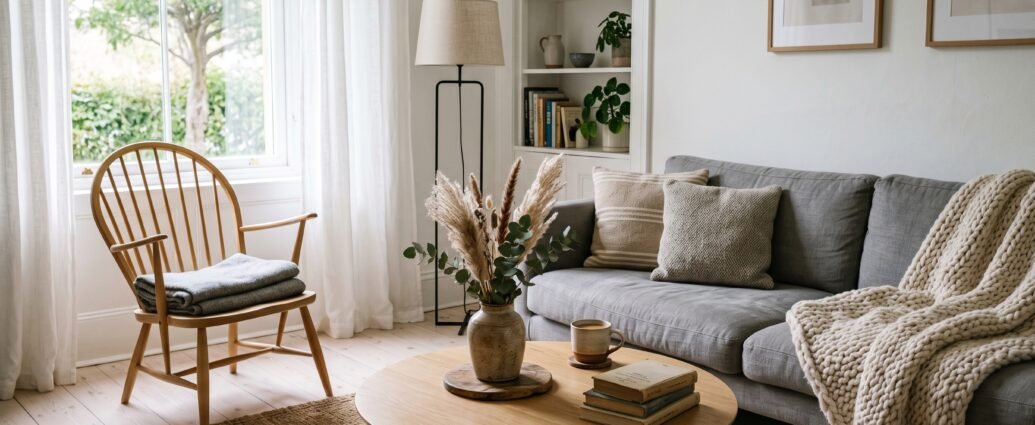
Scandinavian interior design is what happens when a home is built around light, not around stuff. It comes from a part of the world where winter afternoons go dark by three, so every choice — the pale floors, the white walls, the uncluttered surfaces — exists to catch and hold what daylight there is. Strip away the trend language and that’s the whole idea: make the room bright, make it work, and let a few good natural materials do the talking.
It has a reputation for being cold and a bit severe, and honestly, that reputation is earned by the version you see in furniture catalogs. Real Scandinavian rooms are warmer than that. They’re soft with wool and sheepskin, worn in at the edges, full of candles and wood and things people actually use. This guide covers what the style really is, the handful of elements that make it work, how it differs from plain minimalism, and — most usefully — how to bring it into each room of your house without buying a single new sofa.
Key Takeaways
- Scandinavian design is a response to darkness — light-reflecting surfaces and clear sightlines are the point, not a style preference.
- Pale wood, white walls, wool, linen, and a little black are the whole material palette. You don’t need more than that.
- Function comes first: if a piece doesn’t earn its place, it doesn’t stay.
- Texture is what keeps it from feeling cold — layer knits, sheepskin, linen, and raw wood grain.
- It’s genuinely cheap to get right, because the look depends on editing and light rather than expensive furniture.
What Scandinavian Interior Design Really Is
The style grew out of Denmark, Sweden, Norway, Finland, and Iceland in the early-to-mid 1900s, when designers there started making furniture for ordinary homes rather than grand ones. The thinking was democratic: good design should be affordable, durable, and useful to everybody. That’s why so much Scandinavian furniture is simple in shape and light in weight — it was meant to be moved, used, and kept for decades.
The climate did the rest. Long, dark winters pushed the palette toward white and pale wood, because those surfaces bounce light around a room instead of swallowing it. Short summers made people want to bring the outdoors in, which is where all the natural materials and plants come from. And the long stretches spent inside produced hygge — the Danish idea of cozy contentment, which in practical terms means candles, blankets, warm lamps, and a chair you actually want to sit in.
Put those together and you get the recipe: bright, simple, natural, and comfortable. Not empty. Not precious.
The Core Elements That Make It Work
You can get most of the way there with five things.
Light, and lots of it. Scandinavian rooms treat windows as the most valuable thing they own. That means no heavy drapes, no furniture blocking the glass, and mirrors placed where they can throw daylight deeper into the room. When the sun goes down, the lighting goes low and warm — several small lamps at different heights rather than one bright ceiling fixture. Our guide to lighting and ambiance in every room goes deeper on how to layer it.
Pale wood everywhere. Ash, birch, beech, pale oak — blond woods with visible grain. They’re the warmth in a room that’s otherwise mostly white, and the grain gives your eye something to rest on when there isn’t much else going on.
A restrained palette. White or off-white walls, warm greys, soft black for contrast, and the natural tone of the wood. That’s the base. Color shows up in small doses and usually comes from something real — a dusty blue cushion, green from a plant, the ochre of a clay pot.
Function you can see. Every piece does a job. Storage is built in or tucked away so surfaces stay clear. Nothing is purely decorative for its own sake, which is why Scandi rooms read as calm even when they’re full of things.
Texture doing the heavy lifting. This is the part people skip, and it’s the reason their room ends up feeling like a waiting room. Wool throws, sheepskin over a chair back, linen curtains, a jute or wool rug, ceramic with a rough glaze, a woven basket. When color is quiet, texture is what makes a room feel rich. Layering texture is the single highest-impact move you can make here.
The Scandinavian Color Palette
Start with white walls — but not a stark, blue-white. Look for warm whites with a hint of cream or grey in them, which stay soft in low light instead of turning grey and gloomy. From there:
- Base (about 70%): warm white, soft grey, pale wood tones
- Secondary (about 20%): deeper grey, natural linen, black in small structural doses — a lamp base, a window frame, chair legs
- Accent (about 10%): one muted color, repeated. Dusty blue, sage, terracotta, or soft ochre all sit well against pale wood.
The mistake is spreading three or four accent colors thinly across a room. Pick one and use it three or four times — a cushion, a throw, a piece of art — so it reads as intentional. If you want help choosing, our piece on choosing paint shades room by room is a good companion.
Scandinavian vs. Minimalist vs. Japandi
These three get used interchangeably and they shouldn’t be.
Minimalism is about reduction — the goal is less. It can be warm or cold, and the palette can be anything. Minimalist interiors are defined by what’s been removed.
Scandinavian design is about light and comfort, and it happens to be simple as a means to that end. It’s cozier than minimalism, more textural, and more forgiving — a Scandi room can hold a lot of blankets and books and still read as calm.
Japandi is the blend of Scandinavian and Japanese design: the pale wood and coziness of one, the darker tones, low lines, and craft focus of the other. If you like Scandi but want something moodier, that’s the direction to go — start with our look at Japanese minimalist interiors.
Modern cottage is the one people mix up with Scandi most often, because both lean on wood, white walls and natural fabric. The difference is where the character comes from: Scandi gets it from light and restraint, cottage gets it from age — worn wood, old ceramics, a little pattern. If you want that warmth without the pale palette, modern cottage interior design is the closer fit, and it is much easier to put together secondhand.
Scandinavian Style, Room by Room
The Scandinavian Living Room
Anchor the room with a low, simple sofa in grey, cream, or natural linen — straight arms, wood or tapered legs, nothing overstuffed. Raising furniture off the floor on visible legs is a small trick that makes the whole room feel lighter and larger.
Add one light-wood piece with real presence: a spindle chair, a slatted bench, a round coffee table. Then layer — a chunky knit throw over the sofa arm, a sheepskin on a chair, a flatweave or jute rug. Keep the coffee table to three things at most. Hang art at eye level in simple thin frames, and leave wall space empty between pieces; the negative space is doing work.
For smaller rooms, the light palette and raised furniture are already on your side — our guide to maximizing a small living room pairs well with this style. If you want more layout ideas, minimalist living room ideas covers a lot of the same ground.
The Scandinavian Bedroom
This is where the style is at its best, because a Scandinavian bedroom is essentially a room designed to help you rest. Keep the bed low and simple — a pale wood frame or an upholstered headboard in oatmeal or grey. Dress it in white or natural linen bedding, deliberately a little rumpled, with a wool blanket folded across the foot and one textured cushion. Crisp, hotel-tight bedding fights the whole mood.
Nightstands should be small and light. Swap a ceiling light for two warm bedside lamps or a pair of wall sconces so the light sits low in the evening. Add a sheepskin or small wool rug beside the bed — a genuinely nice thing to step onto on a cold morning, and the kind of detail that makes the room feel considered.
Storage matters more here than anywhere. Clear surfaces are most of the look, so a bedroom with nowhere to put things will never quite work. Simple storage solutions will do more for the room than any new furniture. For a closely related take, see warm minimalist bedroom ideas and minimalist bedroom ideas for serene spaces.
The Scandinavian Kitchen
Flat-front cabinets in white, pale wood, or soft sage. Simple hardware — slim black or brushed steel pulls, or none at all. Counters in light stone or butcher block. Open shelving with a small, honest collection of things you use: white ceramics, wood boards, a couple of glass jars.
You don’t need to replace cabinets to get here. Painting existing doors a warm white and swapping the handles changes a kitchen dramatically for very little. Add a linen runner, a wood bowl, and one plant on the windowsill, and you’re most of the way. Our minimalist kitchen guide and the Japandi kitchen concepts both work as visual reference.
The Scandinavian Dining Room
A pale wood table with clean legs, and chairs that don’t match it exactly — molded shells, spindle backs, or woven seats all work. One pendant hung low over the center of the table, around 30 to 36 inches above the surface, does most of the styling.
Keep the table itself nearly bare: a linen runner, a low ceramic vase with branches or dried stems, and candles. Taper candles in simple holders are about as Scandinavian as it gets, and they cost almost nothing.
The Scandinavian Entryway
A bench with storage underneath, hooks at two heights, a mirror, and a basket for shoes. That’s the entire formula. Pale wood, white wall, one wool runner. The mirror isn’t decorative — it’s throwing daylight back into what’s usually the darkest part of the house.
If you’re short on room, small entryway ideas that actually work covers the tight-space version.
The Scandinavian Home Office
A light wood desk, ideally facing or beside a window. A comfortable chair with a wood frame. One good task lamp. Cables hidden, surface clear, and a shelf or pegboard holding only what’s in use. Add a plant and a wool throw over the chair back so it doesn’t read as an office cubicle at home. Pair it with home office organization ideas to keep the surfaces honest.
The Scandinavian Bathroom
White tile, pale wood accents, matte black or brushed fixtures. A teak bath mat or stool, white waffle towels, and toiletries decanted into simple bottles or kept behind a door. A small plant that likes humidity — eucalyptus hung from the showerhead is the classic move. See simple minimalist bathroom ideas for more.
Getting the Look Without Spending Much
Scandinavian style is one of the cheapest looks to achieve, because it depends on subtraction and light rather than on expensive pieces.
- Paint first. A warm white on the walls changes more than any purchase will, and a couple of gallons is the cheapest renovation there is.
- Take things away. Clear your surfaces before you buy anything. Half the look is just empty counter space.
- Buy secondhand wood. Pale wood furniture from the 60s and 70s turns up constantly at thrift stores and estate sales, and it’s usually better made than new. Our thrifting guide is a good place to start, and reviving old furniture covers sanding a dark finish back to blond.
- Swap the small metal. Cabinet pulls, switch plates, curtain rods. Cheap to change, disproportionately visible.
- Spend on textiles, not furniture. A real wool throw and a decent linen duvet cover will do more than a new chair.
- Add plants. One large plant per room. Free if a friend has cuttings.
If budget is the main constraint, our budget interior design guide has more on where money actually shows.
Common Mistakes
Going all-white with no texture. This is the big one. White walls plus a white sofa plus a white rug equals a room that feels like a dentist’s office. Texture is not optional in this style; it’s the warmth.
Buying a whole matching set. A room furnished entirely from one collection looks like a showroom floor. Scandinavian rooms mix old and new, and the mismatch is what makes them feel like homes.
One bright ceiling light. Overhead lighting flattens everything. Three or four small warm lamps at different heights will do more for a room than new furniture.
Confusing empty with simple. A Scandi room isn’t bare — it’s edited. Books, blankets, plants, and worn wooden things all belong. What doesn’t belong is clutter with no purpose.
Cool white paint in a dark room. Blue-toned white looks crisp in a showroom and grey and sad in a north-facing room. Go warmer than you think you need to.
Frequently Asked Questions
Is Scandinavian design the same as minimalism?
No. Minimalism is about having less; Scandinavian design is about light, function, and comfort, and it uses simplicity to get there. A Scandi room is usually softer and more textural than a strictly minimalist one.
Does Scandinavian style work in a dark house?
Yes, and arguably that’s what it was built for. Warm white walls, mirrors opposite windows, light floors, and low warm lamps in the evening will do more for a dark room than any other approach.
Can I mix Scandinavian with the style I already have?
Easily. It plays well with almost anything because the palette is so quiet. Scandi plus rustic gives you a farmhouse feel; Scandi plus a few global or plant-heavy pieces edges toward boho; Scandi plus darker wood and low furniture is Japandi.
What flooring works best?
Pale wood or wood-look flooring in a light, natural tone. If you’re renting or can’t replace floors, a large light rug over dark flooring does most of the same work.
Is it a good style for small spaces?
It’s one of the best. Light colors, raised furniture, clear surfaces, and built-in storage all make a small room read larger. Styling small spaces has more on this.
Where to Start
If you only do three things this weekend: clear every horizontal surface in one room, add a warm lamp at a low height, and put a wool or knit throw somewhere you’ll actually use it. That’s Scandinavian design in miniature — light, less, and something soft to reach for. The rest can happen slowly, a thrifted chair and a can of warm white paint at a time.


1 Comment