
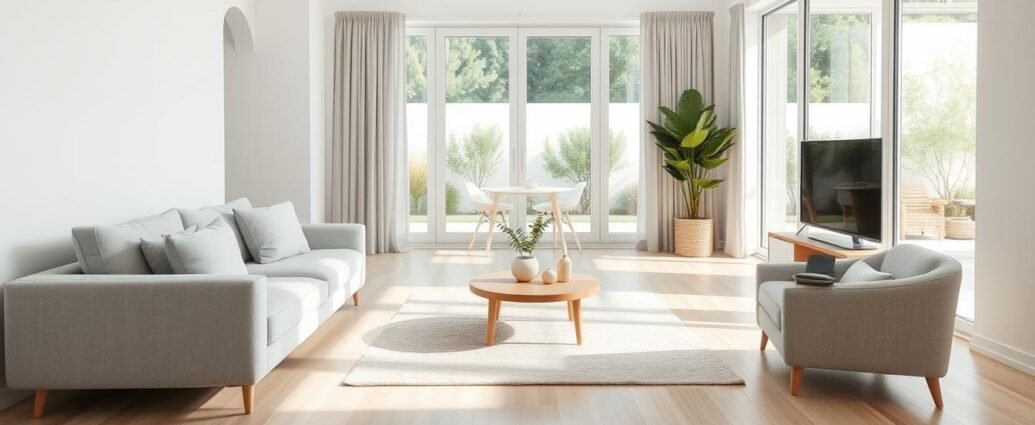
There’s a particular kind of quiet that lives in a well-designed minimalist home. You walk in, your shoulders drop, and the space seems to hand you back a little of your attention. That feeling isn’t about owning less for its own sake — it’s about owning intentionally, so that everything around you earns its place.
Minimalist home interior design gets sold as a look, but in practice it behaves much more like a set of constraints. Every surface has to earn its place, and there is nowhere for clutter to hide. Done well, it feels calm and generous; done badly, it feels cold and unworkable within a year of move-in. This guide covers what separates the two — principles, palette, materials, storage, and how it all changes room by room.
Key Takeaways
- Minimalism is a constraint, not a style — it only works if you plan where things go before you strip things out.
- Clean sightlines, abundant natural light and generous negative space are the structural foundation.
- Build the palette from one dominant warm neutral, cap it at three or four colors per room, and let sheen and texture carry the variation.
- Texture — not color or pattern — is what makes a pared-back room feel rich instead of clinical.
- Storage belongs in the architecture (full-height cabinetry, a real drop zone, one closet for the ugly stuff), not bolted on later as furniture.
- Start with one room, get the palette and one anchor piece right, and let the rest follow at your own pace.
What Minimalist Home Interior Design Really Means
Minimalism gets misread as cold, bare, or austere — white walls, a single chair, nothing on the shelves. In practice, the best minimalist interiors are the opposite of empty. They’re warm, tactile, and deeply personal. The difference is restraint: instead of filling a room and editing later, you start from calm and add only what genuinely belongs.
The working rule is simple: stick to the essentials, and whatever you don’t need in a space, take it out.
The payoff is practical, not just aesthetic: less visual noise, less cleaning, and more room — literally and mentally — for what you actually care about.
Less, but Warmer
The contemporary version of this style is often called warm minimalism: the clean lines of classic minimalism softened with natural materials, earthy tones, and layered texture. It’s the difference between a room that looks like a showroom and one that feels like a deep breath. If that’s the direction you’re drawn to, our guide to warm minimalist bedroom ideas shows the approach worked out in detail in a single room. Push the warmth a step further and you land in cottage territory — the same restraint, but the character comes from age rather than line, and modern cottage interior design is the version of it you can put together almost entirely from secondhand pieces.
The Roots: Japanese and Bauhaus Design
Modern minimalism draws from two traditions. The early 20th-century Bauhaus movement stripped design down to form and function. The lesson it left behind: strip the design back and let form carry the room, with materiality and texture doing the work ornament used to do.
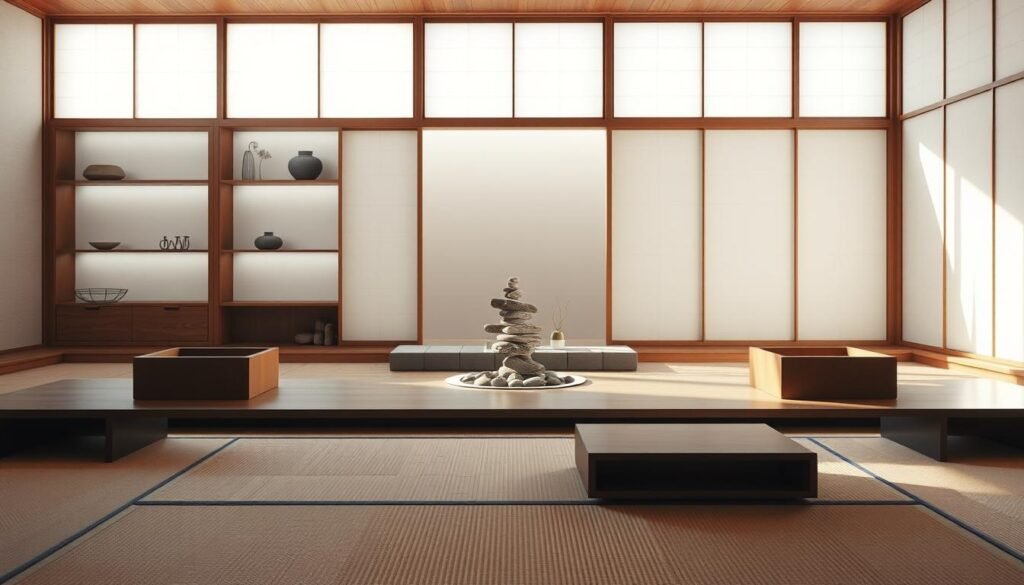
From the East comes the Japanese sensibility of ma (intentional negative space) and wabi-sabi (beauty in imperfection). Together they give minimalism its soul: a sense of harmony where every element feels intentional, understated, and at home with what surrounds it. If the Eastern side of that lineage is what draws you — low furniture, tatami-inspired proportions, screens and sliding panels, a deep tolerance for empty floor — our guide to Japanese minimalist interior design goes further into it.
The Core Principles That Make It Work
Before you choose a single piece of furniture, get these fundamentals right. They’re what separate a calm, considered room from one that simply looks half-finished.
Every Piece Earns Its Place
Before anything stays, it has to be useful, beautiful, or genuinely meaningful — ideally two of the three. In practice that means fewer, larger, better pieces: a typical living room holds ten to fifteen furniture and decor items, while a minimalist one usually lands at four or five.
Clean Lines and Uninterrupted Sightlines
Clean lines — straight edges, gentle curves, low profiles — give the eye places to rest and make any room feel larger. Just as important is the sightline: what you can see in an unbroken run from the entry through to the back of the plan. Keeping that view clear is often more powerful than anything you add. Low-profile seating, furniture on legs rather than plinths, and open-riser or floating stair treads all read as lighter because light passes under and through them.
Negative Space as a Design Tool
Empty space isn’t wasted space — it’s what lets the pieces you do choose be seen. A useful working rule: leave roughly 30% of every horizontal surface bare. Leaving a wall blank takes confidence, but it’s often the single most powerful move in the whole style.
Natural Light Does the Decorating
In a room with very little in it, light is the main event. Maximize it before you buy anything. Hang curtain rods roughly 4 to 6 inches above the window frame and extend them 8 to 12 inches past each side, so the panels stack off the glass instead of covering it. Use sheer linen rather than heavy drapery. Keep tall furniture away from windows, and place a large mirror opposite one to push daylight deeper into the room.
Storage Belongs in the Architecture
The failure I see most often is minimalism applied only to the visible layer. People strip out the decor but keep the same volume of belongings, so countertops, floors and window sills quietly become the storage. The fix has to be planned early, and no amount of sustainable materials or smart technology rescues a plan with nowhere to put anything.
Building the Palette
The foundation of a minimalist home is a restrained, tonal color scheme. Build around one dominant neutral — soft white, warm greige, parchment, or a gentle taupe — then layer shades within the same warm family. A well-considered, restrained palette does more for a minimalist room than any single piece of furniture in it.
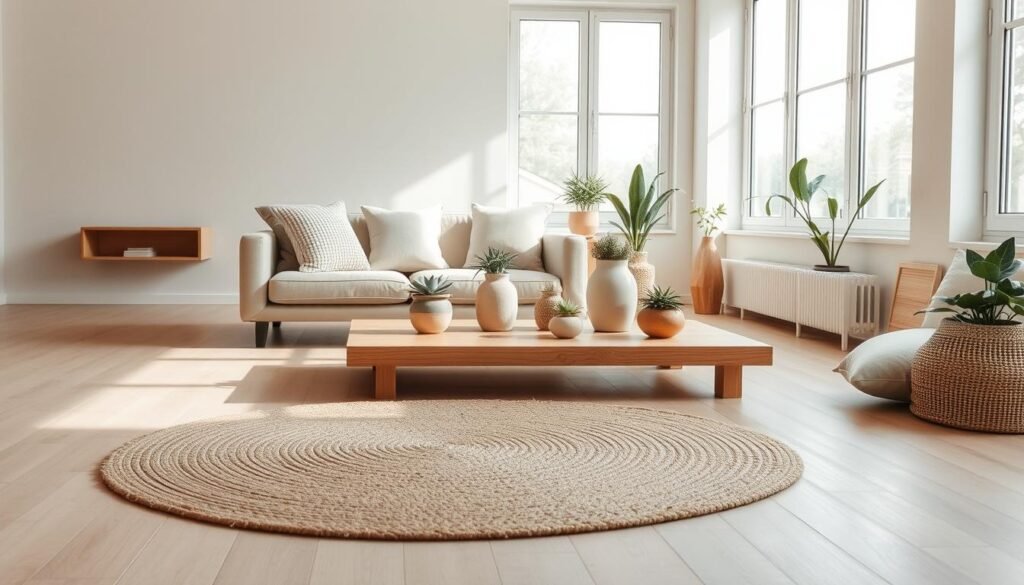
Two numbers keep this from drifting: three to four colors per room, and six to eight across the whole house. Distribute them roughly 60/30/10 — 60% dominant neutral on walls and large furniture, 30% secondary tone in rugs, curtains and upholstery, 10% accent in small objects and art. That ratio is why minimalist rooms read as calm even when they contain a strong color.
Some specifics worth knowing, using Benjamin Moore as a common reference point:
| Family | Examples | Best used for |
|---|---|---|
| Clean warm whites | Chantilly Lace OC-65, White Dove OC-17, White Heron OC-57, Simply White OC-117 | Whole-house base, trim, ceilings, small rooms that need to breathe |
| Creams and parchments | Maritime White OC-5, Ballet White OC-9 | North-facing rooms and anywhere pure white reads cold |
| Greiges | Revere Pewter HC-172, Edgecomb Gray HC-173 | Living rooms and open plans — warmth of beige with the discipline of gray |
| Deep accents | Black Tar 2126-10, Iron Mountain 2134-30, Starry Night Blue 2067-20 | One cabinet run, a fireplace surround, an interior door, a powder room |
Two habits matter more than the color you pick. First, sample on the actual wall and look at it three times a day — morning, midday and lamplight. A greige that reads as mushroom at noon can go distinctly pink at sunset. Second, use sheen deliberately: matte or eggshell on walls, flat on ceilings, satin on trim and doors. In a tonal room, the shift between flat and satin does the work that pattern would do elsewhere, and it costs nothing.
For bulbs, stay around 2700K — warm white flatters wood and plaster and keeps neutral walls from turning gray-blue at night. Put the main sources on dimmers, and never light a minimalist room from a single ceiling fixture.
Materials and Texture
With color turned down, material is what carries the room. Choose things with their own quiet character: wood with visible grain, undyed linen, hand-thrown ceramic, stone with natural variation.
- Wood. White oak, ash and beech read light and calm; walnut adds depth without heaviness. Let the grain show through a matte or hardwax-oil finish rather than a high-gloss coating. Dark and mid-brown woods have come back strongly — a walnut table paired with creamy upholstery is one of the most reliable warm-minimalist combinations there is.
- Stone. Travertine, honed marble, quartzite and limestone all suit a pared-back room because their veining is the pattern. Honed and leathered finishes are more forgiving than polished in daily use.
- Wall finishes. Limewash, polished plaster and tadelakt add depth that flat paint can’t. A single wood-slat wall does the same job more architecturally.
- Textiles. Linen, cotton, wool, bouclé and leather are the difference between austere and inviting — bouclé on seating, linen at the windows, wool underfoot.
- Rugs. Layering is the cheat code: a wool rug over a larger jute or sisal one gives softness and structure at once, and defines a zone in an open plan without a wall.
A simple test before you call a room finished: touch three things. If they all feel the same, add something nubby, something with weight, and something that reflects a little light. Depth you can feel is the goal.
Storage That Makes Minimalism Livable
Clear surfaces are what make this style work day to day, and furniture is your best tool for it. The pieces that consistently pay for themselves:
- Full-height cabinetry. Running cabinets to the ceiling instead of stopping at standard upper height adds a surprising amount of capacity and removes the dust ledge — in kitchens, laundries and home offices alike.
- An appliance garage. A counter-depth cabinet with a door, sized for the toaster, kettle and blender. It does more for a minimalist kitchen than any amount of styling.
- A real drop zone. Hooks, a bench with concealed space and a bowl, within a few steps of the door you actually use. Without one, the kitchen island becomes the drop zone.
- Beds with drawers, storage ottomans, closed-front media consoles. Each replaces two or three single-use pieces.
- One closet for the ugly stuff. Vacuum, tools, seasonal bins, the router. Every calm house has one, and it is never the pretty one.
Then two habits: a one-in, one-out rule to stop accumulation, and a daily fifteen-minute reset — clear surfaces, make the bed — which is genuinely all a decluttered house needs.
Minimalist Design, Room by Room
The principles stay constant; the application shifts with each space.
Living Room
Anchor the space with one comfortable, clean-lined sofa and a single large rug — an undersized rug is the fastest way to make a room look unfinished. Get the front legs of every seating piece onto it, and leave roughly 18 inches of bare floor between the rug edge and the wall. Set the coffee table about 16 to 18 inches from the sofa, and choose one whose height is within an inch or two of the seat cushion.
Style the table with two or three intentional objects, not a collection. For the wall above the sofa, one large piece beats a gallery wall: aim for art about two-thirds the width of the sofa, hung 6 to 8 inches above the back, with the center around 57 to 60 inches from the floor. Either a large-scale statement piece or a clean vertical row of frames will balance the wall; what doesn’t work is a scatter of small pieces fighting the sofa for attention. Our full walkthrough is in minimalist living room ideas.
Bedroom
This is where minimalism pays off most — a calm bedroom genuinely helps you rest. Use a low-profile platform frame; the lower the bed, the taller the ceiling reads. Leave 24 to 30 inches of walking room on each side, and choose nightstands whose surface lands within a couple of inches of the top of the mattress so reaching for a glass of water doesn’t require aiming.
Layer natural bedding — linen or cotton sheets, a wool throw for cold nights — and keep the nightstand near-empty: a lamp, a book, one small object. Skip the heavy drapery in favor of sheers or a simple roller shade. See our minimalist bedroom ideas, or for a cozier, more textural take, warm minimalist bedroom ideas.
Kitchen
Kitchens are where minimalism is won or lost, because they generate the most stuff. Reduce visual clutter with flat-front or simple Shaker doors, integrated or panel-front appliances, and either handleless push-to-open fronts or a single slim pull profile repeated throughout. Run cabinetry to the ceiling, add a floor-to-ceiling pantry if the plan allows, and give the small appliances a home behind a door.
Keep the standard dimensions honest: counters at 36 inches, uppers 18 inches above the counter, 42 to 48 inches of walkway between runs. Honed stone and quartz composites both hold up, and white oak cabinetry with a stone top is the warm-minimalist default for good reason. Open shelving looks wonderful and only works if you genuinely own few enough dishes for it. More in our minimalist kitchen design guide.
Bathroom
Aim for spa-like calm: a tight palette of warm whites and natural stone, one statement element (a soaking tub, a solid-wood vanity, a slab of veined marble), and everything else concealed. Wall-hung vanities and large-format tile with minimal grout lines both make small bathrooms read larger.
Material choices matter more here than anywhere — tadelakt plaster and honed limestone bring warmth to a room that can easily go clinical. Respect the clearances: roughly 30 inches of clear space in front of the toilet and 15 inches from its center to any side wall. And give yourself real concealed storage; a bathroom with three shampoo bottles on the tub ledge is not a minimalist bathroom. See our guide to simple minimalist bathroom ideas.
Home Office
A workspace is the one room where minimalism is straightforwardly functional: fewer things in your eyeline, fewer things pulling at your attention. Put the desk perpendicular to a window rather than facing it (glare) or backing it (screen reflections). Choose a desk with at least one closed drawer, wall-mount your shelving to keep the floor clear, and solve cables properly — a cable tray under the desk and a single power strip in a drawer will do more for the look of the room than any accessory.
Layer the light — one ambient source plus a dimmable task lamp — and extend the discipline to the digital side, where a scanned-and-filed paper system removes most of what would otherwise need physical storage. The same clean-lined, low-profile pieces that work in a minimalist living room work here too.
Dining Room
A solid wood or stone table, chairs that tuck fully underneath, one sculptural light fixture, and a single considered centerpiece. That’s the entire brief. Allow about 36 inches of clearance around the table so chairs can pull out and people can pass behind them, budget roughly 24 inches of table edge per person, and hang the pendant 30 to 36 inches above the tabletop.
If the dining area sits inside an open plan, define it without walls — a rug or a pendant centered over the table is enough to signal “this is a room.” One vintage fixture over otherwise clean-lined furniture keeps the space from feeling showroom-new.
Warm Minimalism: The Version Most People Actually Want
Classic minimalism can be beautiful and unlivable. Warm minimalism keeps the discipline — clean lines, restraint, negative space — and swaps the cold materials for ones with a pulse: oak instead of chrome, linen instead of leatherette, limewash instead of flat white.
It comes down to three moves. Go warm on the walls: creamy oat, mushroom, sun-baked clay or a soft greige rather than a clinical white. Let materials age — unlacquered brass, oiled wood and natural leather develop patina, and that patina is what stops a room looking staged. Build deliberate stages for personal things: pick two or three spots per room — a floating shelf, one wall, a console — give your meaningful objects room to be seen, keep the other surfaces clear, and rotate what’s on display seasonally.
Plants belong here too: two or three statement plants — an olive tree, a fiddle-leaf fig, a large snake plant — do more than a dozen small pots, and plain terracotta planters keep them inside the palette. The bedroom is usually the easiest room to test the whole approach in, which is why we broke it out in full as warm minimalist bedroom ideas.
Common Mistakes to Avoid
- Confusing empty with minimal. A room with nothing in it reads as unfinished, not intentional. Warmth and texture are what make restraint feel deliberate.
- Editing the visible layer only. If you remove the decor but keep the volume of belongings, the counters and floors just become the new storage. Plan where things go first.
- Too many tones. Past three or four colors in a room, the calm starts to fray. Vary shade and sheen within one family instead.
- All-smooth surfaces. Without a mix of textures, neutral rooms fall flat. Something smooth, something nubby, something with weight.
- One overhead light. Under-lighting is the most common reason a minimalist room feels cold. Layer ambient, task and accent sources, and dim them.
- Undersized rugs and art. In a pared-back space, go larger than feels comfortable.
- No personality at all. A few meaningful objects, given space, are the point — not a violation of it.
- Treating “minimalist” as a shopping category. Edit first; buy last.
How to Start
Don’t try to redesign the whole house in a weekend. Pick the one room where calm matters most — usually the bedroom or living room — and work in this order:
- Empty it, or as close as you can get, then put back only what earns its place.
- Declutter properly. Four categories — keep, donate or sell, recycle, discard. Box the undecided items and set a date three months out.
- Settle the palette. Paint is the cheapest transformation available and it sets everything that follows.
- Solve storage before you buy decor. Answer “where does the stuff go?” and the surfaces stay clear on their own.
- Buy one quality anchor — a sofa, a bed frame, a dining table. Solid wood is often better and cheaper bought secondhand.
- Fill in slowly. Live in the room a while before deciding what it still needs.
None of this requires a designer budget. Decluttering is free, paint is cheap, and because you’re buying fewer pieces you can afford to buy the important ones well and fill in affordably around them.
Frequently Asked Questions
Can a minimalist home still feel warm and inviting?
Yes — that’s exactly what warm minimalism is about. Use natural materials like wood and linen, a warm-neutral palette, and layered textures (a wool throw, a jute rug, a ceramic lamp). Warm 2700K bulbs on dimmers do as much as any of it. These add coziness without clutter, so the room feels calm and welcoming rather than stark.
How many colors should a minimalist room have?
Three to four per room, and six to eight across the whole house. Distribute them roughly 60/30/10 — dominant neutral, secondary tone, small accent. Get variation from sheen and texture rather than from adding more colors.
How do I keep a minimalist home clutter-free day to day?
Give everything a designated home and lean on furniture with built-in storage — an ottoman with hidden space, a bed with drawers, a closed-front console. Add a one-in, one-out rule and a fifteen-minute daily reset. Once the systems are in place the look maintains itself, because there simply isn’t much to put away.
Is minimalist interior design expensive?
Not at all. It’s about intentionality, not price. Decluttering costs nothing, paint is inexpensive, and because you’re buying fewer pieces you can invest in one or two quality anchors and fill in around them affordably — the secondhand market is especially good for solid-wood minimalist furniture.
Does minimalism work in a small home or apartment?
It’s arguably better suited to small spaces than large ones. Favor fewer, slightly larger pieces over many small ones, keep profiles low and legs exposed so you can see floor underneath, use vertical storage to free up the floor, and place a mirror opposite a window. The trade-off is that storage has to be planned harder, not less.
What’s the difference between minimalist and Scandinavian design?
They overlap heavily — both favor clean lines, neutral palettes, and natural materials. Scandinavian design tends to add a little more pattern and graphic contrast, while warm minimalism leans more organic and texture-driven, with an emphasis on natural imperfection and materials that age.
Minimalist home interior design isn’t a finish line — it’s a way of making decisions about your space. Start with one honest edit, one good anchor piece, and one calm palette, and let the rest follow. Have questions or a room you’re working on? Share it in the comments — we’d love to help you get there.

8 Comments