
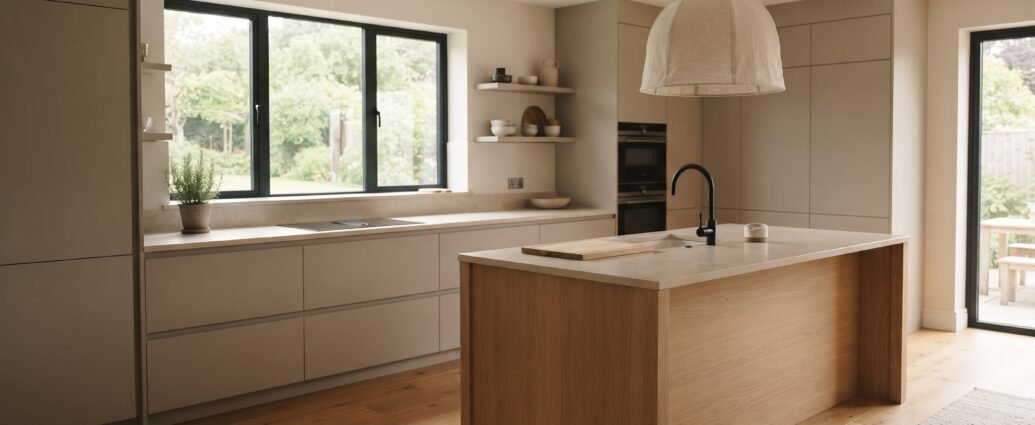
A kitchen has to work harder than almost any other room in the house, which is exactly why a minimalist approach suits it so well. Strip back the visual clutter and you get a space that’s calmer to cook in, faster to clean, and easier to actually think in. Good minimalist kitchen design isn’t about empty shelves or a room that feels like a showroom — it’s about smart storage and clear surfaces so the space stays calm and works hard every single day.
This guide walks through the whole thing: layout, cabinets, countertops, palette, materials, appliances, and lighting, plus how to get the look in a small kitchen and on a real budget. Take what fits your space and leave the rest.
Key Takeaways
- Minimalist kitchen design is about calm and function, not emptiness — every choice should reduce visual noise or earn its keep.
- Clear countertops are the single biggest factor in the look. Give every item a home.
- Cabinets cover the most surface area, so flat or Shaker fronts, discreet hardware, and integrated appliances do the heavy lifting.
- A tight, warm-neutral palette plus natural materials keeps the room from feeling clinical.
- Layered, warm lighting is what separates “calm” from “cold.”
- The style works in any size kitchen and at any budget — you can start with decluttering and paint alone.
- Warmth comes from texture and natural grain, not from adding more stuff.
What Minimalist Kitchen Design Really Means
Minimalism gets misread as cold, white, and bare — a room you’d be nervous to actually cook in. The best minimalist kitchens are the opposite. They’re warm, hard-working spaces where everything has a place, so the surfaces can stay clear and the room can breathe. The point isn’t to own less for its own sake; it’s to remove the visual clutter that makes a busy room feel busier.
Less, but Warmer
The version of this look most people actually want is often called warm minimalism: clean lines softened with natural wood, stone, and a warm-neutral palette. It’s the difference between a kitchen that feels sterile and one that feels calm. If that direction appeals to you, the same thinking runs through our guide to a warm minimalist bedroom — the materials change, but the principle carries across the whole home.
It Has to Work First
A kitchen is a workspace before it’s anything else, so function leads every decision. Storage has to be generous enough to keep small appliances and tools out of sight. Work zones — prep, cook, clean — need to flow. If a design choice looks minimal but makes cooking harder, it isn’t the right choice. Calm surfaces are only sustainable when there’s a sensible home for everything behind them.
Start With the Layout
Before you think about finishes, get the bones right. A minimalist kitchen relies on clear sightlines and uninterrupted runs of counter, so the layout matters more here than in almost any other style.
Work With Your Kitchen’s Shape
Galley, L-shaped, U-shaped, or single-wall — each can be minimalist. The goal is the same: keep runs of cabinetry and counter continuous and unbroken so the eye travels smoothly instead of stopping at every seam. Fewer, longer cabinet runs read calmer than lots of small mismatched sections. Where you can, line up the tops of cabinets, windows, and the range hood so horizontal lines feel deliberate.
Islands and Peninsulas
A minimalist kitchen with an island works beautifully when the island stays simple: one clean-lined block, a waterfall or flush counter edge, and ideally hidden storage or a single integrated appliance rather than a cluttered display shelf. If your kitchen is tight, a slim peninsula or a butcher-block cart gives you the same extra prep surface without crowding the floor. Leave at least a metre (about 40 inches) of walking space around it so the room still feels open.
Cabinets: The Biggest Visual Decision
Cabinets cover more surface area than anything else in the room, so they set the tone. Get them right and the rest of the kitchen almost falls into place.
Flat-Front or Shaker
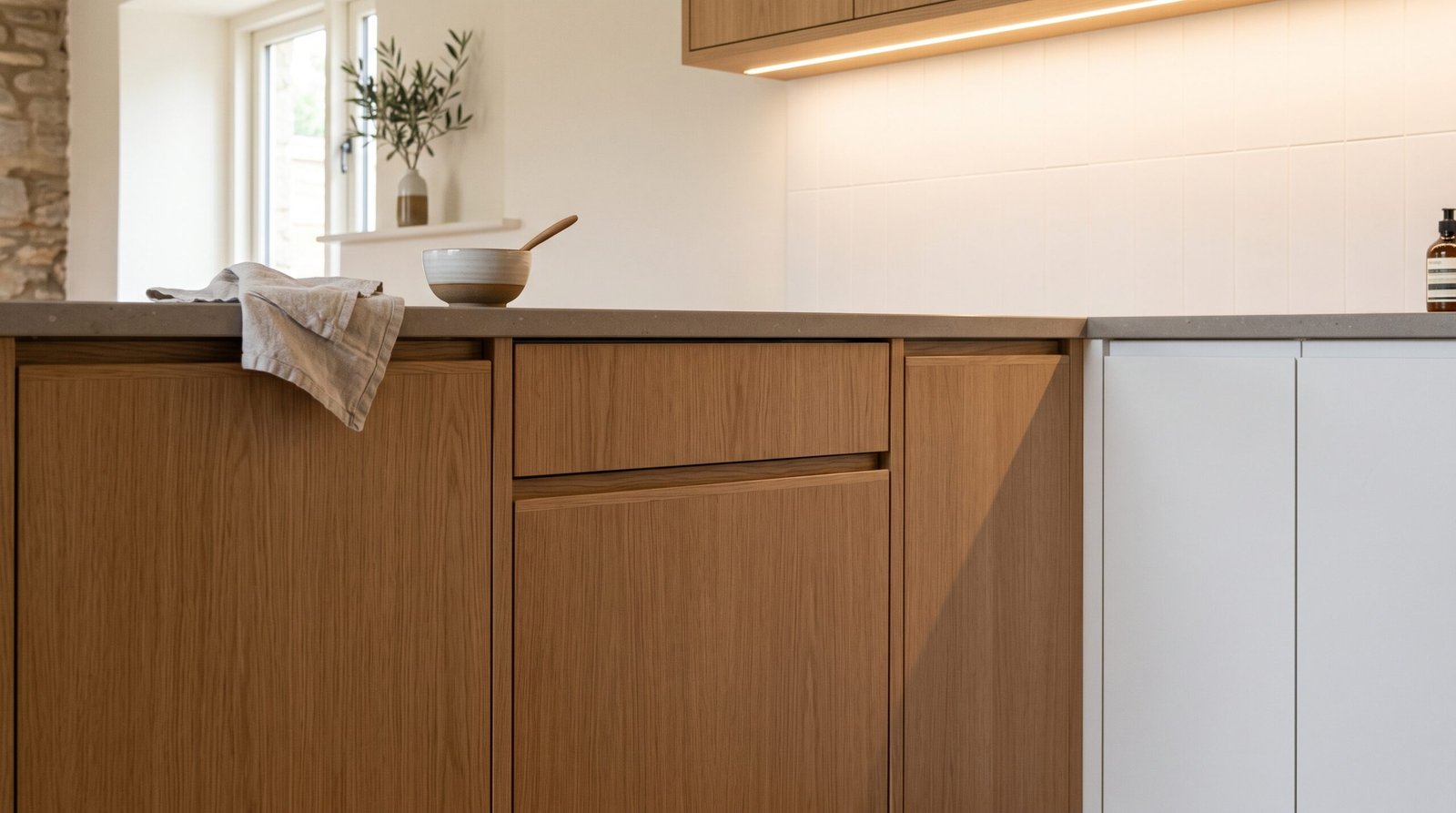
Two door styles carry the minimalist look. Flat-front (slab) doors are the most pared-back — a clean, unbroken plane with no detailing. Simple Shaker doors, with their single recessed panel, are a slightly warmer, more traditional option that still reads calm. Both work; flat fronts feel more modern, Shaker feels a touch softer. Avoid ornate, glass-front, or heavily moulded doors, which add exactly the visual busyness you’re trying to remove.
Hide the Hardware
Handles are small but they add up visually. For the cleanest look, choose handleless cabinets with a routed finger-pull channel or push-to-open mechanisms. If you’d rather keep handles, pick discreet edge pulls or simple bar pulls in brushed brass or matte black and use them consistently throughout — repetition is what keeps hardware from looking fussy.
Open Shelves or Upper Cabinets?
This is the choice people agonise over. Integrated upper cabinets hide the most and keep lines seamless, which makes them the safer minimalist option. A few open shelves feel airier and more personal, but they demand real discipline — everything on them is on display, so they only stay calm if you keep them styled with a handful of matching, everyday pieces. A popular middle path is banishing upper cabinets on one wall in favour of two floating shelves, then storing the bulk of your kit in base cabinets and a pantry.
Keep the Countertops Clear
If there’s one move that makes a kitchen read as minimalist, it’s clear counters. You can have the most beautiful cabinetry in the world, but a crowded worktop undoes it instantly.
Give Everything a Home
Clear surfaces are really a storage problem in disguise. Store small appliances in a cabinet or a dedicated appliance garage, tuck utensils into a drawer instead of a countertop crock, and keep only one or two genuinely daily items out — a kettle, maybe a wooden board. Deep drawers with simple dividers hold more and stay tidier than deep cabinets you have to dig through. When everything has a designated spot, clear counters stop being a daily battle.
Pare Back the Kit
Minimalism in the kitchen is as much about what you own as how you store it. Most of us keep far more tools, mugs, and gadgets than we use. A gentle edit — keep the pans you cook with weekly, donate the duplicates and the single-use gadgets — makes storage roomier and surfaces easier to keep clear. You don’t need a capsule kitchen; you just need less than you probably have.
Choose a Warm, Restrained Palette
Colour is where a minimalist kitchen either feels serene or feels like a dentist’s office. The fix is a tight, warm palette rather than a cold white-on-white scheme.
Warm Neutrals and One Grounding Tone
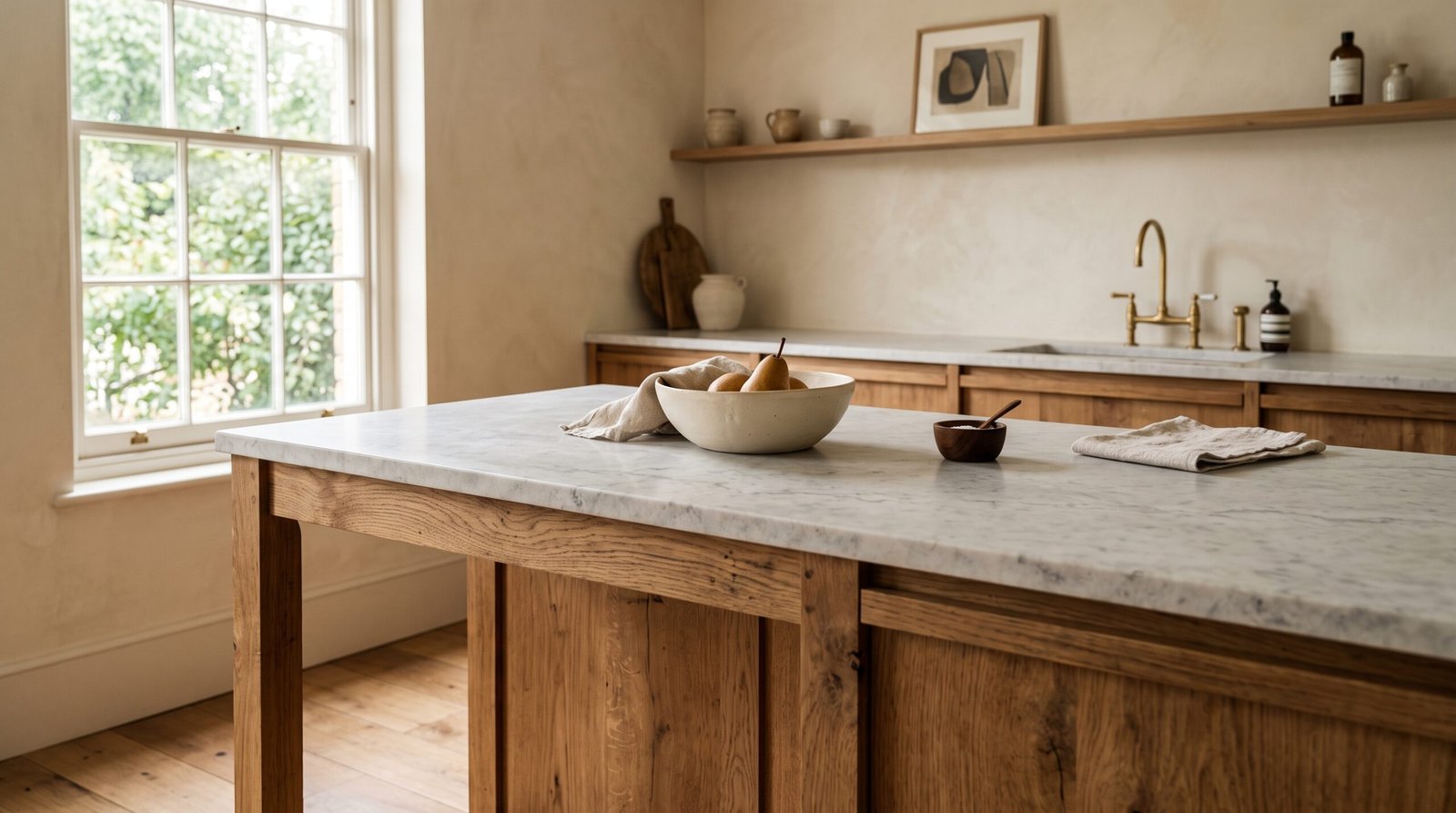
Build the room from one dominant warm neutral — soft white, greige, warm taupe, or a gentle putty — then stay within that family. Add depth with a single grounding tone: a natural wood island, sage or clay-green base cabinets, or a warm stone counter. Keeping the whole scheme to three or four related tones is what makes a pared-back kitchen feel calm instead of flat. If you want colour, let it live on the cabinets or a single feature and keep everything else quiet.
Materials That Add Warmth
Natural materials do the work that colour and pattern would in a busier kitchen. Wood with visible grain (open shelving, an island, or the flooring), a stone or quartz counter with subtle veining, and matte rather than high-gloss finishes all add texture you can feel without adding clutter. Let one material be the quiet star — a beautiful counter or a solid wood island — and keep the supporting cast simple.
Integrated, Quiet Appliances
Appliances are often the busiest-looking things in a kitchen, so minimalist design works to calm them down. Panel-ready dishwashers and fridges disappear behind cabinet fronts. A counter-depth or integrated fridge keeps the wall line flush. A slimline or downdraft extractor avoids a bulky hood breaking up the sightline. You don’t have to replace everything at once — even choosing panel-ready models the next time an appliance dies gradually moves the room toward that seamless look. In the meantime, a simple stainless or matte-black finish reads far calmer than a mixed set of colours and logos.
Get the Lighting Right
Lighting is what separates a calm minimalist kitchen from a cold one. Aim for layers rather than a single bright overhead. Recessed ceiling lights handle general tasks and keep the ceiling clean. Warm under-cabinet lighting brightens the counters where you actually work and adds a soft glow at night. One considered fixture — a single pendant or a slim linear light over an island or table — gives the room a focal point without clutter. Choose warm bulbs (2700K or lower) throughout and add a dimmer if you can; the ability to soften the light in the evening does more for the mood than any decor.
Minimalist Kitchen Styles to Borrow From
“Minimalist” isn’t a single look. A few related styles all share the same clean-lined DNA, and borrowing from whichever one you’re drawn to keeps your kitchen feeling intentional rather than generic.
Modern Minimalist
Flat-slab handleless cabinets, integrated appliances, and a cool-to-warm neutral palette. The most seamless and architectural of the group — best when you want the kitchen to almost recede into the wall.
Scandinavian
Pale woods, soft white walls, and a little more warmth and texture than strict modern minimalism. Scandinavian kitchens allow a touch of pattern or a plant or two, which makes them feel especially livable.
Japandi
The current favourite: Japanese restraint meets Scandinavian warmth. Think natural wood, handmade ceramics, low-contrast palettes, and a deep respect for empty space. It’s minimalist but quietly soulful.
Industrial-Minimal
Concrete or stone counters, matte-black hardware, and open shelving on a warm-neutral backdrop. A slightly harder-edged take that still keeps surfaces clear and lines simple.
Minimalist Design in a Small Kitchen
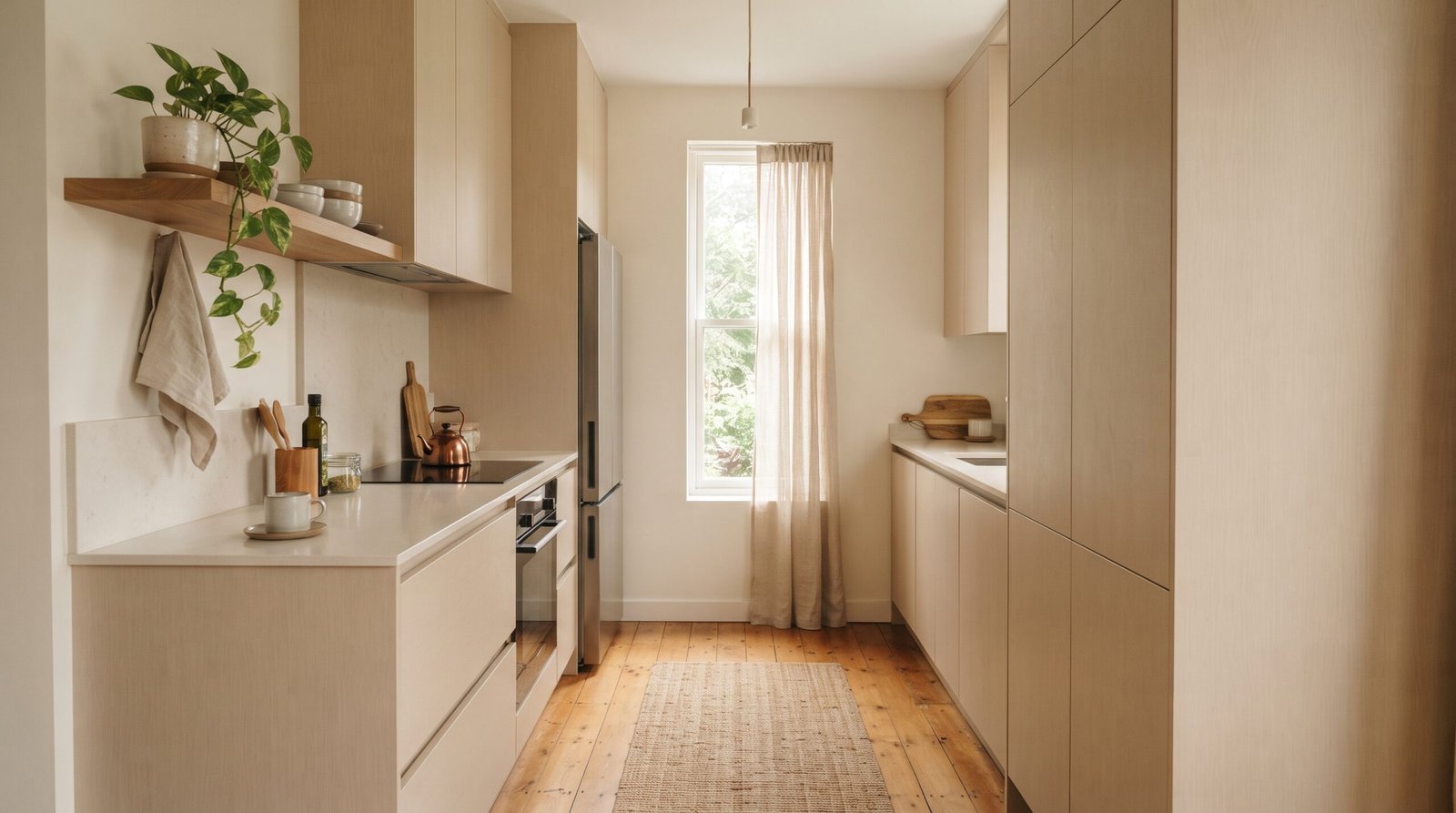
Small kitchens might be where minimalism pays off most — there’s simply no room for clutter to hide. A few moves make a compact space feel calm and open. Keep the palette light and tonal so the walls recede. Choose handleless cabinets to the ceiling to draw the eye up and add storage. Pick one or two multi-tasking pieces (a fold-away table, a cart that tucks under the counter) rather than several small ones. And be ruthless about what earns counter space — in a small kitchen, a clear worktop is the difference between cramped and serene. The same principles that make a minimalist living room feel bigger apply here: fewer, larger, quieter choices.
A Realistic Budget Guide
One of the best things about this style is that it rewards restraint over spending. Decluttering and clear counters cost nothing, and a coat of paint on existing cabinets plus new handleless-look hardware can get you most of the way there. Here’s how the bigger decisions break down across budgets.
| Element | Budget ($) | Mid-Range ($$) | Investment ($$$) |
|---|---|---|---|
| Cabinets | Paint existing doors, IKEA SEKTION | Semihandmade fronts on IKEA boxes, Home Depot semi-custom | Custom flat-panel or Shaker cabinetry |
| Countertops | Butcher block, laminate, IKEA | Quartz remnant or mid-range slab | Full quartz or natural stone (Caesarstone, Silestone) |
| Hardware | Knobless / DIY edge pulls | Matte-black or brushed-brass bar pulls | Integrated channel pulls, push-to-open |
| Appliances | Keep existing, unify finish | Panel-ready dishwasher, counter-depth fridge | Fully integrated set (Bosch, Fisher & Paykel) |
| Lighting | Plug-in LED under-cabinet strips | Hardwired under-cabinet + one simple pendant | Integrated recessed + designer linear fixture |
| Flooring | Keep existing or vinyl plank | Engineered wood, large-format tile | Solid oak or large stone slabs |
If you only do one thing, declutter and clear the counters — it’s free and it changes the whole room. For help choosing the pieces that stay, our guide to minimalist furniture for your space uses the same “useful or beautiful” test.
Common Minimalist Kitchen Mistakes to Avoid
- Confusing empty with minimal. A kitchen with nothing on the walls and no warmth reads as unfinished, not calm. Texture and natural materials are what make restraint feel deliberate.
- Going all-cold-white. Pure white with chrome and glass is the fastest route to a clinical feel. Warm the palette with wood and softer neutrals.
- Under-planning storage. Clear counters are impossible to maintain without enough hidden storage. Solve storage first, then style.
- Open shelves you can’t keep tidy. They look easy in photos and cluttered in real life unless you’re disciplined. Be honest about which you are.
- Too many finishes. Three or four materials, tops. Every extra metal, wood, and stone adds visual noise.
Frequently Asked Questions
How do I get a minimalist kitchen without it feeling cold?
Warm up the palette and the materials. Swap cold white and chrome for warm neutrals, wood with visible grain, stone counters, and warm-toned lighting (2700K bulbs). Texture and natural grain add warmth while surfaces stay clean, which is the whole balance of warm minimalism.
What are the best colors for a minimalist kitchen?
Build from one dominant warm neutral — soft white, greige, warm taupe, or putty — and add one grounding tone through wood or a muted green, clay, or stone. Keep the whole scheme to three or four related colors. If you want a stronger colour, put it on the cabinets and keep everything else quiet.
Are open shelves or upper cabinets better for a minimalist kitchen?
Upper cabinets hide more and keep lines seamless, so they’re the safer minimalist choice. Open shelves feel airier and more personal but only stay calm with disciplined, matching styling. Many people compromise: open shelves on one short wall, closed storage everywhere else.
What’s the fastest way to make my kitchen look minimalist?
Clear the countertops. Giving every small appliance and tool a designated home does more for the look than any single design change — and it costs nothing. Follow it with unifying your appliance finishes and swapping busy hardware for something simple.
How do I design a minimalist kitchen in a small space?
Keep the palette light and tonal, run handleless cabinets to the ceiling for storage and height, choose one or two multi-tasking pieces instead of several small ones, and protect your counter space fiercely. Small kitchens have nowhere for clutter to hide, so clear surfaces matter even more.
Do minimalist kitchens have to be expensive?
Not at all. The look rewards restraint over spending. Decluttering is free, paint updates existing cabinets, and affordable systems like IKEA plus custom-look fronts get you most of the way there. Invest where it shows and lasts — counters and cabinet fronts — and save everywhere else.
What’s the difference between a minimalist and a modern kitchen?
They overlap heavily. “Modern” describes an era and aesthetic (clean lines, current materials), while “minimalist” describes an approach (reducing visual clutter to the essentials). A modern kitchen can be busy; a minimalist kitchen is defined by restraint. Modern minimalist kitchens simply combine the two.
A minimalist kitchen isn’t a finish line you cross once — it’s a way of making decisions about the room, from the cabinet fronts down to what you leave on the counter. Start with an honest declutter, settle a warm palette, and add only what genuinely belongs. For the principles behind this look and ideas for every other room, see our complete guide to minimalist home interior design, or carry the same calm into the dining room next door. Working on your own kitchen? Tell us what you’re planning in the comments — we’d love to help.


1 Comment