
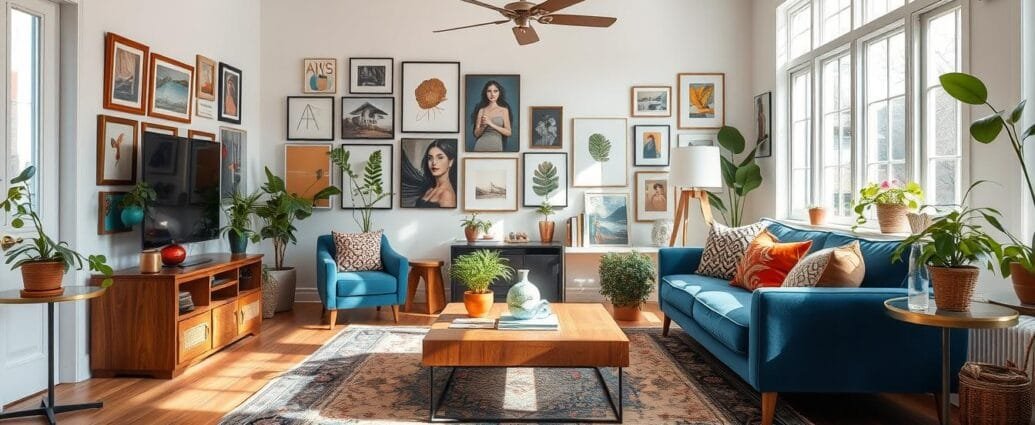
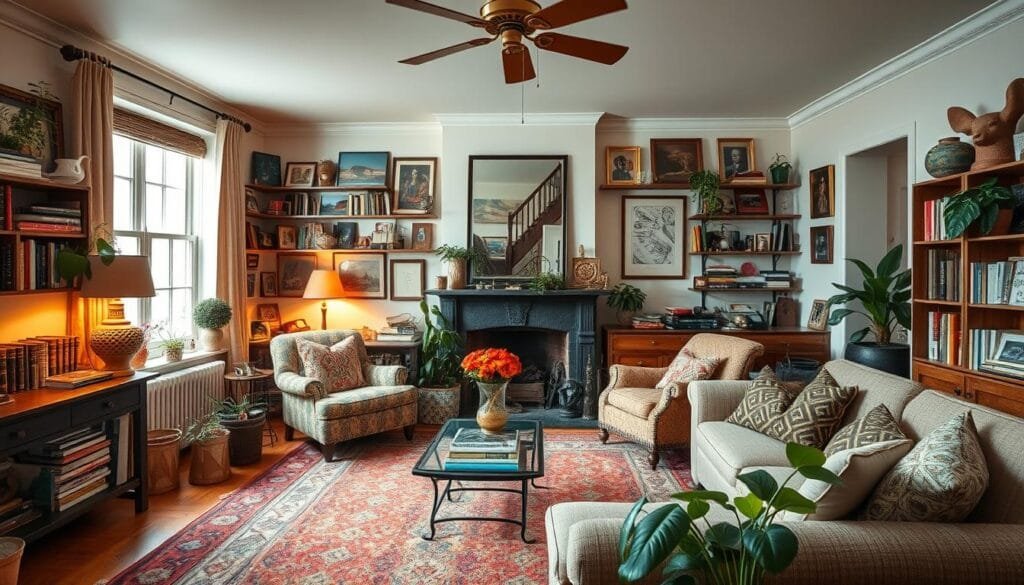
Eclectic interior design is the most misunderstood style in the business. People hear “eclectic” and picture a room where nothing matches, put together by someone who couldn’t commit. What it actually describes is a room built from more than one style vocabulary, held together by deliberate repetition. The mixing is the easy part. The holding together is the whole job.
I’m Quinn Parker, and eclectic is the style people ask about most often without ever using the word. What they say is: “I have my grandmother’s dresser, a sofa we bought last year, and a rug from a trip, and none of it looks right together.” That’s an eclectic room in the raw. This is how you finish it.

What Eclectic Interior Design Actually Is
Eclecticism entered design language in the nineteenth century, when architects stopped working strictly inside one revival style and began borrowing across several in a single building. A modern eclectic room does the same: it draws on two, three, sometimes four sources — a Danish modern credenza, a Victorian mirror, a contemporary sectional, a hand-knotted rug — and organises them so the eye reads a whole, not a list.
The crucial word is organises. Eclectic isn’t the absence of a system; it’s a different one. A single-style room gets coherence for free, because the factory made the pieces relate. In an eclectic room you supply that relationship yourself, through colour, finish, scale and spacing.
Eclectic vs. Simply Mismatched
This is the question almost everyone actually has. A mismatched room is one where pieces from different sources share nothing. An eclectic room is one where they share something specific and repeated, and where the differences are the point rather than an accident of what was available. You can diagnose your own room in five minutes — stand in the doorway and ask three questions:
- Does any colour appear at least three times? Not “there’s some blue in here” — three distinct occurrences spread across the room rather than bunched in one corner.
- Do the metals resolve into one or two families? Brass and bronze read warm; chrome, nickel and stainless read cool. One family of each, repeated, is intentional. Five finishes appearing once each is noise.
- Is one piece clearly the most important thing in the room? If four things compete for the title, it’s mismatched. If one wins and the rest support it, it’s eclectic.
Fail all three and the room is mismatched. Pass two and it’s usually fixable in a weekend without buying anything, because the repairs are mostly editing and rearranging.
How It Differs From Maximalism and Boho
| Style | Core idea | How to tell it apart |
|---|---|---|
| Eclectic | Multiple style periods, unified by repetition | Density is optional; an eclectic room can be quite spare. |
| Maximalism | Abundance, pattern on pattern, full surfaces | Density is the point. See our maximalist living room ideas. |
| Boho | A set palette and material list — rattan, plants, earth tones | One style, not a mix. Our boho decor guide covers it room by room. |
The Rules That Make an Eclectic Room Cohere
1. Repeat One Colour at Least Three Times
Pick one non-neutral colour and place it in three widely separated spots at three sizes: large (an upholstered chair, a rug field, a painted wall), medium (a lampshade, a throw), and small (a ceramic, a picture mat). The eye traces the three points and reads the room as one composition.
Named colours make this concrete. Farrow & Ball Hague Blue (No. 30) on a bookcase back, echoed in book bindings and one glazed vase, does more than any amount of general “blue accents.” Same with Benjamin Moore Hale Navy HC-154, Sherwin-Williams Naval SW 6244, or on the warm side Farrow & Ball Setting Plaster (No. 231). To settle palette first, see our post on choosing paint shades for every room.
2. Commit to a Metal Family and a Wood Family
Mixed metals are encouraged, but chosen rather than accumulated: use two finishes and repeat each at least twice. Unlacquered brass with matte black is the most forgiving pairing I know, and the brass improves as it patinates. Polished nickel with oil-rubbed bronze is the traditional version. Chrome with brass is hardest, because both are shiny and they fight.
Wood follows the same logic, except you aren’t matching tones — that’s what a showroom does — you’re keeping them in one temperature family. Walnut, teak, cherry and mahogany are warm; white oak, ash, birch and maple are cool to neutral. A red-toned mahogany secretary against a grey-washed oak table is where wood mixing goes wrong: the undertones argue.
3. Vary Scale on Purpose
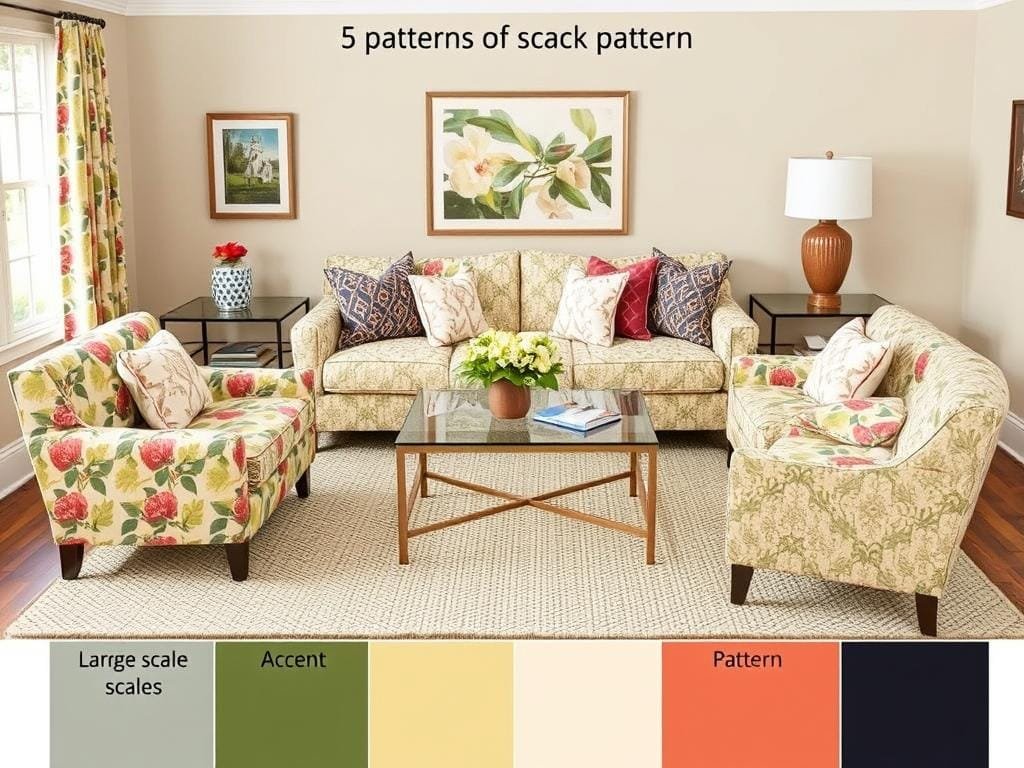
The most common structural failure in an eclectic room is that everything is medium: medium sofa, medium table, medium art, medium plant. There’s variety of style but none of size, so the room flatlines. Add one genuinely large gesture — art at least 36 inches wide over a sofa, a tall secretary, a 9 x 12 rug where most people put an 8 x 10 — plus several genuinely small things, and edit the middle hard. Pattern works the same way: one large-scale pattern with a repeat over 12 inches, one mid-scale geometric, one small texture like herringbone, two of the three sharing a colour. Our guide to blending colours, patterns and textures goes deeper.
4. Let One Style Dominate at About 60 Percent
An even split between two styles reads as indecision. Give one roughly 60 percent of the visual weight — usually the larger, more permanent pieces — and let the others come in around 25 and 15. In practice the dominant style is whatever your big upholstery and casegoods already are; trying to make an antique secretary dominant while a contemporary sectional sits there is fighting your own furniture.
5. Leave Negative Space
This is the rule people skip, and it separates a designed eclectic room from a crowded one. Leave one wall largely empty, keep a third of every horizontal surface clear, and maintain 30 to 36 inches of walkway on primary paths. A Victorian chair in a crowded room is clutter; with three feet of clear floor around it, it’s a sculpture. Eclectic design borrows here from its opposite — the restraint in our minimalist home interior design guide and the discipline of Japandi interiors both translate.
Eclectic Living Room Ideas
The living room carries more furniture types than any other room, which makes it the best place to work eclectically and the easiest to get wrong. Work in order: anchor, dimensions, seating mix, lighting, art.
Choose the Anchor First
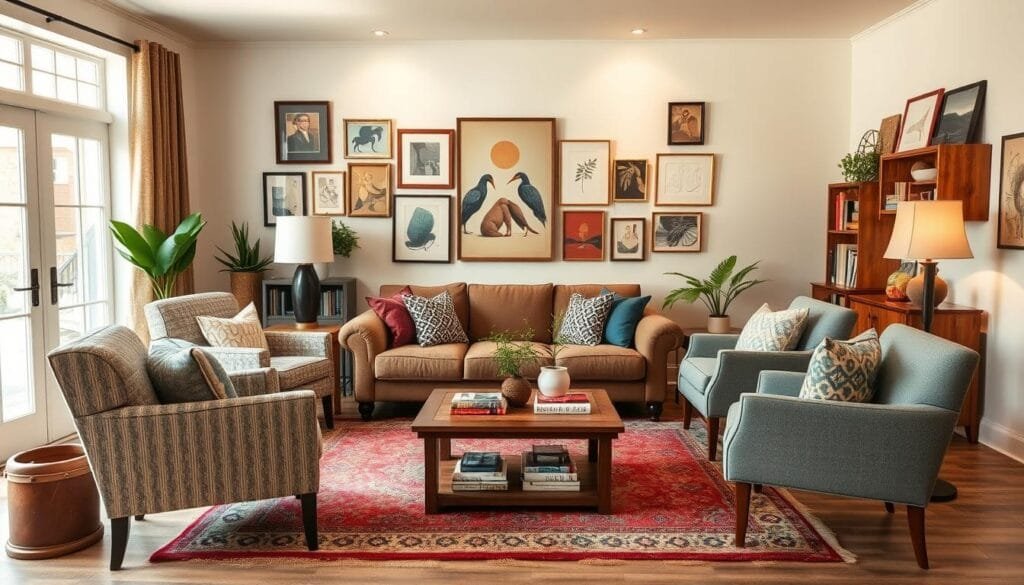
The anchor is the single piece the room is organised around: large, characterful, something you’d take with you if you moved. A deep-toned velvet sofa, a big painting, an antique armoire, a genuinely good rug. Choosing it first solves the sequencing problem that wrecks most eclectic rooms, where people buy in the order things go on sale and then try to reconcile the results. Pick the anchor, pull three to five colours from it, and buy to that palette.
Get the Dimensions Right
Style mixing can’t rescue bad proportions, so settle these before you shop:
- Coffee table height: within 1 to 2 inches of the adjacent sofa’s seat height, typically 16 to 18 inches. A too-low table is the most common reason a mixed seating group feels off.
- Coffee table distance: 14 to 18 inches from the sofa front — closer and you can’t get past it, further and you can’t reach it.
- Rug size: in most living rooms an 8 x 10 is a compromise and a 9 x 12 is correct. At minimum, front legs of every seating piece on the rug, with 18 inches of rug beyond the sofa’s outer arm.
- Seat heights across mixed chairs: within about 2 inches of each other. Different styles, similar heights — that’s the trick that makes an unmatched group read as a set.
- Art above a sofa: roughly two-thirds the sofa’s width, bottom edge 8 to 10 inches above the back cushion.
Mix the Seating, Not Just the Accessories
The strongest eclectic living rooms mix seating types rather than buying a suite. A clean-lined contemporary sofa, two vintage lounge chairs, and one odd single — a Thonet bentwood, a Windsor, a low slipper chair — covers three periods in one group, provided seat heights stay close and at least two pieces share a colour or wood tone. Two different chairs sharing a frame finish read as more considered than a matched pair, and cost less.
Layer the Lighting
Aim for three sources at three heights: overhead or a tall floor lamp, table lamps around 26 to 30 inches overall, and something low or indirect. Put what you can on dimmers and use warm bulbs around 2700K throughout — mixing colour temperatures will undo a good room faster than mixing styles ever could. Lighting is also the cheapest way to introduce a second period: a sculptural modern floor lamp beside a traditional sofa shifts a room’s register for a few hundred dollars. Our post on lighting, mood and ambiance covers the layering.
Hang the Art Properly
Hang art with its centre 57 to 60 inches from the floor — gallery standard, and eye level for most people standing. For a mixed collection the frames are the unifying device: run one frame finish across everything, or mix frames freely and keep the mats consistent. A salon arrangement is the most eclectic-friendly format there is; our gallery wall guide walks through laying one out.
Eclectic Bedroom Ideas
A bedroom has a requirement the others don’t: it has to be interesting and it has to let you sleep. My working rule is that the eclectic energy goes above waist height and around the perimeter, while the bed and the large floor plane stay calm.

Pick One Focal Point and Protect It
Choose one: a statement headboard, a large artwork above the bed, a dramatic light, or a boldly painted wall. One. If you have a carved antique headboard, the wall behind it stays quiet. If you drench the wall in colour, the headboard goes simple — upholstered linen, plain wood, or none at all. The failure mode is patterned wallpaper, a carved headboard, patterned bedding and a patterned rug at once: each is fine, but together they’re static in the one room where you least want it.
Mismatched Nightstands, Done Properly
Deliberately unmatched nightstands are one of the best eclectic moves available, and easy to get wrong. The constraints are dimensional, not stylistic:
- Height: both within 2 to 4 inches of the mattress top. This matters most — wildly different heights read as an accident.
- Visual weight: roughly comparable. A chunky bedside chest opposite a spindly wire table looks lopsided; pair the chest with a drum table or stool of similar mass.
- One shared element: the same wood family, hardware finish, or colour.
Let the lamps differ too — different shapes, same finish, similar height so light falls evenly. A marble-topped bistro table on one side and a small painted chest on the other, with two brass lamps of different silhouettes, is a combination I’ve used repeatedly.
Layer Textiles in a Tight Palette
Bedrooms are where texture does the work colour does elsewhere. Washed Belgian linen sheets, a wool blanket with visible weave, a chunky knit or mohair throw at the foot, two or three pillows in mixed but related fabrics — velvet, a small woven pattern, plain linen — all inside three or four colours. Underfoot, a worn Turkish or Persian wool rug brings age into a room that’s otherwise soft goods; extend it at least 24 inches past the sides and foot of the bed, or run two runners along each side if a large rug isn’t in budget.
Add One Piece That Doesn’t Belong in a Bedroom
The move that most reliably makes a bedroom feel collected rather than furnished: bring in one thing that isn’t bedroom furniture. A writing desk used as a vanity. A leather club chair in the corner. A library ladder holding blankets. An old drafting stool as a nightstand. It’s also the cheapest way out of a matched suite you already own — see our budget bedroom refresh ideas.
Eclectic Kitchen Design
Kitchens are the most fitted, most matched room in the house, which is exactly why eclecticism reads as a relief here. It’s also where mistakes are most expensive, so the strategy differs: keep the permanent, plumbed and installed elements disciplined, and put the variety into what you can change.
Break Up the Run of Cabinetry
A continuous wall of identical cabinets is the single thing that makes a kitchen read as a showroom. Interrupt it, roughly in order of cost:
- Open shelving on one wall — a pair of 2-inch-thick reclaimed oak or walnut shelves changes the room’s character for a few hundred dollars.
- A freestanding piece: an antique hutch, a marble-topped baker’s table, a repurposed dresser as an island. Highest impact, lowest commitment.
- A contrasting island: a different cabinet colour, or butcher block against a stone perimeter. Furniture-style legs rather than a plinth base push it further toward “collected.”
- Glass or mesh fronts on two upper doors, turning storage into display.
Hold It With One Constant
A kitchen has more competing elements than any other room, so the unifying constant must be strong. Choose one and enforce it absolutely: a single counter material throughout, one hardware finish on every door and drawer, or a strict two-colour cabinet palette. I usually choose hardware, because it’s cheapest to change and most visible — unlacquered brass on every knob, pull and the faucet will hold a very mixed kitchen together. Honed Carrara or soapstone running unbroken through mismatched cabinetry does the same at higher cost.
Mix Old and New With a Clear Division of Labour
The working parts should be modern — range, dishwasher, sink, counters, task lighting. You want an eclectic kitchen, not an inconvenient one. Character comes from everything else: a flea-market pendant, a long low-pile Turkish runner (which survives a kitchen better than anything), an antique cutting board collection, open shelves of mismatched but colour-related ceramics, a vintage stool at the island.
Zellige tile earns a specific mention: its handmade irregularity does eclectic work a machine-made subway tile can’t, because the variation in surface and colour reads as age even when new. Encaustic cement floor tile plays the same role. For more, see our roundup of creative ways to add personality to a kitchen.
Make the Lighting the Statement
Kitchen lighting is where I’d spend the discretionary money. Hang pendants with the bottom edge 30 to 36 inches above the island counter, spaced 24 to 30 inches apart and centred on the island rather than the room. One oversized woven or aged-brass pendant is often stronger than three small ones.
Eclectic Bathroom Ideas
Bathrooms are small, which cuts both ways. A single bold decision carries the whole room, and material costs stay manageable — a 40-square-foot floor of expensive tile is a project, not a renovation. It also makes restraint non-negotiable: there’s no space for a second competing idea.
Make Exactly One Bold Move
- A graphic floor: encaustic cement tile, black-and-white checkerboard, or small hex in an unexpected colour. Historically accurate in older houses, instantly characterful in new ones.
- A converted vanity: an antique dresser or washstand fitted with a sink. Budget for a plumber to notch the back and expect to seal the top. This most reliably makes a bathroom look like it wasn’t ordered from a catalogue.
- An oversized vintage mirror: a gilt or carved frame against plain tile — the cheapest bold move here.
- Deep colour: a small room is the right place to take a paint risk. Farrow & Ball Railings (No. 31) or Sherwin-Williams Urbane Bronze SW 7048 on a vanity against white tile does a great deal of work.
Mix Metals, With Repetition
Bathrooms are full of metal — faucet, shower fittings, towel bars, hooks, mirror frame, light, drain — so this is where mixed finishes most need managing. Use two finishes, each at least twice: unlacquered brass fittings with a black-framed mirror and black hooks, or polished nickel taps with an antique brass sconce and mirror frame. Keep the tub filler and sink faucet in the same finish if they’re visible together; that mismatch reads as an error rather than a choice.
Treat It Like a Real Room
The fastest route from utilitarian to characterful is adding what bathrooms normally lack: a framed print or two (real art survives fine away from direct spray), a small stool or a stack of books, a proper textile underfoot instead of a bath mat, and a humidity-tolerant plant — a pothos or fern with any natural light is nearly unkillable. Keep the palette tight and surfaces clear; at this size, visible clutter cancels every good decision above it. If storage is the constraint, see our bathroom storage solutions, and current tile directions can help narrow the floor decision.
Mixing Furniture: Periods, Woods and Upholstery
Furniture is where eclectic style is actually decided. Accessories can be swapped in an afternoon; a sofa and a dining table set the terms for years.
Which Periods Combine Easily
| Combination | Why it works |
|---|---|
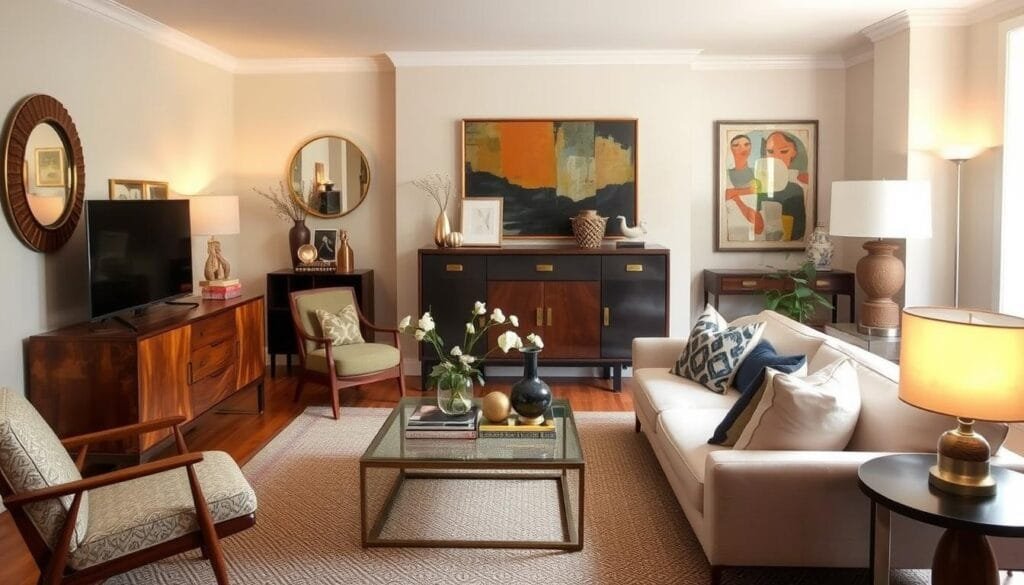
| Midcentury Danish + contemporary upholstery | Teak and walnut frames are visually light, modern sofas heavy. The contrast in mass does the work. |
| Georgian or Federal casegoods + midcentury seating | Both favour restrained line and tapered legs. They rhyme more than they clash. |
| Art Deco + industrial | Shared geometry and a shared taste for metal. |
| Shaker or Windsor + modern minimal | Both stripped of ornament; the difference is age and material, not form. |
| Victorian + anything clean-lined | Heavy ornament needs plain company. One Victorian piece is a highlight; three is a period room. |
Mixing Wood Tones in Practice
Decide whether the room is warm or cool and keep most of the wood in that family, three tones maximum with one clearly dominant, and let a rug or textile carrying both tones bridge any deliberate contrast. Painted furniture is the underrated solution: a piece painted out in a deep neutral stops being a wood tone at all and becomes a colour, removing it from the negotiation. That’s what to do with the inherited piece whose finish fights everything — but only if it’s veneered or already refinished, never an intact antique with original surface.
Upholstery: Reupholster or Leave the Patina
Reupholster when the frame is solid hardwood joined with dowels or mortise-and-tenon rather than staples; the shape is one you love and can’t buy new; the fabric is damaged or fighting the room; or the piece will get daily use. Expect roughly $600 to $1,200 in labour for a club or wing chair in most US markets, plus 6 to 8 yards of fabric — from around $40 a yard for a decent cotton or linen to well over $150 for performance velvets. A sofa is usually $1,500 to $3,000 in labour plus 14 to 18 yards. Regional variation is wide, so get quotes.
Leave the patina when the piece is leather worn evenly rather than split — aged leather is essentially irreplaceable; the original fabric is intact horsehair, mohair or a period textile that’s part of the piece’s value; the piece is decorative rather than hardworking; or the wear reads as history rather than neglect. Honest wear is exactly what stops an eclectic room looking staged.
The option people forget is slipcovering. A washed linen slipcover on a dated sofa costs a fraction of reupholstery and keeps the frame available for a proper job later. If you’re weighing a refinishing project instead, our guide to reviving old furniture covers the practical side.
Where to Source, and How to Spot Quality
- Estate sales. The best source for real furniture. First day for the good pieces, last day for the discounts, typically half price. Family-run sales are where the bargains are.
- Regional auction houses, especially online. They routinely sell solid brown furniture — mahogany chests, dining tables, sideboards — for a fraction of new-furniture prices, because that market has been soft for years. Factor in buyer’s premium, usually 20 to 28 percent.
- Thrift and charity shops. Best for accessories, art, frames, ceramics and glass. Frequency matters more than luck; our thrifting guide has tactics.
- Online marketplaces. Best for midcentury pieces. Search by material rather than style word — “teak sideboard,” “walnut credenza,” “cane chair” — because most sellers don’t know what they have.
- Antique malls and architectural salvage. Higher prices, but you can see and touch everything. Salvage is the source for doors, mantels, hardware and lighting with real age.
How to Tell Good Furniture From Bad in Two Minutes
On casegoods, open a drawer and look at the corners: dovetail joints, hand-cut or machine, mean a piece built to last, while staples and glued butt joints don’t. Check for a dust panel between drawers, and look at the back — solid wood or ply set into a rabbet is good, thin fibreboard stapled on isn’t. Veneer isn’t automatically bad, since fine antiques use it over quality substrates, but veneer over particleboard is disposable. Lift one end: real hardwood is heavy, and the weight tells you before your eyes do.
On seating, look for a kiln-dried hardwood frame, corner blocks screwed and glued rather than stapled, and springs — eight-way hand-tied is the gold standard, sinuous S-springs an acceptable middle, webbing alone is not for daily use. Grip a chair back and try to rack it side to side; wobble means loose joints, fixable but an added cost. Cane and rush seats can be rewoven, a few hundred dollars for hand caning. On price, a solid midcentury teak sideboard at a regional auction or estate sale commonly lands in the $300 to $900 range, against several times that for a comparable new piece; traditional mahogany and walnut casegoods are often cheaper still. Documented designer midcentury — Knoll, Herman Miller, Danish maker’s marks — is a much higher market.
Common Eclectic Design Mistakes
- No dominant style. Three styles at equal weight reads as confusion. Decide which is the 60 percent and demote the others.
- Too many focal points. A bold rug, a gallery wall, a statement light and a patterned sofa means none of them wins.
- Confusing “different” with “good.” An ugly chair is still ugly when it’s the only one of its kind.
- Mismatched heights. Dimensional mismatches read as errors; style mismatches read as intent. Know which one you’re making.
- Buying to fill rather than waiting. The stopgap you buy because a corner looks bare is the piece you’ll replace in a year. Leave it bare.

How to Know When an Eclectic Room Is Finished
Eclectic rooms have no obvious stopping point, which is why so many tip into clutter. The checklist I use:
- Your eye enters at one clear place — the anchor — then moves around rather than bouncing or stalling.
- Every piece connects to at least one other through colour, material, finish or shape.
- There’s somewhere for the eye to rest: an empty wall, a clear surface, a quiet expanse of floor.
- All three lighting layers work, and the room is good at night as well as at midday.
- Nothing is there purely as a placeholder.
- You can name what the room is doing — “warm traditional with modern seating” — in one short sentence.
When all six are true, stop buying. One further test: photograph the room on your phone, because a photo flattens depth and exposes composition problems your eye edits out in person.
Eclectic design endures while individual trends come and go because it’s the only approach defined by the owner rather than by a look. A farmhouse room is finished when it matches other farmhouse rooms; an eclectic room is finished when it matches you. It also costs less than people expect: assembled from estate sales, auctions and inherited pieces, an eclectic room comes in well under a matched suite, and the price is time rather than money. Small rooms suit it particularly well, since the discipline is forced on you — our guide to styling small spaces covers those constraints, our interior design styling tips apply to any style, and the farmhouse decor guide is a counterpoint on how single-style rooms build cohesion.

2 Comments