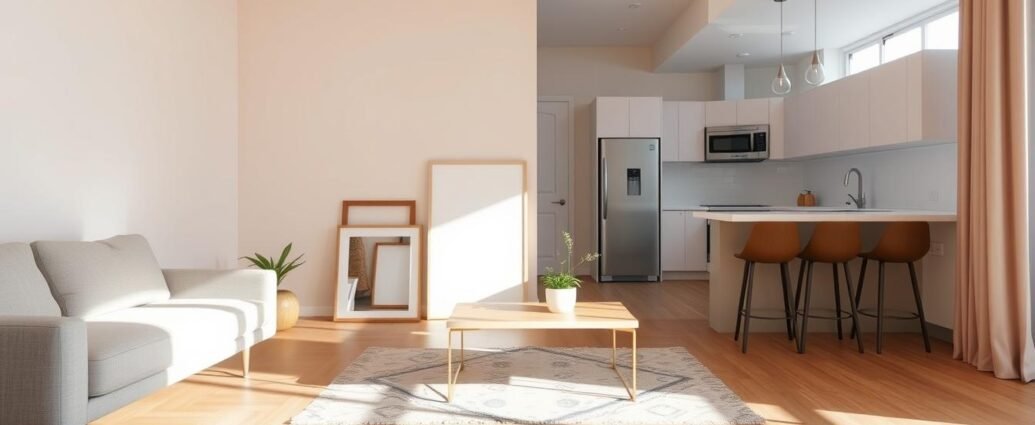
There’s a particular feeling that comes with standing in an empty apartment for the first time: half excitement, half where-do-I-even-start. We’ve had that feeling in more than one rental, and we still think it’s the best part of moving.
An empty room isn’t a problem to solve. It’s the one moment when nothing has been decided yet, and everything you put in it from here is a choice you made on purpose.
This guide walks through the order we’d actually work in: figure out your style, measure before you buy, get the large furniture right, then layer in storage, lighting and the small things that make a place feel like yours. There are renter-safe options throughout and a free or low-cost version of nearly every idea. You’ll also find dining room decor ideas that don’t involve drilling into anything.
Take it in stages. A home that comes together over six months almost always looks better than one bought in a single weekend.
Key Takeaways
- Work out your style before you shop, so you buy once instead of three times.
- Measure the room and every doorway first. A sofa that won’t fit through the door is the most expensive mistake in this guide.
- Spend on the pieces you touch daily — bed, sofa, dining chairs — and save on everything decorative.
- Multifunction furniture and vertical storage buy back floor space in a small apartment.
- Three layers of light (ambient, task, accent) do more for a room than any single fixture.
- Command strips, peel-and-stick wallpaper and freestanding pieces keep your deposit intact.
- Furnish in phases over a few months rather than all at once.
Start With the Space, Not the Shopping List
Before you fill a cart, spend a little time in the empty rooms. What you learn here shapes every decision that follows, and it costs nothing.
Read the room first
Walk through each area at three different times of day and note where the sun lands. A room that gets hard afternoon light needs different colors and window treatments than one that stays dim until evening.
Then measure: wall lengths, ceiling height, window sizes, and the width of every doorway, hallway and stairwell the furniture has to pass through. Sketch the floor plan on paper, or tape the outline of a sofa onto the floor with painter’s tape and live with it for a day. It sounds fussy. It’s also how you find out that the sofa you liked leaves eleven inches to walk past the kitchen.
Work out what you actually like
Ask yourself which rooms you’ve felt genuinely comfortable in. A friend’s crowded, warm den? A quiet hotel lobby with three things in it? Those memories are more reliable than any style quiz.
Build a mood board
Collect images, paint chips and fabric scraps in one place, physical or digital, then look for what repeats. If half your saved images have wood and greenery in them, that’s your answer, even if you’d have described your taste differently. Don’t worry about everything matching yet. Plain furniture under bold art is a real and good look.
| Assessment Method | Key Questions | Expected Outcome |
|---|---|---|
| Room Walk-Through | How does light change through the day? Where do you naturally stop? | Understanding of spatial dynamics |
| Measuring Pass | Wall lengths, ceiling height, doorway widths? | A floor plan you can shop from |
| Mood Board Creation | Which colors and textures appear again and again? | Visual theme identification |
Every apartment has quirks: a radiator in an awkward spot, one wall of windows, a hallway that’s too narrow for anything. Plan around them rather than fighting them and the room comes together much faster.
Finding Your Decorating Style
Your style is really a set of repeated preferences, and naming it makes shopping much easier. Once you can say “warm and simple, with one loud rug,” you stop buying things that don’t belong together.
Minimalism vs. maximalism
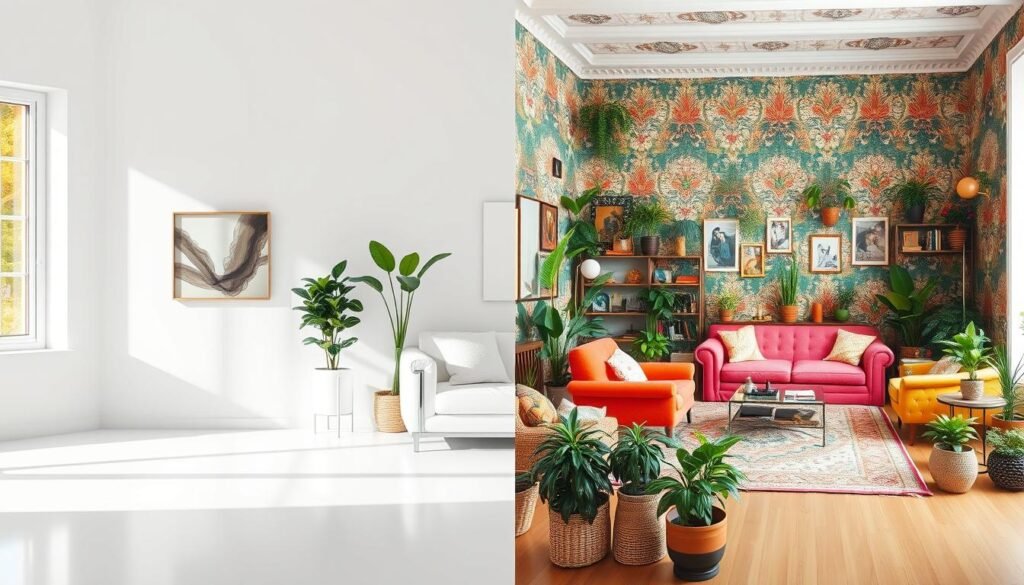
Minimalism keeps the count low and the lines clean. Every piece earns its place, and the payoff is a room that feels calm and takes ten minutes to tidy. If that’s the direction you’re headed, our minimalist living room design ideas are a good next read.
Maximalism goes the other way: layered patterns, saturated color, collections out on display. Done with intention it reads generous and personal rather than cluttered. The trick is repetition — one color or one shape carried through the room ties the whole thing together.
Most people land somewhere in between, and that’s the honest answer. Plain furniture with bold art. Neutral walls with a rug you’d fight someone over. Try a few things, keep what still pleases you a month later, and let the rest go without guilt.
Decorating on a Budget
A good-looking apartment is mostly about proportion, light and restraint, none of which cost money. Here’s where to spend and where not to.
Where to find furniture for less
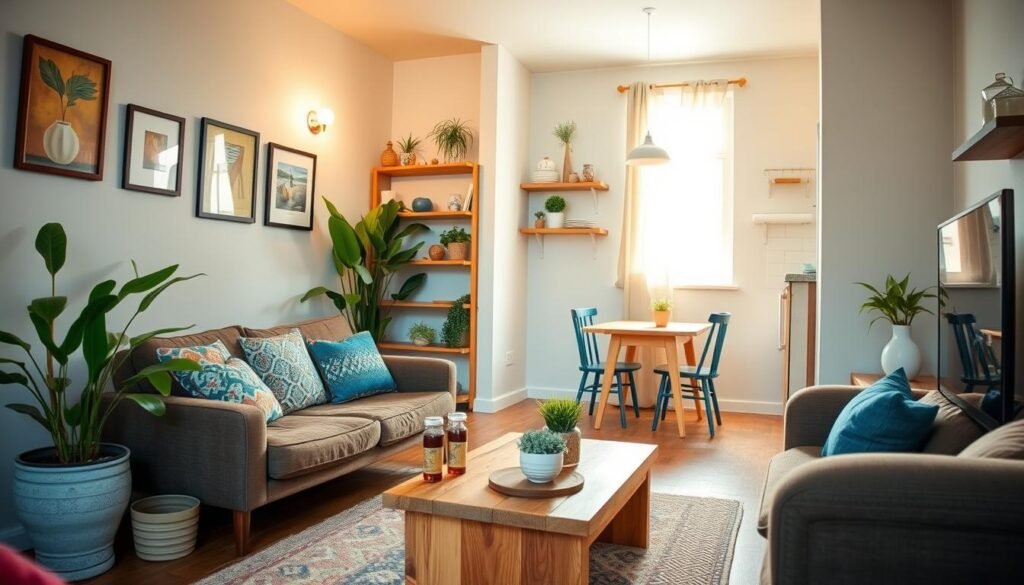
- Facebook Marketplace and Craigslist. Save a search for the specific piece you want and check it daily for a couple of weeks. Solid wood dressers and mid-century chairs turn up constantly at a fraction of retail.
- Estate sales and thrift stores. Go on the last day, when most run half price.
- Sale timing. Larger retailers discount 20–40% around holiday weekends and at the end of each quarter. If it isn’t urgent, wait for one.
- Free options. Buy Nothing groups, the curb near any university on move-out weekend, and family attics. A sanded, repainted side table costs a Saturday and a $5 sample pot.
Check secondhand upholstery for smell and structure before you fall in love with it. Fabric can be cleaned or covered. A broken frame can’t be fixed cheaply.
Mixing new and vintage
Rooms that look collected rather than ordered in one go almost always mix old and new. A $10 flea market vase can sit beside an expensive sofa and look better for the contrast, as long as the two share something: a color, a material, a period.
Our rule is to invest in the things your body touches every day — the mattress, the sofa, the dining chairs — and save on anything decorative, because decorative is exactly what you’ll want to change in two years.
DIY Decor That’s Worth the Afternoon
Handmade pieces carry a kind of meaning that store-bought decor doesn’t, and they’re usually the cheapest route to the thing you actually pictured.
Small projects to start with
- Glue or sew decorative trim along the leading edge of plain curtains. Half an hour, and they read custom.
- Repaint a thrifted side table: clean, sand with 120 grit, prime, two thin coats.
- Knot a macramé plant hanger from cotton cord. Around $8 of materials and one video tutorial.
- Mount a floating shelf with a stud finder and two brackets, or lean a ladder shelf if you’d rather not drill.
- Swap the knobs on a plain dresser. Ten minutes, and it changes the whole piece.
Start with something small enough that a mistake doesn’t matter. Confidence is the real output of a first project.
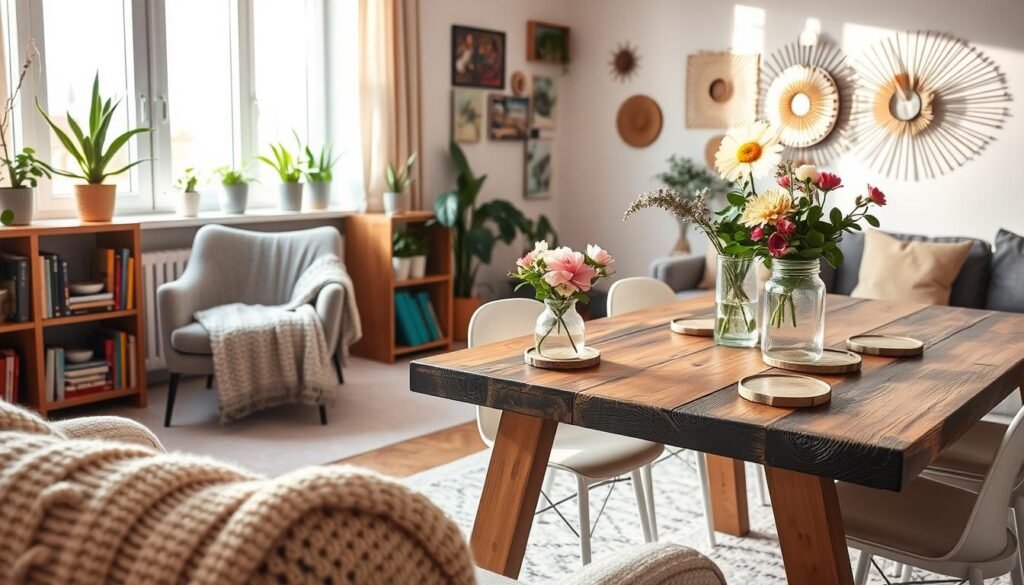
Peel-and-stick wallpaper, step by step
Peel-and-stick wallpaper is the most useful renter product we know. It goes on with a squeegee and a steady hand, and it peels off cleanly when you move.
- Wipe the wall down and let it dry completely. Dust is the main cause of lifting edges.
- Measure and cut each panel with a few extra inches at the top and bottom.
- Peel back about a foot of backing, line the top edge up against the ceiling, and press.
- Work downward in sections, smoothing outward from the center with a plastic squeegee to push the air out.
- Trim the excess at the baseboard with a sharp blade held against a straight edge.
Use it on one wall — behind the bed, or the wall you see from the entry — rather than the whole room. A vertical pattern makes a low ceiling read taller; a horizontal one widens a narrow room. Removable tile decals and washi tape work the same way on smaller areas, and both come off without residue.
Storage and Space Planning
In a small apartment, storage is what stands between you and daily clutter. The goal is a system that works without you having to think about it.
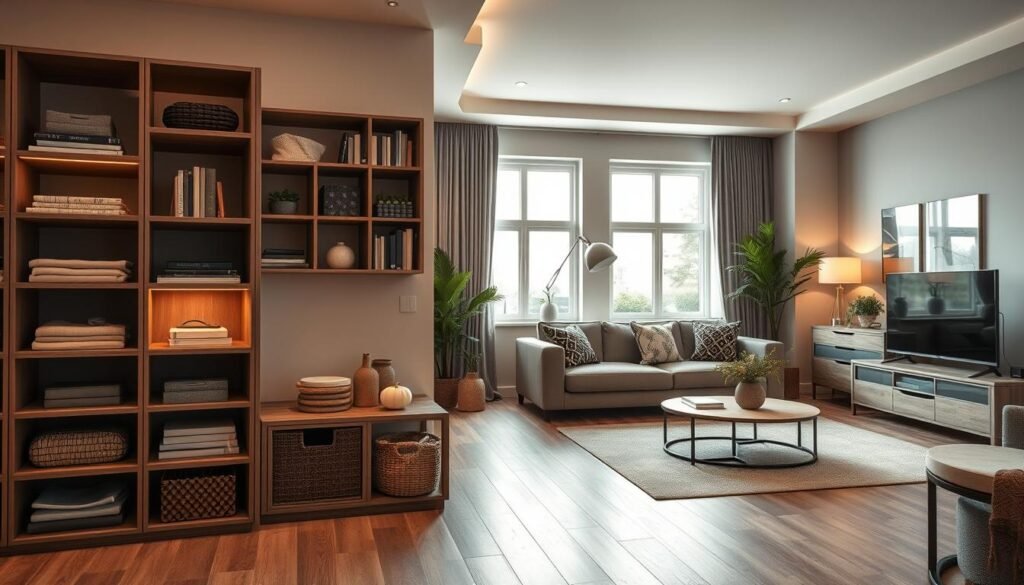
Furniture that does two jobs
Every large piece in a small space should earn its footprint twice. A sofa bed seats people by day and sleeps a guest at night. A storage ottoman holds blankets and gives you a spare seat. Lift-top coffee tables rise to eating height. A console with a deep top works as a desk.
When you’re comparing options, check the interior dimensions rather than the exterior ones. A large ottoman can have a surprisingly small cavity once you account for the frame.
Storage in the space you’re already ignoring
- Vertical. Shelves above door height hold the things you reach for a few times a year.
- Under the bed. Wheeled bins for off-season clothes. Bed risers add six inches of clearance for about $15.
- Behind doors. Over-door organizers for shoes, cleaning supplies or pantry overflow.
- Inside cabinet doors. Adhesive hooks and slim racks for lids, measuring spoons and small tools.
- Stackable cubes. A low room divider one year, a pair of nightstands the next.
| Storage Solution | Best For | Space Impact |
|---|---|---|
| Sofa Beds | Guest accommodation | Dual-function footprint |
| Floating Shelves | Display & organization | Vertical space utilization |
| Under-bed Storage | Seasonal items | Hidden capacity |
| Stackable Cubes | Flexible configurations | Adaptable layouts |
The test is straightforward: if a thing doesn’t have a home, it ends up on a surface. Give everything a place and the apartment stays calm without much daily effort.
Lighting and Atmosphere
Light does more for how a room feels than almost anything else you can buy, and rentals usually start from a bad position: one overhead fixture throwing flat light straight down.
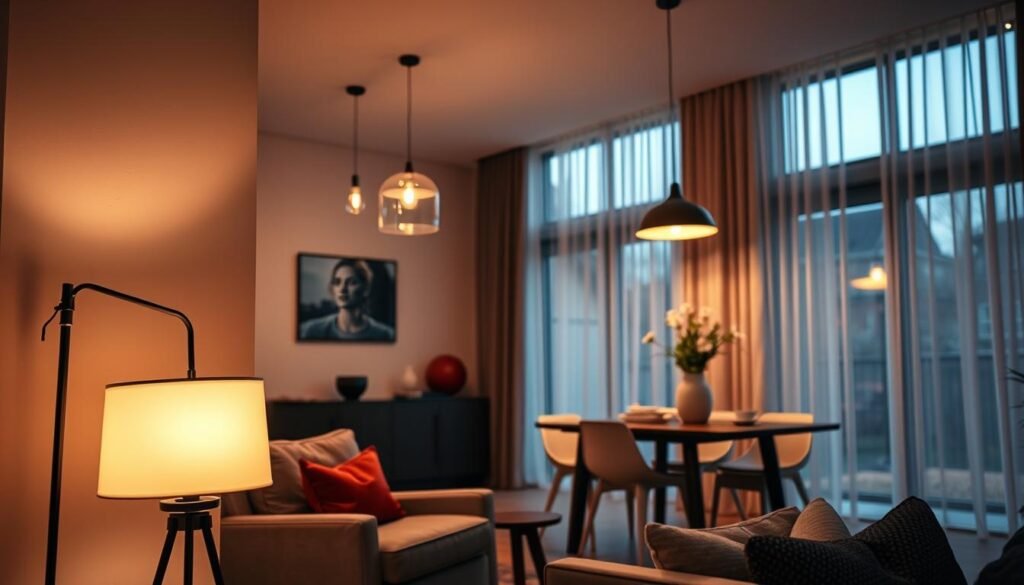
Layer your light
Three layers, in this order:
- Ambient. The general light in the room. Your ceiling fixture, or a couple of floor lamps if the fixture is unflattering.
- Task. Light aimed at what you’re doing: a reading lamp beside the chair, an under-cabinet strip in the kitchen, a lamp on the desk.
- Accent. Small pools of light that give a room depth — a picture light, a lamp on a shelf, a string of lights along a bookcase.
Aim for at least three light sources in any room where you spend real time. Plug-in wall sconces and clip lights give you the look of installed lighting with no wiring and no holes in the wall.
Bulbs and energy use
Choose LED bulbs at 2700K to 3000K for living areas and bedrooms. That’s the warm range that reads cozy rather than clinical. Save cooler, brighter bulbs for task lighting in the kitchen or over a desk.
A plug-in dimmer costs around $15 and lets one lamp serve both a working evening and a quiet one. It’s the cheapest upgrade on this page and the one we recommend first.
Laying Out the Living and Dining Areas
These rooms carry the most daily life, so the layout matters more than the individual pieces. Good flow is what makes a room feel easy to be in. A well-planned living and dining room layout is worth sketching before you buy anything.
Arranging furniture for flow
Start with the walking paths. Leave at least 30 inches for a main route through the room and about 18 inches between the sofa and the coffee table, close enough to set a cup down without leaning forward. Around a dining table, allow 36 inches from the table edge to the nearest wall so chairs can pull out.
If the square footage allows, pull the sofa a few inches off the wall. It sounds counterintuitive in a small room, but the gap creates a defined zone and makes the space read as planned rather than pushed to the edges.
An area rug is the cheapest zoning tool there is. Size it so at least the front legs of every seating piece rest on it. A rug floating in the middle makes the furniture look adrift. In a combined living-dining room, two rugs of different sizes mark the two areas clearly.
Choosing one or two standout pieces
A room needs something to look at. One bold piece — a colorful sofa, an oversized pendant, a large canvas — keeps the space from reading like a showroom floor. Choose it first and let the quieter pieces fill in around it.
Let your actual life decide which piece that is. If you host often, spend on a dining table that extends. If your evenings are mostly on the couch, put the money in the sofa and keep the dining set modest. A secondhand table and four mismatched chairs painted one color will carry you for years while you save. For more ways to finish a room without spending much, browse our stylish ways to decorate your home.
Sustainable Choices That Still Look Good
Eco-friendly furniture has come a long way, and prices now sit close to conventional options. You’ll find well-made pieces in any style, from sleek and modern to soft farmhouse.
Materials worth looking for
- Reclaimed wood — character you can’t buy new, and no new trees cut.
- Bamboo — grows back within a few years and makes durable, lightweight pieces.
- Recycled metal — industrial look, very long life.
- FSC-certified wood — the label means the forest it came from is managed responsibly.
- Secondhand anything — the greenest option is a piece that already exists, and it’s usually the cheapest too.
Biophilic design is the idea that we feel better around natural materials and living things. In practice that means stone or ceramic accessories, wood you can see the grain in, and plants. A pothos in a thrifted pot costs under $15 and does more for a bare corner than most decor at any price.
For more on the subject, these eco-friendly design tips go deeper. Low-VOC paint and natural-fiber textiles are two easy swaps, and both mean less off-gassing in a small apartment.
Wall Decor Without the Holes
Bare walls are what make a furnished apartment still feel unfinished. They’re also the easiest thing to fix, and you can do it without a single nail.
Damage-free hanging
Command strips hold up to 16 pounds when you use them properly, which means pressing the strip to the wall for 30 seconds, waiting an hour before you hang anything on it, and pulling straight down on the tab to remove. Skipping the wait is why they fail.
For a gallery wall, lay the whole arrangement on the floor first and shuffle it until it looks right. Then trace each frame onto kraft paper, tape the paper up, and step back before you commit. Keep about two inches between frames and center the group at roughly 57 inches from the floor, which is standard eye level.
Peel-and-stick wallpaper works here too, on one wall behind the bed or in an entry. Subtle geometric and botanical prints tend to age better than bold graphics.
For more ideas, these accent wall ideas are a good starting point, and our own guide to bold ideas for statement-making spaces covers versions that work in a rental.
| Hanging Method | Best For | Weight Capacity |
|---|---|---|
| Command Strips | Frames & shelves | Up to 16 lbs |
| Washi Tape | Posters & decals | Lightweight items |
| Removable Hooks | Plants & textiles | Up to 5 lbs |
| Tension Rods | Tapestries | Varies by size |
If your lease allows painting, a fresh wall color is the biggest change available for about $40. Check the agreement first, and plan on repainting it neutral before you move out.
Leave some wall empty. One well-placed piece with room around it reads better than four crowded together, and an uncluttered wall makes the whole room feel larger.
Decorating Tips for Renters
A rental deserves the same care as a place you own. The only difference is that everything you do should be reversible.
Temporary solutions that actually work
Freestanding pieces do the work of built-ins with none of the risk. A folding screen divides a studio into sleeping and living zones. A leaning ladder shelf gives you display space without brackets. Tension rods hold curtains, and a second rod inside a closet doubles the hanging space.
The upside of temporary is that you can change your mind. Move things around every few months until the layout stops annoying you.
Protecting walls, floors and surfaces
- Felt pads under every furniture leg, checked twice a year.
- Area rugs in hallways and under dining chairs, where carpet wears fastest.
- Coasters and trivets on any wood or laminate surface.
- Removable hooks rather than nails, adhesive strips rather than screws.
Before you unpack a single box, photograph every room, including the scuffs and stains that were already there, and email the photos to yourself so they carry a date. This ten-minute habit is the most reliable way we know to get a full deposit back.
| Protection Method | Best Application | Damage Prevention |
|---|---|---|
| Furniture Pads | Chair/table legs | Scratch resistance |
| Removable Hooks | Wall decor | Paint preservation |
| Coasters & Trivets | Surface protection | Heat/water marks |
| Area Rugs | High-traffic zones | Carpet wear reduction |
Decorating Your New Apartment: A Phase-by-Phase Plan
Here’s the order we’d work in. Doing it in phases keeps you from buying a whole apartment in one panicked weekend and regretting most of it by spring.
Phase one: the bones
Set a budget and split it before you shop. Roughly half goes to the bed and the sofa, since those get used every day and are the most miserable to replace. Add the dining table and whatever storage you can’t manage without. Nothing decorative yet.
Phase two: definition
Rugs, curtains and lamps. This is the stage where rooms stop being furniture-in-a-box and start feeling like rooms. Hang curtains wide and high, a few inches above the window frame and extending past the sides, and the windows will look considerably bigger than they are.
Phase three: the personal part
Art, plants, books, the things on your shelves. Buy these slowly and only when something genuinely appeals to you. This is the layer that makes an apartment recognizably yours, and it rewards patience more than any other.
| Phase | Key Focus Areas | Timeline |
|---|---|---|
| Foundation | Major furniture, storage solutions | Month 1-2 |
| Definition | Rugs, curtains, lighting | Month 3-4 |
| Personalization | Art, accessories, kitchen shelves | Month 5+ |
Conclusion
You don’t need a finished apartment to have a home. You need a bed you sleep well in, somewhere comfortable to sit with someone, decent light in the evening, and a few things on the walls that mean something to you. The rest can arrive over the next year.
Work out your style before you shop. Measure twice. Spend on what you use daily and save on what you’ll want to change. Keep the changes reversible, and keep those move-in photos.
Whatever the budget and however small the place, it can be somewhere you’re glad to come back to at the end of a day. That’s the whole job, and you’ve already started.