
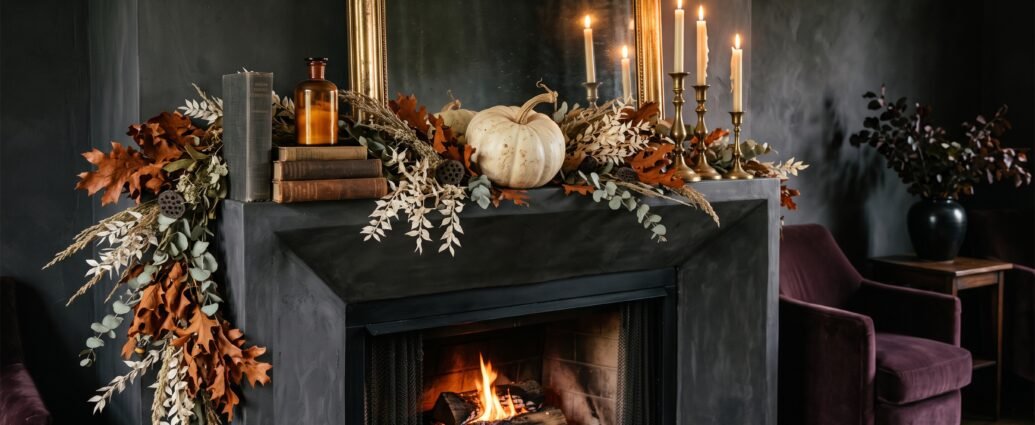
The mantel is the single best place to do Halloween in an adult house. It is one horizontal surface at eye level, usually 48 to 60 inches wide, and it is already the thing everyone in the room looks at. You can restyle it in forty minutes, it costs very little, and — crucially — it is contained. Nobody has to live inside a Halloween theme just because the fireplace is wearing one.
It is also the place where the season most often goes wrong. The fall-to-Halloween transition on a mantel almost always fails the same way: someone adds plastic orange and purple objects on top of an otherwise restrained room, and the whole thing reads costume rather than design. The fix is not more restraint in quantity. It is a change of palette and material.
Below are fourteen Halloween mantel decor ideas with real dimensions, honest costs, candle specifics, the wax and heat problems that damage stone mantels, and a full section on how to keep the whole thing elegant rather than novelty.
The structure underneath any good mantel
Before the Halloween layer, the composition has to work. Four things do most of the heavy lifting, and they apply in October exactly as they do in June.
Three heights, minimum. A tall element of 18 to 30 inches — leaning art, a mirror, branches. A mid element of 8 to 14 inches — candlesticks, a vessel, a cloche. A low element under 6 inches — books, a bowl, a pumpkin. If everything on your mantel sits between 8 and 12 inches tall, that is the entire problem.
Asymmetry at roughly 60/40. Put about sixty percent of the visual mass on one side, forty on the other, and let the lightest zone breathe. Perfectly mirrored arrangements read as hotel lobby.
Depth on a shallow shelf. A standard mantel is only 5 to 8 inches deep, but that is enough to overlap front-to-back: art against the wall, a vessel in front of it, a small object in front of that. Overlap turns three objects into a vignette instead of a row.
Odd numbers, clustered. Three candlesticks, not four. Two clusters and a gap, not five evenly spaced things.
We go much deeper on all four in our guide to fall mantel decor ideas, which is the base layer this post sits on top of. Build that first, then add Halloween.
Classy Halloween decor: how to keep it elegant
Almost everything sold in the seasonal aisle is engineered to read as Halloween from thirty feet away in a store. That means saturated orange, saturated purple, glossy plastic and high-contrast cartoon shapes. Put those objects on a mantel in a real room and they fight every material already there — the wood, the stone, the upholstery, the warm light.
Classy Halloween decor is not about doing less. It is about swapping the palette and the material while keeping the same imagery. A bat is still a bat. It just does not have to be purple glitter foam.
The palette. Bone, cream and warm white. Matte black and charcoal. Aged brass and unlacquered copper. Deep plum, oxblood and aubergine instead of orange. Dusty sage and grey-green from dried botanicals. Amber and smoked glass. That is the whole range, and it works because every one of those colours already exists in most living rooms.
The materials. Real dried and preserved botanicals rather than plastic foliage. Unglazed stoneware and matte ceramic rather than gloss. Antique brass rather than gold-tone spray. Wax rather than battery-and-tinsel. Paper and vellum rather than moulded plastic. Velvet and linen rather than polyester satin. Elegant Halloween decor is mostly a texture question, and matte, tactile and slightly aged is the direction in every case.
The one-strange-object rule. A mantel does not need eight Halloween references. It needs one, and it should be sculptural rather than comic: a single matte black bird, a bell jar over a dried specimen, a small brass skull, an antique key, a taxidermy-style paper moth. One good strange object surrounded by beautiful ordinary things reads far more sophisticated than a full set of themed items.
What to drop entirely. Anything with a printed face. Anything that lights up in green or purple. Glitter of any kind, which migrates across a room for months. Fake cobweb on an interior mantel, which collects dust and reads grubby within a week. Saturated orange in volume — keep orange to a single small note or skip it, and let plum and bronze carry the seasonal warmth instead.
14 Halloween mantel decor ideas
1. An asymmetric dried garland
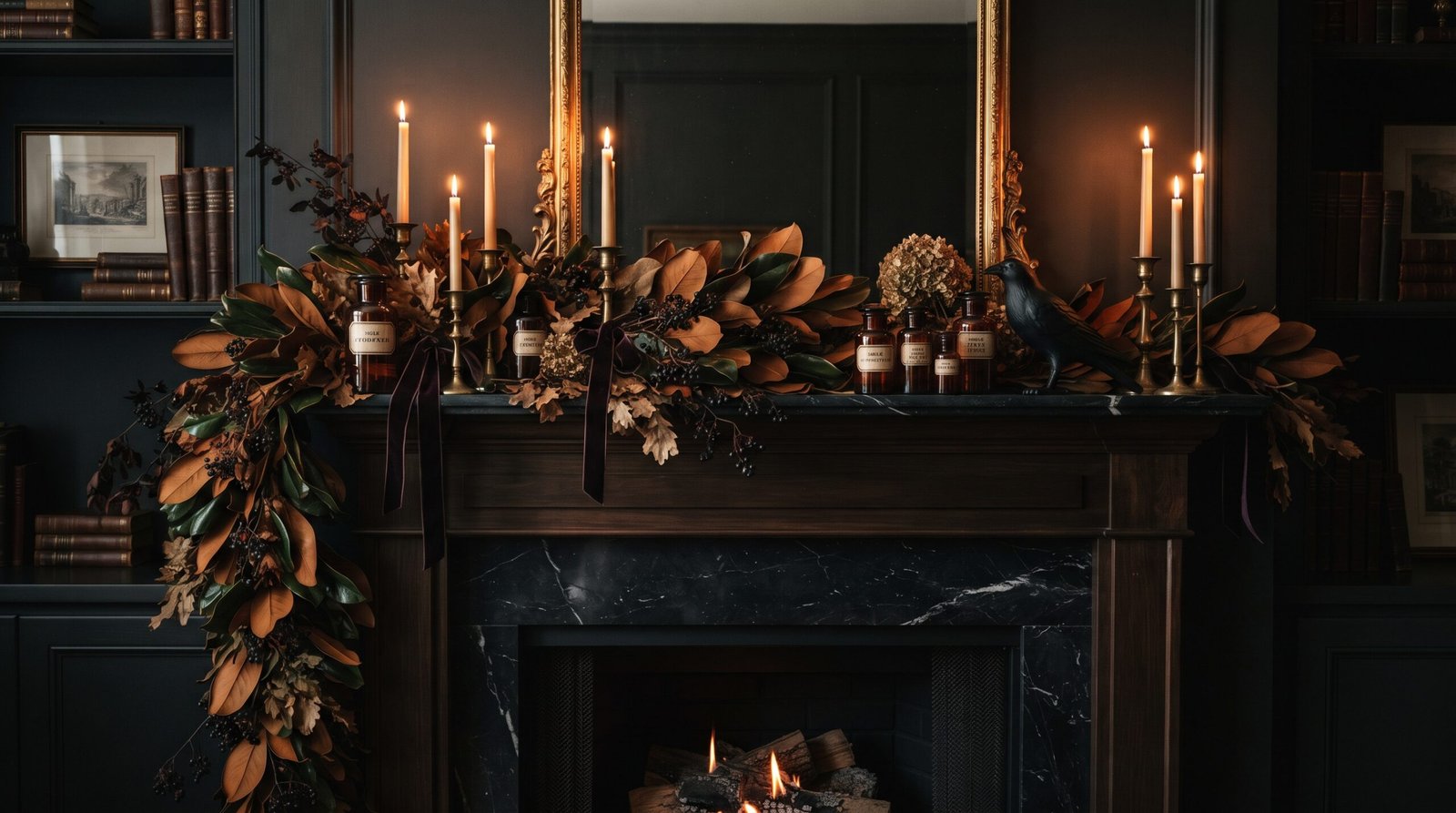
Weight it heavily toward one end and let it trail past the mantel edge rather than swagging evenly. For a 48 to 60 inch mantel, buy roughly 1.5 times the width — a 6 to 8 foot garland — so it can pool rather than stretch tight. Dried oak, preserved magnolia, bleached ruscus and dusty sage eucalyptus all sit inside the palette. Expect $35 to $70 for a good 6-foot preserved garland.
The failure mode: a garland that is too thin. A 6-foot garland weighing half a pound looks like a dropped extension cord. Buy denser than you think, or wire two together. Our DIY fall garland tutorial covers exactly how to build a full one for less.
2. Black taper candles in aged brass
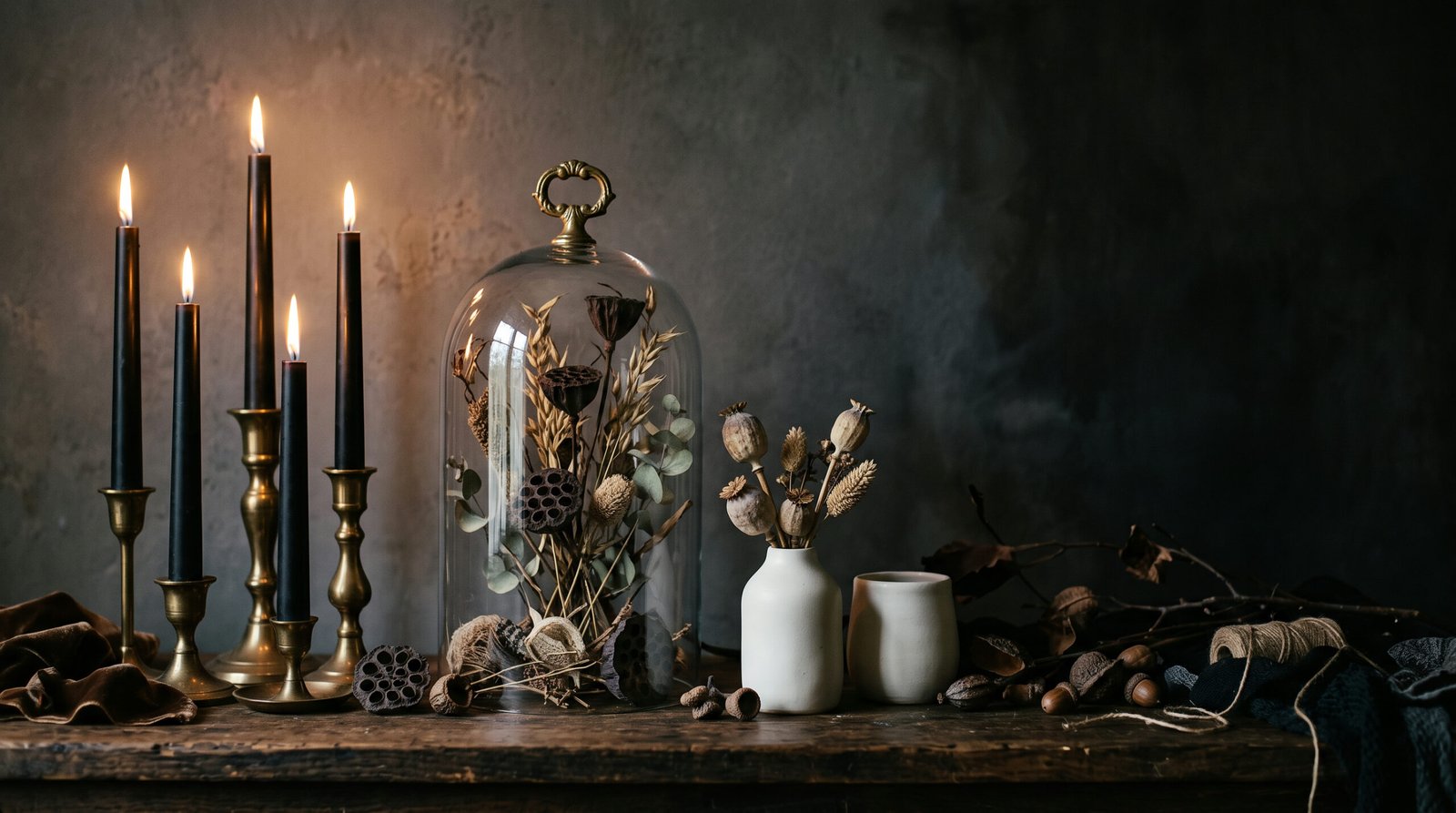
Three or five tapers at staggered heights, clustered toward one end. Matte black tapers against warm brass is the most efficient single move in this entire category — it costs about $15 and instantly signals that the room is doing Halloween on purpose.
The failure mode: black wax on a pale stone mantel. Dyed candles drip and the pigment soaks straight into porous marble, limestone and unsealed concrete. Use holders with a wide bobeche, or set the whole cluster on a brass or slate tray. That $12 tray saves a $2,000 mantel.
3. A bell jar cloche over one specimen
An 8 to 12 inch glass cloche over a dried botanical, an interesting seed pod, a stack of antique keys or a single pale gourd. The glass makes whatever is under it look considered. Cloches run $20 to $50, and they earn their keep year-round.
4. Bone and black painted pumpkins
Small to medium pumpkins in matte bone, chalky black and dusty sage, clustered in threes at graduated sizes. Indoors they hold for six to eight weeks easily because nothing is cut. We cover which paints actually bond to pumpkin skin in our guide to painted pumpkin ideas, and the no-carve pumpkin decorating ideas roundup has the wrap and finish options if you would rather not paint.
5. A leaning antique mirror
Lean a mirror rather than hanging it. It gives you a tall element with no nail holes, it lets you overlap objects in front of it, and it doubles every candle flame on the mantel. Size it to about two-thirds the mantel width — on a 54-inch mantel, 32 to 38 inches wide. Put a strip of rug tape or two clear bumper dots under the bottom edge so it does not slide on a slick painted shelf.
6. Amber and smoked apothecary glass
A cluster of three to five thrifted amber bottles, $2 to $10 each, grouped in front of the mirror. Amber glass in candlelight is the single warmest thing you can put on a mantel, and it is the closest this palette gets to genuine colour.
7. Dried wheat, grasses and dark seed pods
The best value on the list. A dried wheat bundle is $8 to $15, bunny tail grass $10 to $18, dark seed pods and nigella $10 to $20. Put them in a heavy stoneware vessel 8 to 12 inches tall and cut the stems so the arrangement reads about 1.5 times the vessel height.
The failure mode: a lightweight vase tipping. Dried stems are top-heavy. Use something genuinely heavy or drop a handful of pea gravel in the bottom.
8. Cheesecloth forms above the mantel
Cotton cheesecloth stiffened over a wire form, hung from the ceiling or perched at one end of the shelf. Undyed cheesecloth is naturally the right bone colour, it costs a few dollars, and it moves slightly in a draught — which is what makes it atmospheric rather than static. Keep it well away from any live flame. Our full guide to cheesecloth ghosts covers the four stiffening methods, armature options and dry times if you want to make these yourself, and there are more projects like it in our roundup of DIY Halloween decorations.
9. Vintage books as risers
Two or three cloth-bound books give you a 3 to 5 inch riser that lifts a small object into the mid-height band. Free if you own books, $1 to $3 each thrifted. Turn the spines to the wall if the colours fight; the deckled page edges are prettier anyway.
10. A paper bat cluster on the wall above
Matte black cardstock bats in graduated sizes, arranged in an ascending diagonal drift on the wall above the mantel rather than an even scatter. Costs almost nothing, and because they are matte paper rather than glossy foam they read graphic instead of novelty. Use removable putty, not tape, on painted walls.
11. One matte black sculptural object
A single raven, a cast iron candle stand, a black ceramic hand, an obelisk. This is the one-strange-object rule made concrete. If you buy only one Halloween-specific item all season, make it this and make it matte.
12. Deep plum velvet as a runner
A length of velvet or washed linen laid along the shelf with the ends draped over each side. It softens a hard stone or brick edge and adds a colour layer without adding objects. Two yards is plenty, $20 to $50.
13. Bare branches in a tall vessel
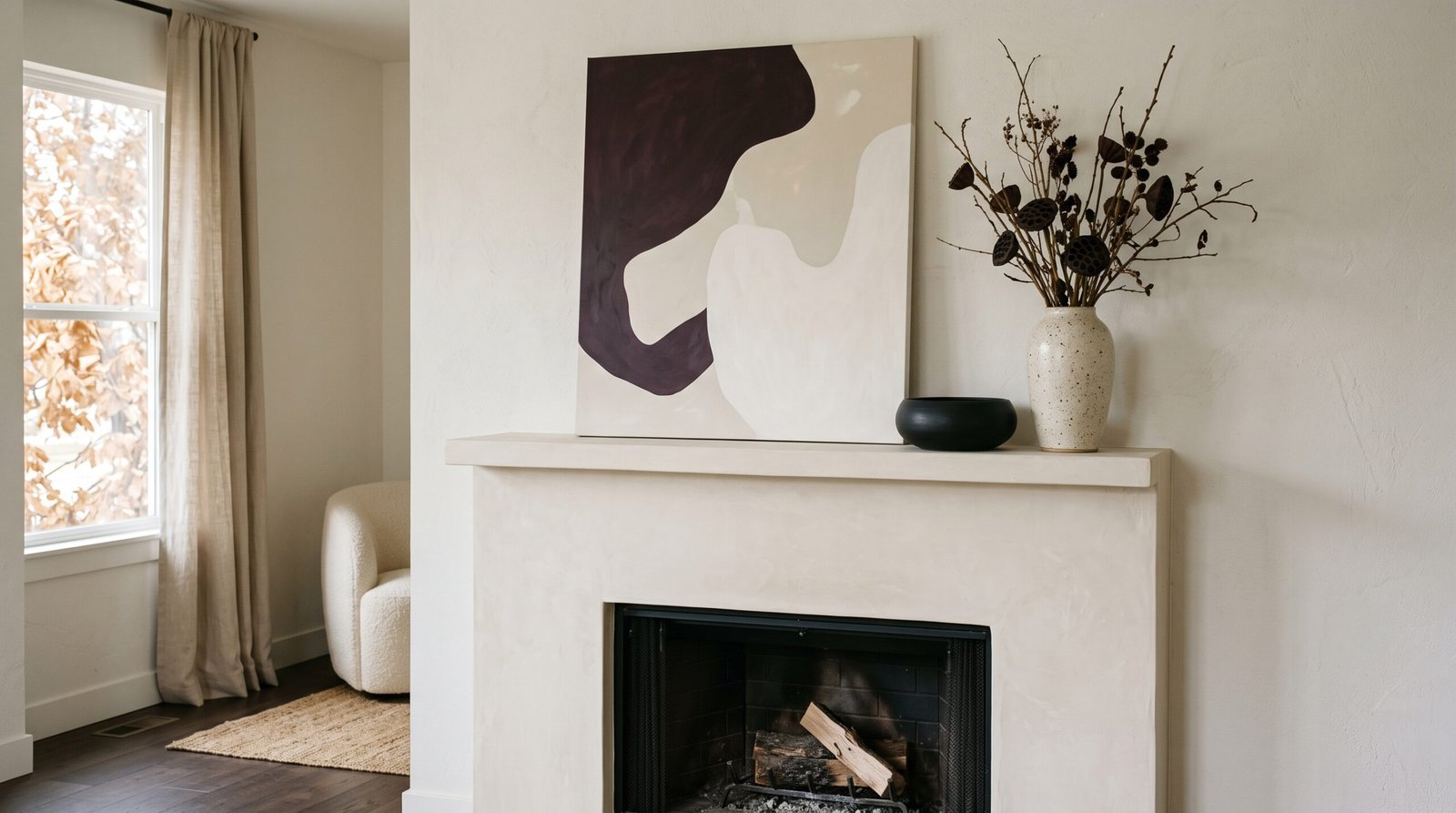
Curly willow, birch or bare oak cut at 30 to 40 inches, stripped of leaves on the lower third. Silhouetted against a pale wall in candlelight this is the most atmospheric thing on the list, and it is free if you have a yard.
14. A dried wreath hung over the mirror
An 18 to 22 inch dried wreath centred over the mantel, hung on a ribbon so it sits slightly forward of the wall. Smaller than a front-door wreath, because the scale reference indoors is the mantel width, not a door. Our DIY fall wreath tutorial scales down cleanly to this size.
Candles, heat and the things that damage a mantel
Candlelight is the entire point of a Halloween mantel, and it is also where the real risks sit.
Clearance. Keep at least 12 inches between any live flame and anything that can burn — dried botanicals, cheesecloth, paper bats, a garland. Dried wheat and preserved foliage are extremely flammable. Treat the space around a lit candle as a no-botanical zone, and never leave flames unattended in a room with a draught.
Burn rate. A standard 10 to 12 inch taper burns down at roughly an inch an hour, so an evening takes a meaningful bite out of it. Buy a box, not a pair, if you intend to light them.
A working fireplace changes everything. The shelf above an active firebox gets genuinely warm. Wax candles soften and bow, dried arrangements dry further and become more brittle, and anything adhesive lets go. If you burn fires regularly, use flameless candles on the mantel and put the real ones elsewhere in the room.
Flameless is not the compromise it used to be. LED tapers and pillars with a warm 2200K flicker and a built-in timer — typically 6 hours on, 18 off, repeating daily — are convincing at $18 to $35 for a set. They also let you put candlelight right in among the dried material, which you cannot safely do otherwise.
Protect porous stone. Marble, limestone, travertine and unsealed concrete absorb wax, oil and berry pigment permanently. Felt pads under every vessel, a tray under every candle cluster. This is the mantel equivalent of a coaster, and it matters more in October than any other month because of the dyed candles.
What a Halloween mantel costs
| Element | Typical cost | Notes |
|---|---|---|
| Preserved 6 ft garland | $35–$70 | Reusable 3–5 seasons stored uncompressed |
| Black taper candles (box) | $12–$25 | Highest impact per dollar here |
| Brass candlesticks (set of 3) | $9–$36 thrifted / $25–$60 new | Thrifted genuinely looks better |
| Glass cloche, 8–12 in. | $20–$50 | Used year-round, not just October |
| Dried wheat bundle | $8–$15 | Lasts several years |
| Dark seed pods / nigella | $10–$20 | Better than faux florals at any price |
| Small painted pumpkins (3) | $6–$15 | Plus a few dollars of paint |
| Amber glass bottles | $2–$10 each | Thrift stores and estate sales |
| Matte black sculptural object | $15–$60 | Buy one good one, not five cheap ones |
| Velvet runner (2 yd) | $20–$50 | No hemming needed |
| Brass or slate tray | $12–$40 | Protects porous stone from dyed wax |
| LED tapers with timer (set) | $18–$35 | Essential over a working firebox |
A complete Halloween mantel lands between roughly $60 and $180, and much of that carries into next year. If you want the cheapest version that still looks deliberate: black tapers in thrifted brass, one cloche, a dried wheat bundle, three bone pumpkins and a book stack. That is around $45 and it beats a $200 pile of seasonal-aisle plastic.
Styling by fireplace and by room
Dark stone or black marble
Lean into it. Bone and cream objects against a dark surround give maximum contrast, and candlelight does its best work here. The dark ground swallows small objects, so go bigger and fewer.
White painted or limestone
Now the black objects carry the drama and the pale mantel is your backdrop. Matte black tapers, a black sculptural object, a charcoal runner. Be strict about wax protection; pale porous stone is exactly what dyed candles ruin.
Red brick
The hardest surround to work with, because brick already brings a warm orange-red that fights plum and orange equally. Cool it down: bone, charcoal and grey-green, a dark runner to break up the brick line, and no orange at all.
A TV above the mantel
Tall arrangements look cramped under a screen. Go low and horizontal: a cluster of vessels, a book stack, a run of low candles, a shallow bowl of dark seed pods. Nothing above about 12 inches.
Modern and minimal rooms
Three objects total — one large piece of art or a mirror, one tall vessel with dried branches, one low matte bowl. Add exactly one strange object and stop. This is the most restrained Halloween mantel decor on the list, and in a busy room it beats a full garland every time.
The mistakes I see most often
Adding rather than editing. The most common failure is putting Halloween objects on top of an already-full mantel. Clear the shelf completely, sort into keep and store, and build back up. Most people put back about half and the mantel improves before a single seasonal item appears.
Everything the same height. Worth saying twice. It accounts for most of the difference between a mantel that looks styled and one that looks stocked.
Too many small objects. Fifteen little things read as clutter however good each one is. Three groupings, each with internal height variation, reads as design.
Forgetting the firebox. A dark empty firebox under a beautifully styled shelf pulls the warmth out of the whole arrangement. A stack of birch logs, a large basket, three pillar candles on a tray, or one oversized dried arrangement in the opening fixes it cheaply.
Ignoring the rest of the room. A Halloween mantel with nothing else shifted in the room looks like an island. One dark pillow, one plum throw, one small vignette elsewhere is enough to make it read intentional — our guides to fall decorating ideas for the living room and fall coffee table decor cover the two surfaces that matter most alongside the mantel.
Making it carry from September into November
Build the base in early autumn with dried material and pale pumpkins — the garland, the candlesticks, the vessels, the books. None of that is Halloween-specific and all of it holds for months.
Add the Halloween layer around the first of October: the black tapers, the paper bats, the cloche specimen, the one strange object, the cheesecloth. That layer is perhaps five items and takes ten minutes.
On November 1, pull those five items. Swap the black tapers back to cream, add magnolia or evergreen to the garland in mid-November, and the same mantel carries through Thanksgiving and into the holidays without a second shopping trip. This is the same two-layer logic that keeps a Halloween porch from having to be dismantled all at once.
One more durability note: keep dried and preserved material out of direct sun. A south-facing mantel bleaches dried florals noticeably over six to eight weeks, so if yours gets hard afternoon light, favour naturally pale materials — bleached ruscus, cream wheat, bone pampas — where fading does not show.
Where to start
If you do nothing else: clear the mantel completely, put back half, add black tapers in brass at three heights, and set one strange object under a cloche. That is under $50 and forty minutes, and it is more convincing than any amount of orange plastic.
The whole approach rests on a base that already works, so if your mantel needs building from scratch, start with our fall mantel decor guide and add this layer on top. — Quinn


1 Comment