
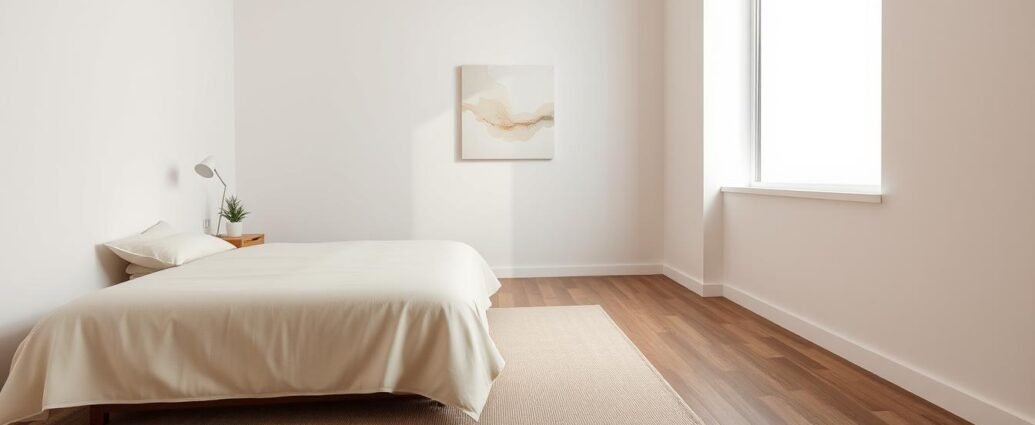
A bedroom is the one room whose entire job is rest — which makes it the natural place to start with minimalism. Strip away the visual noise and you’re left with a space that genuinely helps you wind down. But there’s a real difference between a bedroom that’s serene and one that’s simply under-furnished, and it usually comes down to a handful of measurements and materials.
The bedrooms that feel best are rarely the largest ones. They’re the ones where the bed is the right size for the room, the nightstands are the right height for the mattress, the lighting is warm and low, and there is nothing on the floor. Below is how to get there — layout, bed and rug sizing, nightstand rules, palette, bedding layers, storage, and the mistakes worth skipping.
Key Takeaways
- Leave 24–30 inches of clear floor on each side of the bed and 36 inches at the foot where you can.
- Nightstand tops should land within 2–4 inches of the top of the mattress — usually 24–28 inches high.
- A low-profile platform frame makes ceilings feel higher and the whole room calmer.
- Bedding does the decorating: linen and washed cotton in undyed tones, layered in three weights.
- Warm light at 2700K or lower, on dimmers, matters more than almost any other choice.
- Texture and natural materials are what separate “serene” from “sterile.”
Start With the Bed and Work Outward
Center the bed on its main wall — ideally the wall you see first from the door, and not directly under a window if you can avoid it. Symmetry does a lot of quiet work in a bedroom; a bed centered with matching nightstands reads as restful before you’ve added anything else.
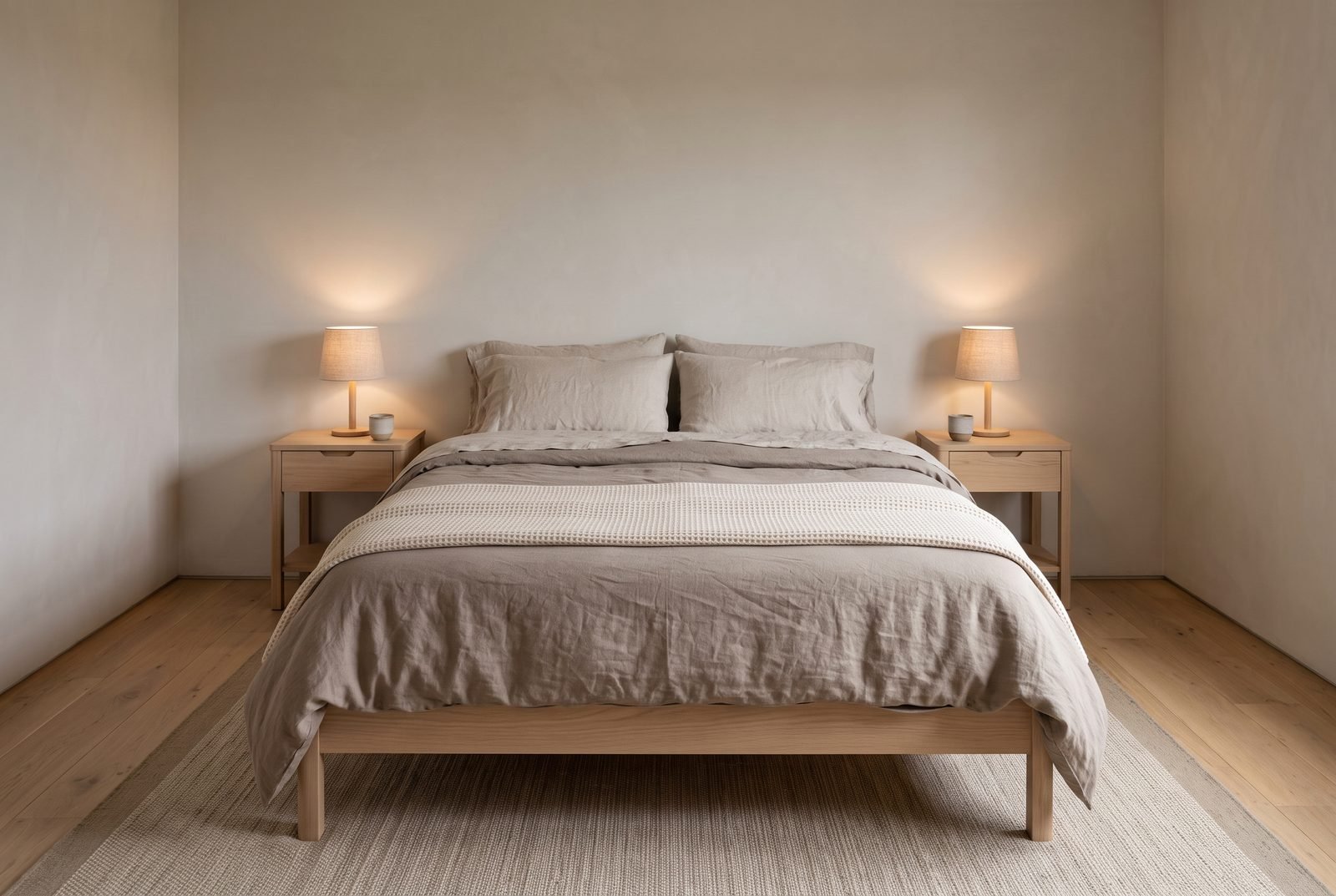
Then protect the floor around it. These are the clearances worth planning to:
| Measurement | Target |
|---|---|
| Clear floor on each side of the bed | 24–30 inches |
| Clear floor at the foot of the bed | 36 inches (24 inches minimum) |
| In front of a dresser or wardrobe (drawer swing) | 36 inches |
| Nightstand height vs. top of mattress | Within 2–4 inches, level or slightly below |
| Nightstand width | Roughly the height of the mattress top, 18–24 inches typical |
Bed sizes matter more than people expect once you apply those numbers. A full is 54×75 inches, a queen 60×80, a king 76×80, and a California king 72×84. A queen fits comfortably in a 10×10 room with walkways on both sides; a king generally needs 12×12 before it stops dominating. If the choice is between a king with 18 inches of squeeze on each side and a queen with proper clearance, take the queen. The room will feel bigger and sleep better.
Free option: The clearance fix usually costs nothing at all. Before you shop for anything, try the bed on a different wall — most rooms have one wall that gives you a walkway on both sides and one that never will, and the only way to know which is to measure. A tape measure and twenty minutes of shoving furniture is the whole job, and it is worth doing before you spend a penny on a frame.
A low-profile platform frame is the minimalist default for good reason: it removes the box spring, lowers the visual mass, and leaves more wall above the headboard, which makes ceilings read taller. If the frame has legs rather than a solid base, you get the same visible-floor effect that makes a living room feel open.
Rug Placement Under a Bed
A rug is optional in a bedroom but it’s the single fastest way to add warmth, and getting the size right is most of the job.
The standard approach is a rug that extends 18–24 inches past the sides and foot of the bed, positioned so it starts just below the nightstands rather than running the full length of the bed. That gives you something soft underfoot exactly where you step out of bed.
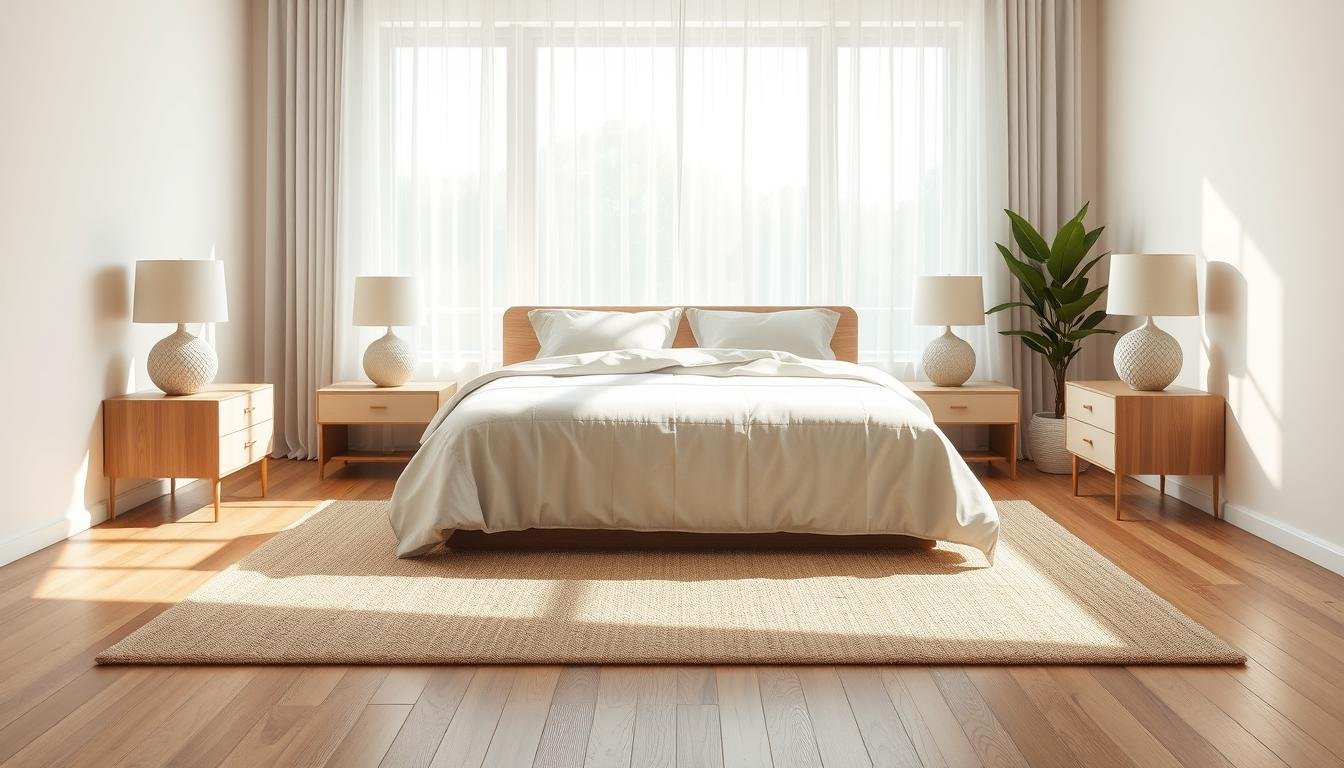
| Bed size | Rug size |
|---|---|
| Full / Queen | 8×10 |
| King / Cal King | 9×12 |
| Any size, small room | Two 2.5×8 runners, one per side |
Wool over jute or sisal is a reliable layer — the natural fiber base adds texture and the wool gives you softness where it counts. In a room where the bedding is already doing the work, a completely undecorated flat-weave in the same tone as the walls is often the better call.
Free option: A rug is the one thing on this list you can skip outright — plenty of calm bedrooms have bare floors. If the problem is cold feet rather than the look, two small washable mats on the sides where you actually step do the practical half of the job for very little, and a rug you already own works here as long as its tone sits somewhere near the wall colour. Roll it out and live with it for a week before deciding it is wrong.
The One-Object Nightstand
Nightstands are where bedrooms collect clutter, and the fix is partly discipline and partly design. Choose one with a drawer or a closed compartment — open shelving beside a bed becomes a pile within a fortnight.
Height is the detail people get wrong. A nightstand top should sit within a few inches of the mattress top so you can reach a glass of water without looking for it. Since mattresses vary from 8 to 14 inches on frames that vary too, measure your actual bed rather than trusting a product’s height on paper. Twenty-four to twenty-eight inches covers most setups.
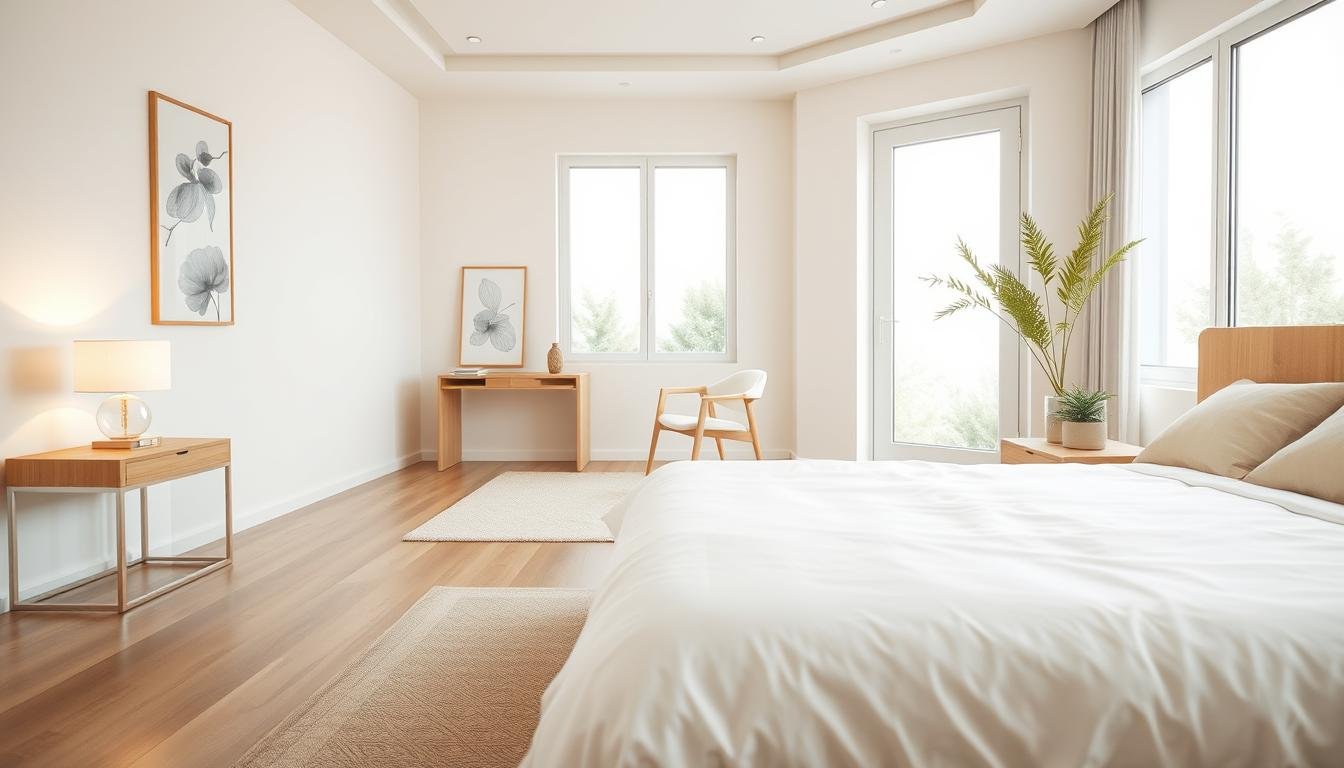
Wall-mounted or floating nightstands are worth serious consideration in small rooms. They free the floor beneath entirely, which makes the room look larger and makes vacuuming trivial. Mount the top at the same measured height you’d use for a freestanding piece.
On top: a lamp, one meaningful object or a small plant, and at most a single book. Everything else — chargers, medication, the second and third book — belongs in the drawer. If you swap the table lamp for a swing-arm wall sconce, you free the entire surface and gain a genuinely better reading light.
Soft, Layered, Warm Lighting
Harsh overhead light undoes a calm bedroom in a second. The goal is three warm sources you can dim independently.
Use 2700K bulbs or lower throughout. Warm-white is what the eye reads as evening; anything cooler signals daytime and works against winding down. Put the overhead on a dimmer if it exists at all, and treat it as a cleaning light rather than a living light.
Bedside sconces should be mounted roughly 30–36 inches above the mattress top, or about 40–48 inches from the floor, positioned slightly toward the outside of the bed so light falls onto the page rather than into your partner’s eyes. Swing-arm models let you correct that after the fact, which is why they’re worth the extra cost.
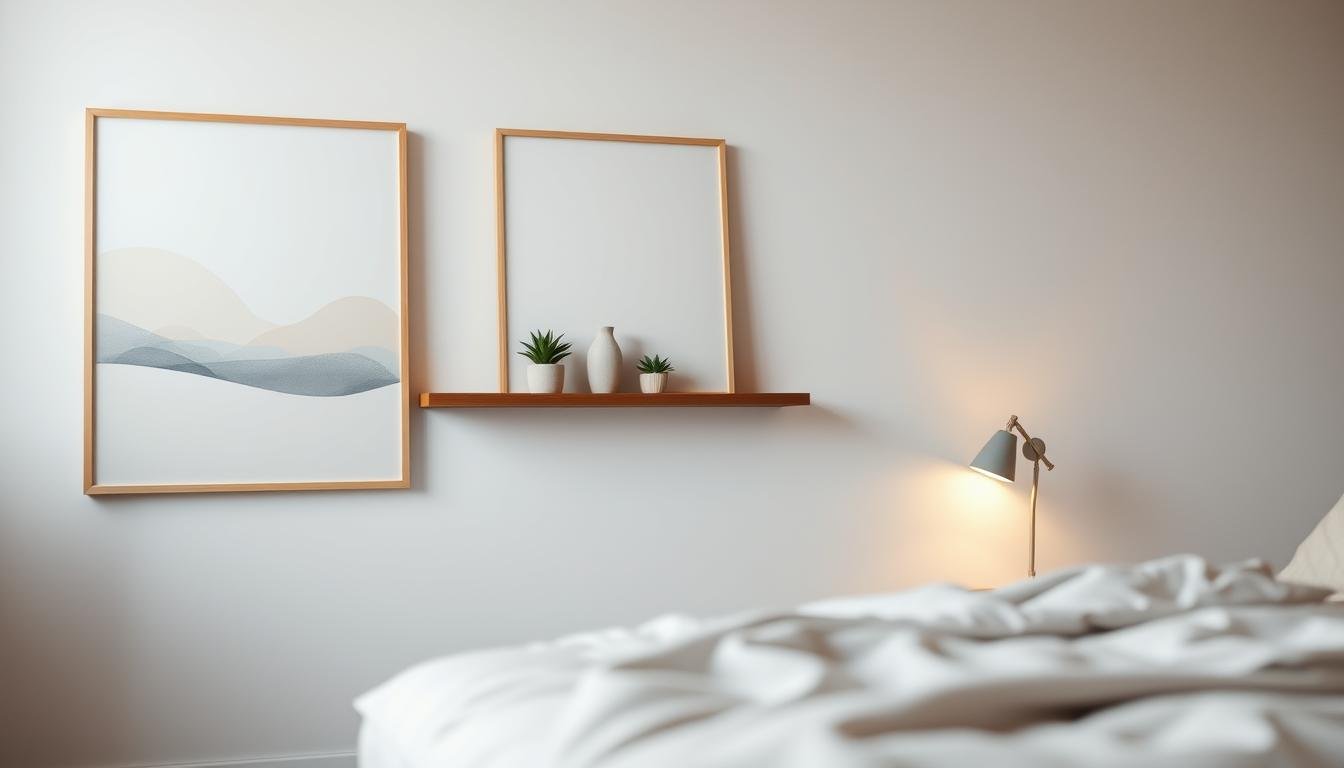
Table lamps beside a bed want a shade bottom near seated eye level — for most beds, a lamp 24–28 inches tall overall. Shades in linen, paper, or another natural material diffuse better and suit the palette. Add one low third source if you can: a small lamp on a dresser, or a plug-in sconce, for the last hour of the evening.
Free option: Most of the benefit here is free. Move the lamp you already own to the outside edge of the nightstand and turn the shade so the light falls on the page instead of across the bed — that is the sconce trick without the sconce. Then swap one bulb for a warm one the next time you are buying them anyway, and stop using the overhead light in the evening. Those three changes cost nothing and do more than a new fitting would.
For daylight, sheer linen panels are the minimalist answer. Hang the rod 4–6 inches above the window frame or halfway between frame and ceiling, extend it 8–12 inches past each side so the panels stack clear of the glass, and let them end about half an inch above the floor. If you need real darkness, run a blackout roller shade inside the frame behind the sheers rather than switching to heavy drapes — you keep the light look and gain the function.
The Palette
Build from one warm neutral and stay inside its family. Linen white, greige, oat, taupe, and soft clay all work. The most common failure is a cool gray on the walls fighting warm wood furniture and cream bedding — pick a temperature and commit to it.
Specific paints worth looking at if you want a starting point: Benjamin Moore White Heron OC-57 and Chantilly Lace OC-65 for a clean, bright white; Maritime White OC-5 and Ballet White OC-9 for something softer; Revere Pewter HC-172 and Pashmina AF-100 when you want a warm greige with more depth. Matte and eggshell finishes suit bedrooms better than satin — they absorb light rather than bouncing it.
If you want color, introduce it through textiles rather than walls, and keep it earthy: sage, olive, clay, muted terracotta. A single accent wall in a tone only a shade or two off the main color adds depth without breaking the calm. Save saturated jewel tones for a room that’s already working.
Bedding: Layers, Not Objects
In a minimalist bedroom the bed is the focal point, so let its materials carry the room rather than adding decorative pieces around it.
A layering formula that works year-round:
- Fitted sheet and flat sheet in washed cotton or linen. Linen creases by nature — that’s the look, and it removes ironing from your life permanently.
- A duvet in a slightly deeper tone than the sheets, in the same family. Buy the duvet insert one size up from your mattress so it drapes over the sides rather than sitting on top like a pancake.
- One textured layer folded at the foot — a waffle blanket, a quilt, a wool throw. This is the piece that adds visible warmth in photographs and in person.
- Two sleeping pillows per person, and at most two larger euro shams behind them. Anything beyond four to six pillows total becomes a nightly chore rather than a design decision.
Look for OEKO-TEX certification on textiles if chemical finishes matter to you, and buy linen in undyed or naturally dyed tones — it softens with every wash and lasts years longer than cotton at the same price point. If you are going to spend on one thing in this room, this is the sensible place for it — the bedding is what you touch for eight hours a night.
Free option: You can get most of the way there with what is already in the cupboard. Strip the bed and put back only what you actually use: one set of sheets, the duvet you own, one blanket folded across the foot, two pillows a side. The pile of spare cushions goes in a bag for now rather than in the bin. A hot wash and a proper line-dry does more for how old cotton feels than people expect, and an unmatched set in two close tones reads as deliberate layering, not as a compromise.
If you want the same palette with more warmth and richer wood tones, our guide to warm minimalist bedroom ideas for a calm retreat takes this in a cozier direction.
Storage That Keeps the Floor Clear
A minimalist bedroom stays minimalist only if everything has somewhere to live. Clear surfaces are a storage outcome, not a personality trait.
- Under-bed storage is the highest-value square footage in the room. A platform frame with integrated drawers can replace a dresser entirely in a small bedroom.
- A single wide dresser beats a dresser plus a chest plus a bench. Six drawers, soft-close, smooth edges.
- Floor-to-ceiling or built-in wardrobes read as architecture rather than furniture, so they add capacity without visual bulk.
- Drawer dividers are unglamorous and they’re what actually keeps a minimalist system running past month two.
- Wall hooks near the door handle the robe and the bag that would otherwise land on a chair.
The rule that keeps it stable long-term is one in, one out — when something new enters the room, something leaves. Ten minutes of tidying a week is enough once the storage is right; no amount of tidying is enough when it isn’t.
Free option: Built-in wardrobes are a long way off for most of us, and the gap matters less than it sounds. Under-bed storage works with boxes you already have, or with nothing at all if what goes under there is out-of-season bedding in a zipped duvet bag. A row of hooks on the back of the door handles the robe and the bag that would otherwise land on a chair, and costs the price of a coffee. The one-in-one-out habit is free and is doing more work than any of the furniture. The same “a place for everything” logic that governs a minimalist kitchen is what makes this sustainable.
Texture, Wood, and a Plant or Two
Remove color and pattern from a room and texture has to carry it. This is exactly why some minimalist bedrooms feel like hotel corridors.
Mix materials that feel genuinely different: linen bedding against a wool throw, an oak or walnut frame with visible grain, a jute or sisal base rug, a limewash or textured plaster wall, one ceramic or stone object. Reclaimed wood and bamboo both add warmth and hold up well; FSC-certified solid oak, walnut, and ash are the materials that improve rather than degrade over a decade.
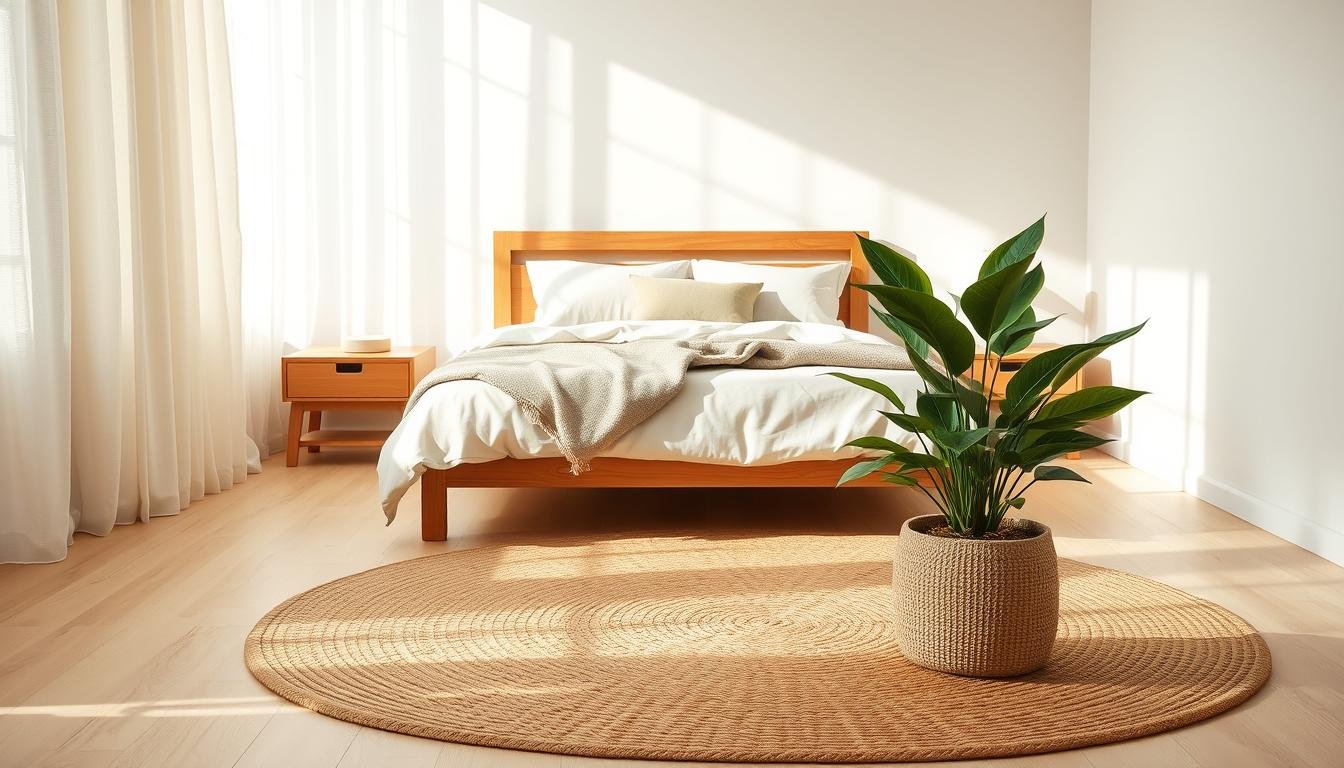
One or two plants are enough. Snake plants, pothos, and succulents tolerate low light and irregular watering, which is what you want in a room you’re mostly in when it’s dark. A single plant on a dresser does more for the feel of the room than three decorative objects would.
For art, one large piece above the bed or on the opposite wall beats a gallery arrangement. Hang it with the center 57–60 inches from the floor, and if it’s going above the headboard, keep the bottom edge 8–10 inches above it and size the piece at roughly two-thirds the width of the bed.
If There’s a TV
Bedroom televisions sit higher than living room ones because you watch reclined rather than upright. Centering the screen at about 50–55 inches from the floor is usually right for a bed with the headboard propped up — but the honest advice is to check it from the actual pillow position before drilling. Mount it flat on the wall opposite the bed, run the cables inside the wall or through a channel, and keep the surface below it closed.
Mistakes Worth Avoiding
- A bed too large for the room. Clearance beats mattress size almost every time.
- Nightstands at the wrong height. A table six inches below the mattress top is a design problem you’ll notice every night.
- One overhead light. Instantly institutional, no matter how good the bedding is.
- Cool-toned bulbs. 4000K in a bedroom fights everything else you’ve done.
- Too many pillows. If making the bed takes more than a minute, the system is wrong.
- Hard surfaces only. Without a rug, curtains, and a textile layer, the room will sound as bare as it looks.
- A matched furniture suite. Bed, nightstands, and dresser all in the same finish reads as a showroom. Vary the wood tones deliberately.
- Nothing on the walls. Empty is not the same as calm. One considered piece is the difference.
Frequently Asked Questions
How much space should I leave around a bed?
Aim for 24–30 inches of clear floor on each side and 36 inches at the foot, with 36 inches in front of any dresser so drawers open fully. If a larger mattress means dropping below 24 inches on the sides, size the bed down instead.
How tall should a nightstand be?
Within 2–4 inches of the top of your mattress, level or slightly below — usually 24–28 inches. Measure your actual made bed rather than relying on the product spec, since mattress and frame heights vary widely.
What size rug goes under a bed?
An 8×10 for a full or queen, a 9×12 for a king, positioned to start just below the nightstands and extend 18–24 inches past the sides and foot. In a tight room, two runners flanking the bed do the same job for less money.
How do I make a minimalist bedroom feel cozy, not cold?
Lean on natural materials — linen, wool, oak, jute — a warm-neutral palette, and three dimmable light sources at 2700K or lower. Texture is what adds warmth without adding clutter.
How should I layer minimalist bedding?
Fitted and flat sheets in linen or washed cotton, a duvet one size up from the mattress in a slightly deeper tone, and one textured blanket or quilt folded at the foot. Two sleeping pillows per person, plus two euro shams at most.
What colors work best in a minimalist bedroom?
Warm neutrals — linen white, greige, taupe, oat, cream — in a matte or eggshell finish, with optional earthy accents like sage or clay introduced through textiles rather than paint.
What should I keep on a minimalist nightstand?
A lamp, one meaningful object or a small plant, and at most a single book. Everything else belongs in the drawer — or swap the lamp for a wall sconce and clear the surface entirely.
A serene bedroom is mostly a handful of correct measurements plus restraint about everything else. If you’re applying the same thinking elsewhere in the house, our minimalist living room ideas cover layout and rug sizing in the same detail, our simple minimalist bathroom ideas handle the smallest room in the house, and Japanese minimalist interior design is where a lot of these ideas about natural materials and low furniture originate. For the principles behind the whole approach, see our complete guide to minimalist home interior design. And if the next room on the list belongs to a child or a teenager, the same rules about light, texture and clear floor still hold — our kids bedroom themes and budget decor hacks for a teen hangout space are built to work inside them rather than against them.


1 Comment