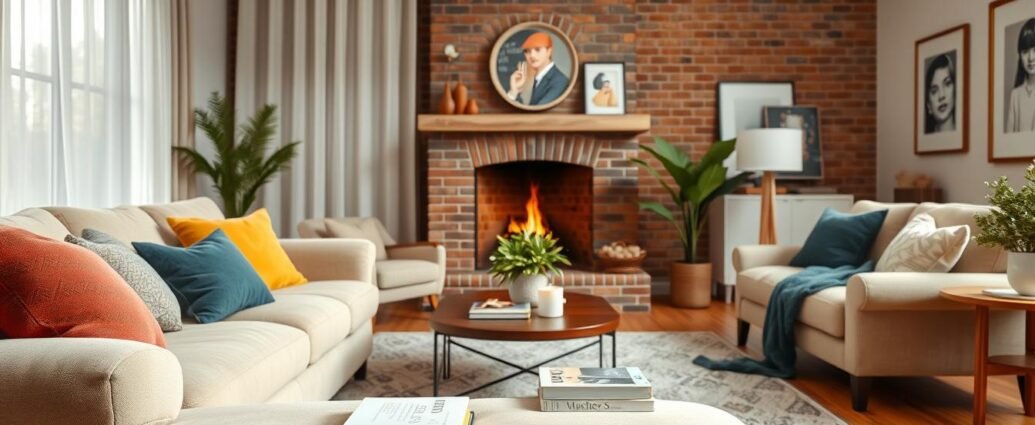
You walk into your living room and something feels off. Maybe the layout fights you, maybe nothing quite goes together, maybe you just can’t tell what’s wrong. That stuck feeling is common, and it’s usually a sign that the room needs a plan rather than more stuff.
This guide gathers the living room decorating ideas that actually move the needle, in the order we’d tackle them: work out what you have, measure it, choose a direction, then layer in furniture, color, light, and the small things. No jumping between a dozen sources.
Whether your space is a compact rental or a wide open floor plan, the same sequence works. We’ll go step by step, and we’ll give you a low-cost or no-cost version of nearly every idea, because a room shouldn’t have to wait on a big budget to feel good.
The goal isn’t a room that looks like a catalogue. It’s a home that suits how you actually live, and a place you like spending your evenings in.
Key Takeaways
- Turn design overwhelm into a clear, ordered plan.
- Work from one set of ideas and strategies instead of a dozen tabs.
- Get guidance that adapts to your room size and layout.
- Follow the process from measuring through to the finishing details.
- Build the confidence to make a space that reflects how you live.
Understanding Your Living Room Space
Before the fun part, spend twenty minutes with the room you already have. This honest look is the foundation for everything that follows, and it costs nothing.
Walk through the space the way you normally would. Notice where you slow down, where you sidestep a coffee table, where a lamp cord catches your foot. That’s your room’s real traffic pattern, and it should shape the layout more than any floor plan you find online.
Assessing Your Current Layout
Take photos from every corner. The camera flattens a room and shows you things you’ve stopped noticing, like a chair that blocks a walkway or artwork hung six inches too high. Pay attention to walls with windows, doors, radiators, or built-in features, since those decide where large furniture can and can’t go.
| Current Feature | Potential Challenge | Opportunity |
|---|---|---|
| Windows on main wall | Limits furniture placement | Natural light focus |
| Doorway traffic patterns | Interrupts conversation areas | Defines clear pathways |
| Room corners | Often underutilized | Good spot for a lamp or chair |
Identifying Problem Areas
Notice where people gather and where they never sit. If one chair is always empty, it’s usually facing the wrong way or sitting too far from the group. If conversations always happen standing in the doorway, your seating is probably too spread out.
Look at how the room connects to whatever is next to it. If the living area opens onto a dining space or kitchen, the two need to read as one home rather than two separate ideas. Once you’ve got this picture, you’re ready to measure.
Measuring and Planning Your Layout
Picture the dream sofa arriving and not fitting through the door. Measuring is the step that prevents that, and it’s far less painful than arranging a return.
It takes half an hour and a tape measure, and it saves you from living with a cramped layout for years.
Measuring the Room Properly
Measure wall lengths, ceiling height, window width and sill height, and door widths. Note outlet and light switch positions too, since a sofa back over the only outlet means an extension lead across the floor forever.
Measure the awkward bits: radiators, chimney breasts, the depth of an alcove, the swing of the door. A single missed radiator can undo an entire plan. Then measure the route in, meaning doorways, hallway width, and any turn at the top of a stairwell.
Sketching Your Floor Plan
Sketch the room on graph paper at a scale of one square to six inches, then cut paper rectangles for each piece of furniture. Moving paper around a page is a great deal easier than moving a sofa, and it’s free. A floor planner app does the same job if you prefer.
Plan walkways of 30 to 36 inches between large pieces where the room allows, or 18 to 24 inches in tighter spaces. Leave 14 to 18 inches between a sofa and a coffee table so you can reach a cup without leaning. These numbers also tell you what rug size and furniture footprint you can accommodate. If yours is a tight room, these ways to maximize space in a small living room are worth a look before you buy anything.
Before you commit, mark the footprint of a big piece on the floor with painter’s tape and live with it for a couple of days. It’s the cheapest test there is. Take the measurements shopping with you so you never have to guess in a showroom.
Selecting Your Interior Style
Now the visual side. This is where you translate how you live into a look that feels like yours rather than someone else’s.
Your personal style should follow the way you use the room. A house with a large dog and two children needs different fabrics than a quiet flat for one, and that’s a practical constraint worth respecting from the start.
Finding Your Design Inspiration
Save images for a couple of weeks without judging them, then look at the collection as a whole. Are you drawn to clean lines or layered texture? Warm woods or cool greys? The pattern in what you’ve saved is usually clearer than anything you could decide in advance.
A digital mood board is free and does this job well. So does a physical one: paint chips, a fabric scrap, and a magazine tear pinned to a board where you’ll see them in daylight.
| Design Style | Key Features | Best For |
|---|---|---|
| Modern | Clean lines, minimal decor | Streamlined, clutter-free spaces |
| Farmhouse | Warm woods, rustic touches | Family-friendly, cozy atmospheres |
| Eclectic | Mixed patterns, personal collections | Creative, individual expression |
You don’t have to pick one label. The most interesting rooms borrow from several styles and hold together through a shared color palette or a repeated material. Your own look will show up on its own once you stop forcing it.
The point of naming a direction is that it makes shopping faster. You’ll know within seconds whether a piece belongs in your living room or not.
Creating Your Ideal Color Palette
Color does more to change how a room feels than any single piece of furniture, and paint is one of the cheapest tools you have. A gallon costs less than a lamp and changes all four walls.
Start with the things you’re keeping. Pull color choices from the sofa you already own, the rug you love, or the view out of the window. Working outward from a fixed point is far easier than picking a palette in the abstract.
Lighting changes everything about how color reads. Paint sample patches directly on your walls, or on white card you can move around, and look at them in morning light, afternoon light, and lamplight before deciding. North-facing rooms pull colors cooler, south-facing rooms warmer.
Mixing dark and light color gives a room depth. Contrasting neutral tones are quietly sophisticated: crisp white walls with warm caramel leather, or soft greige with charcoal, read as finished without shouting.
Think about mood. Warm color makes a room feel active and sociable, cool tones make it calm. There’s no wrong answer, only what suits how you use the room. For more combinations to borrow, see these stylish living room color palettes.
A workable rule: three to five colors total, roughly sixty percent dominant, thirty percent secondary, ten percent accent. If repainting isn’t an option in your rental, get the same effect for less with cushion covers, a throw, and a couple of framed prints in your chosen palette.
Choosing Furniture That Makes an Impact
Furniture is where the plan becomes real. The aim is pieces that look good and hold up to actual life, not showroom life.
Treat the sofa as the anchor. It’s the biggest object in the room and it sets the flow for everything else, so choose it first and arrange around it.
Finding the Perfect Sofa and Seating
Be honest about how you use it. If most evenings are films and lying down, a deep sectional earns its space. If you mostly sit upright and talk, a shallower sofa with a firmer seat will suit you better and take up less floor.
Check three things before buying: seat depth (22 inches or more if you like to curl up, under 22 if you sit upright), frame material (kiln-dried hardwood lasts, particleboard doesn’t), and fabric. With pets or children, performance fabrics and removable, washable covers are worth the premium.
Balance the sofa with a couple of complementary chairs. An accent chair or an ottoman adds flexible seating you can pull into the group when people come over. On a tight budget, a secondhand chair reupholstered, or covered with a well-fitted slipcover, does this beautifully for a fraction of the price of new.
Balancing Function and Style
Every piece should do a job. Too much furniture turns a room into an obstacle course, and the fix is usually removing one thing rather than adding another.
Keep clear paths around your seating. People should be able to cross the room without turning sideways. A good psychology of furniture placement explains why that ease of movement changes how comfortable a room feels.
Your furniture should look chosen rather than bought in a set. Matching suites read flat. Put the money into the sofa you sit on daily and have fun with secondary chairs, side tables, and lamps, which are the easiest things to find secondhand.
Handled this way, the room ends up both good-looking and genuinely comfortable to use.
Help Decorating My Living Room: Practical Strategies
Here’s how to close the gap between inspiration and a room that actually looks pulled together.
The most common problem is a space that feels bitsy, where twenty small things all compete and nothing stands out. When everything is the same visual weight, the eye has nowhere to rest.
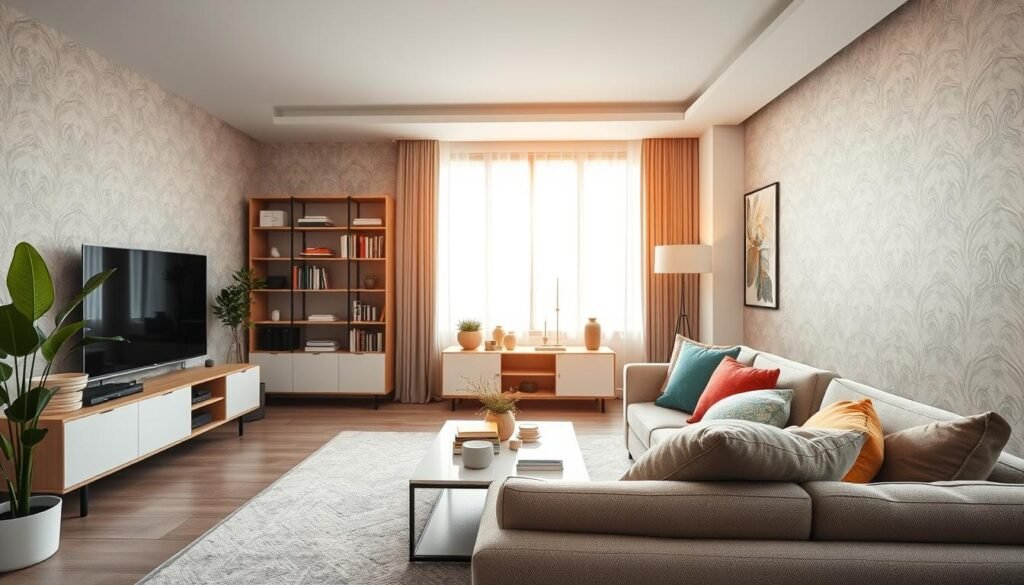
If you like a fuller, maximalist look, vary the scale. One tall object, one medium, one low, grouped in threes, gives the eye a path around the room. Uniform little objects spread evenly read as clutter; the same objects grouped read as a collection.
If you lean minimal, give your favourite pieces breathing room. Taking three things off the shelf usually does more than adding a fourth.
Spread visual weight around the room. If the dark bookcase, the black lamp, and the dark artwork all sit on one side, the room tips. Move one dark element to the opposite wall and it settles.
Think about how the main gathering area meets the spaces next to it. Repeating one color or one wood tone across the boundary makes an open plan feel like one home instead of two rooms sharing a floor.
None of this depends on budget. It’s about being deliberate with what you already own, and it’s the fastest free improvement on this list.
Picking the Perfect Rug and Wall Art
Two elements do most of the anchoring work in a living room: what’s on the floor and what’s on the walls. Get these right and the room reads finished.
Rug Sizing and Placement Tips
The most common mistake is a rug that’s too small, which makes the furniture look like it’s floating. Typical living room rug sizes are 8’x10’ or 9’x12’.
Your rug should extend at least 6 inches past each end of the sofa, and ideally run its full length. Leave 10 to 20 inches of bare floor between the rug edge and the room walls so the border looks intentional.
Set the furniture so all legs sit on the rug, or at minimum the front legs. The coffee table should sit fully on it. If a large rug is out of reach, layer a smaller patterned one over an inexpensive jute or seagrass rug in the size you actually need. It costs a fraction and reads as deliberate.
Choosing Eye-Catching Wall Art
Now the wall art. Scale is the thing people get wrong. One large piece usually does more than five small ones, and a group of small frames works best hung tightly as a single block rather than scattered.
Hang art so the centre sits 57 to 60 inches from the floor, which is average eye level. Above a sofa, aim for artwork about two-thirds the sofa’s width, with 6 to 10 inches between the frame and the sofa back. Leaning a large piece against the wall on a console table is a relaxed alternative that needs no nails, which helps in a rental.
Art doesn’t have to be bought. Framed fabric, a page from an oversized book, your own photographs printed large, or a charity shop frame repainted all work. These are the pieces that make the place feel like yours. For more on floor coverings, this designer trick for selecting the right rug is worth a read.
Lighting Strategies for Ambience and Function
Lighting changes a room more than almost anything else, and it’s one of the cheapest things to fix. Swapping bulbs alone can shift the whole mood for the price of a coffee.
Work with three types together. Ambient lights the room overall, task lights what you’re doing, and accent picks out artwork or architecture. Layering the three is what stops a room feeling flat.
Combining Floor, Table, and Ambient Lighting
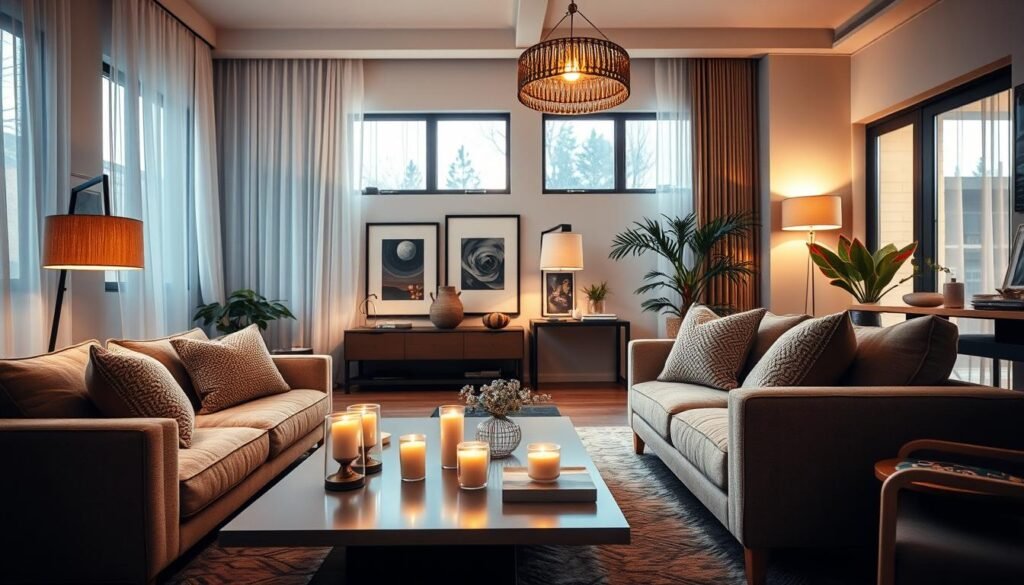
Start with a floor lamp and at least one table lamp. Varying the heights of your light sources adds depth and spreads the light evenly around the room. Three points of light at different heights is a good target.
Put the floor lamp beside a seat where someone reads. Put table lamps on side tables or the coffee table. That combination fills the dark corners and gives the room a warmer feel at night.
| Lighting Type | Primary Function | Ideal Placement |
|---|---|---|
| Ambient Lighting | Overall room illumination | Ceiling fixtures, wall sconces |
| Task Lighting | Focused activity light | Reading chairs, workspaces |
| Accent Lighting | Highlight features | Artwork, architectural details |
Practical Lighting Ideas
Match your bulbs before you buy new lamps. Aim for 2700K to 3000K for warm light and keep every bulb in the room at the same temperature. Mismatched bulbs are the reason a lot of rooms feel slightly wrong at night, and correcting it costs almost nothing.
Don’t match your lamps exactly. Let them relate through finish or scale instead. Two identical tripod lamps look staged; two different lamps in the same brass finish look collected over time.
Smart bulbs that shift color temperature through the day, LED strips behind a TV, or a picture light over artwork are worth-it upgrades if you have the budget. A plug-in dimmer costs a few dollars and delivers most of the same benefit.
Here’s our favourite habit: once you have enough lamps placed well, stop using the overhead light in the evening. The room instantly feels calmer, and your living room becomes somewhere you want to sit rather than somewhere lit like a kitchen.
Incorporating Accent Pieces and Throws
This is the final layer, and it’s the one that makes a well-planned room feel lived in. Accent pieces and throws bring texture and color without any structural change.
Styling Your Throw for Impact
A throw softens a sofa in seconds. For the loose, casually dropped look, hold the blanket slightly off-centre, lift it, and let it fall onto the cushions.
It takes a few tries to land well. Thinner fabrics drape better this way; chunky knits tend to sit like a lump.
If you prefer neat, fold the throw lengthwise and then in half, separate the layers slightly, and drape it over one seat cushion or the arm of a chair. Both approaches are correct, so use whichever you’ll actually maintain.
Adding Accent Decor with Confidence
Now the small things. A tray on a coffee table or side table corrals remotes and coasters and instantly makes a surface look tidier, because the mess now has an edge around it.
Choose a tray that contrasts with the table’s shape, so a round tray on a square table. Group a few pieces inside it, like a small plant, a candle, and a book. Odd numbers and varied heights work better than a neat row.
Your accent pieces should mean something to you. A shell from a holiday, a bowl someone made, a stack of books you actually read. That’s what stops a room looking like a showroom, and it costs nothing at all.
Designing with Soft Curves and Modern Lines
Curved furniture makes a space feel more welcoming, which is why it’s everywhere at the moment. Rounded shapes soften a room full of straight lines and hard corners.
Using Curved Furniture and Fixtures
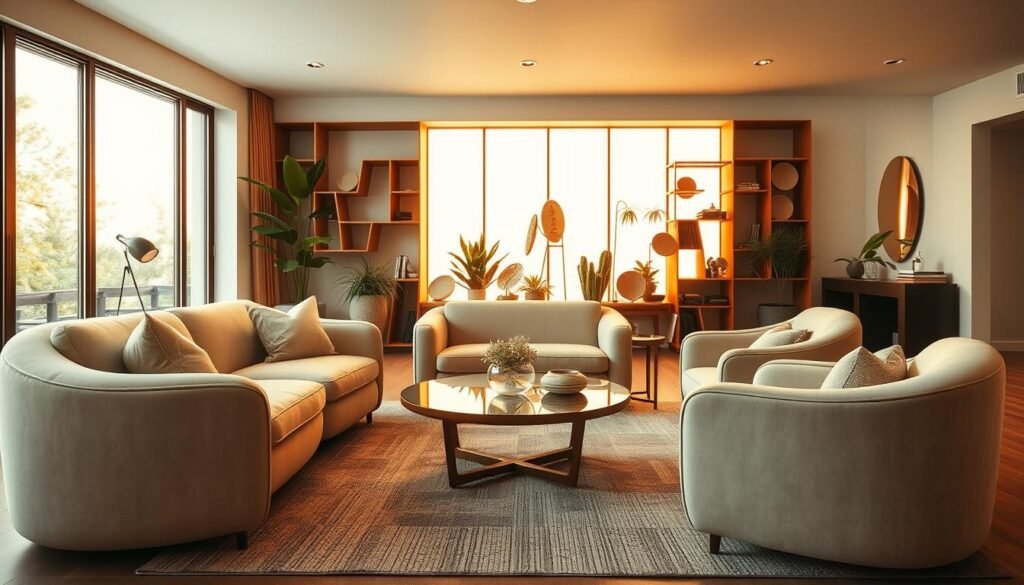
One approach that works: build a corner around a sofa with a curved back — a vintage fainting couch shape, say — then add nesting tables with rounded edges and a sculptural side table. The curves do the work; nothing else in the corner is fussy.
You don’t need to commit to a curved sofa. Start small with a round ottoman, a circular mirror, an arched floor lamp, or a rug with a curved edge. Mixing round shapes into a straight-lined room is what creates the contrast, so you only need one or two.
Awkward architecture can work in your favour too. A subtle diamond-patterned wallpaper drawing the eye up a barrel-vaulted ceiling turns a quirk into the best thing in the room. Working with what a space already has usually beats fighting it, and it’s cheaper.
Curves suit almost any aesthetic, which makes them a low-risk way to soften your living area. Your furniture shapes affect how the living room feels far more than most people expect.
Maximizing Space with Multifunctional Furniture
When square footage is limited, each piece needs to earn its place by doing more than one job. That’s what makes a small room feel generous rather than crowded.
Books stacked underneath a low coffee table are a good reminder that storage doesn’t only go up the walls. Look for the space under and behind things you already own.
Creative Storage Solutions
Ottomans with hollow bases swallow blankets and act as extra seating. Coffee tables with a lower shelf keep books and remotes off the floor without hiding them. A console behind the sofa gives you a desk, a drinks surface, and a place for lamps in one narrow footprint.
A storage bench under a window adds seating and hides board games and toys. These are the pieces that help you make room for what you actually use. The free version: baskets under the console and a lidded box that doubles as a side table.
Selecting Modular Pieces
Modular furniture is flexible over time. Sectionals that come apart let you reconfigure when you move or when the family changes. Nesting tables spread out for guests and tuck away the rest of the week.
Keep some pieces light enough to move with one hand, like a small stool or a pouffe. That gives you a living room that adapts through the day rather than one fixed arrangement. Your space should feel open, not packed.
| Furniture Type | Primary Function | Space-Saving Benefit |
|---|---|---|
| Storage Ottoman | Seating and hidden storage | Removes the need for a separate storage unit |
| Nesting Tables | Surface space and compact storage | Saves floor space when not in use |
| Modular Sectional | Flexible seating arrangement | Adapts to room layout changes |
Whatever you choose, keep the walking routes clear and don’t block a doorway or a window. For more low-cost ways to make a small area work harder, see these budget-friendly living room makeover tips.
Arranging Furniture for Easy Conversation
A room should make it easy for people to talk to each other. That’s largely a matter of where the seats point and how far apart they sit.
Optimizing Seating Layouts
Avoid lining every piece against the walls, which is how waiting rooms are arranged and it puts everyone too far apart. Pull the furniture in and create a group that faces itself.
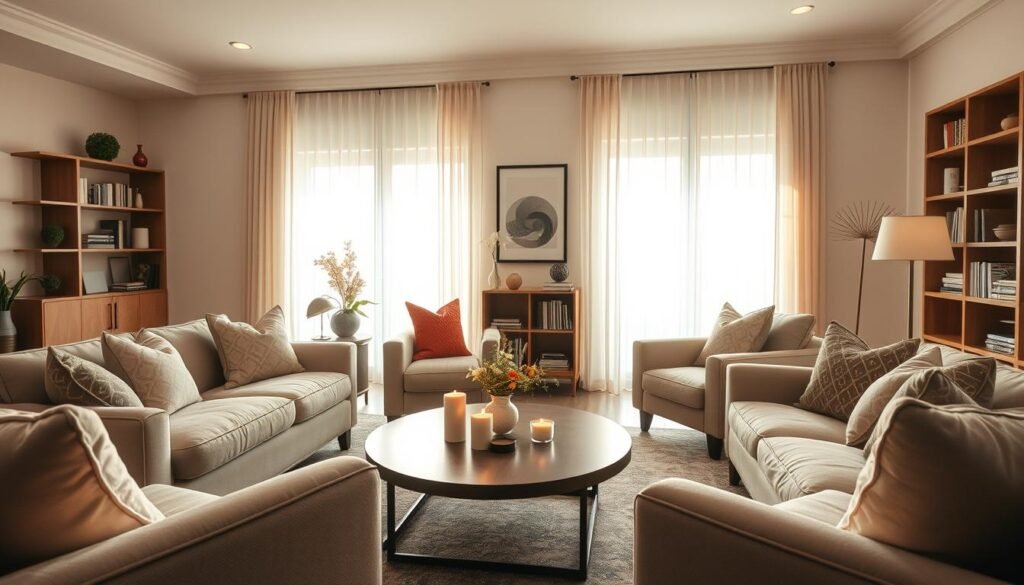
In Sara’s home, the sofa sits directly opposite two chairs, which makes conversation the default. In a smaller space, Mel angled a chair at each end of the sofa instead, giving the same effect in half the footprint.
Putting people before the television — turning the chairs toward the sofa so everyone can see each other while they talk — costs nothing and changes how the room gets used. If the TV has to stay central, angling one chair away from it is a good compromise.
| Room Size | Ideal Layout | Conversation Benefit |
|---|---|---|
| Spacious | Sofa facing chairs | Direct eye contact |
| Compact | Angled chair placement | Comfortable side conversations |
| Open Concept | Floating furniture groups | Multiple intimate zones |
Keep seats within 8 to 10 feet of each other. Past that, people raise their voices and stop talking. Think about how the living room meets the dining table zone as well, so the two areas feel related. For more on making a seating area feel warm as well as workable, see these cozy living room ideas.
Embracing Small Space and Open Floor Concepts
A small room can be an advantage once you know the tricks that make it read larger. Most of them cost nothing.
Visual Tricks to Create a Roomier Feel
Choose furniture with visible legs rather than pieces that sit on the floor. Seeing the floor continue underneath makes a room look bigger. The opposite can work too: one oversized sectional that fills most of the room but gives so much seating that the space reads as generous rather than tight.
Light, neutral decor bounces light around — patterned Roman shades in a pale colour keep windows bright while still giving you something to look at. Shelves hung above the windows for books use the dead band of wall near the ceiling that most people ignore.
Low-profile furniture keeps proportions right under a low ceiling. A short wooden stool in place of a bulky side table is an easy swap, and a thrifted one costs a few dollars. In an open plan, area rugs are the simplest way to mark out zones without building anything.
A daybed-style sofa with a low back won’t block sightlines across the room. And a mirror hung opposite a window bounces daylight deep into the space, which is the cheapest way to make a small place feel bigger, especially if you already own the mirror.
Mixing Trends: Minimalism with Bold Accents
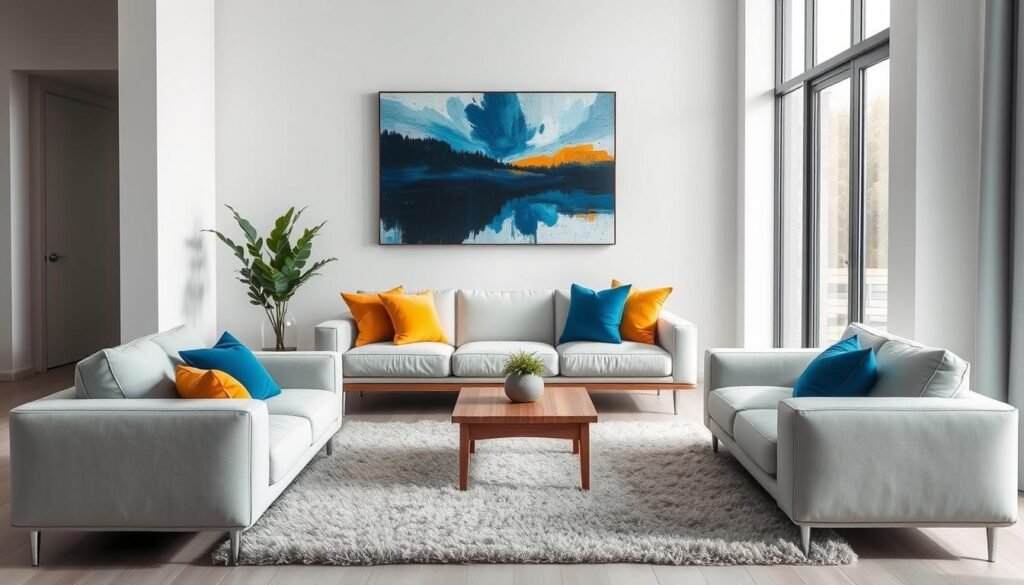
You can have calm and personality in the same room. A restrained base with a few bold moments gives you both.
Mixing decor trends works as long as there’s a common thread. Combine colors, patterns, and different styles, but let one element repeat throughout so the look holds together.
Layering Textures and Patterns
If bold color feels risky, use texture instead. Leather, cotton, wool, stone, and rough ceramic give a neutral room depth without introducing a single new color. It’s the low-risk route, and it’s very forgiving.
A Nordic-style room is proof that minimal doesn’t have to mean cold. A few carefully chosen items, warm wood, and soft textiles do it. If that direction appeals, our guide to minimalist living room design ideas goes further.
At the other end, the team at French & French Interiors layered several busy patterns in blues to create a jewel-box effect in a small living area. Pattern can make a compact room feel deliberate rather than cramped.
Cohesion is what makes layering work. Either let the patterns share a palette, or let the colors stay neutral while the textures vary. Pick one of the two.
The easiest starting point: clean-lined furniture and neutral walls, then one bold thing, whether that’s artwork, a patterned rug, or a single painted alcove. Keeping the base calm means you can swap the bold element later without redoing the room.
Choosing Quality Pieces for Long-Term Value
Some purchases pay off for decades, and knowing which ones deserve the money is half the skill.
Sustainable and Timeless Design Choices
When designer Ashley Gilbreath put together a sun-filled room, she chose pieces that age well rather than pieces that photograph well this year. Materials that patina, like leather, solid wood, and wool, tend to look better in five years, not worse.
Put your budget into the sofa, the rug, and any solid wood tables. Those carry daily use and they move with you through different rooms and life stages. Lamps, cushions, art, and side tables can be inexpensive or secondhand without anyone noticing.
Timeless doesn’t mean beige. It means a classic silhouette that won’t date, in a color you still like. That leaves you free to change the accessories as your taste shifts over time.
| Investment Type | Short-Term Cost | Long-Term Value | Environmental Impact |
|---|---|---|---|
| Quality Pieces | Higher initial cost | Lasts decades | Sustainable, less waste |
| Fast Furniture | Lower initial cost | Frequent replacement | High landfill contribution |
Run the cost-per-use sum. A $2,000 sofa used daily for fifteen years works out cheaper than a $500 one replaced three times, and it’s more comfortable throughout. That said, if $2,000 isn’t available, a solid-frame secondhand sofa reupholstered, or a well-made older piece from a resale site, gets you the same longevity for far less. Older frames are often better built than new budget ones.
Building a home takes time, and there’s no rule that says a room has to be finished at once. Living with a gap while you save for the right piece is a perfectly good strategy. For blending lasting pieces with personal character, see how to create your modern eclectic space.
Craftsmanship is what any experienced designer looks at first. Well-made things become the pieces you keep, and they’re what make rooms feel collected rather than bought all at once.
Conclusion
That’s the whole sequence: understand the room you have, measure it, choose a direction, then work through furniture, color, lighting, and the finishing layer.
None of it is rigid. The numbers here are guidelines that keep you out of trouble, not rules, and the best rooms usually break one or two of them on purpose.
You don’t have to do it all at once, and you shouldn’t. Pick the one thing that bothers you most, whether that’s the layout, the lighting, or a rug that’s too small, and fix that first. Rooms come together in stages, and the ones that take a while are usually the ones that feel most like their owners.
Come back to this guide whenever you’re stuck on the next step. Now go move some furniture and see how it feels.