By Quinn Parker
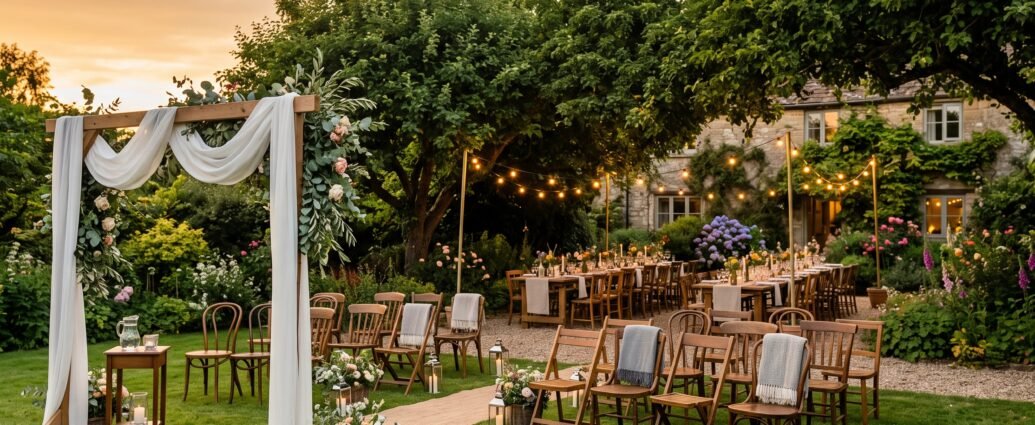
The best wedding I’ve ever been to was in my friend Dana’s parents’ backyard. Forty folding chairs, a borrowed arch we’d built the Thursday before, string lights I personally swore at while balancing on a ladder, and a potluck of the best food you’ve ever eaten. It rained for exactly six minutes during the toasts and nobody cared. I cried twice. It cost a fraction of the catered hall down the road, and it felt like them in a way no venue ever could.
So if you’re thinking about a backyard wedding — yours, your kid’s, a friend’s you’ve been roped into helping — let me save you some of the ladder-swearing. This is the full plan: how to lay out the space, what to actually rent versus make, the ceremony and the tables and the lighting, and a budget breakdown that doesn’t pretend you have ten thousand dollars to spend. There’s a free or cheap version of nearly everything here.
Why a backyard wedding (and what you’re really signing up for)
A backyard wedding gives you three things a venue rarely does: a much smaller bill, total control over the vibe, and a place that already means something to you. The trade-off is honest — you’re not just hosting, you’re producing. The venue’s price tag quietly includes tables, chairs, bathrooms, parking, power, and a person whose whole job is making sure the day runs. In a backyard, those become your list.
That’s not a reason to skip it. It’s a reason to plan it. Let’s make the list friendly.
Start with the space, not the Pinterest board
Before you fall for a single centerpiece, walk the yard and map where the day actually happens. A backyard wedding is really four little zones:
- The ceremony — a focal point (an arch or backdrop) and seating for the “I do.”
- Dinner — tables and chairs, ideally near the kitchen or catering spot.
- Drinks and mingling — a bar or drinks station and somewhere to stand.
- Dancing or a lounge — an open patch, or a cozy seating area if you’re not the dance-floor type.
The trick most people miss: you can reuse the same space. Set up chairs for the ceremony, then “flip” that area for dinner or dancing while guests are at cocktail hour. Plan the flip before the day, and assign two helpers to it.
How many guests actually fit?
A rough rule: allow about 8 square feet per seated guest for dinner, plus room for tables, a buffet, and walkways. A standard suburban backyard comfortably handles 50–75; push much past that and you’re renting a bigger lot or trimming the list. Be honest about the number early — it drives every other cost.
The boring list that saves the day
Walk the yard with these in mind:
- Power. Lights, music, and catering all need it. Map your outdoor outlets, plan heavy-duty outdoor extension cords on safe runs, and consider a quiet generator if you’re far from the house.
- Bathrooms. One indoor bathroom for 60 guests is a long line. For larger counts, a clean portable restroom (they make genuinely nice ones now) is worth every penny.
- Parking. Where do 30 cars go? A neighbor’s driveway, a nearby lot, or a carpool plan.
- Weather backup. Have a tent reserved or a rain plan you actually like — not just a frantic Plan B. A tent doubles as shade and a lighting anchor.
- Permits and neighbors. Many areas have noise ordinances and limits on large gatherings or tents. A quick call to the town and a heads-up (or invite) to the neighbors heads off the only thing that can really sour the night.
The ceremony: your one big focal point
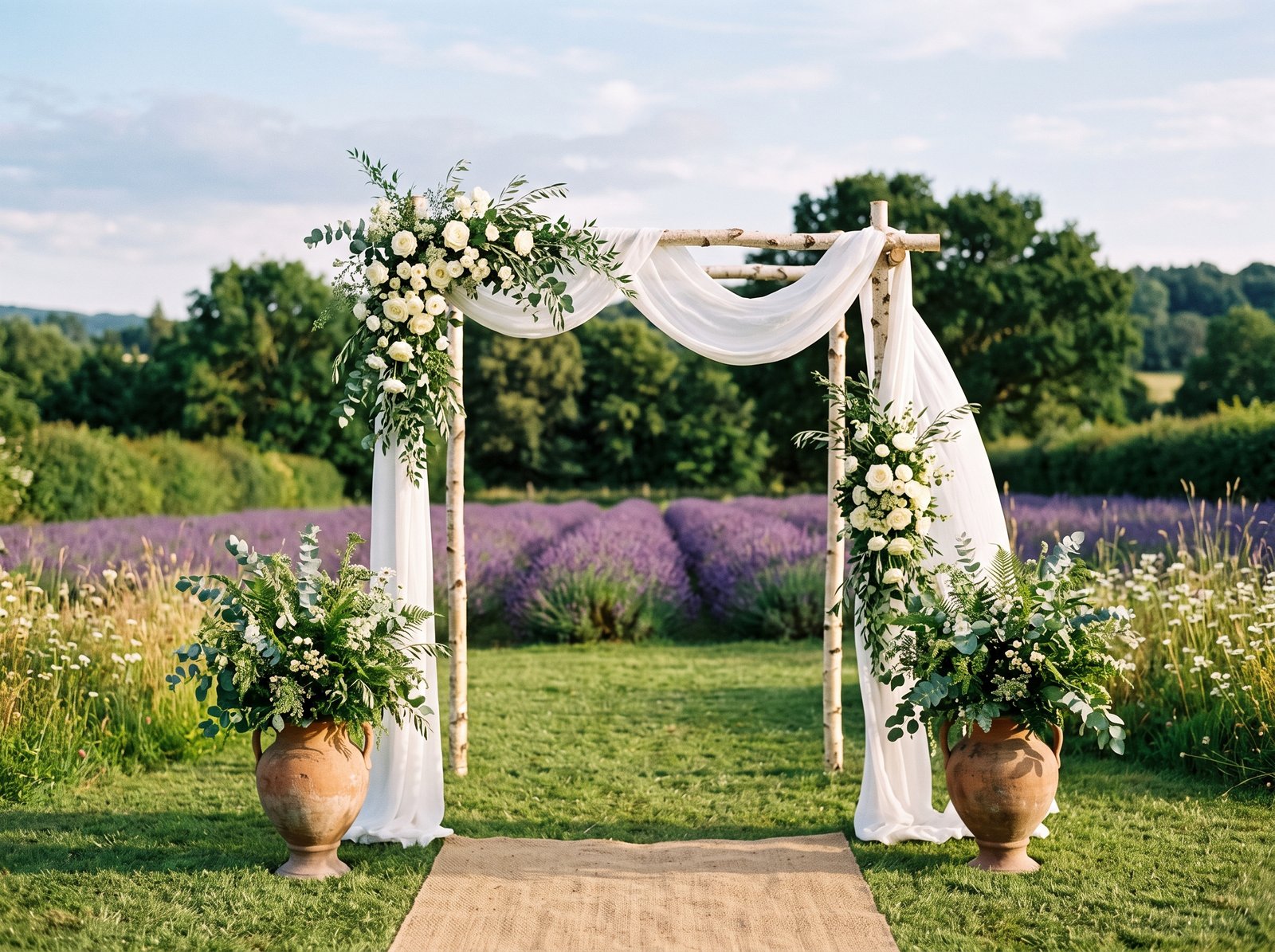
The ceremony needs exactly one thing to feel intentional: something to stand in front of. That’s where your money and effort should go, because it’s the backdrop for every photo of the actual vows.
An arch is the classic move — birch poles or a simple wood frame, draped with fabric and greenery. We broke down five versions for every skill level and budget in our DIY wedding arch builds guide. If building isn’t your thing, a backdrop — a fabric panel, a flower wall, a vintage door, a hanging installation — does the same job; our DIY wedding backdrop ideas have build guides and costs.
For seating, mismatched chairs are a feature, not a flaw — borrow, rent, or mix what you have. Line the aisle with petals, lanterns, or potted plants you’ll replant after (a free favor to yourselves).
The tables: where backyard weddings get beautiful
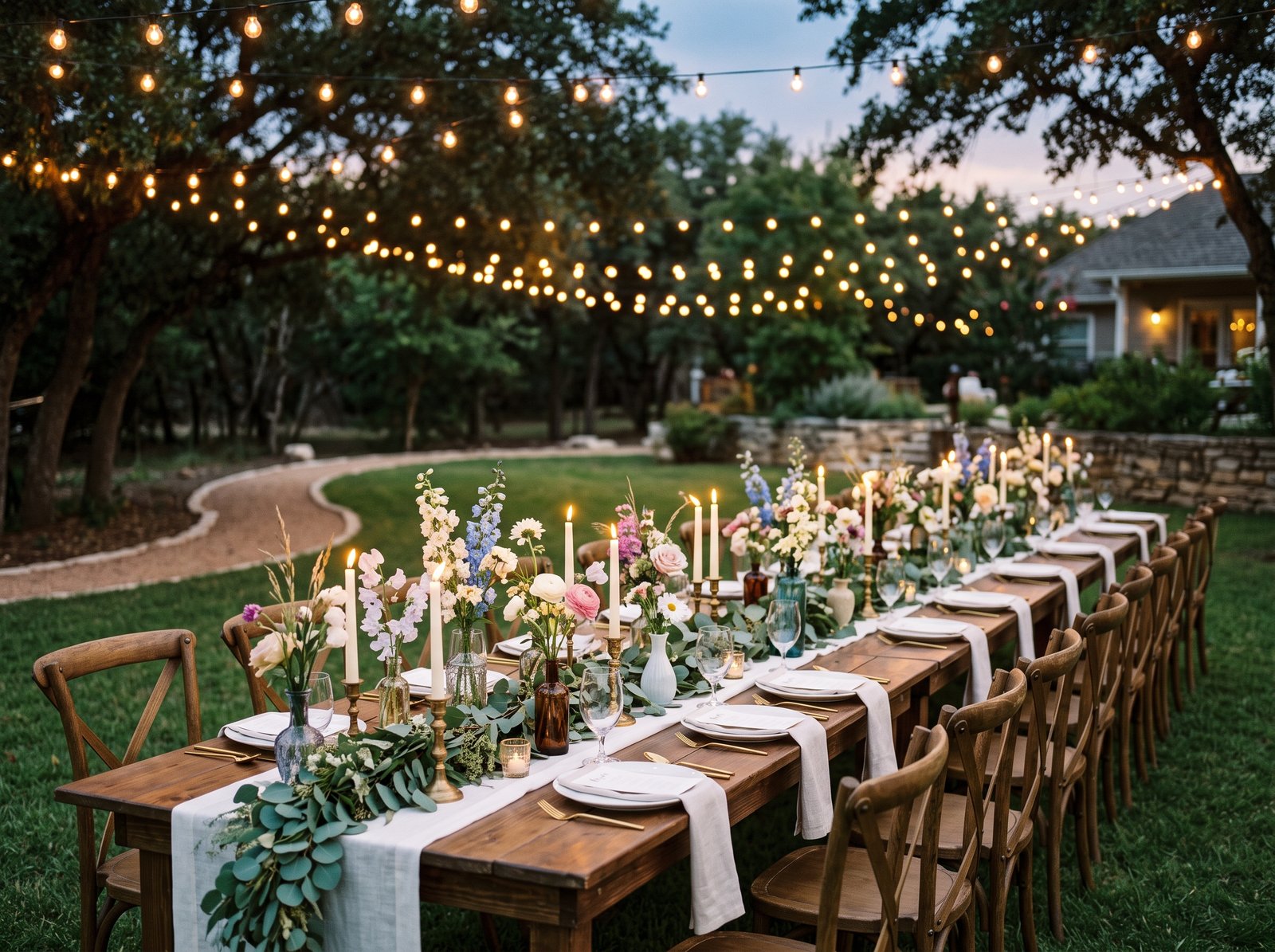
Long farmhouse tables or a cluster of rounds both work; long tables photograph better under string lights and cost less to decorate because one runner does a lot. Keep the formula simple: a greenery garland or a runner down the center, a few clusters of flowers in thrifted vases at varying heights, and candlelight. Candles do more for a backyard table at dusk than almost anything else.
You don’t need a florist’s budget. We kept whole tables under fifty dollars in our DIY wedding tablescapes guide, and our budget wedding centerpieces that look high-end are the exact pieces I’d make again. For place settings, lean on what you own and what you can borrow — and let the wedding favors double as table decor so one thing pulls two shifts.
Lighting is the whole mood
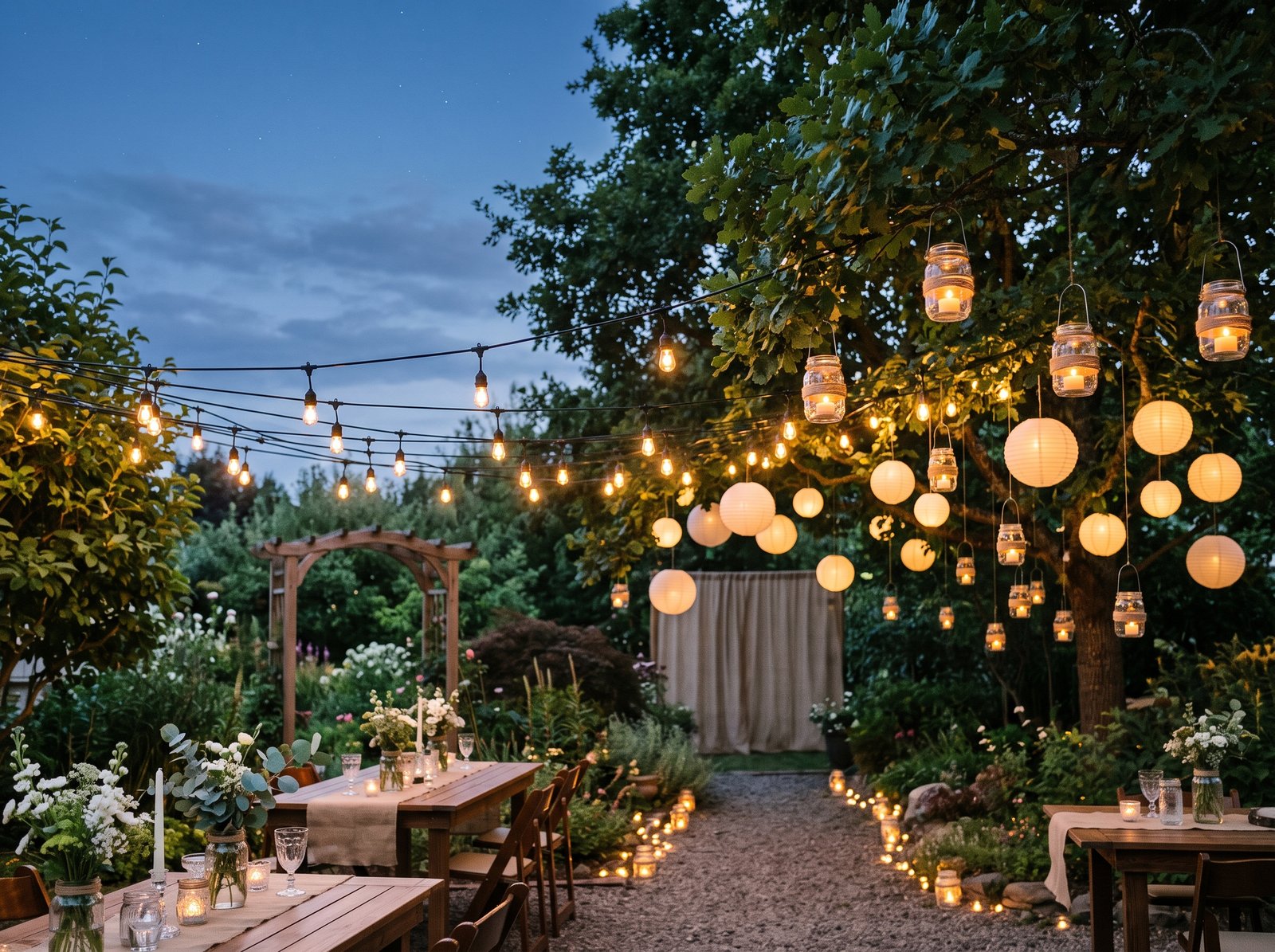
If you do one thing well, make it the lights. Nothing turns a regular yard into a wedding faster than warm light overhead at dusk. Layer it:
- Café string lights crisscrossed over the dinner and dance areas — the single highest-impact rental or buy. Warm white, not cool. Plan your anchor points (trees, poles, the house) ahead of time.
- Candles and lanterns on tables and along the aisle for glow at eye level. Our DIY outdoor lanterns are a sweet, cheap project.
- A few uplights or solar stakes to wash a fence, a tree, or the arch after dark.
Test every light the night before. Daylight lies about how dark a yard gets.
Drinks, food, and a place to linger
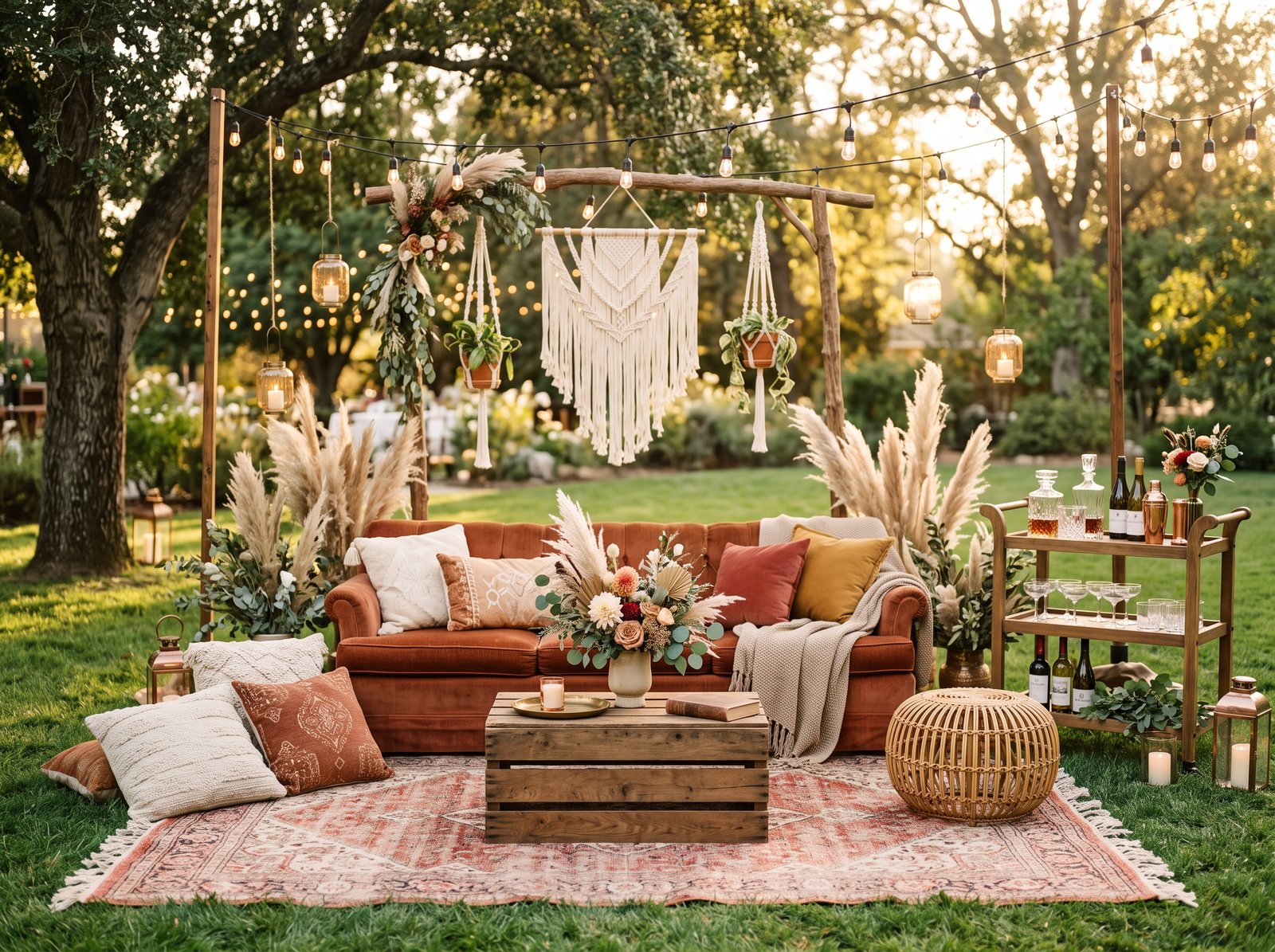
You don’t need a full bar. A self-serve drinks station — a couple of signature cocktails in drink dispensers, beer and wine in galvanized tubs of ice, a water station — keeps costs down and lines short. A rolling backyard bar cart makes a charming, moveable focal point.
For food, backyard weddings are forgiving: a taco or pizza cart, a barbecue, family-style platters, or a genuinely good potluck all fit the setting better than stiff plated service. Give people somewhere to sit and sink in — a lounge area with a borrowed sofa, floor cushions, and a rug turns a corner of the lawn into the spot everyone ends up. Our affordable boho patio lounge translates straight to a wedding.
Pick a style and let it carry the decor
You don’t need much decor when the style is consistent. Three that suit a backyard:
- Boho — pampas and dried florals, rugs and cushions, macrame, warm earth tones. Forgiving and secondhand-friendly.
- Rustic — wood, wildflowers, mason jars, kraft paper, gingham. Made for a lawn.
- Classic garden — white blooms, greenery, candlelight, simple linens. Timeless and photographs beautifully.
Whatever you pick, repeat it in three or four places and stop. Restraint reads as intentional.
Don’t forget the getting-ready space
Everyone plans the party and forgets where the couple and party actually get ready. A spare room works, but if you’ve got a backyard studio or shed, it makes a dreamy, private getting-ready suite with good light and zero hotel cost. (One of my favorite uses for the spaces in our she shed ideas guide.) Stock it with a mirror, a clothing rack, snacks, and a fan.
And if there’s a shower before the day, our DIY bridal shower decoration ideas reuse a lot of the same pieces — buy and build once, decorate twice.
A realistic budget breakdown
Where the money tends to go, with a save-here option for each:
- Rentals (tables, chairs, tent): The biggest line. Save by borrowing chairs, using long tables you build or borrow, and renting only the tent.
- Restrooms & power: Don’t skip these for big counts; they’re what separates a lovely night from a stressful one.
- Lighting: Splurge a little here — it earns it. Buy string lights (you’ll reuse them) rather than rent.
- Flowers & decor: Save hard. DIY arrangements, greenery garlands, thrifted vessels, and candles. This is where our cluster of DIY guides above pays off.
- Food & drink: A cart, barbecue, or family-style spread beats plated catering on cost and fits the setting.
The backyard wedding I started with came in under a third of a traditional venue, and the savings went straight into a honeymoon. That’s the whole pitch.
What I’d tell you over coffee
Three honest things. Rent the bathrooms — really. Buy the lights, don’t rent them, because you’ll want them on your own patio for years. And build or assign a “flip team” of two reliable people so the couple never touches a folding chair on their own wedding day. Do those, and a backyard wedding is the warmest day you can throw.
Go look at that backyard a little differently. I think it’s got a wedding in it. — Quinn
Frequently asked questions
How much does a backyard wedding cost?
Widely variable, but commonly $5,000 to $15,000 versus $25,000+ for a traditional venue — and far less if you own the yard, DIY the decor, and keep the guest list tight. The big costs are rentals (tents, tables, chairs), restrooms, power, food, and photography.
How many guests can fit in a backyard wedding?
Allow roughly 8 square feet per seated guest plus room for tables, food, and walkways. A typical suburban backyard handles 50 to 75 comfortably; larger counts need a bigger lot or a tent.
Do I need a permit for a backyard wedding?
Often yes for tents, amplified music, or large gatherings, and many areas have noise ordinances. Rules vary by location — call your town or county before you book anything.
What do you actually need for a backyard wedding?
Seating, tables, a ceremony focal point, lighting, a drinks station, restrooms, power, a weather backup, and a clear layout. Decor and flowers can be DIY.
How do I plan a backyard wedding on a budget?
Keep the guest list small, borrow or rent only what you must, DIY the arch, backdrop, and centerpieces, buy reusable string lights, and serve family-style or cart food instead of plated catering.