
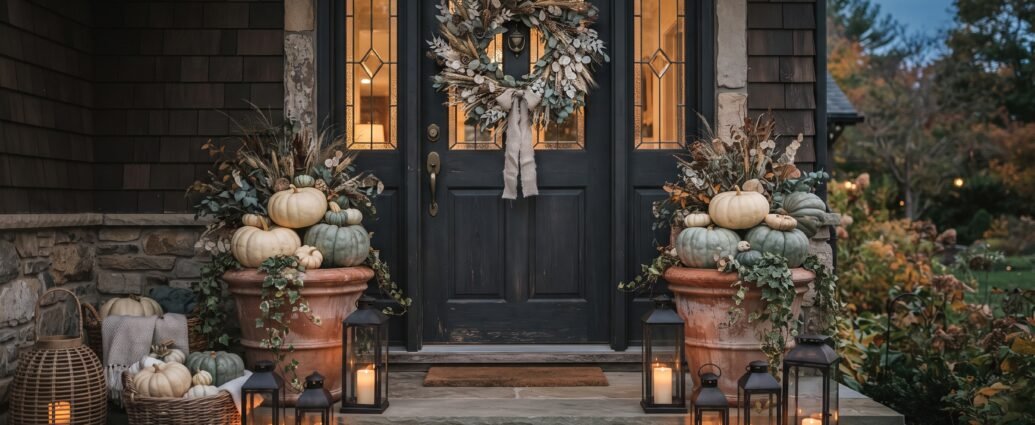
The front porch is the only room in your house that strangers grade. It is also the only one exposed to rain, UV, wind and a thirty-degree temperature swing between two in the afternoon and four in the morning. That combination is why so much Halloween porch decor looks wonderful the day it goes up and looks like litter three weeks later.
That durability problem is the part almost nobody writes about. There are thousands of pretty Halloween porch photos online and virtually none tell you which of those materials will still be standing on October 31. The gap between a display that lasts and one that collapses comes down to material choice, weight and drainage. Not styling talent, and not budget. A porch that takes hard afternoon storms and a porch that gets steady rain from late September onward fail in different ways, and both are fixable with the right materials rather than more of them.
So this guide is built around durability first: the sizes that actually fit a standard front door, lighting specifics, honest costs, and a six-week plan that gets you to Halloween night without a rebuild.
Start with the calendar, not the shopping list
Most people want the porch up by the last weekend in September and still looking intentional on Halloween night. That is five to six weeks outdoors, and almost every mistake in Halloween porch decor comes from buying for the photo on day one rather than for day forty.
Six weeks is long enough that a carved pumpkin will rot twice over, long enough for a dyed garland to bleed down a painted door, and long enough for polyester foliage in hard sun to shift from deep burgundy to chalky pink. Plan in two layers instead: a durable base that goes up in late September and stays, plus a small perishable layer you refresh once in mid-October. That habit is the most useful thing on this page.
What survives outside, and what does not
The honest breakdown, assuming a partially covered porch in a temperate autumn. An exposed stoop is harsher on everything here.
| Material | Realistic outdoor life | How it fails |
|---|---|---|
| Uncarved pumpkins & heirloom squash | 6–12 weeks cool, 3–5 in warm humidity | Soft spots underneath where they sit in moisture |
| Carved pumpkins | 3–7 days warm, 1–2 weeks cold | Cut edges dehydrate then mould; collapses inward |
| Painted pumpkins | 4–8 weeks | Far longer than carved — the skin stays sealed |
| Corn stalks | Full season | Sheds constantly, greys out, blows over untied |
| Dried wheat, grasses, pods | Full season covered; 2–3 weeks exposed | Goes limp and mildews after sustained rain |
| Preserved (dyed) eucalyptus | Under cover only | Dye bleeds in rain and stains doors and stone |
| Faux polyester foliage | 1–2 seasons shaded, 4–6 weeks in hard sun | UV fade — reds and purples go first |
| Cheesecloth and cotton gauze | Covered porch only | Sags heavy when wet, then mildews and stains |
| Mums in nursery pots | 3–6 weeks | Small pots need water every 1–2 days |
| Ornamental kale and cabbage | Through frost | Almost nothing — colour deepens as it gets cold |
| Stretch spider webbing | Days, honestly | Greys and mats, catches leaves, snags birds and insects |
| Foam props and signs | Season, if anchored | Becomes a sail; needs rebar or landscape staples |
The pattern is clear enough. Natural, undyed, uncut and heavy survives. Dyed, cut, hollow and lightweight does not.
Getting the proportions right
Scale is where most porches quietly go wrong, and it is entirely fixable with a tape measure.
Wreath to door. A standard American exterior door is 36 inches wide by 80 tall, and your wreath should read about half the door width — a 22 to 24 inch outer diameter. An 18-inch wreath on a 36-inch door is the most common sizing error there is; it looks like a doorknocker. On double doors drop to 20 to 22 inches each. Hang it so the centre sits roughly 55 to 60 inches off the ground, just above eye level rather than dead centre. Over-door hooks fit doors up to about 1.75 inches thick, so check yours — a hook that does not seat scratches the paint every time the door swings.
Garland to door frame. To surround a 36 by 80 inch door you need roughly 16 feet — 80 up, 36 across, 80 down, plus slack. Buy 18 feet, or two 9-foot lengths wired together at the corner. For a railing, measure the run and multiply by 1.5 so the garland can swag. A garland pulled taut always looks anxious.
Planters to entry. A pair flanking a standard door wants to be 16 to 20 inches in diameter and 20 to 28 inches tall, with planting about one and a half times the planter height. The whole composition should land around 36 to 44 inches — roughly half the door height. Shorter reads as an afterthought at the bottom of a tall opening.
Rugs and mats. A 24 by 36 inch doormat looks marooned on a wide porch. Layer it over a 3 by 5 foot jute or flatweave outdoor rug and the entry immediately reads deliberate. Keep jute under cover; it holds water for days.
16 Halloween porch decor ideas that hold up
1. A dried wreath sized properly to the door
A 22 to 24 inch base of wheat, bleached ruscus, dried grasses and seed pods, finished with matte black or deep plum ribbon. Under cover it survives the season and stores for next year. Expect $45 to $90 for a good preserved wreath, or $25 to $40 in materials to build one — our step-by-step DIY fall wreath tutorial uses the same wire frame and construction method.
The failure mode: dyed eucalyptus on an exposed door. One heavy rain and you get grey-green streaks down the paint that are genuinely hard to remove.
2. A graduated cluster of heirloom pumpkins
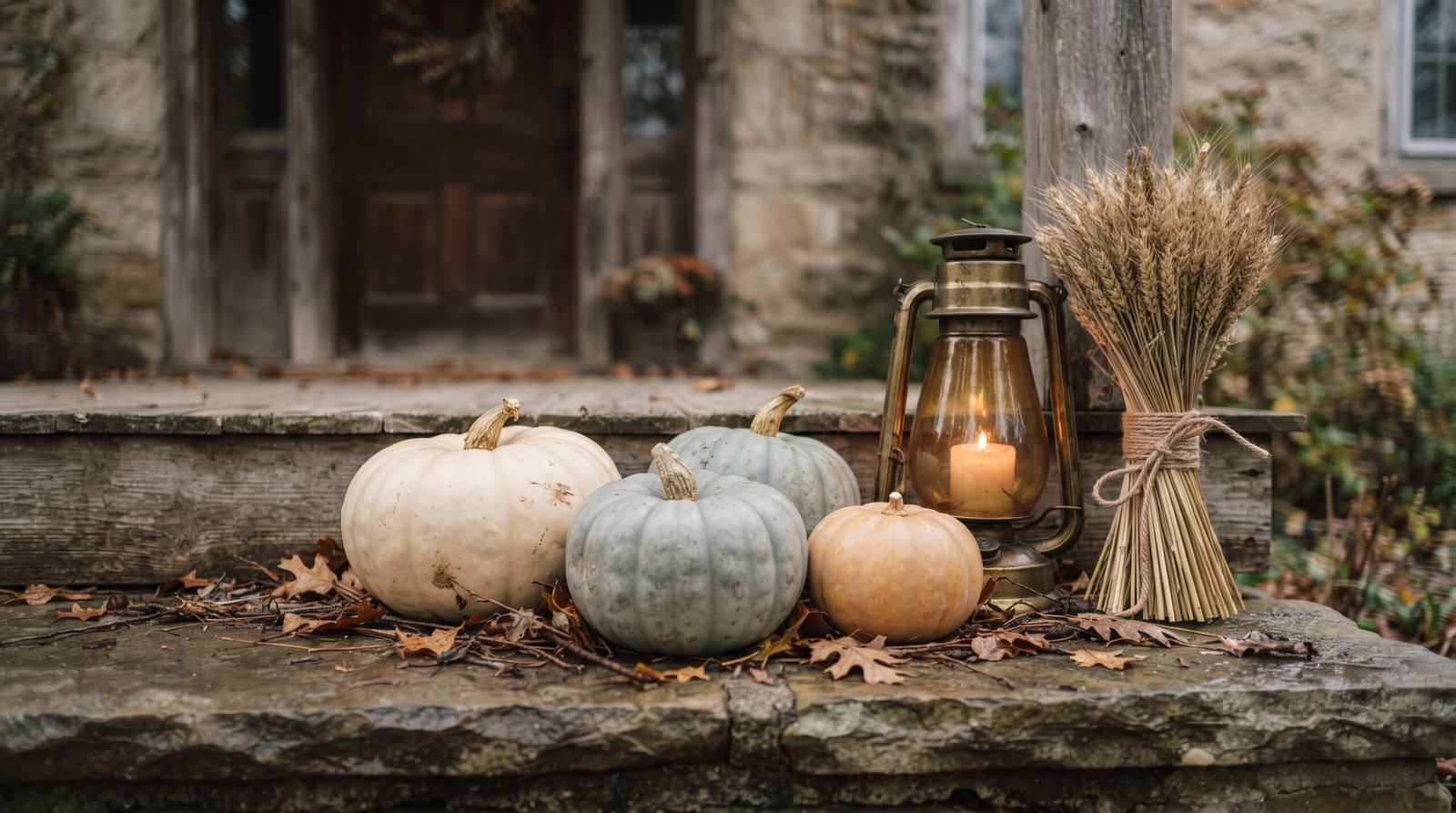
Three or five pumpkins in descending sizes on one side of the steps, not a symmetrical row. Skip orange field pumpkins for pale cream Lumina, sage-green Jarrahdale, blue-grey Blue Doll, buff Long Island Cheese and peachy Porcelain Doll. Those varieties are the whole reason an elegant Halloween porch reads elegant rather than seasonal-aisle.
Set every one of them on something — a slate offcut, a terracotta saucer, a cedar shim. A pumpkin sitting on damp concrete softens underneath within two to three weeks and leaves a stain. Lifted a quarter inch so air moves beneath it, the same pumpkin often makes it to November.
3. Weighted urn planters flanking the door
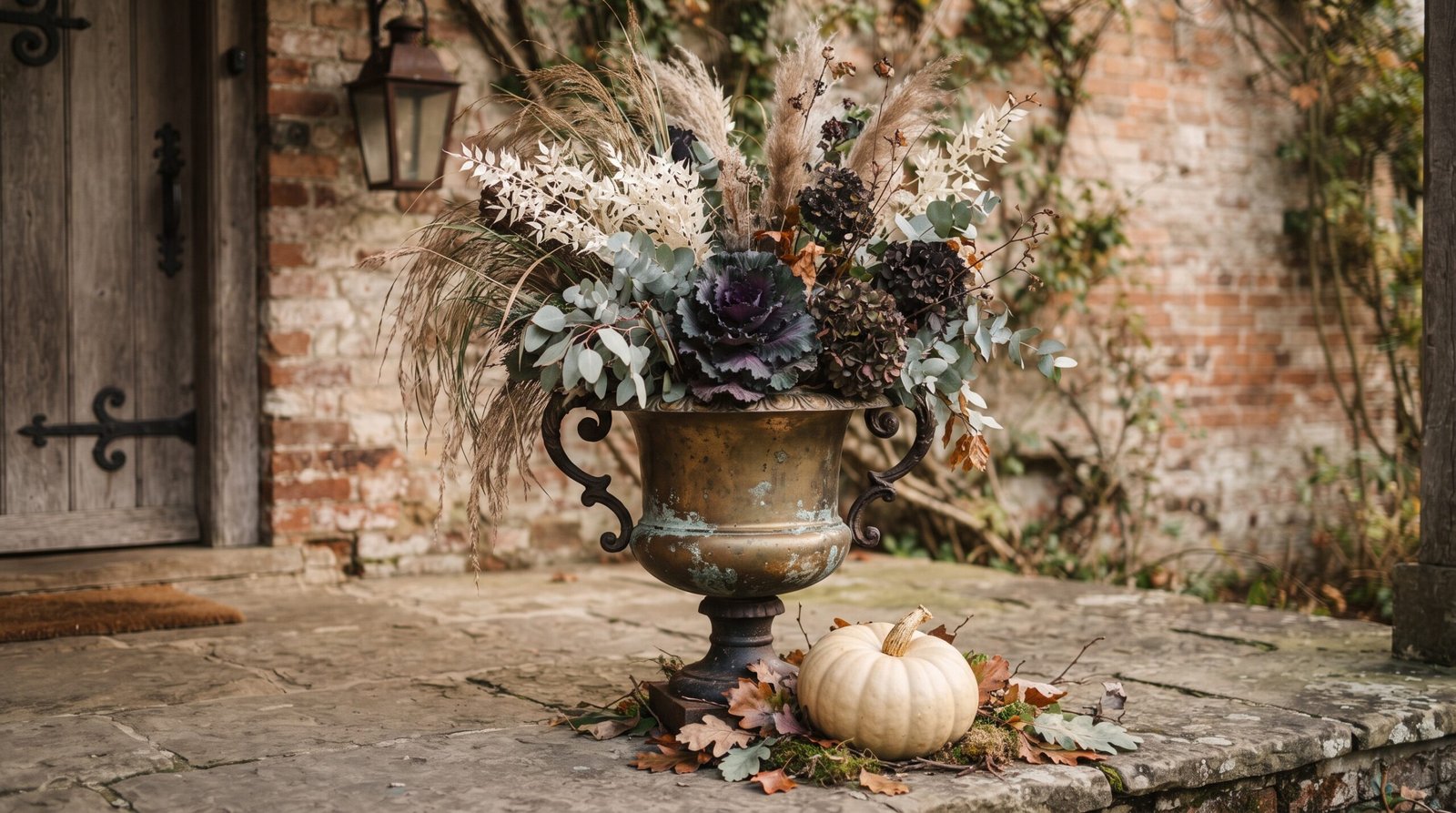
Two matte black or aged brass urns filled with dried grasses, bleached ruscus, dark ornamental kale and a pale pumpkin at the base. Fill the bottom third with pea gravel or play sand before planting — a 50-pound bag runs $6 to $9 and is the cheapest insurance against a gust taking out your entire entry.
4. A lantern run along the steps
Five matte black wrought iron lanterns in staggered heights down one side of the steps. Iron and glass do not care about weather, they store flat, and they carry from Halloween into December. Lanterns run $18 to $45 each.
5. Corn stalks bound to the columns
Two bundles at $10 to $20 each, lashed to the columns with jute twine at two heights — one low, one two-thirds up. A single tie always loosens and lets the bundle fan sideways.
6. Black and bone painted pumpkins
Painted pumpkins outlast carved ones by weeks because the skin stays sealed. Matte black, bone white and dusty sage on cream pumpkins is about as sophisticated as this category gets. Use exterior-grade acrylic or spray paint with a clear matte sealer if the porch is exposed. We cover which paints actually adhere to pumpkin skin in our guide to painted pumpkin ideas, and if you would rather not paint at all, the no-carve pumpkin decorating ideas roundup covers wraps and finishes that need no drying time.
7. Draped cheesecloth forms in a covered corner
Stiffened cheesecloth forms read beautifully at dusk, but they only belong somewhere genuinely sheltered — see our step-by-step guide to cheesecloth ghosts for the stiffening methods and outdoor sealing, and our wider roundup of DIY Halloween decorations for projects that handle weather better.
Cotton cheesecloth stiffened over a wire or balloon form and hung from a covered ceiling so it drifts in the breeze. Atmospheric rather than frightening, and cheap. Keep it strictly under cover: wet cheesecloth sags into a heavy grey rag within a day and mildews within three.
8. Amber glass on a porch console
A cluster of amber and smoke-glass apothecary bottles, thrifted at $2 to $10 each, grouped in odd numbers with one flameless candle among them. Amber glass catches low autumn light better than anything else at that price.
9. A layered doormat
The fastest upgrade here. A black-and-cream mat over a 3 by 5 jute rug, roughly $50 to $100 for the pair, makes everything else on the porch look more considered by comparison.
10. Dark mums and ornamental kale
Deep plum, burgundy and bronze mums instead of the default yellow and orange, paired with purple ornamental kale — the most weather-durable plant on this list. Kale takes frost without flinching and its colour intensifies as nights get cold.
The failure mode: mums left in the nursery pot. Those pots are small and mums are thirsty. Slip them into a larger cachepot with soil around the rootball and the watering interval stretches considerably.
11. A bare-branch arrangement
Curly willow, birch or bare oak cut at 36 to 48 inches in a heavy weighted urn. The cheapest tall element available — free if you have a yard — and it gives height where a pumpkin cluster gives none.
12. Silhouettes in the windows
Black paper or vinyl shapes in the sidelights, backlit from inside with a warm lamp. Bats, bare branches, an arched frame. Costs almost nothing, reads beautifully from the street after dark, and it is entirely weatherproof because it lives indoors.
13. Woven baskets and wood crates
A weathered crate on its side as a riser under pumpkins, or a large basket holding branches. Risers matter outdoors even more than indoors, because from the sidewalk everything at ground level compresses into one flat band.
14. Velvet ribbon on the door
A wide deep-plum or matte-black velvet tail on the wreath, under $10 a spool. Real velvet flattens and water-marks permanently in rain — on an exposed door use polyester faux velvet or outdoor-grade grosgrain.
15. A styled porch bench
An outdoor cushion and a wool-blend throw in bone or charcoal makes the porch look inhabited rather than staged. Use a solution-dyed acrylic fabric that sheds water.
16. Restrained spider webbing, or none
If you use stretch webbing, keep it to one small covered area, pull it genuinely thin so it reads as gossamer rather than cotton wool, and take it down promptly. Left up it mats grey, collects wet leaves, and snags birds and insects. On a porch aiming for elegance, skipping it entirely is the better call.
Lighting: the part that decides everything after 6pm
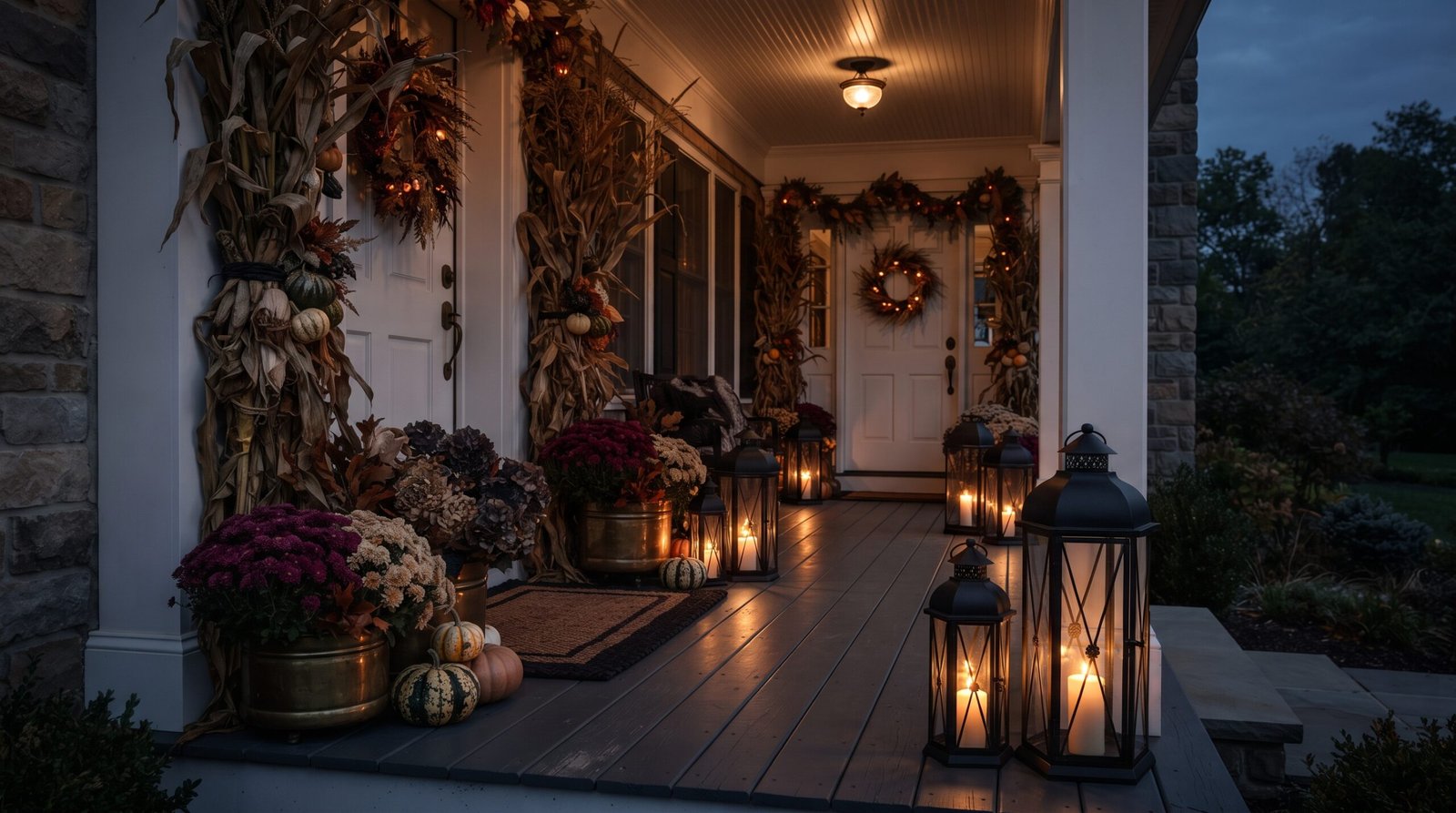
Colour temperature is the whole game. Warm amber light between 2200K and 2700K makes bone, brass, dried botanicals and matte black look rich. A standard cool 4000K or 5000K porch bulb makes exactly the same display look like a hardware aisle. Swapping one bulb for a 2200K amber LED costs about $6 and is the highest-return five minutes on this page.
Brightness. A typical porch fixture takes an 800-lumen bulb, the 60-watt-incandescent equivalent. For atmosphere rather than security, drop to 450 to 600 lumens at the door and let lanterns carry the rest. Bright overhead light flattens texture; several small warm sources at different heights create depth.
Buy for wet location, not damp. “Damp location” means covered porches only. “Wet location,” or an IP65 rating, means direct rain is fine. If any part of the run is exposed, buy wet-rated. A 48-foot commercial-grade wet-rated string runs $25 to $45 and lasts years.
Flameless over flame. LED pillar candles with built-in timers — typically a 6-hour-on, 18-hour-off cycle repeating daily — are the practical choice inside lanterns. They run $18 to $30 for three, will not blow out, and do not put an open flame near dried corn stalks and wheat. That fire risk is not theoretical; dried botanicals are extremely flammable.
Automate it. An outdoor-rated smart plug or a photocell dusk-to-dawn timer is $12 to $25, and the porch that lights itself at sunset is the porch that gets seen. Any outdoor outlet should be GFCI protected, and any cord an outdoor-rated SJTW-jacketed one.
A note on solar. Solar lanterns work well in September and progressively worse through October as daylight shortens and the sun angle drops. If your porch is north-facing or shaded, run a cord instead. And skip coloured floods aimed at the street — if you want colour, wash a wall with it so you see the light, not the bulb.
Wind, rain and how to weight things down
- Sand, not water. Fill hollow bases and planter bottoms with play sand or pea gravel. Water is free but it freezes, expands and splits the container at the first hard frost.
- Anchor anything flat. Foam props and signs act as sails. Two 24-inch lengths of rebar or a pair of landscape staples per prop — $2 to $4 of hardware — keeps them put.
- Tie at two points, always. A single tie becomes a pivot.
- Give water somewhere to go. Planters need open drainage and should sit on pot feet or shims. Standing water rots decking and kills plants faster than drought.
- Fishing line for anything hanging. Clear 20 to 30 pound monofilament is invisible from the street and does not stretch when wet the way twine does.
- Do not screw into your door. Use outdoor adhesive hooks rated for the weight, and check that rating — a soaked wreath can weigh two to three times its dry weight.
What a Halloween porch actually costs
| Item | Typical cost | Notes |
|---|---|---|
| 22–24 in. preserved wreath | $45–$90 | DIY for $25–$40 in materials |
| Large heirloom pumpkin | $12–$25 | Jarrahdale and Lumina cost more than field pumpkins |
| Medium heirloom pumpkin | $8–$18 | Buy in odd numbers |
| Mini pumpkins / gourds | $2–$4 each | Cheapest way to add count |
| Corn stalk bundle | $10–$20 | Sheds — expect to sweep |
| Mums, 12 in. pot | $15–$25 | 8 in. pots $6–$12 but dry out fast |
| Ornamental kale, 6 in. | $5–$9 | Best durability per dollar on the porch |
| Urn planter | $40–$120 each | Resin looks fine and weighs nothing — add sand |
| Iron lantern | $18–$45 each | Reusable indefinitely; works in December too |
| Wet-rated string lights, 48 ft | $25–$45 | Do not buy damp-rated for exposed runs |
| LED pillar candles with timer (3) | $18–$30 | 6-hour daily cycle |
| 2200K amber LED bulb | $5–$10 | Biggest visual change per dollar here |
| Outdoor smart plug / photocell timer | $12–$25 | Set and forget |
| Play sand, 50 lb | $6–$9 | Ballast for planters and props |
A complete, good-looking porch lands between roughly $150 and $400 the first year and far less after that, because the lanterns, planters, wreath frame, lights and timer all come back out of the box next October. On a $60 budget, do the amber bulb, one good wreath, a pumpkin cluster on risers and two lanterns. Our roundup of Dollar Tree fall decor that does not look cheap covers which budget pieces survive a look from six feet away.
The mistakes I see most often
Everything at ground level. A porch is viewed from below, from the sidewalk. If every object is under 18 inches tall the display compresses into a single band and disappears. You need at least one element above 36 inches — the wreath, branches, corn stalks, a tall lantern.
Carving too early. A pumpkin carved on October 1 is a puddle by the 10th. Carve on the 28th or 29th, or paint instead and get six weeks from the same pumpkin.
Perfect symmetry everywhere. A matched pair either side of the door is a fine framework, but if every element is mirrored the porch reads like a showroom.
Buying one of everything. Three large pumpkins look better than fifteen small unrelated objects. Volume in a few materials beats variety in many.
Ignoring the backdrop. Cream pumpkins vanish against a white porch floor; matte black props disappear against a dark grey door. Choose for contrast against what you have.
No plan for November 1. An all-orange, all-cobweb porch has to come down at once. Build the base in neutral autumn materials — wheat, kale, heirloom pumpkins, lanterns — and add a thin Halloween layer on top. Pull that layer on the first and the porch carries straight through Thanksgiving. Our fall porch decor ideas guide is the base-layer companion to this piece.
A six-week schedule that works
Late September — the durable base. Planters weighted with sand and planted with kale, grasses and bleached ruscus. Corn stalks lashed at two points. Wreath on the door. Layered mat and rug. Lanterns positioned, timers set, amber bulb swapped in. None of this is Halloween-specific and all of it holds eight weeks or more.
Early October — the pumpkins. Heirloom pumpkins in graduated clusters, every one lifted off the deck. Painted pumpkins if you are painting.
Mid October — the Halloween layer. Window silhouettes, cheesecloth under cover, velvet ribbon on the wreath, string lights. This is also the moment to walk to the sidewalk at 8pm and look honestly — almost everyone finds they need more light and less clutter.
Late October — refresh and carve. Replace any pumpkin gone soft, water the mums, carve on the 28th or 29th if carving at all, and check every tie after the first storm.
November 1 — pull one layer only. Silhouettes, cheesecloth and anything overtly Halloween comes down in ten minutes. The rest becomes your Thanksgiving porch.
Where to take it next
The porch sets the expectation; the first room inside has to meet it. The natural companion to this piece is our guide to Halloween mantel decor, which applies the same restrained palette to a fireplace. If you need a garland for the door frame or railing, our DIY fall garland tutorial gives real lengths and costs, and the same build works outdoors under cover.
Start with the calendar and the amber bulb. Then weight everything down. The rest is just choosing better pumpkins. — Quinn


1 Comment