
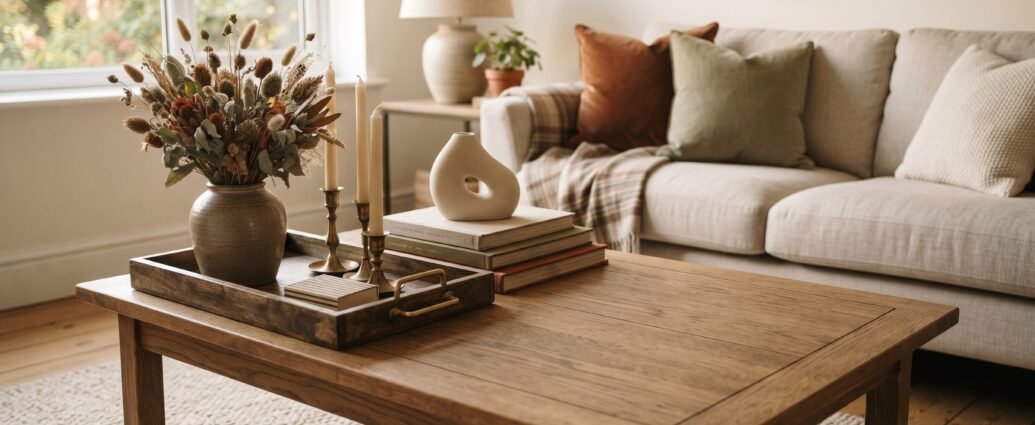
The coffee table is the hardest surface in the house to style, and it’s not close. It sits in the middle of the room so you see it from every angle. It’s low, so the arrangement reads from above rather than head-on like a console. And unlike a mantel, it has an actual job — people put drinks, remotes, laptops, and feet on it. Any arrangement that ignores that job gets dismantled within a week.
Which is why most coffee tables end up in one of two states: bare except for a remote and a coaster, or buried under a slow accumulation of things that got set down and never left. Neither is a styling failure exactly. It’s just that nobody gives you the numbers.
So here are the numbers. Tray sizing relative to your table, the odd-numbers rule and why it works, the height triangle, how much surface to leave genuinely clear, and how to adapt all of it for fall without ending up with a centerpiece you have to move every time someone sits down.
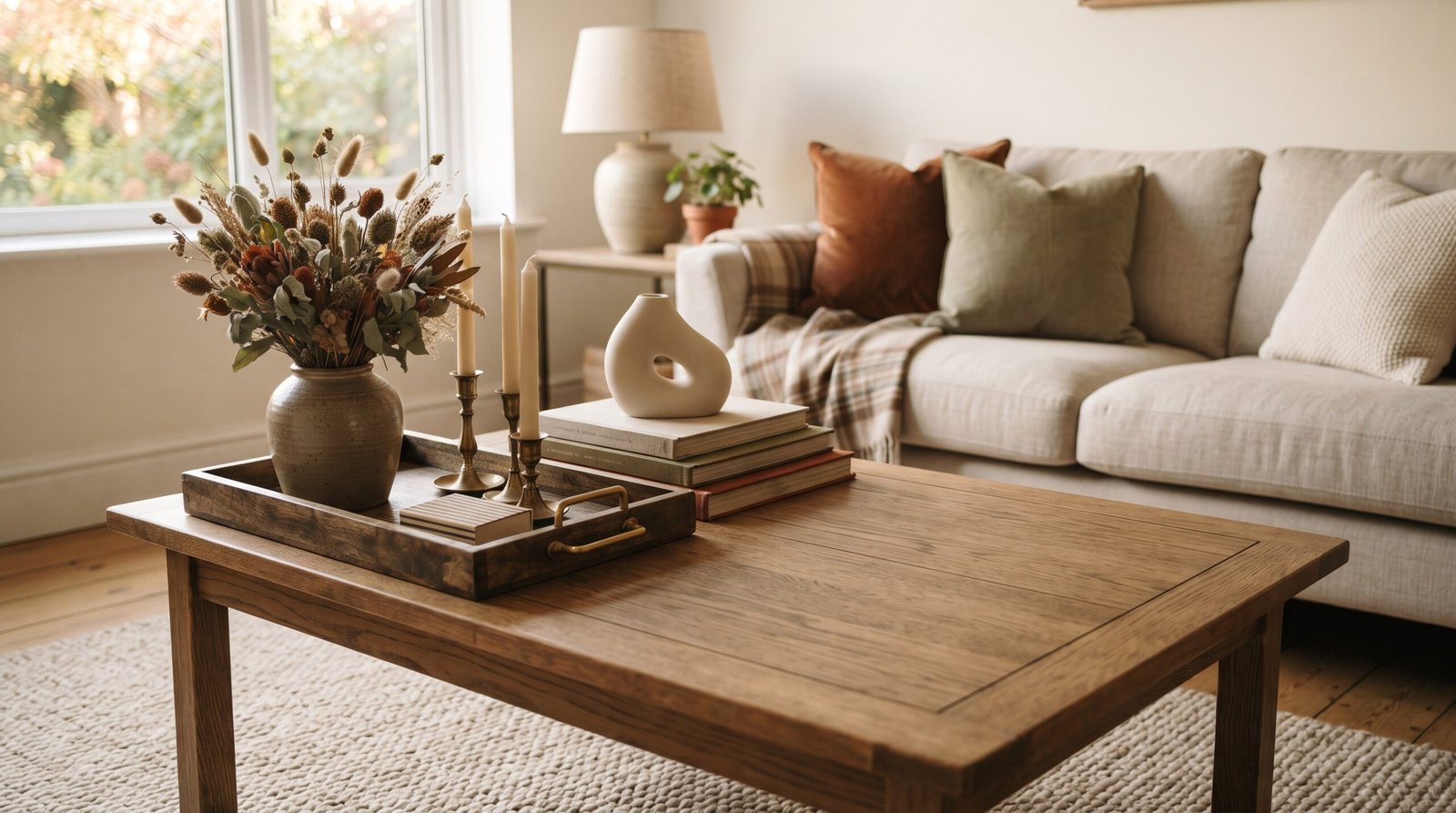
First: is your coffee table the right size?
Before styling anything, it’s worth checking the table itself, because no amount of decor fixes a table that’s the wrong scale for the seating. Three proportions I check in every living room:
- Length: roughly two-thirds the length of your sofa. An 84″ sofa wants a table around 48″ to 56″. Much shorter and it looks like a footstool; much longer and it crowds the walkways.
- Height: within about 1″ to 2″ of your sofa’s seat height, and ideally level with it or slightly below. Most sofa seats sit 17″ to 19″ off the floor, so most coffee tables land at 16″ to 18″. A table noticeably taller than the seat is uncomfortable to reach into and looks top-heavy.
- Clearance: 14″ to 18″ between the sofa’s front edge and the table. Under 14″ and you can’t get past it or stretch your legs; over 20″ and you can’t reach your coffee without standing up.
Common coffee table footprints, for reference when you’re sizing a tray: rectangles are usually 48″x24″, 50″x26″, or 54″x28″. Rounds are usually 36″, 40″, or 42″ in diameter. Ovals tend to run 48″x28″.
The tray: sizing it to your table
A tray is what turns four separate objects into one intentional group. It’s also, practically, what lets you clear the whole arrangement with one hand when someone wants to play a board game. If you buy one thing from this post, buy the tray.
The proportion
The working rule: the tray should cover roughly a third to a half of the tabletop surface area, and its longest dimension should be about 40% to 50% of the table’s longest dimension.
| Coffee table | Tray longest dimension | Typical tray size |
|---|---|---|
| 48″ x 24″ rectangle | 19″ – 24″ | 20″ x 12″ or 22″ x 14″ |
| 54″ x 28″ rectangle | 22″ – 27″ | 24″ x 14″ or 24″ x 16″ |
| 36″ round | 14″ – 18″ | 16″ round or 15″ square |
| 40″ – 42″ round | 16″ – 21″ | 18″ – 20″ round |
| 48″ x 28″ oval | 19″ – 24″ | 20″ x 14″ oval or rectangle |
The most common mistake here is buying a tray that’s too small — a 12″ tray on a 54″ table looks like a coaster that got ambitious. When in doubt, go one size up. An oversized tray still reads as deliberate; an undersized one always reads as an accident.
Shape and material
Match the tray shape to the table shape as a default: rectangular tray on a rectangular table, round on round. Deliberately contrasting — a round tray on a rectangle — works too and softens a very linear table, but only if the round tray is generously sized. A small round tray on a big rectangle just looks lost.
For fall specifically, the material is doing real work. Aged wood, rattan, woven seagrass, cane, and unlacquered brass all read warm and seasonal without a single pumpkin involved. Mirrored, chrome, and high-gloss white trays read cool and modern — fine year-round, but they’ll fight the season. Swapping a mirrored tray for a wooden one in September is one of the single highest-impact seasonal changes you can make to a living room, and it costs whatever a tray costs.
One functional detail: look for a tray with a lip of about 1″ to 2″. A flat board with no edge doesn’t visually contain the group, and a lip over 3″ starts hiding shorter objects behind it. If you like making things, our DIY resin coffee table tray tutorial walks through building one in a custom size, which is genuinely useful if your table is an odd dimension.
Where to put it
Not dead center. Position the tray off to one side — roughly a third of the way in from one end on a rectangular table — and let the remaining surface stay open. Centering the tray splits the table into two equal empty halves, which reads static. Offsetting it creates one generous clear zone, which is both better looking and more useful.
On a round table, place the tray slightly off-center so a crescent of bare wood shows on one side. The asymmetry is what keeps it from looking like a display.
The odd-numbers rule, and why it actually works
Group objects in threes or fives, not twos or fours. This is the oldest rule in styling and it’s genuinely worth understanding rather than just following.
The reason: an even-numbered group naturally splits into symmetrical pairs, and your eye resolves it instantly — two identical things flanking a center point, done, nothing more to look at. An odd-numbered group can’t split evenly. Your eye keeps moving between the elements looking for a resolution it doesn’t find, and that small unresolved movement is what registers as visual interest. It’s the same reason florists build arrangements in odd stem counts.
In practice on a coffee table:
- Three objects is the reliable default for anything up to a 48″ table. Something tall, something medium, something low.
- Five objects works on 54″+ tables or when you’re spreading across the tray plus one item beside it. Five is the practical ceiling — seven starts looking like a shop display.
- A stack counts as one object. Three books stacked read as a single unit, not three. This is how you get visual mass without raising the object count.
- Odd numbers apply within groups too. Three candles, not four. Three books in a stack, not two.
The one exception worth knowing: a pair reads well when the two items are genuinely identical and clearly meant as a set — two matching candlesticks flanking a central bowl, for example. That’s a deliberate symmetrical statement rather than an accident. But you have to commit to it fully; two almost matching things just looks like you couldn’t find a third.
Height variation: the triangle
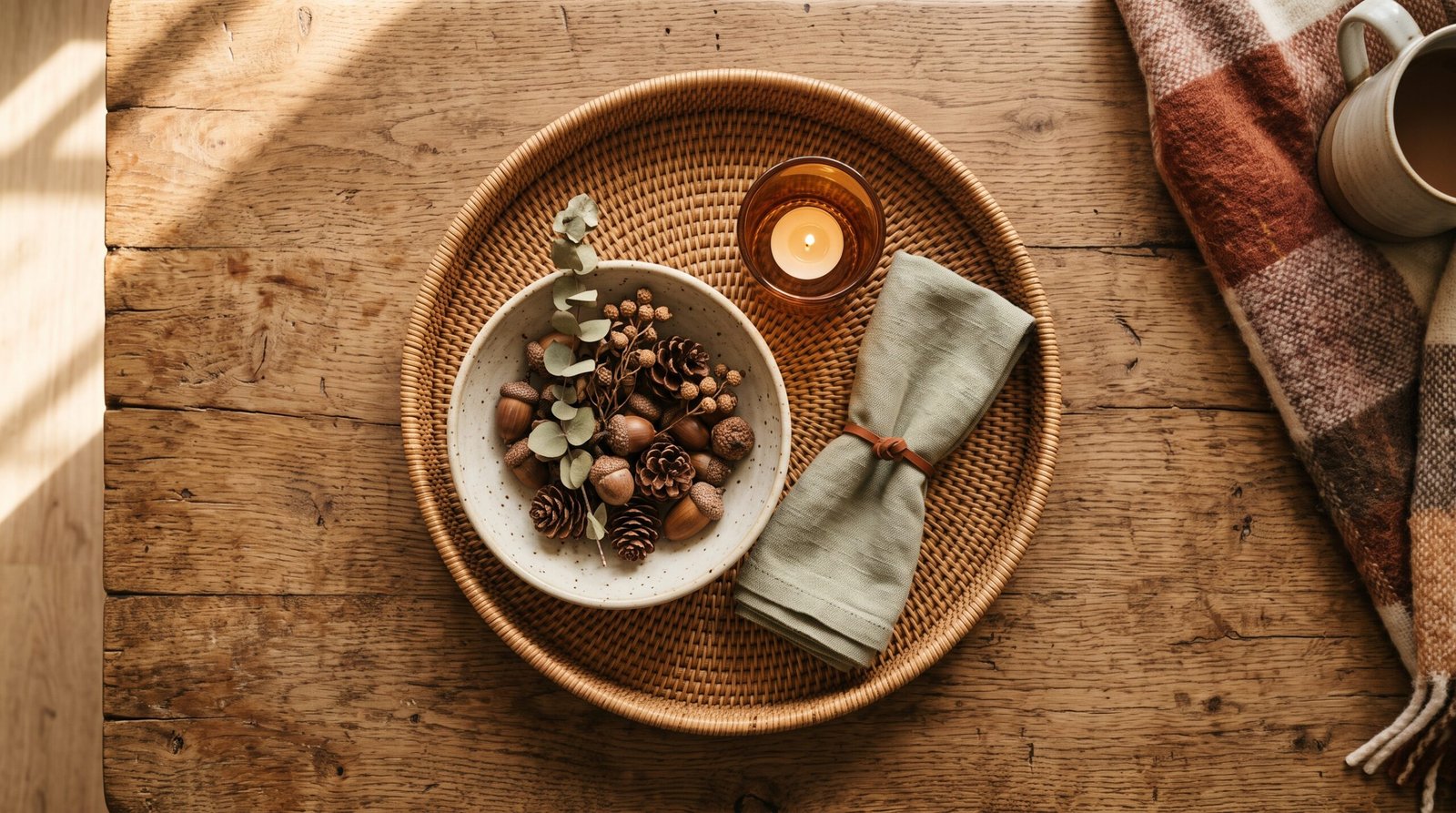
Three objects at the same height is a row. Three objects at different heights is a composition. This is the difference between a table that looks styled and one that looks like things were set down.
The ratios
Aim for your three heights to land roughly at a 3:2:1 relationship. If your tallest piece is 12″, the middle sits around 8″, and the low one around 4″. You don’t need a ruler — you need enough difference that it’s obvious at a glance. The failure mode is objects that are slightly different heights, which reads as an accident rather than a choice. Either match exactly or differ clearly.
Arrange them so the three heights form a triangle when viewed from your usual seat, rather than a straight descending line. Tallest at the back corner of the tray, medium diagonally forward, low object filling the remaining corner. A straight staircase of heights looks mechanical; a triangle looks natural.
The ceiling on height
Here’s a constraint unique to coffee tables: nothing should be tall enough to block sightlines across the room when people are seated. With a table at 16″ to 18″ and seated eye level around 44″ to 48″ off the floor, you have real room — but the practical limit for a coffee table object is about 14″ to 16″ tall. Beyond that and you’re talking across a barrier.
This is why tall dramatic vases belong on a console or a dining table, not here. If you want height on a coffee table, get it from slim tapers in low holders, where the candle is visually light enough to see past.
What plays each role in fall
- Tall (10″–15″): a pair of taper candles in brass or ceramic holders; a narrow bud vase with two or three stems of dried oak leaves or wheat; a slim hurricane.
- Medium (5″–9″): a squat stoneware vase of dried hydrangea; a footed bowl; a lidded ceramic jar; a small pillar candle.
- Low (1″–4″): a stack of two or three books; a shallow dish holding acorns or a few small gourds; a matchbox; a coaster set.
The books
Books are the workhorse of the low tier and worth doing properly. Stack two or three, largest footprint on the bottom, smallest on top. Alternate the spine directions if the spines are busy, or turn them all spine-out if the spines are good-looking. Then put one small object on top of the stack — a smooth ceramic form, a small dish, a candle. That object is what turns a pile of books into a styled element, and it’s a two-second change most people skip.
For fall, warm-toned book covers do more than you’d expect. Rust, ochre, cream, and deep green linen-bound spines pull the seasonal palette down onto the low tier where you’d otherwise only have wood.
How much surface to leave clear
This is the rule people break most often, and it’s the one that determines whether your styling survives past Thursday.
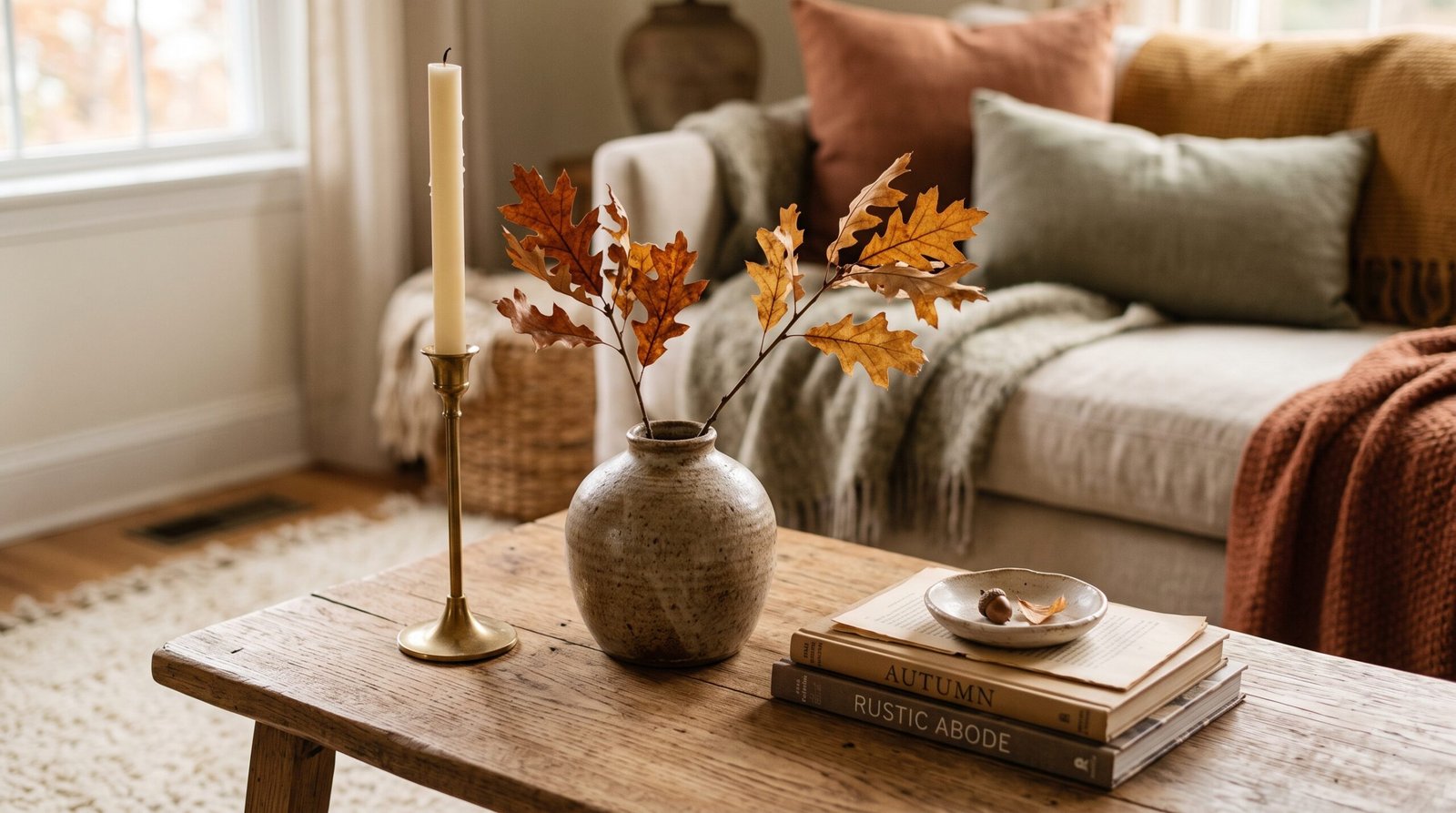
Leave at least 50% of the tabletop genuinely clear — meaning open, reachable, and usable. On a 48″x24″ table, that’s a full 24″x24″ zone with nothing on it. Not “clear except for a coaster and a remote.” Actually clear.
Two reasons. The functional one: a coffee table that can’t hold two mugs, a bowl of popcorn, and someone’s phone is a decorative object, not furniture, and it will get quietly dismantled by the people living there. The aesthetic one: negative space is what makes the styled portion read as deliberate. An arrangement surrounded by empty wood looks composed. The same arrangement with objects creeping to the edges looks like clutter that happens to include a tray.
On smaller tables — anything under 40″ long, or a 36″ round — push it further and leave 60% clear. Small tables need editing, not scaling down. Three objects on a 36″ round is plenty; five will look crowded no matter how well proportioned they are.
A useful test: put your styled arrangement together, then set down two coffee cups and a book as if you were actually using the room. If you have to move anything, the arrangement is too big. This is the check I run on every table, and it fails more often than you’d think.
Fall-specific materials that don’t look seasonal-aisle
The material palette does more for the season than any explicitly autumn object. What to reach for:
- Stoneware and unglazed ceramic — matte, warm-toned, slightly irregular. Reads autumn in any color. Our post on handcrafted ceramic vases covers what to look for in shape and glaze.
- Unlacquered or antiqued brass — candle holders, tray handles, small bowls. Brass warms up under lamplight in a way chrome and nickel never do.
- Dried botanicals over fresh — dried hydrangea, wheat, seeded eucalyptus, oak leaves, bittersweet. They last the whole season, they cost once, and they don’t need water on a surface where a spill is a real risk.
- Textured natural fiber — a small folded linen napkin, a woven coaster set, a rattan tray. Texture is what reads as warmth.
- Amber and smoked glass — votives in amber glass throw genuinely warm light and are one of the cheapest seasonal upgrades available.
What to avoid: anything bright orange and plastic, glitter, novelty shapes, and text. A “hello autumn” block on a coffee table dates the whole room to a specific year. If you want the pumpkin shape, use muted fabric versions or real white and sage varieties — our no-sew fabric pumpkins are the right scale for a coffee table where a real pumpkin would be too big.
A practical note on candles here: if the tapers are lit, they need to be nowhere near a dried arrangement. Dried botanicals are extremely flammable. Keep at least 12″ between an open flame and anything dried, or use unlit candles for styling and put your working candles somewhere else. If you’re making your own, our hand-poured candle guide covers wick sizing and safe burn practice.
Adapting the rules to your table shape
Round tables
Round tables want a single central-ish grouping rather than the spread-out arrangement a rectangle can carry. One footed bowl or one tray with three objects, placed slightly off-center, and a lot of bare curved surface around it. Resist the urge to place objects around the perimeter — a ring of objects on a round table looks like a séance.
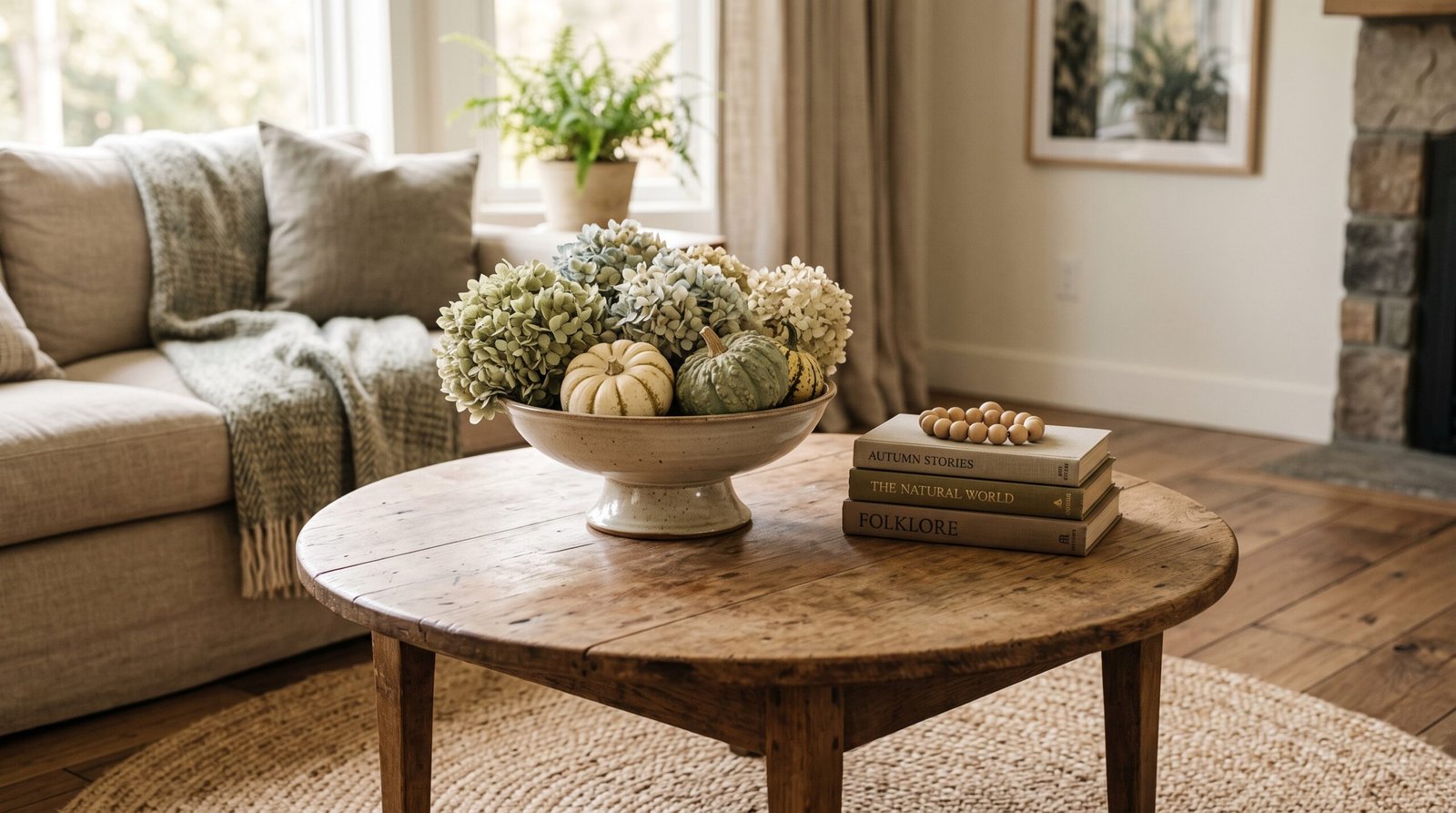
The pedestal bowl is the round table’s best friend. A wide, low footed bowl filled with dried hydrangea heads or a few small gourds gives you height, mass, and seasonal content in one object, and it satisfies the odd-numbers rule on its own by being a single strong element.
Ottomans and upholstered tables
A tray isn’t optional here — it’s structural. Objects sitting directly on upholstery tip over and stain. Use a large, rigid, flat-bottomed tray covering roughly 40% of the top, and keep everything on it. Skip open bowls of loose material entirely; anything that can spill will.
Nesting and paired tables
Style the larger table and leave the smaller one almost bare — one object, or nothing. Two fully styled nesting tables cancel each other out. The smaller one’s job is to be available.
Very small tables and apartments
Under 36″, drop to two elements total: a small stack of books with one object on top, plus one low bowl or candle. That’s it. In a small living room, an over-styled coffee table is the single fastest way to make the whole room feel cramped. There’s more on this balance in our guide to apartment living room decorating.
Three arrangements you can copy directly
The five-minute version (48″x24″ table). A 20″x12″ wooden tray offset a third from the left end. On it: two cream tapers in brass holders at staggered heights, a squat stoneware vase with three stems of dried wheat, a small dish of acorns. Beside the tray, a stack of three books topped with a smooth ceramic object. Right half of the table clear.
The low-profile version (for households with kids or dogs). No candles, no loose material, nothing over 8″ tall. A 22″x14″ rattan tray with a shallow footed bowl of dried hydrangea, a stack of two books with a small lidded jar on top, and a woven coaster set. Everything on the tray, everything liftable in one motion.
The round table version (40″ round). An 18″ round tray placed slightly off-center. One wide footed stoneware bowl of dried hydrangea and two or three small pale gourds, one amber glass votive, one folded linen napkin. Nothing else. The bare crescent of wood is the point.
The mistakes I see most often
- Tray too small. The most common issue by a wide margin. Measure your table and go to 40–50% of its longest dimension.
- Everything the same height. Three objects between 6″ and 8″ tall is a row, not a composition.
- No clear zone. If a mug has nowhere to go, the arrangement won’t last a week.
- Too many small things. Six little objects always look worse than three considered ones. Consolidate onto the tray or remove.
- Ignoring the view from above. A coffee table is mostly seen looking down. Stand over yours before you call it done — arrangements that work at eye level often collapse from above.
- Styling it once and never touching it. Dried material collects dust. Take it outside every few weeks and blow it off with a hair dryer on the cool setting.
Carry it through the rest of the room
A coffee table doesn’t stand alone — it should relate to the mantel, the console, and the textiles around it. Our full guide to fall decorating ideas for the living room covers the pillow sizing, throw dimensions, bulb temperatures, and mantel proportions that make the coffee table read as part of a plan rather than an island. If you want to make the seasonal centerpiece yourself, our DIY fall garland tutorial scales down easily to a table-length runner.
For more on the underlying principles, interior design styling tips and the art of layering both go deeper on grouping and negative space. Layering textures for a cozy fall home is the seasonal companion piece. And if you’d rather work with fewer objects overall, minimalist home interior design shows how to get the same warmth with a much shorter list.
Want to make the accessories rather than buy them? Beaded coasters handle the low tier, and fall table settings for entertaining applies the same proportion rules to the dining table when people come over.
Measure your table, buy the bigger tray, and leave half the surface alone. That’s most of it. — Quinn


1 Comment