
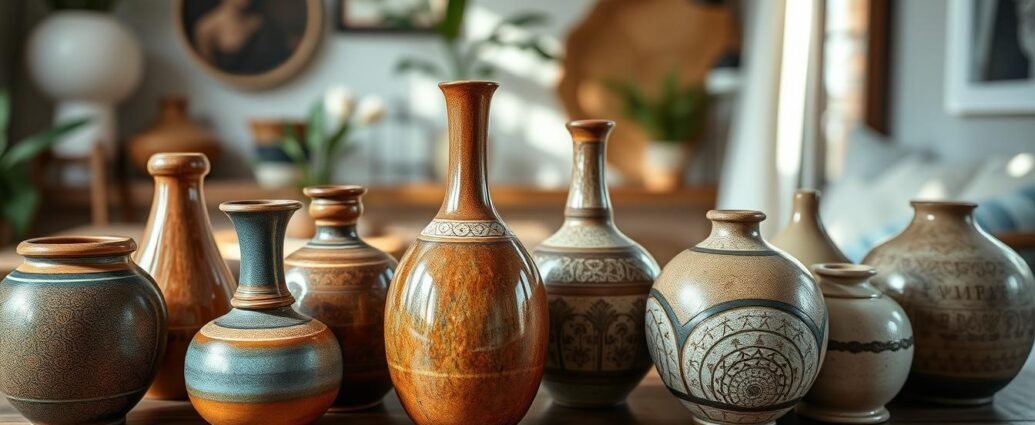
Do you ever walk into a room and feel like something is missing? That final touch that pulls everything together? A ceramic vase is one of the cheapest ways we know to answer that feeling. It takes up almost no space, costs far less than furniture, and changes the character of a shelf in about four seconds.
This is a guide to buying and styling one well. Not a shop — Design and Dwelling doesn’t sell vases. Just what we’ve learned about telling a genuinely handmade piece from a factory copy, what a fair price looks like, and how to arrange the ones you already have so they earn their spot.
Key Takeaways
- Handmade pieces carry small irregularities — that’s the point, not a flaw.
- Scale matters more than style: match the vase to the surface it sits on.
- You do not need to buy anything. Thrift shelves are full of good ceramic.
- Look for lead-free glaze if the piece will ever hold food or drink.
- Grouping in odd numbers and varied heights does most of the styling work.
- An empty vase is a finished object. It doesn’t need flowers to look right.
What Makes a Vase Actually Handcrafted
There’s something worth noticing about an object that was shaped by hands rather than a mould. You can usually feel it before you can explain it — the wall thickness varies slightly, the base has a faint spiral where it left the wheel, the glaze pools deeper in one dip than another.
How to Tell Handmade From Mass-Produced
Turn the piece over. A hand-thrown vase almost always shows a foot ring that was trimmed by hand, often with a maker’s mark or initials pressed into the clay. A slip-cast factory piece has a seam — run your thumb up the side and you’ll find a faint vertical ridge where the two halves of the mould met.
Look inside, too. Hand-thrown walls carry gentle horizontal ridges from the potter’s fingers. Cast interiors are glassy and uniform. Neither is wrong — a factory vase can be beautiful and costs a fraction as much — but it’s worth knowing which one you’re paying for. This side-by-side on handcrafted versus mass-produced ceramics covers the manufacturing difference in more detail.
Glaze, Safety and Everyday Use
If a vase will only ever hold dried stems, glaze chemistry doesn’t much matter. If it might hold water, or ever get used as a pitcher, look for a piece described as food-safe or lead-free. Reputable makers state this plainly; if a listing avoids the question, assume the answer is no and keep it decorative.
Vintage and imported pieces are the ones to be careful with — older decorative glazes were not made to food-safe standards. A cheap fix: drop a small glass jar inside the vase and put the water in that. The vase still does its job and nothing leaches.
Choosing the Right Vase for Your Space
The most common mistake we see isn’t picking the wrong style. It’s picking the wrong size.
Match the Piece to the Surface
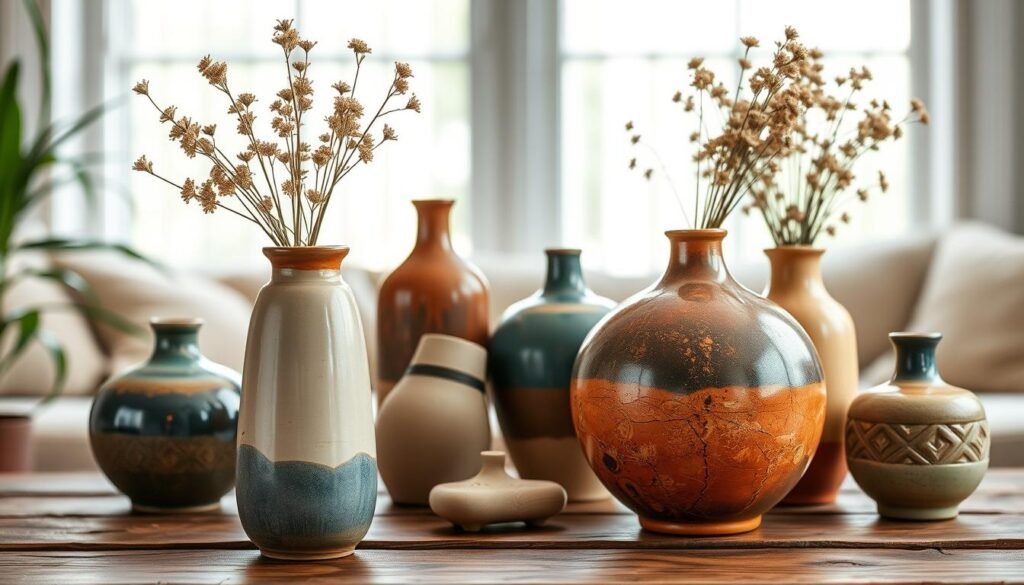
A rough rule that has never let us down: a vase should be roughly one-third to two-thirds the height of whatever sits behind it, and no wider than half the depth of the surface it stands on. A tall, slender piece holds its own on a living room console. On a bedroom nightstand it will be knocked over inside a week.
Think about sightlines as well. A vase on a dining table needs to sit below eye level so people can talk across it. A vase on a high shelf can be taller and simpler, because you’ll only ever read its silhouette.
What You Can Expect to Pay
Prices vary enormously by maker and region, so treat this as a rough map rather than a quote. Small factory-made ceramic vases turn up for a few dollars at discount and craft stores. Mid-range pieces from independent potters commonly land somewhere in the tens of dollars. Larger, signed, one-off work from an established studio runs well into the hundreds, and that price is mostly the hours the potter spent on it.
The free version: thrift stores and charity shops are, in our experience, the single best source of ceramic. Pottery is heavy and unfashionable in bulk, so it gets donated constantly and priced to move. Look for the hand-trimmed foot ring described above and you will occasionally walk out with studio work for the price of a coffee. If you’d rather make something, our guide to painting and personalising terracotta pots turns a two-dollar garden pot into something with real character.
Styling Ceramic Vases Around the House
We think good styling should feel intuitive rather than intimidating. Most of it comes down to three decisions: height, texture, and how much you leave empty.
Mixing Shapes and Textures
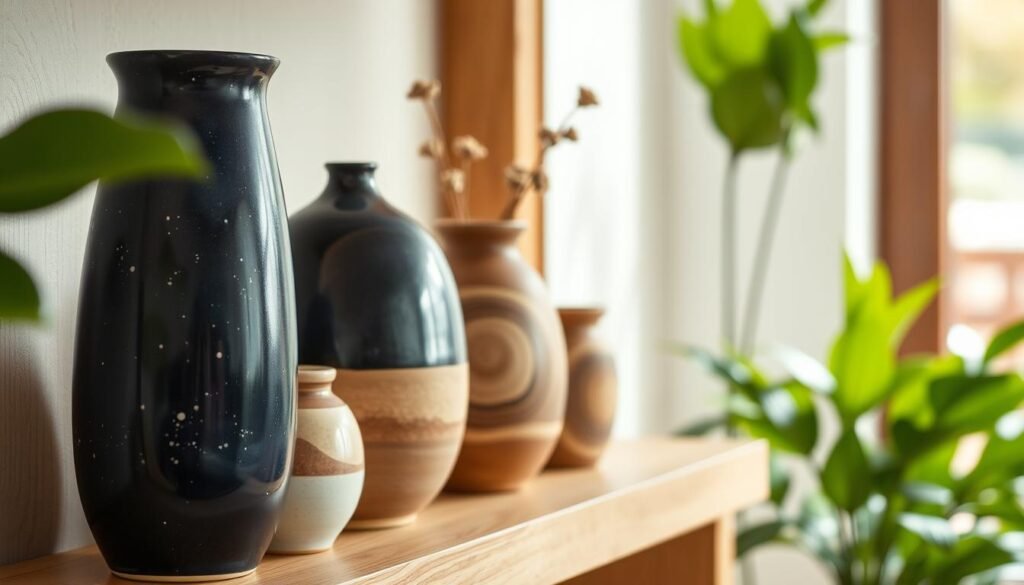
Contrast does the heavy lifting. Pair a smooth, glossy piece with a rustic matte one on the same shelf and each makes the other more interesting. Group in odd numbers — three reads as a deliberate arrangement, four reads as storage.
Vary the heights within a group, but keep one thing constant, usually colour family or finish. That single shared thread is what stops a collection looking like clutter. The same principle scales up to a whole wall of objects, which we covered in our guide to handmade home decor.
Let Some of Them Stay Empty
The vessel itself is the object. You can fill it with seasonal branches, or let its shape stand on its own — an empty vase is not an unfinished one. This matters practically, too: it means the piece works in January when there is nothing in the garden. For seasonal filling on a budget, cut branches, dried grasses and grocery-store eucalyptus last for months, and our coastal centerpiece ideas use foraged material almost entirely.
| Principle | Quick Tip | Best For |
|---|---|---|
| Play with Height | Mix tall and short vases in odd-numbered groups. | Console tables, shelves |
| Embrace Texture | Combine glossy and matte finishes. | Creating focal points |
| Use Empty Space | Let one vase stand alone as a sculptural element. | Modern spaces, mantels |
| Style with Seasons | Swap contents — dried grasses, bare branches, fresh blooms. | Keeping a shelf current |
| Go Beyond Tabletops | Use a floor vase to fill an awkward empty corner. | Large rooms, entryways |
Move Them Around
The cheapest refresh available to anyone is relocation. A vase that has sat on the kitchen counter for a year looks new on a home-office shelf. Nothing is bought, nothing is thrown away, and the room reads differently by evening. For more of this kind of no-cost change, decorating with vases has a good round-up of placement ideas.
Caring for Ceramic
Hand wash with mild soap and warm water, and skip abrasive scourers — they will dull a glossy glaze and permanently scratch a matte one. Hard-water rings inside a vase come out with a little white vinegar left to sit for an hour.
Unglazed terracotta and raw stoneware are porous and will sweat if you put water in them directly. Use the inner-jar trick, or keep those pieces for dried material only.
Conclusion
The reason we keep coming back to ceramic is the ratio: almost no money, almost no space, and a noticeable difference in how finished a room feels. You don’t need a full makeover — one well-scaled piece on a surface you look at every day does more than most furniture purchases.
Start with what you already own. Pull every vase in the house onto one table, group them by finish, and put the best three somewhere you’ll actually see them. If nothing survives that test, the thrift shelf is a better first stop than a checkout page.


1 Comment