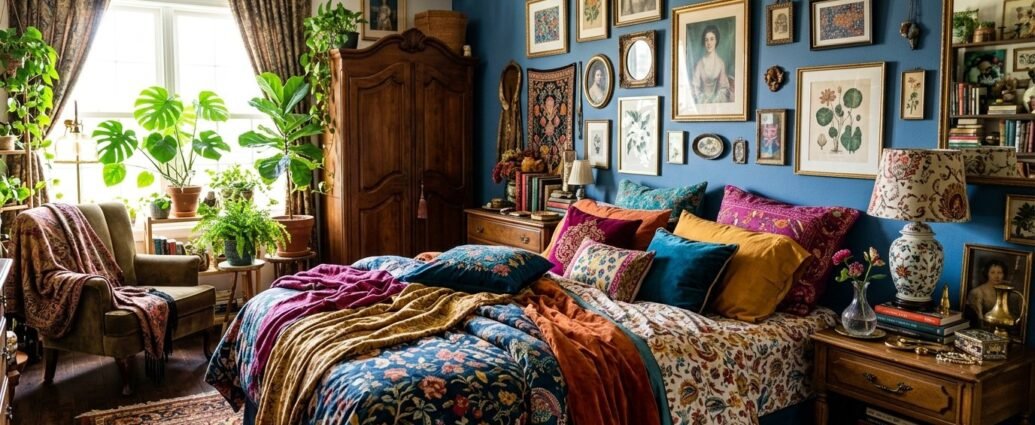
Do you ever walk into a room and feel like it was designed to hold its breath — everything perfectly placed, nothing out of order, and yet somehow completely lifeless? That quiet, restrained aesthetic has its place — done well, a warm minimalist bedroom is genuinely restful rather than sterile. But for those of us who believe a bedroom should feel like a love letter to yourself, there’s another way entirely.
In this post, we’re diving deep into the world of maximalist bedroom ideas — how to layer, build, and collect a space that feels genuinely indulgent without ever tipping into chaotic. You’ll walk away with a clear framework for bold bedroom decor that’s personal, rich, and deeply you.
Key Takeaways
- A strong hero piece — like a statement headboard or canopy bed — anchors the whole room and gives your maximalism a clear focal point.
- Layered bedding in complementary colors and varied textures creates depth without looking messy.
- Mixing velvet, linen, and faux fur is the secret to a bedroom that looks expensive and feels irresistible.
- Painting all four walls (including the ceiling) in a bold color transforms a room into an immersive sanctuary.
- Art, plants, and curated objects are what make a maximalist space feel collected rather than cluttered.
- The key to bold bedroom decor that works is repetition of color and intention behind every choice.
Why Maximalist Bedroom Design Deserves a Comeback
For the better part of a decade, minimalism ruled every mood board and design magazine. And while I respect a clean line as much as anyone, I kept noticing something: the most memorable rooms — the ones people photograph, revisit, and genuinely love living in — almost always had more going on. More color, more texture, more personality.
Maximalism isn’t about piling things in. It’s about abundance with intention. A maximalist bedroom should feel like stepping into a world someone built specifically for themselves: warm, layered, and full of story.
The Difference Between Maximalism and Clutter
This is the question I get asked most. The answer comes down to two things: cohesion and repetition. Clutter happens when objects share no visual language. Maximalism works when colors echo across the room, when textures play off each other, when even the unexpected elements feel like they belong to the same world.
Think of it like a great playlist — wildly varied, but unmistakably curated by the same taste.
Who Maximalism Is Really For
If you’ve ever felt vaguely bored by a room that’s technically beautiful but emotionally flat, you might be a maximalist at heart. This design philosophy suits people who collect things they love, who find comfort in color, and who want their bedroom to feel like a destination rather than a placeholder.
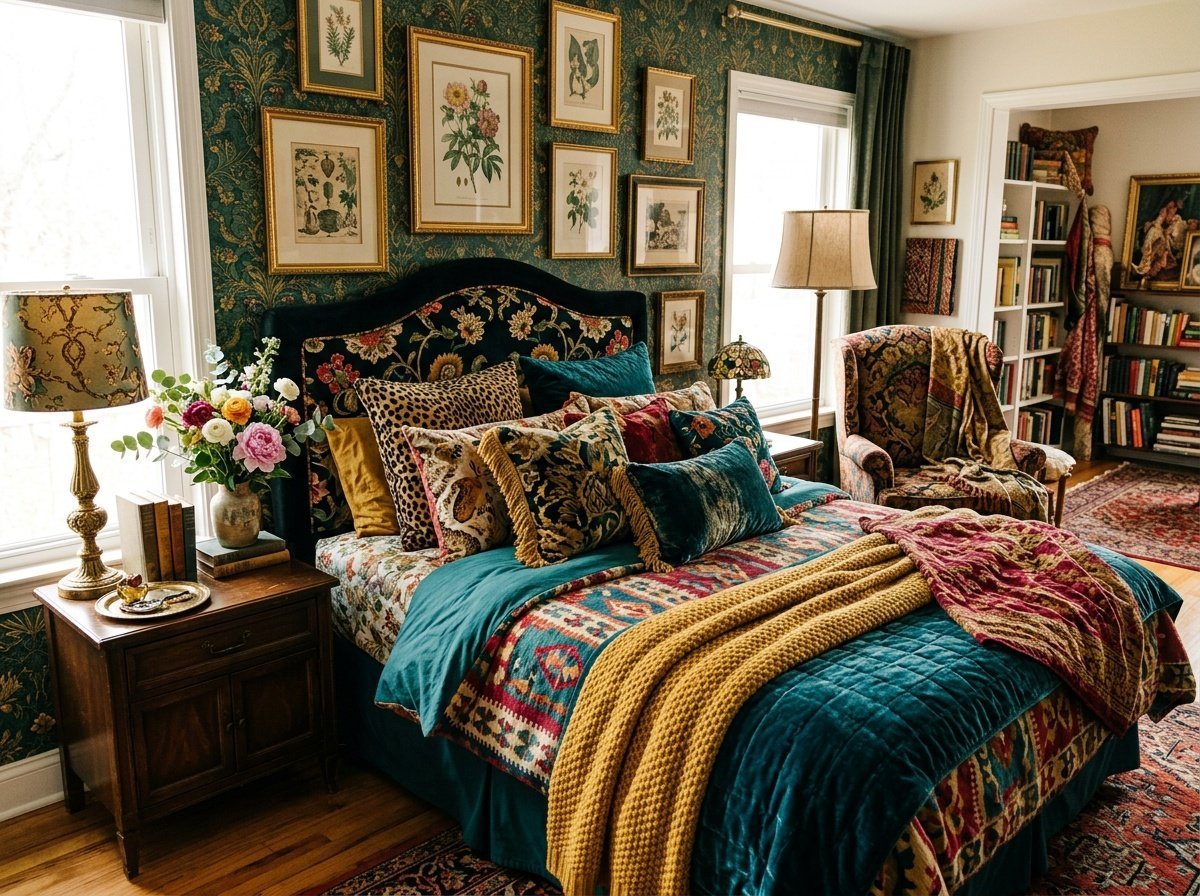
Start with a Hero Piece: Statement Headboards and Canopy Beds
Every great maximalist bedroom begins with one undeniable focal point. Before the art goes up, before the pillows are stacked, before the plants are arranged — you need a hero piece that sets the tone for everything else.
Why the Headboard Is Everything
A statement headboard is the single fastest way to transform the energy of a bedroom. We’re not talking about the upholstered rectangle that came with the bed frame. We’re talking about something architectural: a curved velvet headboard in deep forest green, a hand-carved wooden piece that spans nearly floor to ceiling, or a dramatically tufted panel in jewel-toned fabric that makes the whole wall feel intentional.
For maximum impact, choose a headboard that’s at least 60 inches tall — ideally taller. Scale matters enormously in maximalist design, and an undersized headboard will always feel apologetic in an otherwise bold room.
The Case for a Canopy Bed
If you want to go all the way in with luxury bedroom design, a canopy bed is the ultimate commitment. The moment you introduce a four-poster or full canopy frame, the room stops being a place you sleep and becomes a space you inhabit. You can dress a canopy with floor-length linen sheers for something romantic and diffused, or with richly embroidered panels for something more opulent.
The canopy also solves one of the trickiest maximalist challenges: vertical space. It draws the eye upward and gives all those beautifully layered lower elements a ceiling to answer to.
Mixing Metals and Wood Tones in Your Bed Frame
Don’t be afraid to mix materials in the frame itself. Brass and dark walnut together? Absolutely. Matte black iron with rattan detailing? Yes. The hero piece earns its name by being visually complex enough to anchor a layered room — a simple frame will get lost.
Layered Bedding: The Art of the Maximalist Bed
If the headboard is your room’s opening statement, the bed itself is the paragraph that follows. Layered bedding is one of the most accessible maximalist moves you can make — it requires no renovation, no major investment, and the results are immediate and dramatic.
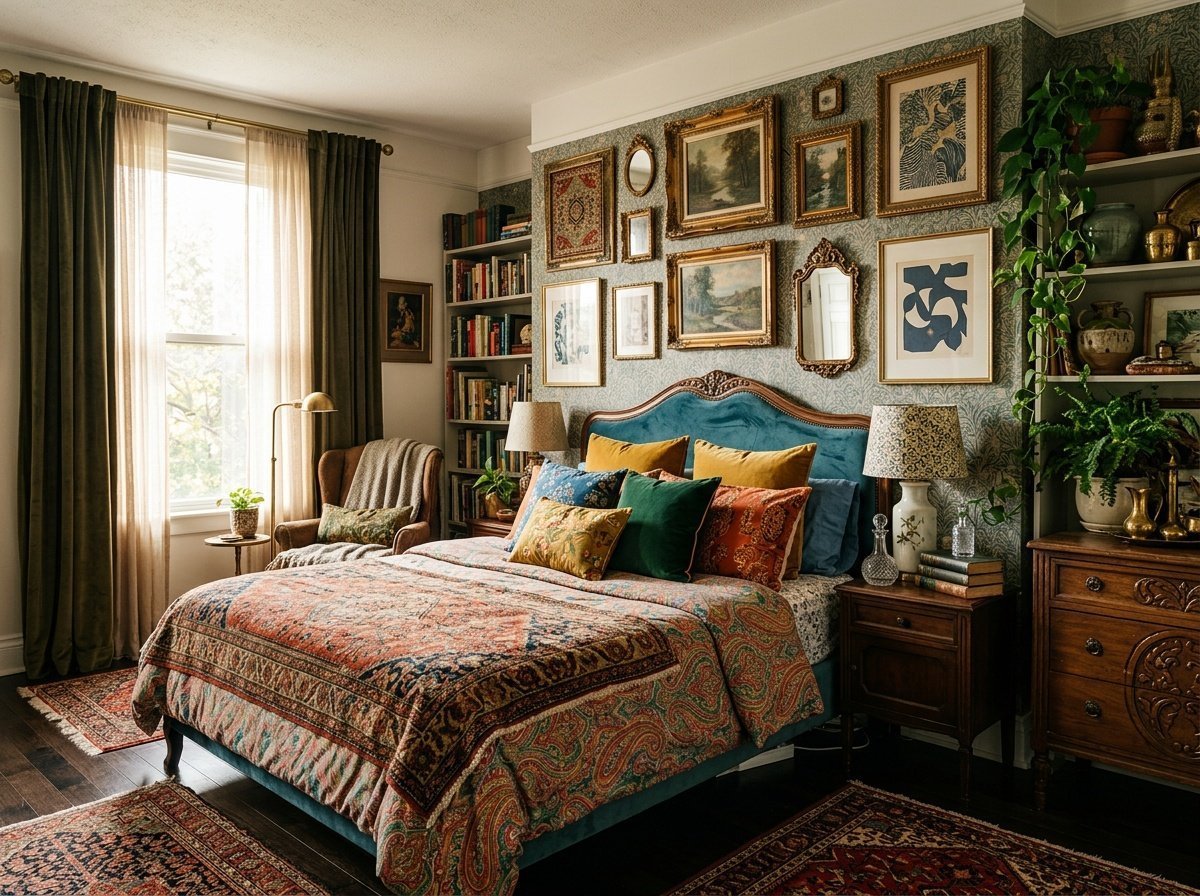
Building the Layer Cake
Here’s how I approach a fully layered bed. Start with a fitted sheet in a foundation tone — something neutral or tonal. Add a flat sheet in a coordinating print or texture. Then comes the main duvet or quilt, which can be your boldest pattern or richest color. On top of that: a folded throw at the foot of the bed in a contrasting texture. Finally, pillows — and this is where maximalism truly gets to play.
- Two euro shams at the back (largest, in a solid or subtle pattern)
- Two standard pillowcases in a complementary print
- Two lumbar or accent pillows in front, in contrasting shapes and fabrics
- One oversized bolster or a single statement pillow as the anchor
The result should look effortful and effortless at the same time — like someone who got dressed beautifully and then fell back onto the pillows.
Color Mixing Without Chaos
The secret to making a colorful bedroom bed work is choosing a palette of three to four hues and letting them rotate across the layers. If your duvet is a deep rust, let that same rust appear in a throw pillow two rows forward. If your euro shams are a moody sage, echo that green in a lumbar pillow fabric or a subtle stripe on the flat sheet. The eye follows repetition and reads it as intention.
“A maximalist bed shouldn’t look like you can’t make a decision — it should look like you made too many wonderful ones.”
Texture Mixing: Velvet, Linen, and Faux Fur
If color is the melody of a maximalist bedroom, texture is the harmony. You can build an entire bold bedroom decor scheme in a single color family and still achieve that rich, layered feeling purely through the interplay of surfaces.
The Core Texture Trio
Velvet is your anchor — it absorbs light, adds depth, and immediately reads as luxurious. Use it on your headboard, on accent pillows, or on a channel-tufted bench at the foot of the bed. Linen is your counterbalance — natural, breathable, slightly rumpled in the best way. It prevents velvet from feeling stuffy and adds that organic quality that keeps a maximalist room from reading as over-decorated. Faux fur is your punctuation mark — a throw draped over a chair, a small rug beside the bed, a single pillow tucked into the arrangement. Used sparingly, it adds drama and warmth without overwhelming.
Adding Depth with Unexpected Textures
Beyond the core trio, consider weaving in boucle (on a chair or cushion cover), rattan (in a light fixture, mirror frame, or side table), and chunky knit (as a throw or floor cushion). Each texture catches light differently, which means the room literally looks different at different times of day — morning sun reveals the velvet’s sheen, evening lamplight deepens the faux fur, afternoon light softens the linen into something almost painterly.
| Texture | Best Used On | Mood It Creates | Pairs Best With |
|---|---|---|---|
| Velvet | Headboard, cushions, bench | Opulent, moody, anchoring | Linen, natural wood |
| Linen | Bedding, drapes, pillow covers | Relaxed, organic, breathable | Velvet, boucle |
| Faux Fur | Throws, accent rug, one pillow | Dramatic, cozy, tactile | Linen, chunky knit |
| Boucle | Chair, cushion cover | Soft, modern, textural | Velvet, linen |
| Rattan | Mirror, light fixture, side table | Earthy, grounding, artisanal | Linen, faux fur |
Using Bold Color on All Four Walls (and the Ceiling)
This is where people hesitate most. Painting all four walls a strong color feels irreversible, dramatic, maybe even reckless. I want to reframe that entirely. Committing to a colorful bedroom on all four walls is one of the most transformative things you can do to a space — and it’s also one of the most budget-friendly moves in the design playbook.
Choosing the Right Color for an Immersive Feel
For a maximalist bedroom, the colors that tend to work best are those that have depth and complexity rather than brightness alone. Think deep terracotta, forest green, inky navy, dusty plum, or warm tobacco brown. These colors read differently in morning light versus candlelight, which means your room is never quite the same experience twice. That’s exactly the kind of living quality a great space should have.
If you’re nervous about committing to a full deep color, I always recommend starting with a large paint swatch (at least 12 x 12 inches) and living with it on the wall for two to three days before committing. See it in daylight, in lamplight, and by natural morning sun. Trust what you see — not the chip on the card.
Don’t Forget the Fifth Wall
The ceiling — what designers often call the fifth wall — is where maximalist bedrooms truly distinguish themselves. Painting the ceiling the same color as the walls creates an enveloping, cocoon-like effect that feels simultaneously dramatic and deeply restful. If you want something slightly less committed, paint it one shade lighter than your walls for a softer version of the same effect. For inspiration on how color palettes behave across a full space, I love referencing current color trend research on earthy, calming palettes — many of those principles apply beautifully to bedroom design too.
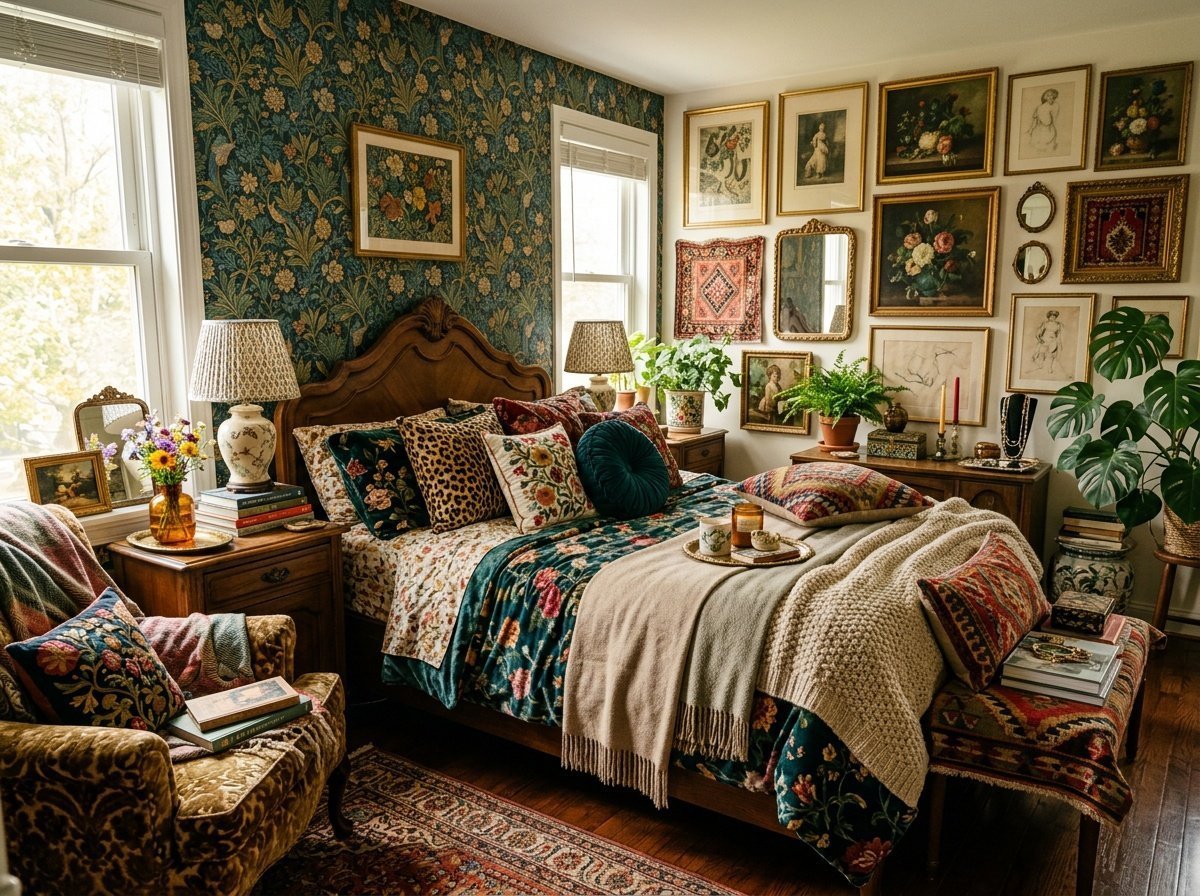
Accessorizing with Art, Plants, and Collected Objects
This is the section where a maximalist bedroom becomes unmistakably yours. The hero piece grounds it, the bedding layers it, the color envelops it — but the accessories are what make it breathe and tell a story.
Building a Gallery Wall That Doesn’t Look Like a Template
The difference between a gallery wall that sings and one that feels like a checklist is mixing the unexpected. Combine framed fine art prints with textile wall hangings, small mirrors, sculptural sconces, pressed botanical specimens, and even a single piece of vintage wallpaper mounted in an oversized frame. Let the frames vary — gilded, dark wood, raw linen — but keep a consistent color thread running through the art itself (even if it’s just that one warm amber tone that appears in every piece).
Hang pieces closer together than feels comfortable. In maximalism, breathing room between frames reads as hesitation. Cluster them with confidence and they become an installation rather than a collection of separate decisions.
Plants as Texture and Life
A maximalist bedroom without plants feels slightly two-dimensional. Plants add the one element no fabric or paint color can provide: actual life. For a bedroom, I gravitate toward large-leaf varieties that create dramatic silhouettes — a fiddle leaf fig in the corner, a trailing pothos draping from a high shelf, a cluster of smaller plants on a bedside tray.
Don’t shy away from dramatic pots either. A terracotta pot with aged patina, a glazed ceramic in deep cobalt, or a woven basket planter all add yet another texture layer to the room’s visual vocabulary. If you’re looking for ideas on how to bring similar warmth to other spaces throughout your home on a realistic budget, the inexpensive family room updates that actually work post is a great companion read.
Curating Objects Without Collecting Clutter
The bedside table, the dresser top, the windowsill — these are your vignette stages. Each one should tell a small story: a stack of books with a beautiful spine, a vintage perfume tray, a ceramic dish holding a few pieces of jewelry, a single candle in a heavy glass vessel. The rule I follow is this: every surface can hold three to five objects maximum, and at least one should be taller than the others to create visual movement. If something doesn’t add to the story the room is telling, it earns a home somewhere else.
Lighting That Amplifies the Maximalist Mood
Maximalist bedrooms deserve maximalist lighting — not in terms of brightness, but in terms of variety and warmth. The goal is layers of light that you can dial up or down depending on the mood.
The Three-Layer Lighting Approach
Think of your bedroom lighting in three layers. Ambient light is your overhead source — ideally on a dimmer, ideally something beautiful like a sculptural chandelier or a rattan pendant that casts interesting shadows. Task lighting lives on the bedside tables: swing-arm wall sconces or table lamps with warm-toned bulbs (2700K is the magic number for a golden, flattering glow). Accent lighting is the finishing touch — a small lamp on a dresser, a plug-in picture light above your favorite art piece, candles grouped on a tray.
Choosing Light Fixtures as Statement Objects
In a statement bedroom, the light fixtures are not afterthoughts — they’re accessories. An ornate antique-style chandelier in a room painted deep green feels cinematic. Mismatched bedside lamps with sculptural bases and contrasting shades feel intentionally eccentric. Don’t match everything perfectly; let the fixtures contribute to the layered, collected quality that defines maximalism at its best.
The Role of Pattern in Bold Bedroom Decor
Pattern is the element most people are afraid to embrace fully — and the one that, used well, most defines the maximalist aesthetic. The key isn’t avoiding pattern clash; it’s understanding how to mix pattern scales.
Mixing Pattern Scales Successfully
The rule that never fails me: pair a large-scale pattern with a small-scale one and a solid. A boldly printed duvet (large-scale floral or geometric) works beautifully with a small-scale stripe on the pillowcases and a solid throw. Add a medium-scale pattern on the curtains and suddenly the room has a full visual rhythm without any single element competing too aggressively with another.
If you’re newer to mixing patterns, start with a palette of two to three colors and source all your patterns within that palette. Even wildly different prints feel cohesive when they share a color family.
Wallpaper as the Ultimate Pattern Statement
In a maximalist bedroom, wallpaper deserves serious consideration — not instead of paint, but sometimes in addition to it. A dramatic botanical print on one feature wall (behind the bed) alongside painted walls in a color pulled from the wallpaper’s palette is one of the most layered, luxurious looks achievable in any bedroom regardless of budget. Removable wallpaper has made this option accessible even for renters, which means there’s genuinely no reason to keep living with a bare, apologetic wall.
Frequently Asked Questions
How do I start designing a maximalist bedroom without it looking messy?
Start with one anchor element — a bold headboard, a strong wall color, or a layered bed — and build from there. The key to avoiding mess is repetition: choose a palette of three to four colors and let those colors echo consistently across textiles, art, and accessories. When things share a visual language, the eye reads abundance rather than chaos.
What colors work best for a maximalist bedroom?
Colors with depth and complexity tend to perform best — think forest green, deep terracotta, inky navy, dusty plum, or warm tobacco. These hues create an immersive quality that shifts beautifully throughout the day. Bright, highly saturated colors can work too, but they require more careful balancing with neutral or muted textures to prevent sensory overwhelm.
Can I achieve a maximalist bedroom on a tight budget?
Absolutely. Paint is the most transformative and affordable tool at your disposal — painting all four walls (and the ceiling) in a bold color costs very little and creates an enormous impact. Beyond that, layering bedding you already own, shopping vintage for art and objects, and adding plants in beautiful pots are all high-impact, low-cost moves. For more budget-friendly inspiration, exploring inexpensive room update strategies can spark some genuinely useful ideas.
How many patterns can I mix in a maximalist bedroom?
There’s no hard ceiling, but a practical approach is to mix three to four patterns across the space — varying the scale (large, medium, small) and keeping them within a shared color palette. The solid elements in your room (a plain throw, a painted wall) act as visual rest points that allow busier patterns to breathe.
What’s the difference between maximalist and eclectic bedroom design?
Maximalist design is defined by abundance and layering — more of everything, all working together within a cohesive visual story. Eclectic design is more about mixing styles and eras that wouldn’t normally coexist. They overlap often (many maximalist bedrooms are also eclectic), but maximalism is specifically about richness and volume, while eclecticism is more about unexpected combinations.
Do I need a big bedroom to go maximalist?
Not at all — in fact, smaller bedrooms can benefit enormously from maximalist thinking. Deep color on all four walls makes a small room feel intentional and cozy rather than cramped. A dramatic headboard that reaches toward the ceiling draws the eye upward and creates the illusion of height. The layered approach works at any scale; you simply curate fewer objects rather than filling every surface.
How do I incorporate plants into a maximalist bedroom without it feeling like a jungle?
Treat plants as you would any other design object — with intentionality about placement, scale, and container. Choose two to three statement plants rather than twenty small ones. Position them at varying heights (a tall floor plant, a medium shelf plant, a small trailing plant on the bedside table) and let the pots themselves contribute to the room’s color story. Less is more with plants — even in a maximalist space.
Designing a maximalist bedroom is, at its heart, an act of courage — the courage to say that your space deserves to be as full of personality as you are. Whether you start with a sweeping canopy bed, a room-wrapping coat of deep color, or a carefully layered pile of textures that beg to be touched, know that there’s no wrong way into this. The only rule is that the room should feel entirely, unmistakably like you. If you’re ready to take that first bold step, start with one piece that makes your heart rate pick up just a little when you look at it — and build your whole beautiful world outward from there. 🖤