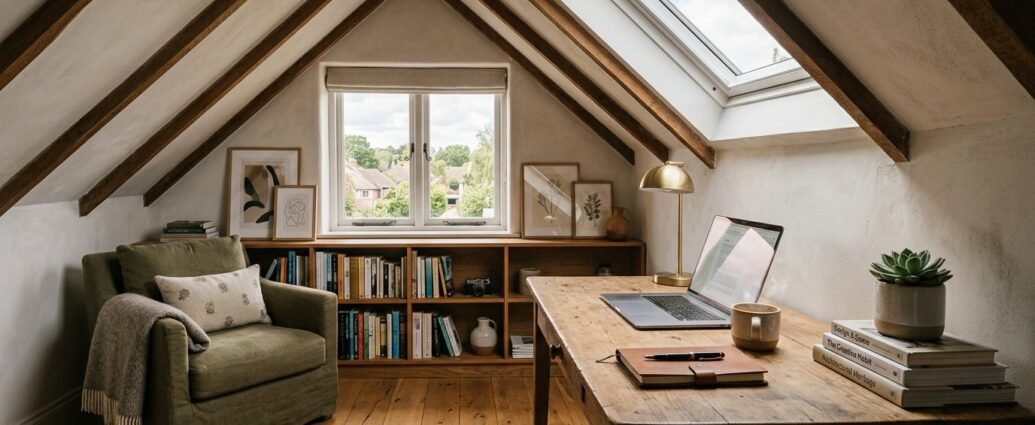
Do you ever find yourself daydreaming about a workspace that feels completely removed from the rest of the house — a place where the noise fades, the door closes, and you can finally just think? There’s something quietly romantic about the idea of tucking yourself away in the treetops of your own home.
An attic home office can be exactly that — a sanctuary carved from wasted square footage, full of character and possibility. In this post, we’re walking through everything you need to know about an attic office conversion, from assessing the space before you lift a single hammer to choosing a design style that makes you actually want to show up to work every morning.
Key Takeaways
- Assess structural load, headroom, and insulation before committing to an attic conversion.
- Heat management is the biggest challenge — mini-split systems are often the most effective solution.
- Knee-wall cavities are prime storage real estate if designed intentionally from the start.
- Sloped ceilings require creative desk placement strategies, not standard furniture thinking.
- Cable management in finished ceilings needs to be planned before drywall goes up.
- Design styles from minimal Scandinavian to cozy library vibes all translate beautifully to attic spaces.
And if a desk isn’t what you’re picturing up there, most of the same groundwork still applies — headroom, insulation, egress and light. Our guide to an attic bedroom conversion covers what changes when the room has to be somewhere people sleep.
The Attic Home Office Pre-Conversion Checklist
Before you fall completely in love with the idea of your attic workspace, there are some non-negotiable boxes to tick. This isn’t the fun part, but skipping it is how renovation dreams turn into expensive headaches.
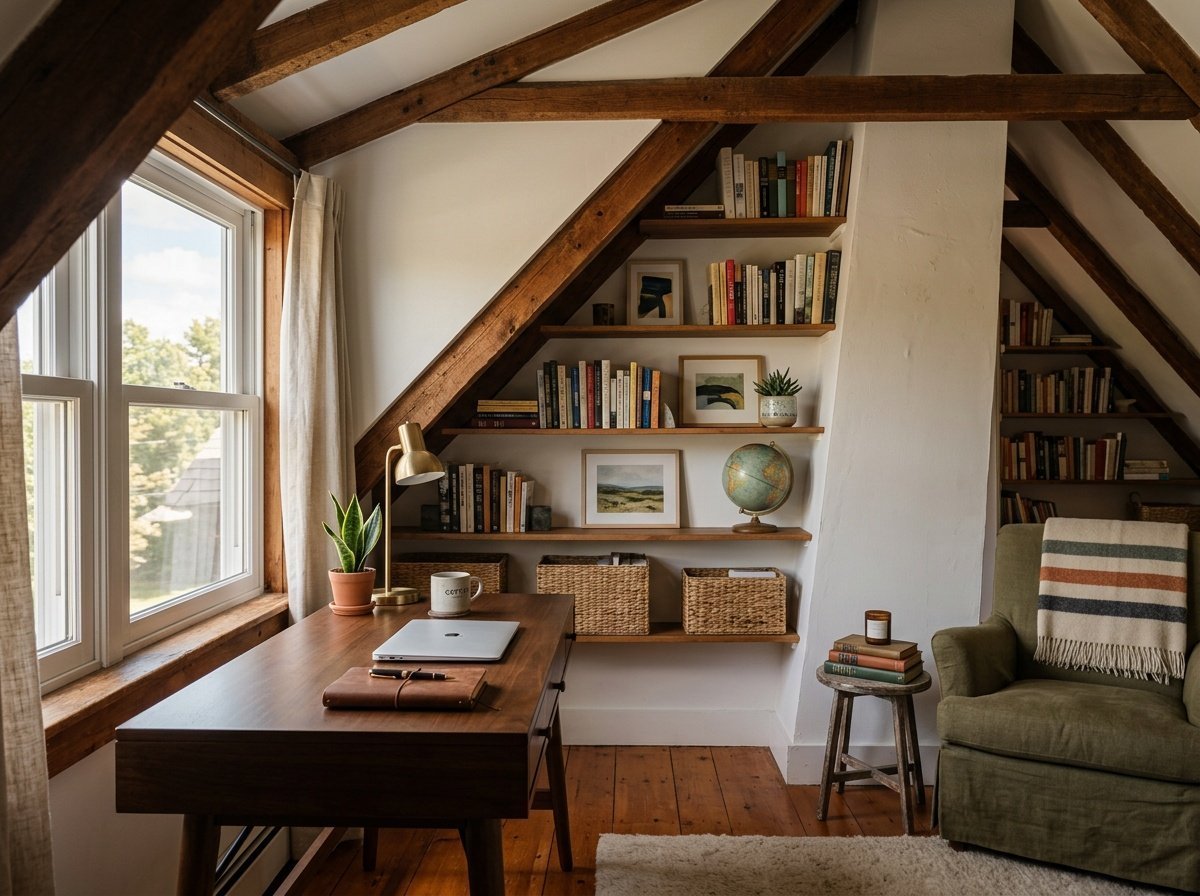
Structural and Floor Load Assessment
Most attic floors are built as ceiling joists for the room below — which means they’re typically not engineered to hold the weight of furniture, equipment, filing cabinets, and a full-time human. A structural engineer or experienced contractor can assess whether your joists need sistering (doubling up) or reinforcement before you proceed. This step alone can save you from a very bad day down the road.
The cost of joist reinforcement varies widely depending on span and material, but it’s almost always worth it. Budget for this as a non-negotiable line item, not an afterthought.
Headroom and Usable Square Footage
Building codes typically require at least 7 to 7.5 feet of ceiling height over a minimum floor area (usually around 50% of the room) for a space to be considered habitable. Measure your peak height and map out exactly where you’ll have full standing clearance. The sloped portions still count for desk placement and storage — they just require smarter thinking.
Insulation and Air Sealing
Attics are notoriously energy-inefficient without proper insulation. Before any finishing work begins, the roof deck or rafters need to be properly insulated — either with spray foam, rigid foam board, or dense-pack blown insulation between rafters. Air sealing around eaves, penetrations, and the attic hatch is equally critical. Skimping here will make your heating and cooling costs painful year-round.
Access and Egress
Is your current attic access a pull-down stair? You’ll likely need a proper staircase for a finished office. Also check local code requirements for egress windows — some jurisdictions require them in any habitable room for fire safety. Both can significantly affect your renovation budget and timeline.
| Assessment Item | What to Check | DIY or Pro? |
|---|---|---|
| Floor Load | Joist size, span, and spacing | Structural Engineer |
| Ceiling Height | Peak height + usable area map | DIY with tape measure |
| Insulation | R-value, coverage, air sealing | Insulation Contractor |
| Electrical | Panel capacity, existing wiring | Licensed Electrician |
| HVAC Access | Duct proximity, load calculation | HVAC Contractor |
| Egress / Access | Staircase feasibility, window code | Contractor + Building Dept. |
Solving the Attic Heat Problem: HVAC Options That Actually Work
Heat management is, without question, the most discussed — and most underestimated — challenge of any attic office conversion. Attics can swing from freezing in winter to suffocating in summer, sometimes within the same week. Getting climate control right isn’t optional; it’s the foundation of a functional workspace.
Extending Your Existing HVAC System
If your home has a forced-air system with available capacity, extending ductwork to the attic is one option. A Manual J load calculation by an HVAC contractor will tell you whether your existing equipment can handle the additional square footage. The challenge is that attics often sit at the end of the duct run, meaning reduced airflow by the time conditioned air arrives. Adding a booster fan or an additional return air grille can help balance the system.
Also consider that ductwork running through unconditioned attic space — before you’ve insulated — needs to be fully insulated itself to prevent energy loss. Plan duct routing early, ideally before drywall.
Mini-Split Systems: The Attic Homeowner’s Best Friend
Honestly? For most attic office conversions, a ductless mini-split system is the smarter play. A single-zone mini-split gives you precise temperature control independent of the rest of your home — which means you’re not heating or cooling the whole house just because you’re working late. Wall-mounted units are sleek and unobtrusive, and modern units are whisper-quiet.
The upfront cost is higher than extending ductwork in some cases, but the long-term efficiency often makes up for it. Look for units with a high SEER rating (18 or above) for the best energy performance. Installation typically requires a small penetration through the roof or exterior wall for the refrigerant line — your installer will advise on the cleanest routing.
Ventilation and Air Quality
Don’t overlook fresh air exchange, especially in a tightly insulated attic. An Energy Recovery Ventilator (ERV) or even a simple bath-fan-style exhaust with a timed intake can prevent the space from feeling stale during long work sessions. If you’re prone to working with windows open, consider adding a ceiling fan — the low clearance options designed for sloped ceilings are both functional and beautiful.
Making the Most of Knee-Wall Storage
One of the most underutilized design opportunities in an attic renovation is the space behind the knee walls — those short vertical walls that run along the sides of the room where the sloped roof meets the floor. Behind them is often dead, wasted space. With a little intention, it becomes your secret storage superpower.
Built-In Drawers and Pull-Out Shelving
Custom or semi-custom knee-wall built-ins are the gold standard. Flush-mounted cabinet doors that align with the knee wall paneling can hide an entire filing system, printer station, or archive storage. Deep drawers on full-extension slides are ideal for bulky items. If budget is a concern, IKEA’s PAX or SEKTION systems can often be adapted to fit knee-wall cavities with some creative carpentry.
Dedicated Equipment Zones
Consider reserving one knee-wall cavity specifically for tech infrastructure: your router, NAS drive, UPS battery backup, and cable management hub. Running all your tech cables to one hidden equipment closet keeps your actual workspace clean and tangle-free. Just make sure there’s ventilation in the cavity — electronics generate heat, and a sealed knee-wall pocket can get warm.
This kind of intentional zone planning is similar in spirit to the storage strategies I love for garage organization — dedicating zones to specific functions so everything has a home and nothing creates visual clutter.
Sloped Ceiling Desk Placement: Working With the Architecture
The slopes and angles that make attic spaces so visually interesting also require you to completely rethink standard office furniture logic. A six-foot straight desk shoved against a wall might leave you bumping your head — or worse, looking at a blank knee wall all day. Here’s how to work with the architecture instead of against it.
Centering the Desk Under the Peak
Placing your primary work surface directly under the ridge line — the highest point of the attic — gives you maximum headroom and creates a naturally commanding focal point. A freestanding desk here, oriented either toward the gable window or perpendicular to it, feels intentional and open. Add a statement pendant light overhead and you’ve essentially created the most dramatic home office backdrop imaginable.
L-Shaped and Corner Configurations
An L-shaped desk configuration can be particularly effective in attic spaces. One arm of the L sits under the peak for your primary monitor and work surface, while the secondary arm runs along the knee wall for a lower surface — perfect for a second monitor, a printer tray, or reference materials. The height difference created by the slope actually becomes a feature rather than a problem.
Built-In Desks Along the Slope
A custom built-in desk that follows the line of the slope can be stunning, especially when paired with open shelving above that steps up with the ceiling. This approach works beautifully in both Scandinavian-minimalist aesthetics (white lacquer, clean hardware, lots of negative space) and in warmer, more collected styles (stained wood, brass fittings, layered books). Just be mindful of monitor height — a built-in that’s too low for your eye line will strain your neck over time.
“The slope isn’t a problem to solve — it’s the whole personality of the room. Design around it, not despite it.”
Cable Management in Finished Attic Ceilings
Once your drywall is up, running cables becomes exponentially harder. This is the section I beg you to read before your contractor closes up the walls. Cable management in finished ceilings starts with planning, not with pretty cable sleeves after the fact.
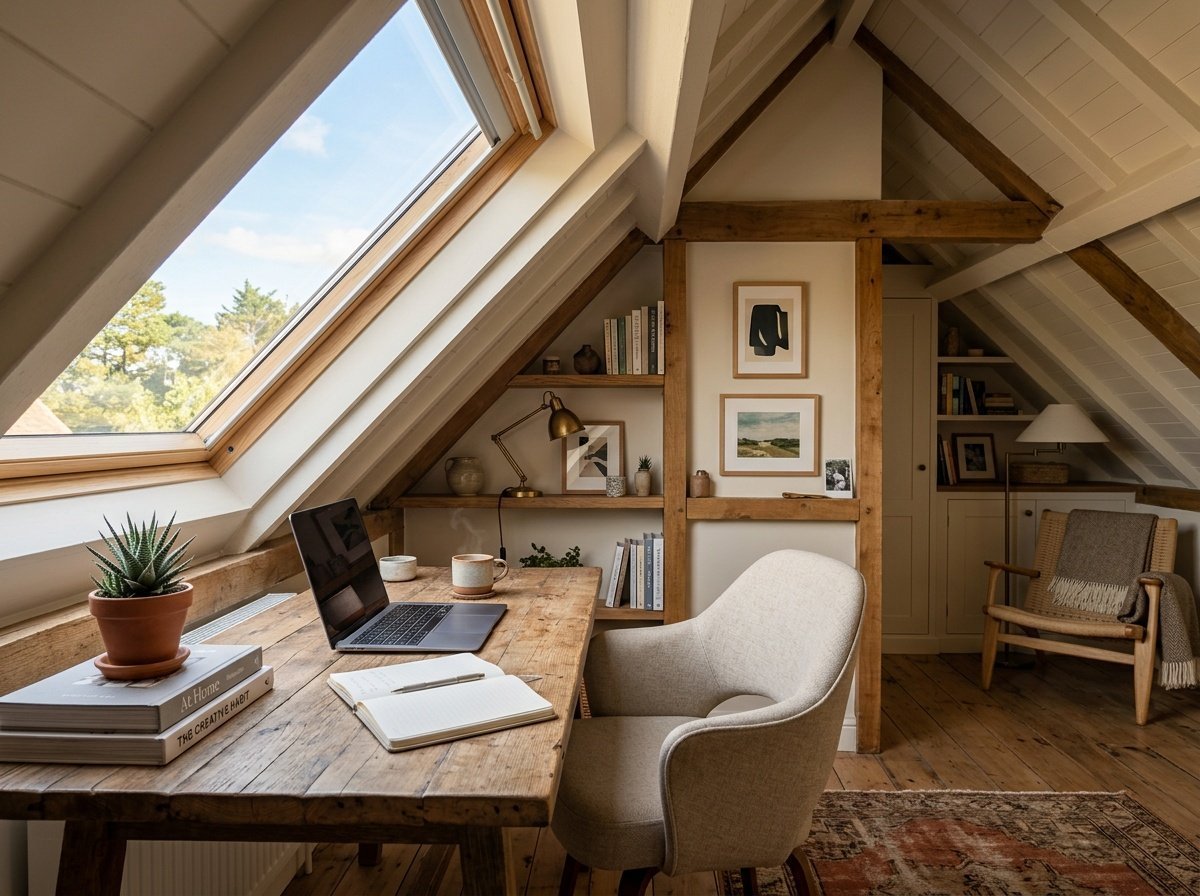
Rough-In Everything Before Drywall
Work with your electrician to rough in not just your outlets and lighting circuits, but also dedicated data conduit runs. Even if you don’t know exactly what technology you’ll need in three years, running empty conduit between key locations (desk area, equipment closet, ceiling light position) costs almost nothing at rough-in stage and saves a fortune later. Think of it as future-proofing your creative space.
Plan for at least one ceiling-level outlet near your desk peak for pendant lighting or a projector if you ever want one. A recessed floor outlet or desk grommet in your built-in is also worth discussing with your electrician while walls are still open.
Surface Raceway and Decorative Options
If you’re working with an already-finished attic, surface-mount cable raceways are your best friend. Paintable PVC raceways along baseboards or up the knee wall blend in surprisingly well when painted to match the wall. For a more elevated look, cable channels in a matte black or natural wood finish can actually look intentional — especially in an industrial or Japandi-inspired workspace.
Wireless-First Strategy
Embrace a wireless-first mindset: wireless charging pads, Bluetooth peripherals, and a mesh Wi-Fi node in the attic equipment closet can eliminate the need for most data runs to the desk. Reserve hardwired ethernet for your NAS or desktop tower only. Every cable you eliminate is one you don’t have to manage.
Design Styles That Shine in Attic Offices
This is the part I love most — because attic spaces have an inherent intimacy and character that makes almost every intentional design style feel more cinematic up here. The sloped ceilings, the dormer windows, the sense of being slightly removed from the world below — it all plays beautifully into a few particular aesthetics.
Minimal Scandinavian
White-washed pine floors, white-painted tongue-and-groove ceiling panels, a simple white oak desk, and a single arched floor lamp. That’s it. The restraint is the point. In this style, the architecture speaks and the furniture whispers. Keep accessories to a single potted plant and a ceramic mug. The sloped ceiling becomes a canvas of clean, quiet intention.
For color guidance in understated, calming palettes — the kind of earthy, calming tones trending right now — don’t be afraid to borrow from adjacent design categories. Warm whites, soft greiges, and muted sage all translate flawlessly to a Scandi attic office.
Cozy Library Vibes
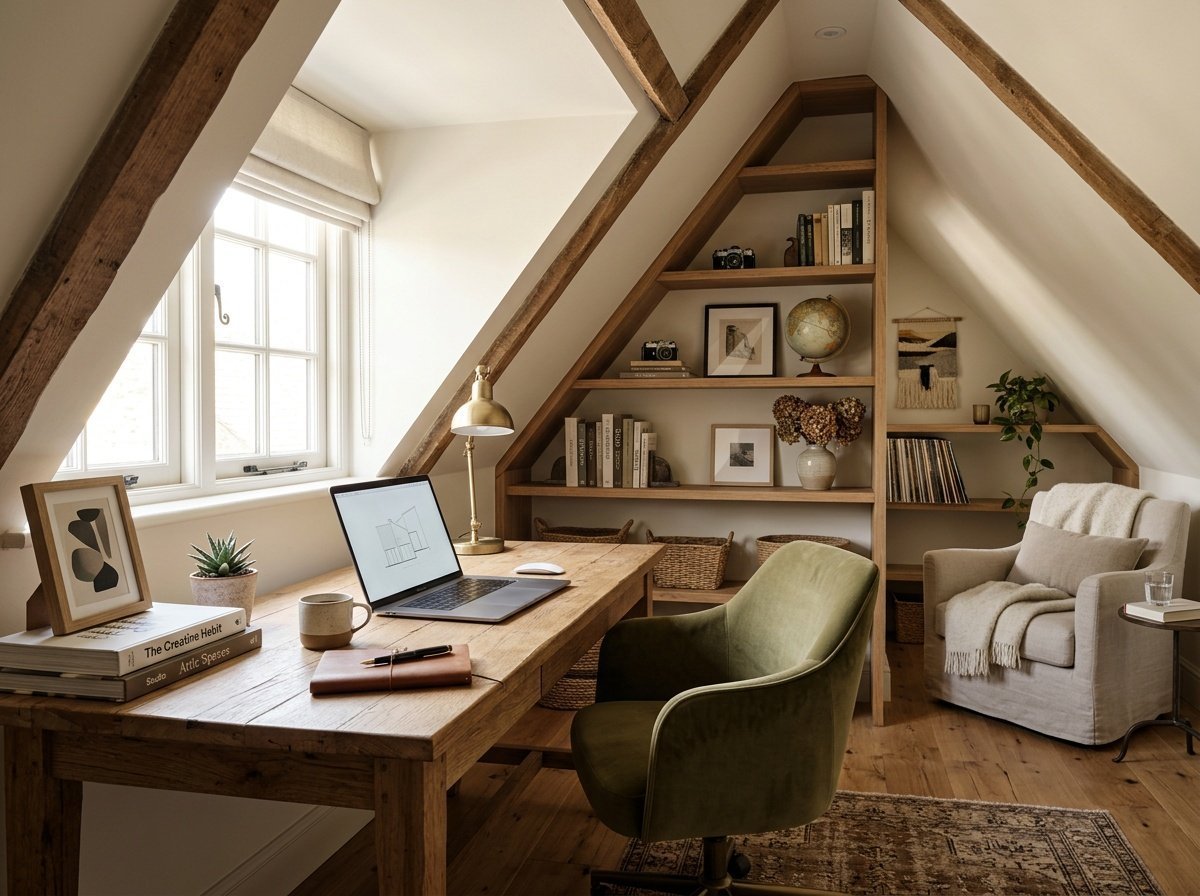
Dark-stained built-in bookshelves lining every available knee wall. A leather or velvet reading chair tucked under a dormer window. A Persian rug over warm hardwood floors. Edison bulb pendants casting amber light. This style leans into every romantic notion of what an attic study should be — and it delivers. The sloped ceiling, rather than limiting the space, creates a sense of canopy and enclosure that feels deeply intimate.
Think deep jewel tones on the knee-wall cabinetry — forest green, navy, burgundy — paired with natural wood and brass hardware. Stack books horizontally on some shelves, vertically on others. Add a few framed vintage prints and a proper desk lamp with a linen shade.
Organic Modern / Japandi Hybrid
This style is having a moment — and it works exceptionally well in attic offices. Think warm-toned concrete-effect walls (achieved with limewash paint), natural linen curtains at the dormer, a live-edge walnut desk, and woven pendant lighting. The material palette is tactile and grounded, the mood is focused and calm. It’s the space that makes you want to close your laptop and just be for a moment before getting back to it.
If you’re renovating other parts of your home simultaneously, the same principles that make inexpensive family room updates feel elevated — layered textures, intentional lighting, and organic materials — apply perfectly to the attic office on a manageable budget.
Lighting an Attic Office: Natural and Artificial
Light in an attic office can be magical or miserable, depending entirely on how intentionally you approach it. The goal is a space that feels luminous during the day and warm and focused at night.
Maximizing Natural Light
Gable-end windows are your primary natural light source — but if you can add a dormer or a skylight, the transformation is remarkable. A well-placed skylight over the desk area floods the peak with diffused daylight that reduces eye strain on screens. Velux-style venting skylights also add passive ventilation, which is a double win in an attic.
If skylights aren’t in the budget, consider tubular skylights (also called sun tunnels) — they’re significantly less expensive to install and can bring daylight into areas where a full skylight would be structurally complicated.
Layered Artificial Lighting
Attic offices need at least three layers of lighting: ambient (overall illumination), task (focused desk lighting), and accent (shelves, artwork, atmosphere). Recessed lighting in the sloped ceiling works beautifully for ambient — just ensure they’re rated for insulated contact (IC-rated) and properly air-sealed. Add a quality adjustable desk lamp for task work and consider LED strip lighting inside knee-wall shelving for a warm glow that makes the space feel collected even after dark.
Budgeting Your Attic Office Conversion
Let’s talk money — because a beautiful vision needs a realistic framework. Attic conversions vary enormously in cost depending on your existing conditions, local labor rates, and finish level. Here’s a general way to think about it.
Budget-Tier Conversion ($8,000–$15,000)
At this level, you’re likely doing structural reinforcement, basic insulation, a mini-split unit, electrical rough-in, drywall, and paint — with simple furniture and minimal built-ins. The bones are done right; the styling is DIY. This is a perfectly respectable starting point, especially if you layer in custom elements over time.
Mid-Range Conversion ($15,000–$35,000)
This range opens up proper stair access, higher-spec insulation and air sealing, a higher-end mini-split, knee-wall built-ins, a custom desk, engineered hardwood flooring, and quality lighting. Most of the projects you see styled beautifully online fall in this range when you factor in both construction and finish.
High-End or Full Renovation ($35,000+)
A full gut renovation with structural changes, dormers, custom millwork, premium HVAC, heated floors, and designer finishes. This level of investment genuinely adds to home resale value, especially in markets where square footage commands a premium. If you’re considering this scale, it’s worth consulting with a designer early to maximize every decision. The same way a thoughtful low-ceiling basement design can transform an awkward space into something genuinely valuable, a well-executed attic conversion adds livable square footage that the market responds to.
Frequently Asked Questions
Is an attic home office conversion worth the investment?
In most cases, yes — particularly if the alternative is renting external office space or if you’re in a market where finished square footage adds meaningful resale value. The key is ensuring the structural and HVAC work is done properly, which protects both the investment and your daily comfort.
How do I keep an attic office cool in the summer?
A ductless mini-split is typically the most effective solution for summer cooling in an attic office. Combined with proper rafter insulation (spray foam is particularly effective at blocking radiant heat from the roof deck), you can maintain a comfortable temperature even in peak summer. A ceiling fan rated for sloped ceilings helps with air circulation too.
Do I need a building permit to convert my attic into an office?
Almost certainly yes — especially if you’re adding electrical circuits, HVAC, structural modifications, or egress windows. Permit requirements vary by municipality, so check with your local building department before work begins. Working without permits can create serious issues at resale and may affect your homeowner’s insurance.
What is the minimum ceiling height for an attic office?
Most residential building codes require a minimum ceiling height of 7 feet over at least 50% of the finished floor area for a space to be classified as habitable. Below 5 feet typically doesn’t count toward usable area at all. Measure your peak carefully before making any assumptions about usable square footage.
Can I use IKEA furniture in an attic office with sloped ceilings?
Absolutely — with some creative adaptation. The PAX wardrobe system and SEKTION cabinets are particularly well-suited to knee-wall applications. Many DIYers build custom face frames around IKEA cabinet bodies to create a seamless built-in look at a fraction of the custom millwork cost. Just measure your knee-wall depth carefully before purchasing.
How do I run ethernet cable in a finished attic ceiling?
If walls are already closed, your best options are a wireless mesh extender in the attic, running cable through surface-mount raceways along the baseboards, or hiring an electrician to fish cable through the existing wall cavities. If you’re mid-renovation, always run conduit before the drywall goes up — it’s the single easiest way to future-proof your wiring.
What flooring works best in an attic home office?
Engineered hardwood is a top choice — it handles temperature and humidity fluctuations better than solid hardwood, which is important given the thermal swings an attic space can experience. Luxury vinyl plank (LVP) is a budget-friendly alternative that also performs well in variable conditions. Avoid solid hardwood and standard laminate unless climate control is very consistent.
Your attic has been waiting up there, full of potential and probably full of boxes that haven’t been opened since the last move. Transforming it into a home office in the attic is one of the most personally rewarding renovations you can make — a space that’s entirely yours, shaped exactly the way you think and work and breathe. Start with the checklist, take your time with the design, and don’t rush the infrastructure decisions. Get those right, and the rest is just the beautiful part. And if the attic turns out to be more project than you want right now, a backyard shed is often the cheaper route to the same thing — our she shed ideas cover what that looks like in practice. If you’re ready to start mapping out your vision, I’d love to hear what style is calling to you — drop it in the comments below. ☕