
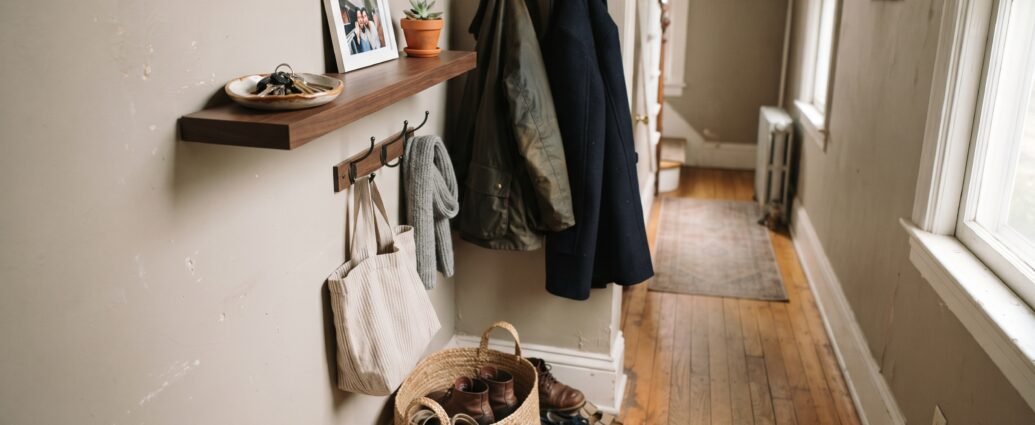
I’ll be honest — for almost two years, our front door opened onto a pile of shoes, a stroller nobody used anymore, and a stack of mail I kept meaning to sort. The whole “entryway” was about three feet of hallway between the door and the stairs, and every single day I walked through it and felt a little worse about coming home. I kept waiting until we could afford to “do the entryway properly” — knock out a closet, add a bench, the whole thing. What actually fixed it took one Saturday and less than sixty dollars, and I wish I’d done it in month one instead of year two.
If your entryway is small — really small, not “small” in a magazine-humble-brag way — this one’s for you. No renovation, no knocking down walls, no pretending you have a mudroom when you have a hallway. Here’s what actually works when square footage is the one thing you don’t have.
Start With What the Space Actually Needs to Do
Before you buy anything, it helps to get honest about what your entryway’s real job is. Not what it looks like in a catalog — what happens there every day. For most of us, that’s: shoes come off, coats come off, keys and mail land somewhere, and the dog gets a leash on or off. That’s it. Four jobs.
A small entryway doesn’t need a bench, a closet, a full gallery wall, and a boot tray to do those four jobs. It needs one spot for each. Once I stopped trying to fit a whole “entryway concept” into three feet of hallway and solved for shoes, coats, keys, and mail instead, the space actually started working. If you want more decor inspiration once the function is handled, our favorite entryway decor ideas is a good next stop.
Solving for the jobs instead of the concept is what rescues every tight room in a house. It’s the same move that makes a small dining room work, where seating and walking room matter far more than the sideboard you can’t fit.
The gut-check: stand in your entryway and picture yourself walking in with your arms full. Where would you naturally want to set things down? That’s where storage should go — not where it looks best on paper.
The One Thing to Buy First: A Landing Zone
If you do nothing else, get a landing zone — a shallow dish, a small tray, or a mounted shelf by the door for keys, wallet, sunglasses. This was the sixty-dollar fix I mentioned. I screwed a floating shelf into the wall by our door (one that was already there, unused, above the coat hooks) and set a $9 dish on it. Keys stopped disappearing into couch cushions within a week.
Splurge: a wall-mounted console shelf with a drawer, $80–150.
Free option: a bowl you already own, set on a windowsill or the top of a shoe rack. It doesn’t need to match anything. It only needs to exist.
Small Entryway Layout Ideas (Even 2 Feet Counts)
Most “small entryway” advice assumes you have at least a little floor space to work with. Here’s what to do when you genuinely don’t.
If you have a wall but no floor space
Go vertical. A row of hooks, a slim shelf, or a wall-mounted cubby system uses zero floor space and does the job of a closet. Smart storage solutions like these are worth a look if you’re working with wall space only — a lot of the ideas scale down fine for a narrow hall.
If you have a corner but no wall
An over-the-door hook rack or a slim corner shelf (even a $15 one from a hardware store) can hold coats and bags without eating into your walking path. Corners get skipped constantly and they’re often the only “extra” space a tiny entryway has.
If you have neither
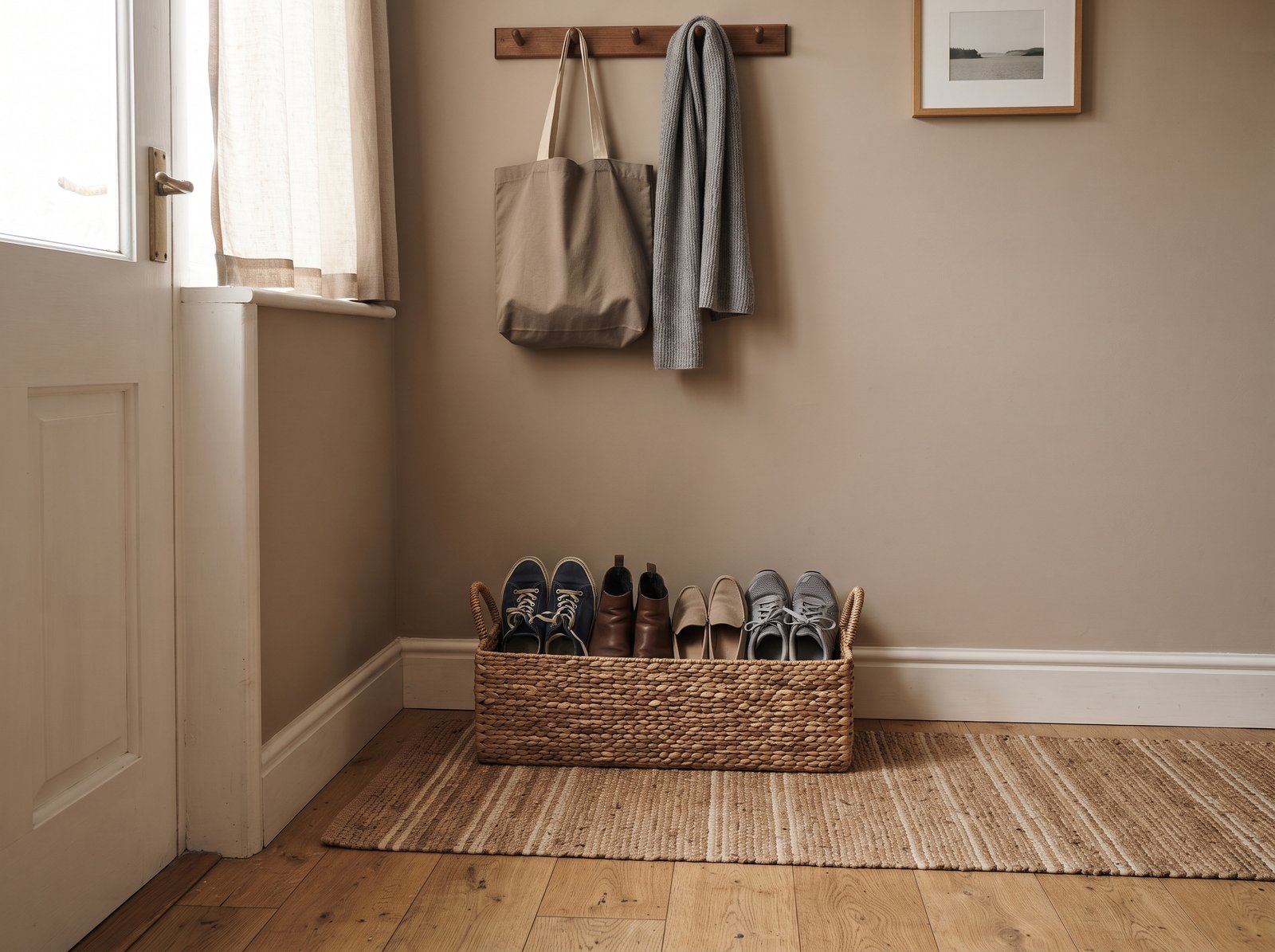
This is the real no-space scenario — a straight hallway with doors on both sides. Here, a single hook strip mounted at 60 inches (coat height) plus a small basket on the floor for shoes is genuinely enough. I lived this way in an apartment for three years. It’s not glamorous, but it works, and it looks intentional instead of chaotic once everything has its one spot.
For more layout thinking specific to tight spaces, this entryway storage solutions post goes deeper on exactly this problem.
Bench or No Bench? What Actually Fits
Everyone wants an entryway bench because it looks so good in photos. Here’s my honest take: a bench needs at least 18 inches of depth to be usable, and in a lot of small entryways, that’s the whole hallway. If you have the depth, a bench with storage underneath (baskets or cubbies) earns its space by doing two jobs at once. If you don’t, skip it — don’t force a bench into a spot where it becomes a place to trip over your own shoes.
Splurge: a slim storage bench built for tight spaces, roughly $150–250.
Free/budget option: a low stool you already own, or just a floor mat that visually marks “this is where shoes go” without taking up permanent furniture space. Shoe racks, hooks, and benches — the actual essentials walks through which of these earns its footprint and which doesn’t.
Vertical Storage: Your Best Friend in a Tight Entryway
I said this above but it’s worth its own section because it’s the single biggest mindset shift for a small entryway: stop thinking about the floor and start thinking about the wall. A narrow entryway can hold a surprising amount of stuff between waist height and the ceiling — you just have to actually use that space instead of leaving it blank.
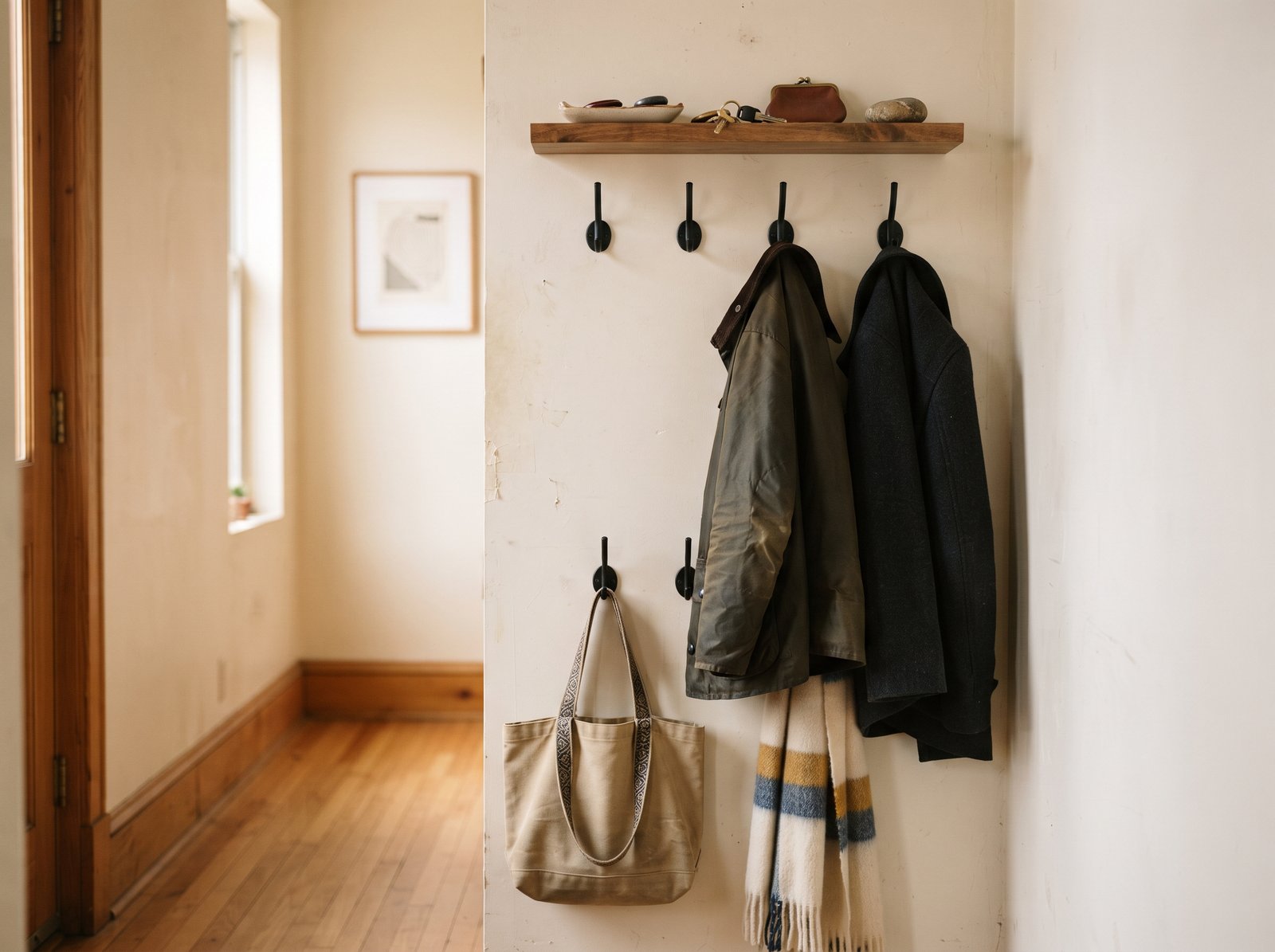
- Hooks at two heights (one row for adults, one lower row for kids or bags) turn one wall into double the hanging space.
- A shallow wall cubby — even 6 inches deep — holds mail, sunglasses, and a phone charger without eating the walkway.
- Over-the-door organizers meant for closets work just as well on the back of a coat closet door or even a bedroom door near the entry, if that’s the closest thing you’ve got.
None of this requires a contractor. Most of it is a stud finder, a level, and an afternoon.
Mudroom Envy? Here’s What Actually Transfers
I know “mudroom” posts are everywhere, and I know most of us do not have a mudroom — we have a doorway. The good news is that the principles behind a great mudroom (dedicated zones, everything off the floor, a place for wet or dirty items) scale down fine to a three-foot entry. You don’t need the room. You need the system.
If you do have a little more space to work with — even a stretch of garage or a converted closet — this mudroom design guide and this one on creating a practical, stylish mudroom are worth reading for the zoning ideas alone, even if you scale them way down. And if a clutter-free drop zone is the actual goal (it usually is), this piece on keeping a mudroom clutter-free has the honest version of how to keep it that way past week one.
For a lot of us the extra space isn’t a garage at all — it’s the bottom of the basement stairs, where the washer already is. That corner takes the same zoning treatment, and it has the advantage of being somewhere wet coats and muddy boots can drip without anyone minding. Our basement laundry room ideas covers the lighting and floor side of making that corner somewhere you don’t mind standing.
Renter-Friendly Small Entryway Ideas
I couldn’t drill into walls for years, and most of what I’ve described above still works without a single hole:
- Command hooks rated for coats (check the weight limit — the light-duty ones will let you down within a month).
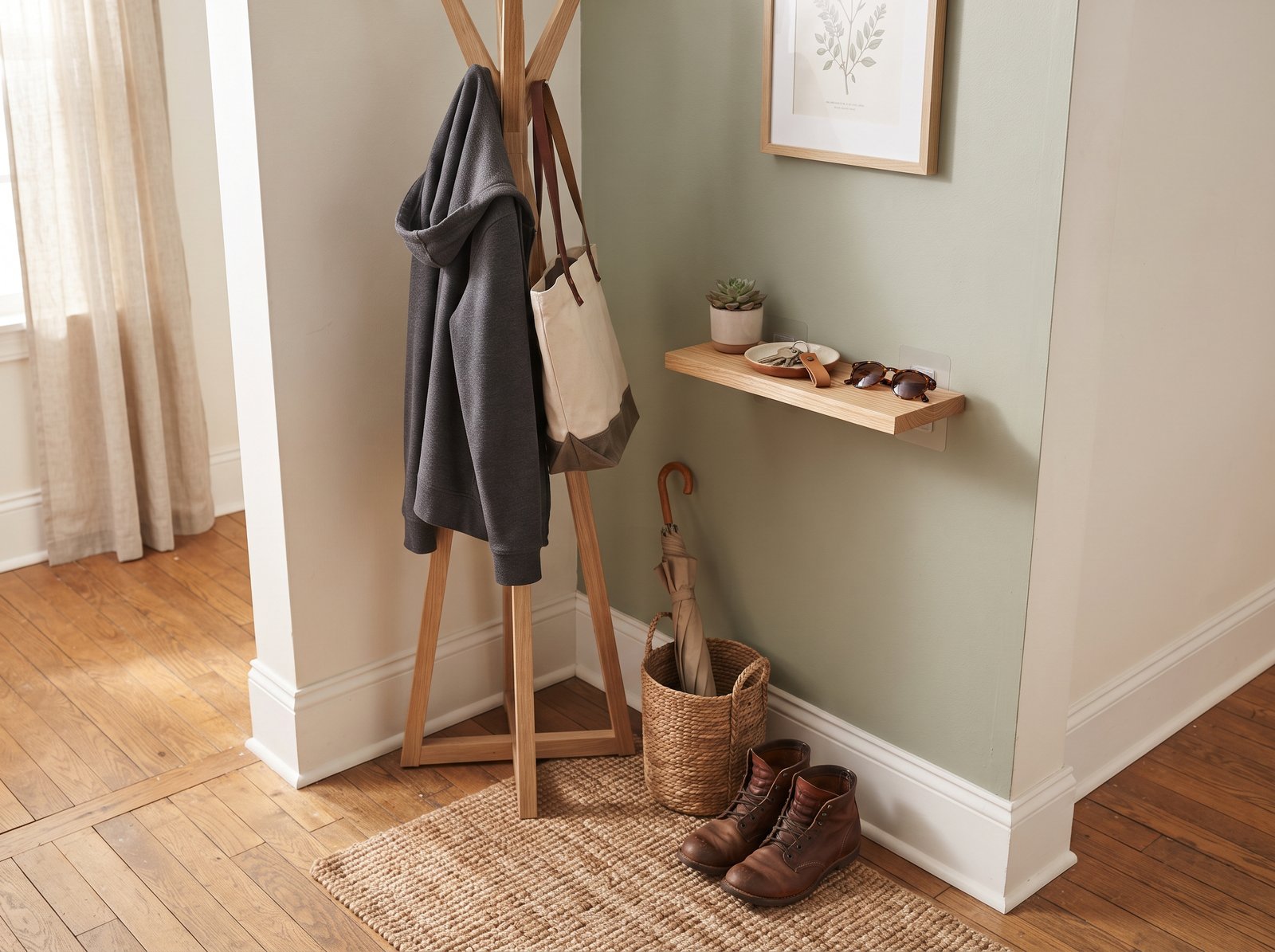
- A freestanding coat rack instead of wall hooks, tucked into a corner.
- Adhesive-backed shelving for a landing zone, no screws required.
- A floor basket for shoes — zero installation, all function.
- Peel-and-stick wallpaper or a runner rug to make the space feel finished, both fully removable when you move.
None of these need approval from a landlord, and all of them come out clean with you when your lease ends.
Make It Feel Like Yours, Not Just Functional
Once the shoes-coats-keys-mail system is solid, there’s room for a little personality — and this is where a small entryway actually has an advantage over a big one. You only need to fill a few square feet, so it’s cheap to make it feel good.
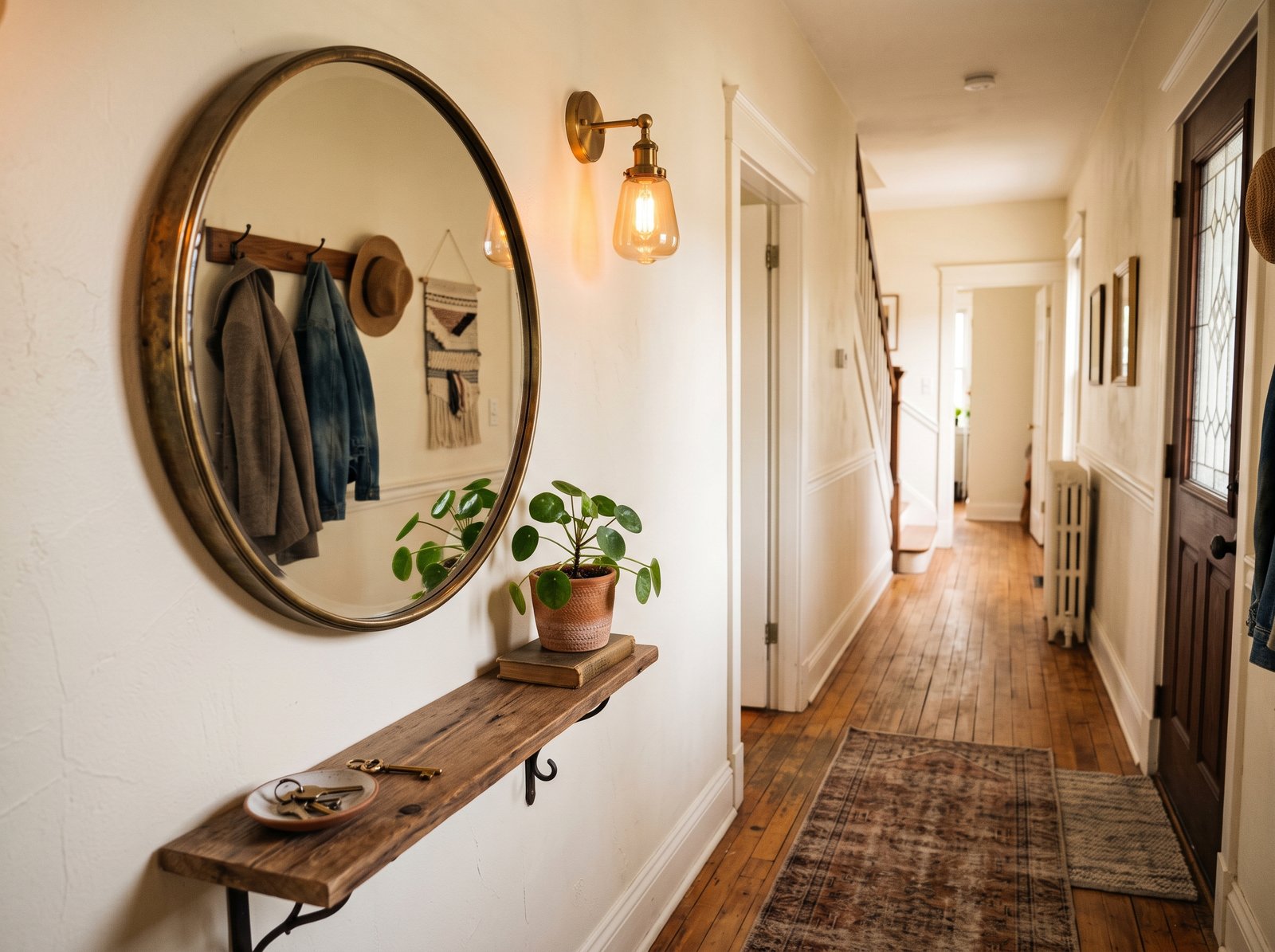
A small mirror (bonus: it makes a narrow hallway feel wider), one piece of real or faux greenery, and a light source that isn’t the harsh overhead bulb go a long way. Entryway styling secrets like these cover the finishing touches once your storage system is actually working — decor is the last 10%, not the first move.
Splurge: a vintage mirror with some character, $60–200 depending on where you look.
Free option: move a mirror you already own from another room. I did this with one from our guest room for a full year before buying anything new for the space, and it worked just as well.
A Seasonal Refresh, Not a Seasonal Overhaul
Small entryways take a beating from weather — wet boots, dropped mittens, sand in the summer. Rather than redecorating four times a year, keep the bones the same and swap one or two things: a washable rug for winter, a lighter basket liner for summer, a small tray by the door specifically for wet umbrellas during rainy stretches. This guide to refreshing an entryway seasonally has specific swap ideas if you want to build out a rotation instead of reinventing the whole space each season.
Mistakes I’d Skip If I Did This Again
The embarrassing part first: I bought a beautiful woven basket for shoes before I ever measured whether shoes would actually fit in it standing up. They didn’t. It sat there, half-empty, looking nice and doing nothing, for months.
A few other things I’d do differently:
- I bought decor before storage. Should’ve been the other way around — the landing zone and hooks first, everything pretty after.
- I tried to fit too many “zones.” A shoe zone, a bag zone, a mail zone, a pet zone — in three feet, you get maybe one and a half zones. Pick what actually gets used daily and let the rest go.
- I ignored the door swing. Measure how far your door opens before you put anything on the floor. I learned this one the hard way with a bench that blocked the door from opening fully.
You Don’t Need More Space, Just a Better System
Here’s the thing I actually believe about small entryways: the size was never really the problem. Mine is still three feet wide today. What changed is that everything in it now has exactly one job and one spot, and I stopped trying to make it do more than a doorway reasonably can. That’s the whole shift — not a bigger room, just a system that fits the one you’ve got.
You’re going to walk through your door tonight and, for the first time in a while, not step over anything. That’s genuinely the whole point.
Go clear one flat surface by your front door this week. Put a dish or a tray on it. Tell me how many days it takes before your keys stop disappearing. — Quinn
What’s the most important thing for a small entryway?
A single landing zone for keys, wallet, and mail. It sounds too small to matter, but it’s the one fix that stops daily chaos before it starts, and it costs almost nothing to set up.
Do I need a bench in a small entryway?
No — only if you have at least 18 inches of depth to spare. If you don’t, a bench becomes something you trip over rather than something you use. A floor mat or low stool can mark the “shoes off here” spot just as well.
How do I add storage without renovating?
Go vertical instead of wide. Hooks, shallow wall cubbies, and over-the-door organizers add real storage without touching the floor plan, and most install with nothing more than a stud finder and a level.
What if I don’t have a proper entryway at all, just a door that opens into a hallway?
That’s the most common version of this problem, and it’s completely workable. A hook strip at coat height plus a basket for shoes covers the essentials in even the narrowest hallway.
How do I make a small entryway feel bigger without renovating?
A mirror is the cheapest trick that actually works — it bounces light and visually doubles the width of a narrow space. Pair it with a lighter rug and a warmer bulb than the standard overhead light, and the whole space reads bigger even though the footprint hasn’t changed.


2 Comments