
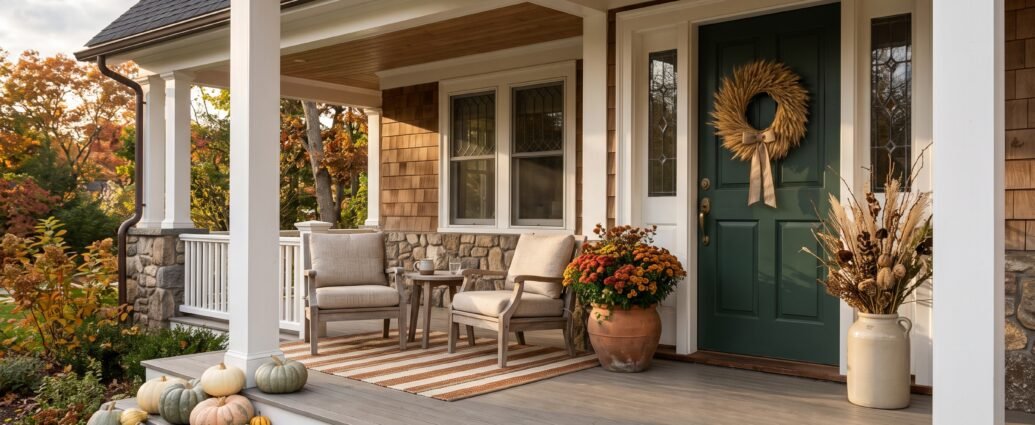
A front porch is the only room in your house that strangers see. It is also, in most homes, the one that gets the least design thought — a mat, maybe a chair nobody sits in, and one mum bought in a panic on the first cold Saturday in October.
The good news is that a porch responds to decorating faster than almost anywhere else, because the bar is low and the fixes are cheap. The entire difference between a porch that looks styled and one that looks decorated is almost always scale and grouping — not how much money went into it.
Below are eighteen fall porch decor ideas with real costs, real plant sizes, and the specific things that go wrong: mums that die in nine days, pumpkins that rot into the concrete, and decor that blows into the neighbour’s yard the first windy night.
The two rules that fix most porches
Go bigger than feels right. Outdoor space swallows scale. A planter that looks enormous in a store looks modest on a porch, and a single 8-inch mum next to a 36-inch door looks like an apology. The most common mistake by a wide margin is buying decor sized for indoors.
Group in odd numbers at varied heights. Three pumpkins in graduated sizes beats five identical ones in a row. Two planters of different heights beats a matching pair. This is the same principle that governs a mantel, applied outdoors — we break the logic down in our fall mantel decor guide, and it transfers directly.
Plants and greenery
1. Chrysanthemums, bought at the right stage
Mums are the default for good reason — they are cheap and they are the right colours. Expect $8 to $15 for an 8 to 10 inch pot and $20 to $35 for a 12-inch. Skip the 6-inch grocery-store ones entirely; they read as small from the street and they dry out in two days.
Buy them in tight bud, not full bloom. A mum in full flower at purchase is already halfway through its display life. One that is 70 percent buds will look good for four to six weeks instead of ten days.
The failure mode: letting them dry out. This is the number one reason porch mums die, and it is not close. A blooming mum in a nursery pot in warm September weather may need water daily — sometimes twice on a hot day. Slide the nursery pot inside a decorative planter rather than transplanting, so you can lift it out and water it thoroughly at the hose.
Colours: bronze, rust, burgundy, dusty rose, cream and soft yellow all sit in a muted autumn palette. The bright school-bus yellow and hot magenta varieties fight almost every house colour there is.
2. Ornamental grasses for height
Purple fountain grass, muhly grass and switchgrass all give you 24 to 40 inches of movement and texture for $15 to $30 a pot. They are also considerably more drought-tolerant than mums, which makes them the low-maintenance choice.
3. Kale and cabbage as the long-haul option
Ornamental kale and flowering cabbage run $5 to $12 a plant and — unlike mums — genuinely improve as the weather cools. Their colour deepens after the first frost. In most climates they carry a porch from October well into December.
4. Trailing ivy and creeping jenny
$4 to $8 a pot, and the job they do is disproportionate: something spilling over a planter edge is what makes an arrangement look designed rather than potted. Tuck one into the side of any large planter.
5. Cornstalks or a wheat sheaf at the columns
Dried cornstalks bundled and tied to a porch column or lamp post cost $12 to $25 a bundle and give you 5 to 7 feet of vertical instantly. Tie them at two points, not one, or they splay.
Pumpkins, gourds and the colour problem
6. Heirloom varieties instead of orange
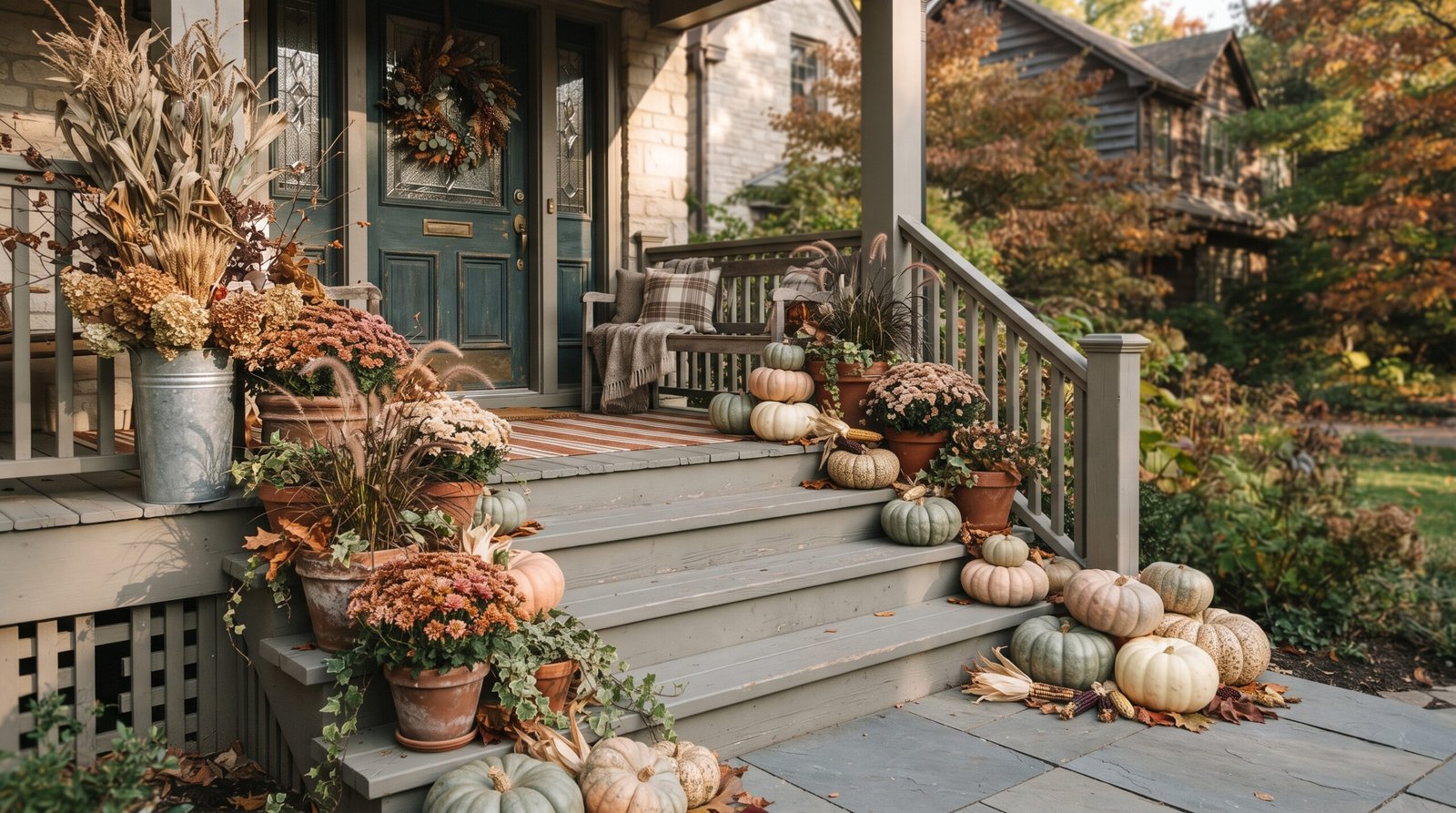
This is the single highest-impact decision on the whole porch. Sage-green Jarrahdale, cream Lumina, blue-grey Blue Doll, buff Long Island Cheese and peach Porcelain Doll pumpkins land inside a muted autumn palette. Standard orange field pumpkins mostly do not, which is why so many porches slide into Halloween territory without meaning to.
Costs: $2 to $4 for minis, $8 to $18 for a medium heirloom, $20 to $40 for a large specimen variety. Farm stands beat grocery stores on price, and often on variety.
7. Group them in threes and fives
Graduated sizes clustered at the base of a planter or on a step corner. Not evenly spaced along a step edge — that reads as a display, not a composition.
8. Raise them off the ground
Real pumpkins in direct contact with damp concrete or wood rot from the bottom, often within two weeks, and they leave a stain that is genuinely hard to get out of unsealed wood. Set them on a slate tile, a slice of wood, a woven mat or a shallow tray. Wiping the outside with a diluted vinegar solution when you bring them home slows surface mould meaningfully.
Squirrels: if your neighbourhood has them, they will chew real pumpkins. Faux is the only reliable answer, or accept it as a seasonal cost.
9. Fabric and painted alternatives
If rot and squirrels have beaten you before, cloth pumpkins are worth the swap — they store flat and last for years. Our tutorial for no-sew fabric pumpkins makes them in linen and velvet for a few dollars each. On a covered porch they hold up fine.
Containers, textiles and the floor
10. Aged terracotta over plastic
Terracotta is the single most underrated porch upgrade. A 12-inch pot runs $15 to $30, ages beautifully, and reads as expensive in a way plastic never will. To speed the patina, brush on a thin slurry of plain yogurt or buttermilk and leave the pot somewhere shaded — it encourages the algae and mineral bloom that takes years otherwise.
Cheaper route: paint the plastic pots you already own. Our guide to painting and personalising terracotta pots covers the technique, and the same masonry-paint approach works on plastic with a bonding primer underneath.
11. An outdoor rug to define the space
A jute-look polypropylene rug is $40 to $120 for a 5×7 and it does more than anything else to make a porch read as a room rather than a walkway. Get a synthetic jute-look rather than real jute — actual jute holds moisture and mildews outdoors.
Size it so the front chair legs sit on the rug, or go runner-length along the length of a narrow porch.
12. A layered doormat
A large coir mat, roughly 30×48 inches, with a smaller patterned mat layered on top. Total cost $30 to $70, and it is the cheapest way to add pattern outdoors without committing to it.
13. Warm textiles on the seating
Two outdoor pillows in rust or ochre and one chunky knit throw over a chair arm changes a porch more than another planter would. Budget $25 to $60 per pillow for solution-dyed acrylic that will not fade in a season, and bring the throw in when rain is forecast. If you want to make your own, our DIY fall throw and pillow projects covers it.
Lighting, which everyone skips
14. Lanterns with real or LED pillars
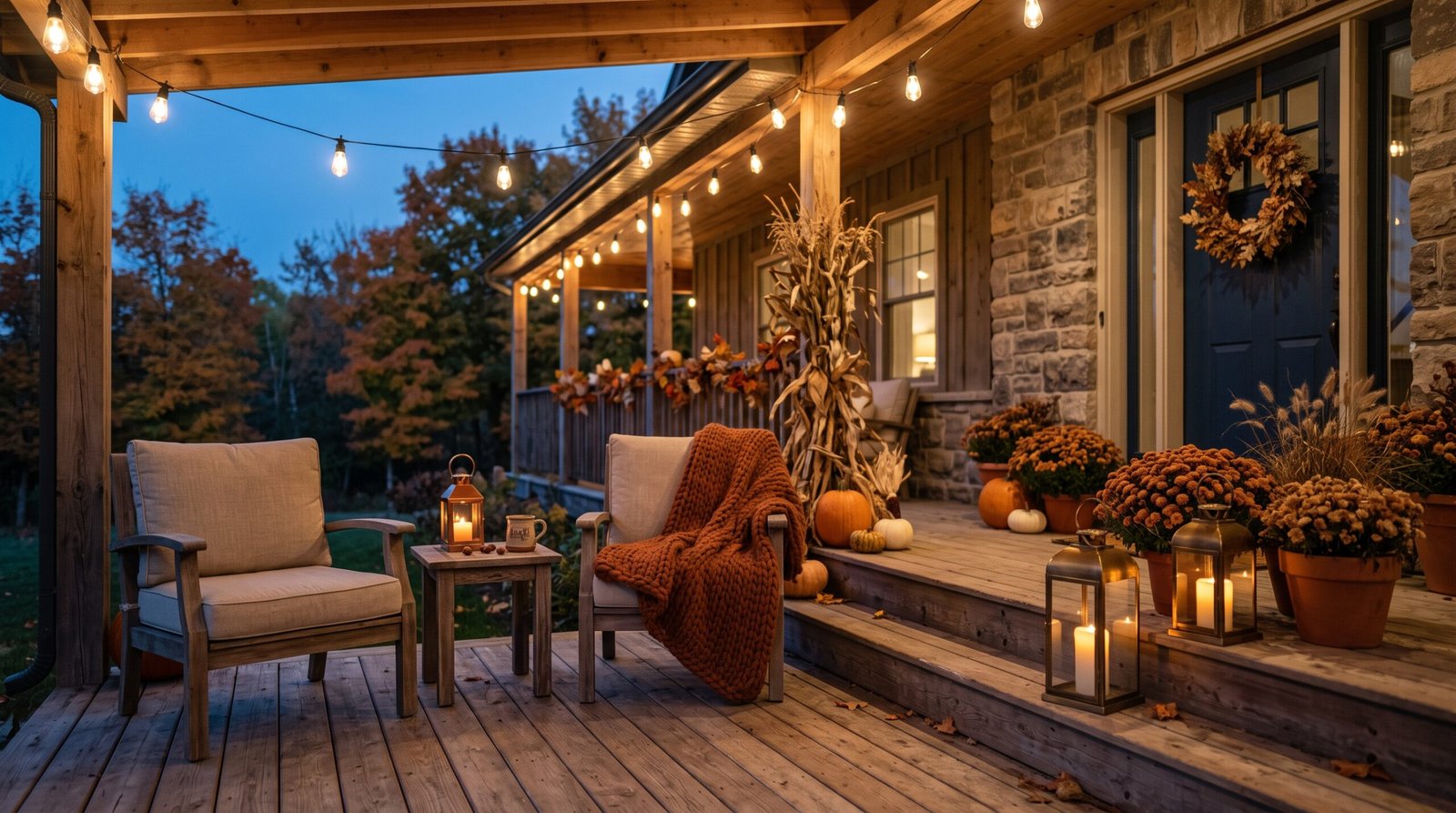
Two lanterns of different heights — say 16 inches and 22 inches — flanking a door or staggered on the steps. Metal and glass lanterns run $25 to $70 each. Battery pillar candles with a warm flicker and a built-in timer are $12 to $25 for a set of three and they turn themselves on at the same time every evening, which is the entire point.
15. String lights along the porch ceiling
Warm-white commercial-grade string lights with clear bulbs, run along the porch ceiling edge or the roofline, cost $25 to $60 for a 48-foot strand. Look for a 2200K to 2700K colour temperature — anything cooler reads blue and clinical against warm autumn colours.
16. A path or step light
Solar step lights at $20 to $50 for a set of four are function first and decor second, but a porch you can safely walk up in the dark at 5:30pm in November is a porch that actually gets used. Warm white only.
The door itself
17. A wreath, sized correctly
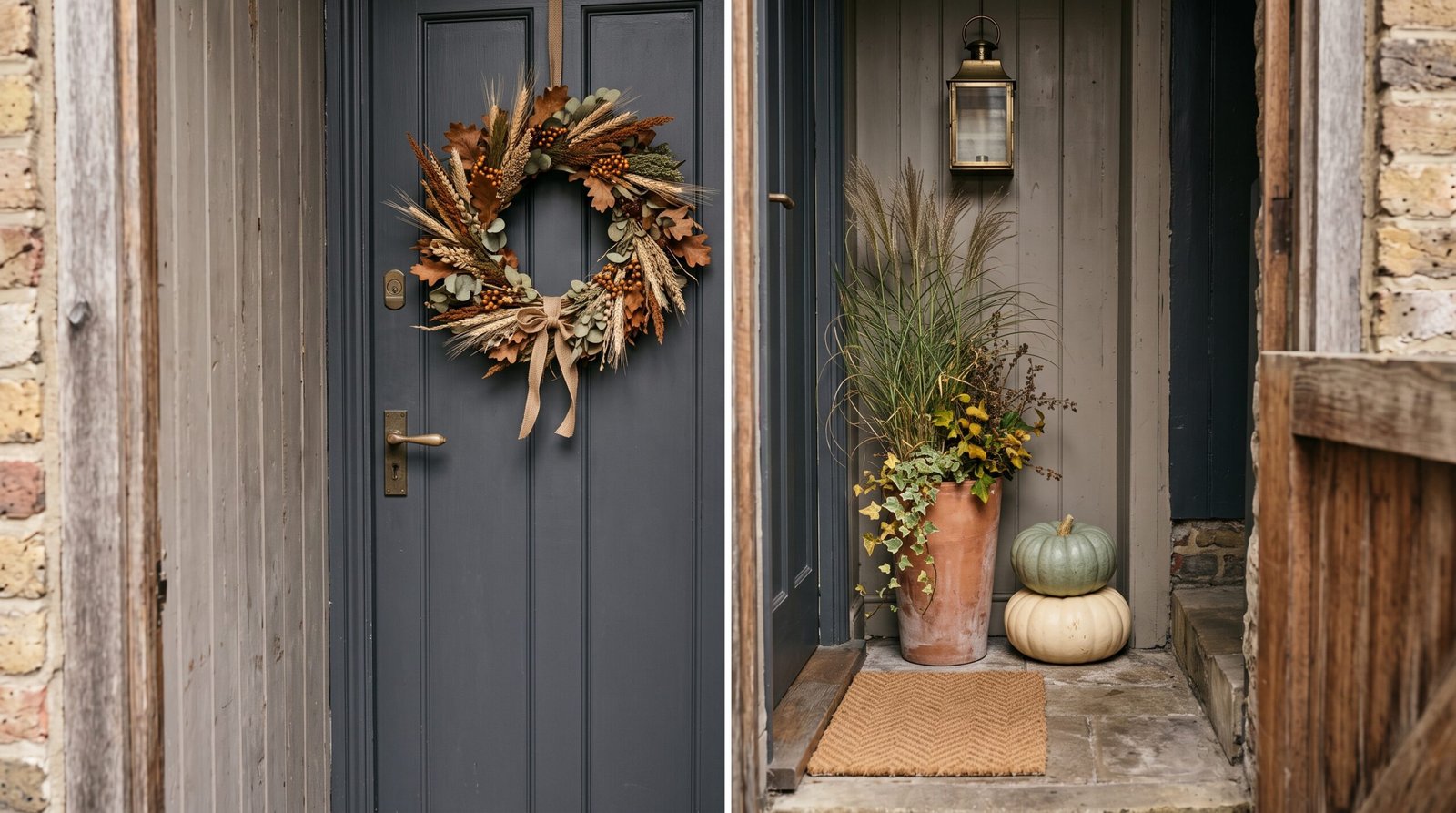
The single most-photographed element on any porch. Size it to roughly half to two-thirds of your door width — 18 to 24 inches finished on a standard 36-inch door. Anything smaller floats.
Store-bought runs $45 to $130. Building one costs $35 to $70 and takes about ninety minutes, and our step-by-step DIY fall wreath tutorial walks through the wiring technique that keeps it from shedding, plus what actually survives an uncovered door.
18. Paint the door
The biggest change on this list and the only one that lasts more than a season. A gallon of exterior door paint is $45 to $75 and one door is a Saturday afternoon.
- Sherwin-Williams Pewter Green SW 6208 — muted sage-grey; makes brass hardware and dried botanicals look expensive.
- Benjamin Moore Hale Navy HC-154 — deep, warm-leaning navy that works with almost any siding colour.
- Sherwin-Williams Iron Ore SW 7069 — soft near-black; the safest bet on a house you are not sure about.
- Sherwin-Williams Cavern Clay SW 7701 — a genuine terracotta if you want warmth rather than depth.
- Benjamin Moore Amherst Gray HC-167 — deep green-grey, excellent on brick.
More on the seasonal palette in our guide to cozy autumn paint colors.
Small porches, stoops and apartment landings
If you have four square feet and a door, the rules change. Go vertical and go sparse.
One tall planter rather than two short ones. A stack of two pumpkins rather than a group of five on the ground. A wall-mounted lantern instead of a floor one. A compact doormat that does not extend past the door frame. And nothing — genuinely nothing — that narrows the walking path or interferes with the door swing.
A three-item porch done at the right scale looks far better than an eight-item porch crammed into a landing. The same restraint that works in a small entry works here; our piece on small patio ideas on a budget covers more of this thinking for tight outdoor spaces.
What it costs, three ways
| Budget | What you get | Total |
|---|---|---|
| Under $75 | Two 10-inch mums in the pots you own, five heirloom pumpkins in graduated sizes, a coir doormat, and a DIY wreath from foraged material | $55–$75 |
| $150–$250 | The above plus two 12-inch terracotta planters, an ornamental grass, a 5×7 outdoor rug, two lanterns with timer pillars, and a store-bought or built wreath | $150–$250 |
| $400–$600 | All of the above plus two outdoor chairs, a side table, outdoor pillows and a throw, string lighting, and a freshly painted front door | $400–$600 |
The under-$75 version, done at the right scale and grouped properly, genuinely looks better than a $400 porch of small things spread evenly around.
The mistakes that cost people the most
Everything at ground level. Pots, pumpkins and mats all sitting on the floor, and nothing between knee height and the roofline. A tall planter, a wall lantern, a wreath, a hanging basket or cornstalks at a column fixes it immediately.
Underwatering the mums. Worth repeating. It is the most common way a porch goes from good to sad in under two weeks.
Blocking the path. Decor that forces guests to walk single file or squeeze past a planter. Keep at least 36 inches of clear walking width and check that the door opens fully.
Ignoring wind. Lightweight faux pumpkins, hollow resin decor and unweighted lanterns end up in the yard. Weight anything hollow with sand or gravel, or accept you will be retrieving it.
Starting too late. Mums, heirloom pumpkins and the good ornamental grasses sell out. The best selection is early-to-mid September; by mid-October you are choosing from what is left.
Too many colours and too much orange. Same rule as indoors: three to four colours, all muted. Rust, ochre, sage, cream and warm brown do the work.
Making the whole front of the house work together
A porch is the handoff between the street and your entry, and it reads best when the inside picks up where it left off. Repeating one or two materials — the same dried wheat, the same terracotta, the same rust textile — across the porch, the entry and the living room is what makes a house feel considered rather than decorated room by room.
Our guide to refreshing your entryway seasonally covers the handoff directly, transitioning outdoor spaces to autumn extends it to the back of the house, and fire pit styling keeps the yard usable once the evenings turn. If your style leans rustic, our farmhouse decor guide is the pillar piece to read alongside this one.
If Halloween is part of the plan, you don’t have to build a second porch from scratch. Our guide to Halloween porch decor works from the same base — the mums, the terracotta, the lanterns all stay — and covers which few pieces to add in early October, and which ones actually survive six weeks of weather rather than sagging by the middle of the month.
Buy fewer, bigger things. Group them in threes. Water the mums. That is most of it. — Quinn


1 Comment