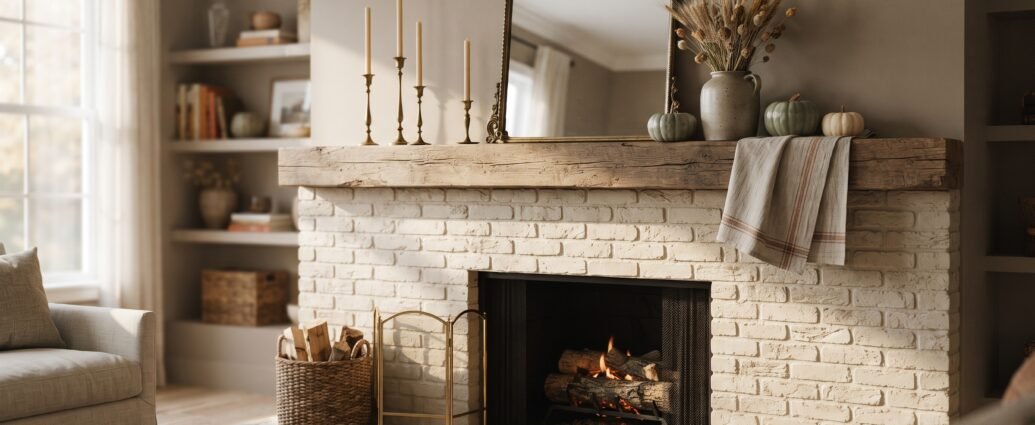
A mantel is the fastest room-changer in the house. It is one horizontal surface, usually somewhere between 48 and 60 inches wide, sitting at almost exactly eye level — which means it gets looked at more per square foot than anything else in a living room. Restyle it and the whole room reads differently. Nothing else you can do in forty-five minutes comes close.
That is also why a badly styled mantel is so obvious. The mantel is where good intentions go to die: a symmetrical pair of candlesticks bookending a sagging garland, everything the same height, everything pushed flat against the wall. It reads as decorated rather than lived in.
So this is the practical version. Below are twelve fall mantel decor ideas with the actual materials, real dimensions, honest costs and the specific failure modes that trip people up. Most of them take under an hour and cost less than $60. A few cost nothing at all, because you already own the pieces — you have just never put them on the mantel.
The composition rules that make a fall mantel work
Before the ideas, the structure. Every mantel that photographs well and still looks good in person is doing four things at once.
Three heights, minimum. A tall element (18 to 30 inches — art, a mirror, a branch arrangement), a mid element (8 to 14 inches — candlesticks, a vase, a pitcher), and a low element (under 6 inches — books, a bowl, a pumpkin). If everything on your mantel is between 8 and 12 inches tall, that is the whole problem, and it is the single most common one.
Asymmetry, weighted about 60/40. Put roughly 60 percent of the visual mass on one side and 40 percent on the other, then leave the lightest zone as breathing room. Perfect symmetry looks like a hotel lobby. It also looks like you gave up.
Depth, not a flat line. A standard mantel shelf is only 5 to 8 inches deep. That is not much, but it is enough to overlap things front-to-back — art leaning at the wall, a vessel in front of it, a small object in front of that. Overlap is what turns three objects into a vignette instead of a row.
Odd numbers and clustered groupings. Three candlesticks, not four. Two clusters and one gap, not five evenly spaced things. Your eye reads clusters as intentional and even spacing as inventory.
If those four ideas feel useful, the same logic applies to every horizontal surface in your house — we go deeper on it in our guide to styling shelves and surfaces with intention.
Clear it off completely first
Take everything off the mantel and wipe it down. Put it all on the floor or the coffee table where you can see it. This takes four minutes and it is not optional, because the alternative — adding fall things around whatever is already up there — is how mantels get crowded.
Then sort into three piles: keeping, maybe, and going back in the cabinet. Most people end up putting back about half of what was on the mantel, and the result looks better immediately, before a single pumpkin enters the picture.
12 fall mantel decor ideas worth your time
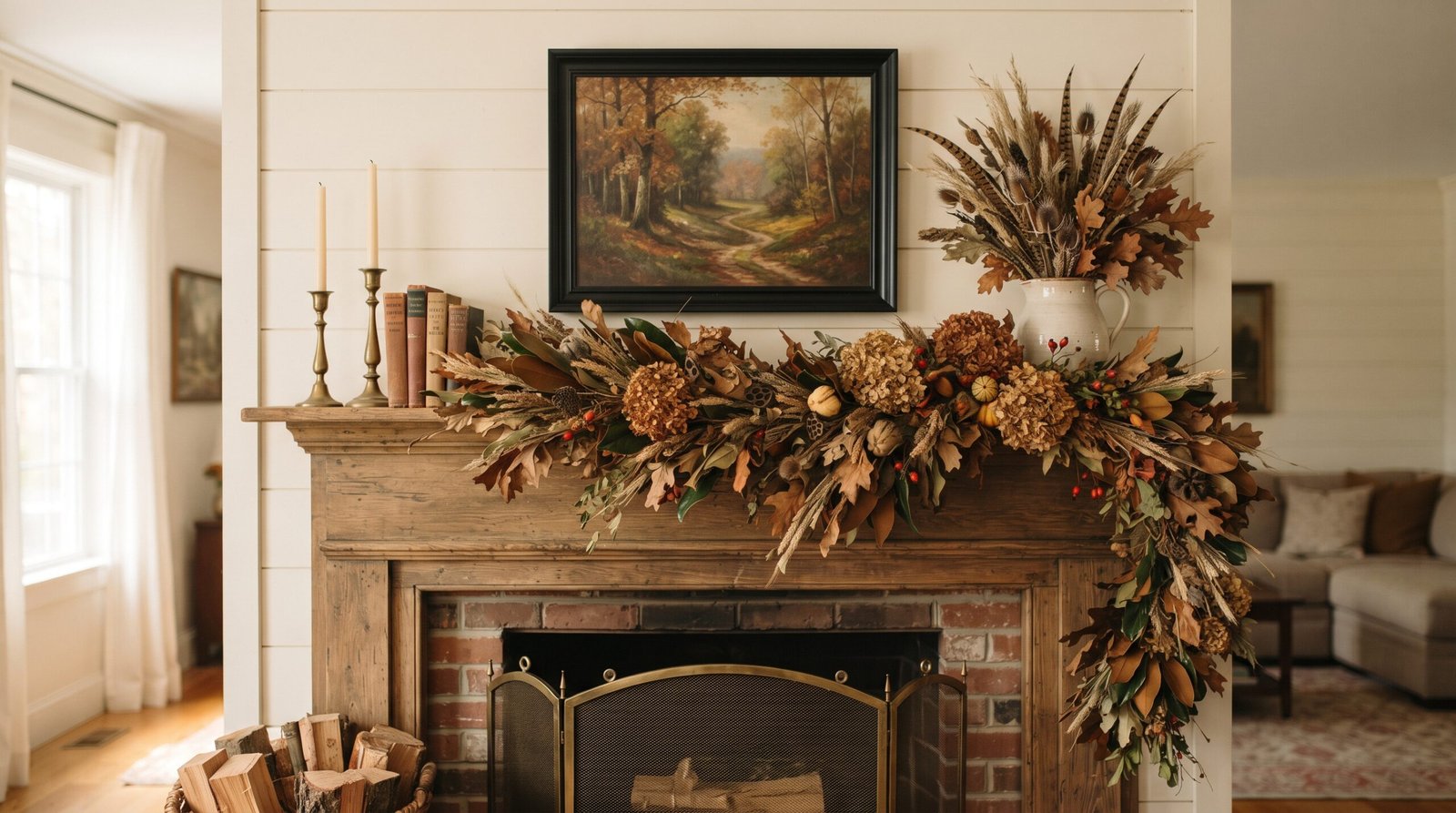
1. The asymmetric dried garland
A garland draped so it is heavy on one end and trails down past the mantel edge, rather than swagged evenly across. Buy or build one at 6 feet for a 48 to 54 inch mantel — you want extra length so it can pool and trail, not stretch tight.
Preserved oak leaf and magnolia garlands run roughly $35 to $70 for 6 feet from craft retailers like Michaels or Hobby Lobby, or from dried-floral specialists like Afloral. The cheaper faux ones — the $15 plastic maple-leaf variety — are the single most recognisable “cheap fall decor” tell, mostly because the leaves are too uniform and too glossy. If your budget is $15, skip the garland entirely and do idea number 4 instead.
The failure mode: a garland that is too thin. A 6-foot garland that only weighs half a pound looks like a dropped extension cord. Buy denser than you think, or wire two cheap garlands together into one full-looking one.
2. Leaning art instead of hung art
Lean a large piece — 24 x 36 inches or bigger for a standard mantel — against the wall rather than hanging it. It instantly gives you a tall element, it lets you overlap smaller frames in front of it, and it means no nail holes if you rearrange in November.
Rule of thumb on size: the art should be about two-thirds the width of the mantel. On a 54-inch mantel that means a piece 32 to 38 inches wide. Smaller than that and it floats.
The failure mode: a heavy frame sliding on a slick painted mantel. A strip of rug tape or two clear rubber bumper dots under the bottom edge fixes it for about $4.
3. Brass candlesticks in staggered heights
Three brass candlesticks — one tall, one medium, one short — clustered toward one end. Not two matching ones at either end. Thrifted brass candlesticks are genuinely everywhere and typically run $3 to $12 each at estate sales and thrift stores; new sets are $25 to $60.
Use 10-inch or 12-inch tapers in cream, bone, or a soft ochre. Skip the orange ones. If the room gets used at night and you want the flicker without the fire risk near dried materials, LED tapers with a warm 2200K flicker are convincing now in a way they were not five years ago.
The failure mode: real flames next to a dried garland. Dried wheat and preserved foliage are genuinely flammable — treat the two-foot zone around any lit candle as a no-botanical zone, and never leave them burning unattended.
4. Dried wheat, grasses and seed pods
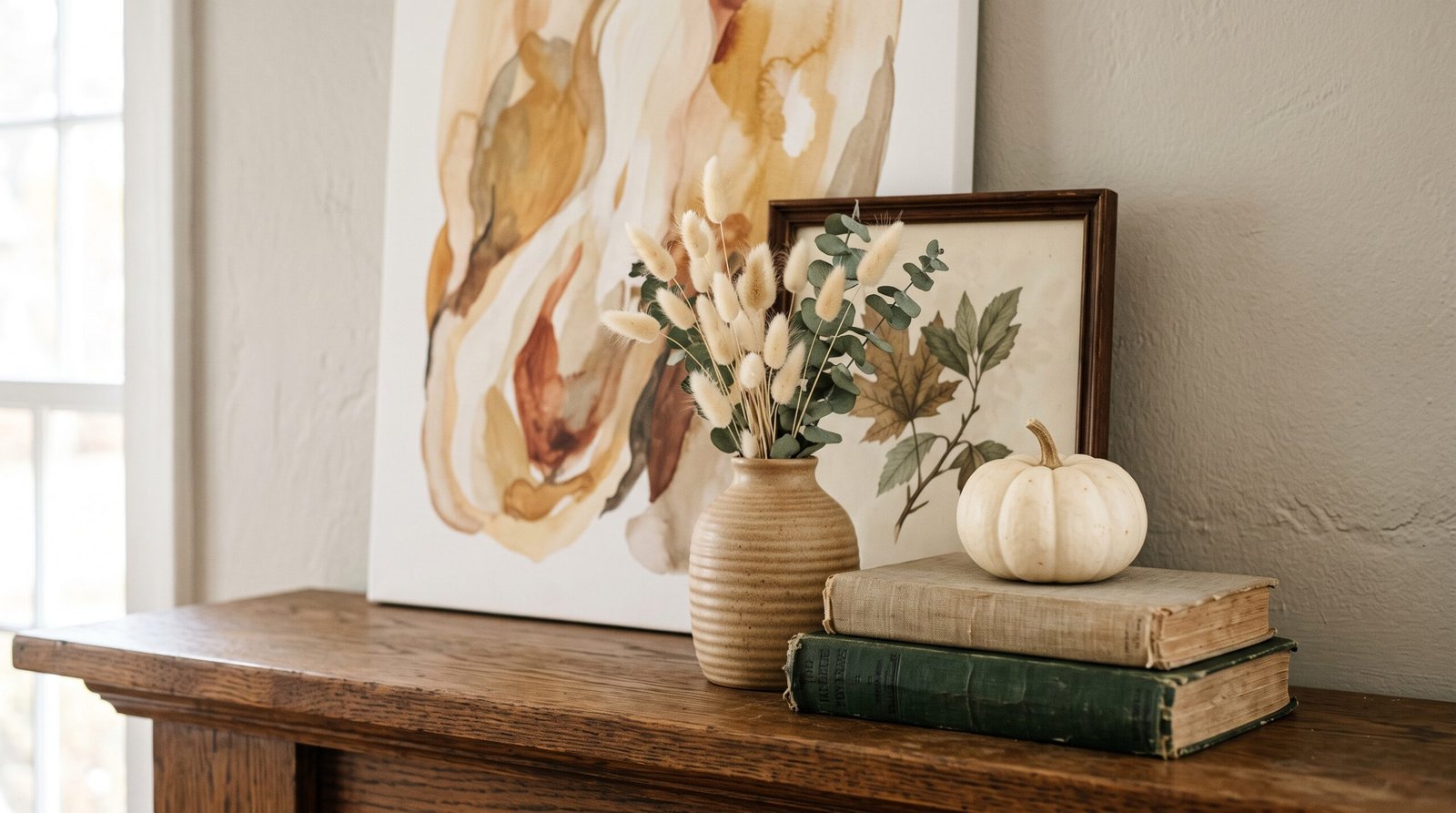
This is the highest-value-per-dollar fall mantel idea there is. A bundle of dried wheat runs about $8 to $15, dried bunny tail grass $10 to $18, and preserved eucalyptus $12 to $20 a bunch. Put them in a heavy ceramic or stoneware vessel — 8 to 12 inches tall — and let the stems fan wide and asymmetrically.
Cut the stems so the arrangement reads roughly 1.5 times the height of the vessel. A 10-inch vase wants stems that top out around 15 to 18 inches from the mantel surface.
The failure mode: a lightweight vase that tips. Dried stems are top-heavy. Either use a genuinely heavy vessel or drop a handful of pea gravel in the bottom.
5. Heirloom pumpkins, not orange ones
The colour of the pumpkin is doing more work than anything else on the mantel. Sage-green Jarrahdale, pale cream Lumina, blue-grey Blue Doll, buff-coloured Long Island Cheese and the soft peach Porcelain Doll varieties all sit inside a muted autumn palette. Standard orange jack-o’-lantern pumpkins do not, which is why so many fall mantels read as Halloween by accident.
Expect $8 to $18 for a medium heirloom pumpkin at a farm stand or a good grocery store, $2 to $4 for the minis. Cluster three in graduated sizes toward one end rather than lining up five across.
The failure mode: rot. A real pumpkin sitting on a warm mantel above a working fireplace will go soft in two to four weeks, and it will leave a ring. Put a felt pad or a small dish under each one and check them weekly. If you want to style once and forget it, our tutorial for no-sew fabric pumpkins gets you the same shapes in linen and velvet for a few dollars each, and they store flat for next year.
6. Vintage books as risers
A stack of two or three cloth-bound books gives you a 3 to 5 inch riser that lifts a small object into the mid-height range. It is free if you own books, and $1 to $3 each at a thrift store if you do not. Turn the spines to the wall if the colours fight your palette — the deckled page edges are usually prettier anyway.
7. One statement branch
A single large branch arrangement — dried curly willow, bare birch, or oak with the leaves still attached — in a floor-standing or tall mantel vessel. This is the cheapest tall element available, because you can cut it in your own yard in October for nothing.
Cut branches 30 to 40 inches long. Strip the lower third of the stems so the vessel opening stays clean.
8. A cluster of ceramic vessels
Three to five vessels in varied heights and one shared material family: speckled stoneware, matte glaze, unglazed terracotta. No florals at all. This is the most modern-looking option on the list and works particularly well if your mantel is under a mounted TV, where fussy tall arrangements would just look cramped.
9. A draped linen or wool runner
A length of washed linen or a small wool throw laid along the mantel with the ends draped over each side. It softens a hard stone or brick edge, adds a colour layer without adding objects, and it costs $15 to $40. Two yards of 55-inch linen is plenty and does not need hemming if you pull a clean edge thread.
10. Amber glass and copper
Amber and smoked glass catch low autumn light in a way nothing else does, and thrifted pieces run $2 to $10 each. A cluster of three or four in front of a mirror doubles visually. Copper and unlacquered brass do the same job in metal.
11. The three-object minimal mantel
One large piece of art, one tall vessel with dried stems, one low bowl. That is it. If your room is already busy — patterned rug, gallery wall, a lot of upholstery — this is almost always the right call, and it is the version I recommend most often in smaller living rooms where every surface is already working hard.
12. The gourd and foraged bowl
A wide, shallow bowl — 10 to 14 inches across, wood or stoneware — filled with mini gourds, acorns, chestnuts, dried orange slices or pinecones. It is the one place on a fall mantel where “a pile of stuff” is the correct answer, because the bowl gives the pile an edge. Free if you have a yard with an oak tree.
What a fall mantel actually costs
Real numbers, based on typical craft-store and grocery pricing. Your mileage varies by region, and farm stands beat retail on pumpkins almost every time.
| Element | Typical cost | Notes |
|---|---|---|
| Preserved 6 ft garland | $35–$70 | Reusable 3–5 seasons if stored in a box, not compressed |
| Dried wheat bundle | $8–$15 | Lasts several years |
| Preserved eucalyptus bunch | $12–$20 | Fades in direct sun |
| Brass candlesticks (set of 3) | $9–$36 thrifted / $25–$60 new | Thrifted is genuinely better looking |
| Taper candles (pair) | $4–$14 | Cream, bone or ochre, not orange |
| Medium heirloom pumpkin | $8–$18 | Farm stands cheaper than grocery |
| Mini pumpkins / gourds | $2–$4 each | Buy in odd numbers |
| Ceramic vessel | $15–$45 | Heavier is better — dried stems are top-heavy |
| Linen runner (2 yd) | $15–$40 | No hemming required |
| Vintage books | $0–$9 | Thrift stores, or your own shelf |
A complete, good-looking fall mantel lands between $45 and $130 depending on whether you buy a garland. Doing ideas 4, 5, 6 and 12 only — dried stems, heirloom pumpkins, book risers, a foraged bowl — gets you there for about $40.
The five mistakes I see most often
Everything the same height. Already covered, but it is worth saying twice, because it is the one that accounts for most of the difference between a mantel that looks styled and one that looks stocked. If you fix nothing else, fix this.
Perfect symmetry. A matched pair at each end and something centered in the middle. It is the safest choice and the least interesting one. Shift the whole composition one-third off centre and the mantel wakes up.
Too much orange. Orange is a legitimate autumn colour, but at full saturation and in volume it reads as Halloween. Keep it to accents and let rust, ochre, bronze, sage, cream and warm brown carry the palette. If you want the full seasonal palette worked out for a whole room, our piece on cozy autumn paint colors walks through the warm, earthy end of the spectrum.
Nothing overlaps. Objects in a single flat line against the wall, none of them touching or crossing in front of another. Pull two or three items forward to the front edge of the shelf and let them overlap whatever is behind.
Ignoring the firebox. The mantel is only half the composition. A dark empty firebox below a beautifully styled shelf pulls all the warmth out of the arrangement. A stack of birch logs, a large woven basket, three pillar candles on a tray, or a single oversized dried arrangement in the opening all fix it for very little money.
Styling a fall mantel by decorating style
Farmhouse and rustic
Aged wood, galvanised metal, ironstone pitchers, dried wheat, cream pumpkins, and a chunky preserved garland. Keep the metals warm — brass and galvanised, not chrome. The wider approach is covered in our farmhouse decor guide, and if you want autumn-specific pieces, rustic farmhouse touches for autumn is the closer match.
Modern and minimal
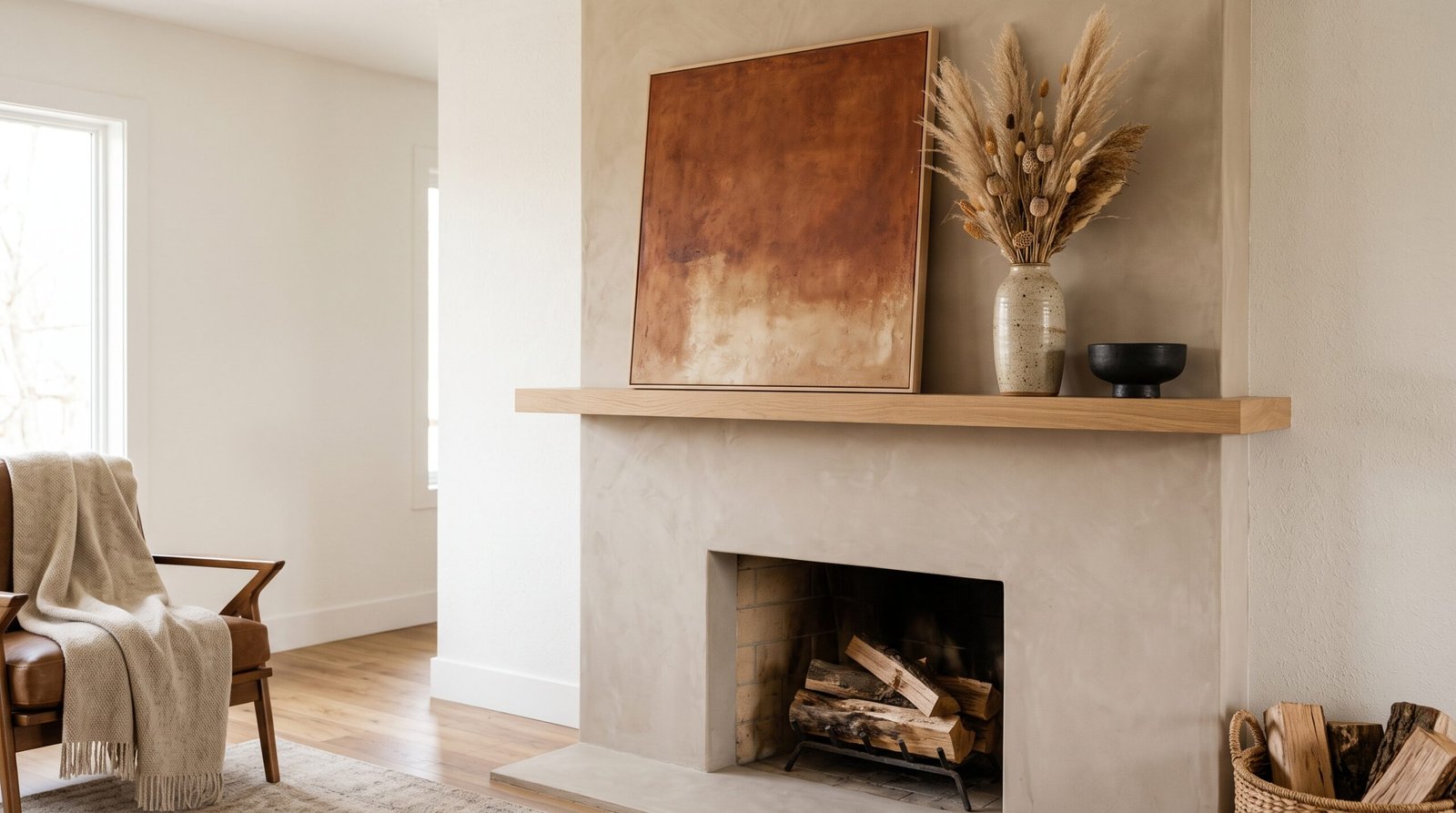
Three objects maximum. One large piece of abstract art in a rust or ochre colour field, one tall hand-thrown vessel with dried pampas or seed pods, one low matte bowl. No garland, no pumpkins, or at most one pale cream one. Let the negative space do the work.
Traditional
A framed landscape or an antique mirror as the anchor, brass candlesticks with real tapers, a swagged garland with visible depth, leather-bound books, and a ceramic pitcher of dried hydrangea. This style tolerates more symmetry than the others — just break it with one deliberately off-balance element.
Wall colours that make a fall mantel look better
You do not need to repaint for one season. But if a repaint is already on the list, a few specific colours make warm autumn styling look considered rather than pasted on.
- Benjamin Moore White Dove OC-17 — a soft warm white that keeps brass and dried botanicals from looking dingy the way a cool white does.
- Sherwin-Williams Accessible Beige SW 7036 — a greige with enough warmth to sit under rust and ochre without going yellow.
- Sherwin-Williams Pewter Green SW 6208 — a muted green-grey that makes a cream-and-brass mantel look expensive. Excellent as a fireplace surround colour specifically.
- Farrow & Ball Setting Plaster No. 231 — the soft dusty pink-beige that reads as warm neutral in low autumn light.
- Sherwin-Williams Urbane Bronze SW 7048 — a deep warm charcoal-brown for a painted brick fireplace, and the single most dramatic before-and-after in this category.
Making it last the whole season
Build the mantel in early September and you want it to still look good at Thanksgiving. Three things get you there.
Use dried and preserved material rather than fresh. Fresh eucalyptus curls and drops within about two weeks indoors; preserved holds for months. Same for wheat, grasses, hydrangea and seed pods — which is why almost every idea here leans dried.
Keep it out of direct sun. A south-facing mantel bleaches dried florals noticeably in six to eight weeks. If yours gets hard afternoon light, favour naturally pale materials — bleached ruscus, cream wheat, bone pampas — where fading does not show.
Plan for one swap. Build in early September with wheat, grasses and pale pumpkins; in mid-November pull the pumpkins and add evergreen or magnolia, and the same mantel carries into the holidays without a second shopping trip.
Where to take it next
A mantel is the anchor, but it works best when the rest of the room shifts with it. Swapping in heavier textiles is the highest-impact next step — our guide to layering textures for a cozy fall home covers the throw, rug and pillow side of it, and cozy fall living room makeovers pulls the whole room together.
If the front of the house is next on your list, our step-by-step DIY fall wreath tutorial pairs directly with a mantel garland — same materials, same afternoon — and our roundup of fall porch decor ideas handles everything from the door out. For the general principles behind all of it, our interior design styling guide is the foundation piece.
And if you want the mantel to carry Halloween without turning the room into a costume shop, our Halloween mantel decor ideas use the same three-height build and the same dried material you already have up. Black taper candles and a little smoked glass do most of the work, so it’s a swap rather than a second shopping trip.
Start with the clear-off. Everything comes down, half of it goes back, and you build up from three heights. That single move does more than any pumpkin you could buy. — Quinn