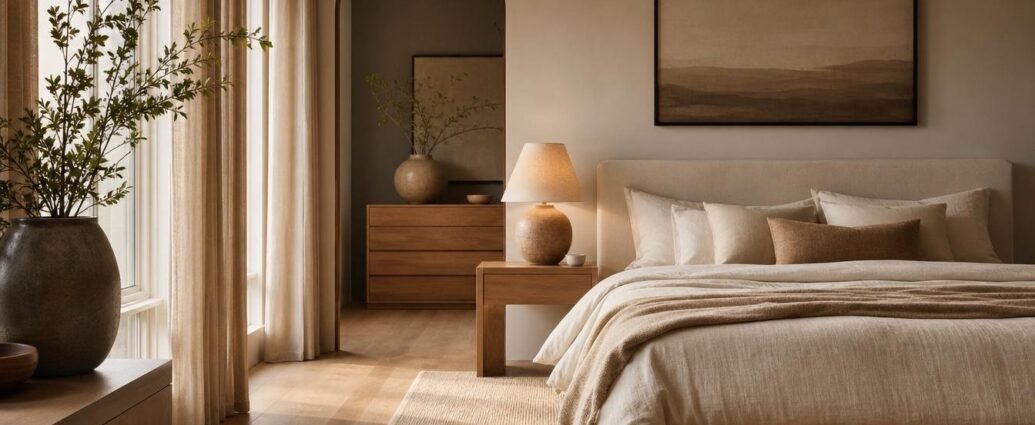
Do you ever walk into a room and feel your whole body exhale — like the space itself is giving you permission to slow down? That’s not an accident. It’s design working quietly in the background, stripping away the noise and leaving only what genuinely matters.
That feeling is exactly what warm minimalist bedroom ideas are built around. Not the stark, cold version of minimalism you might picture — all white walls and a lone succulent — but something richer, more human, more like a deep breath wrapped in linen and golden light. In this post, we’re going to walk through how to build that bedroom from the ground up, including how to choose your palette, layer textures wisely, and shop smart at every budget level.
Key Takeaways
- Warm minimalism is about intentional simplicity — every piece earns its place through beauty, function, or feeling.
- Natural wood tones, linen textiles, and soft neutral palettes are the foundation of a cozy minimalist bedroom.
- Negative space is a design tool, not an oversight — it creates calm and visual breathing room.
- Layering textures (rather than colors or patterns) is the secret to a room that feels rich without feeling cluttered.
- You don’t need a luxury budget — thoughtful curation always beats quantity.
- Lighting choices and bedding palette have the single biggest impact on the overall mood of the room.
What Is Warm Minimalism, Really?
Before we start pulling mood boards, it helps to understand what separates warm minimalism from its colder, more clinical cousin. Traditional minimalism can feel punishing — like you’re not allowed to own anything. Warm minimalism says something different entirely.
The Core Philosophy
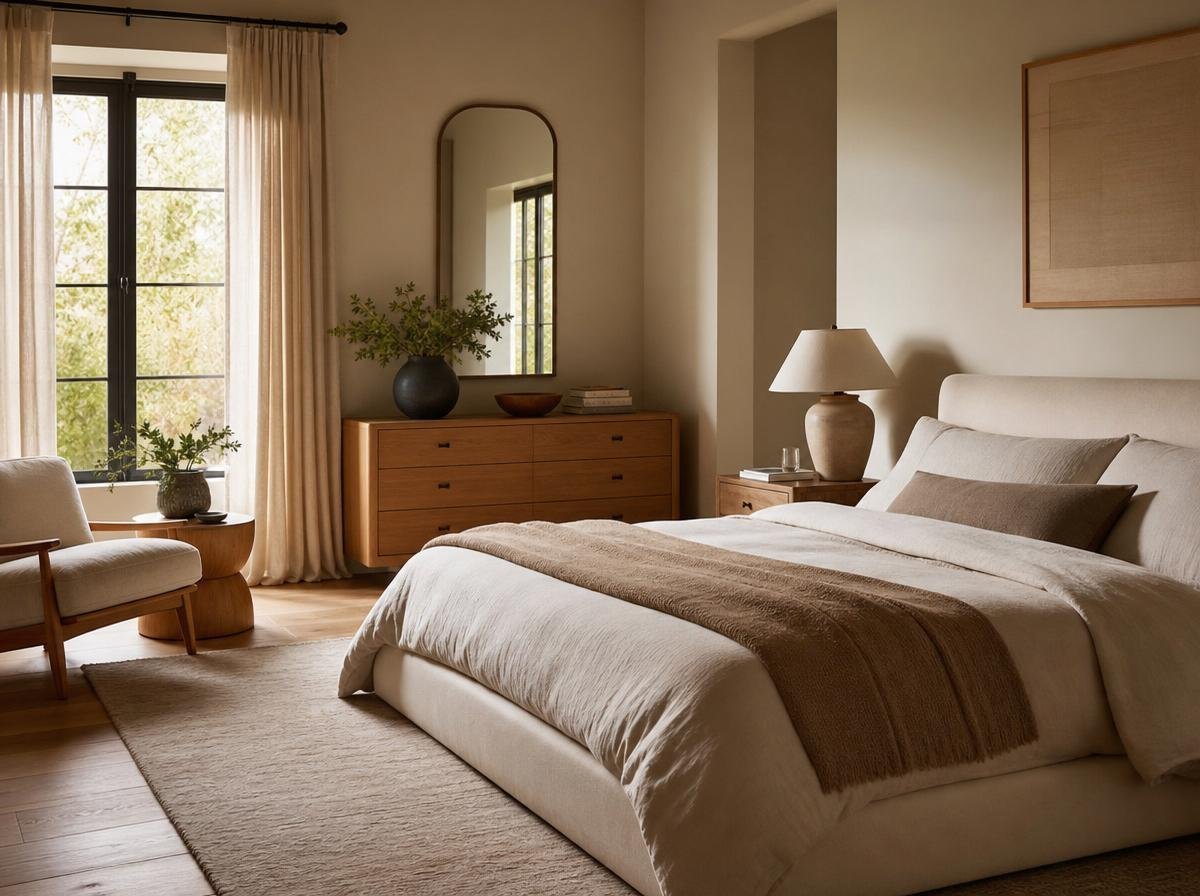
Warm minimalism is the practice of keeping only what serves you, but ensuring everything that stays is beautiful, tactile, and emotionally resonant. It’s less about reduction for its own sake and more about intentionality. You’re not removing personality from a room — you’re distilling it.
Think of it like editing a sentence. You cut the filler words, and suddenly the meaning becomes clearer, stronger, more felt. The room becomes the sentence you actually meant to write.
How It Differs from Cold Minimalism
Cold minimalism tends to prioritize visual perfection over sensory warmth. Glass, chrome, and stark white dominate. There’s nowhere for the eye — or the body — to settle. Warm minimalism counters this with materials that have memory: worn wood, undyed linen, hand-thrown ceramics, stone with natural variation.
Where cold minimalism says “less is more,” warm minimalism says “less, but warmer.” The goal is a room that feels curated and calm, not sparse and sterile. If you’ve ever been drawn to the muted richness of a Scandinavian or Japanese-inspired interior, you’re already speaking this design language. And if you’re curious how this philosophy translates to other spaces beyond the bedroom, the ideas behind maximalist bedroom design make for a fascinating contrast.
Building Your Warm Neutral Bedroom Color Palette
The palette is where your warm minimalist bedroom either sings or falls flat. Get this right and the rest of the room almost styles itself. The goal is a collection of tones that feel layered and alive, even when they’re quiet.
The Foundational Neutrals
Start with your wall color. For a truly warm neutral bedroom, look beyond flat white and consider tones like warm linen, greige (that perfect grey-beige blend), parchment, or even a very soft terracotta wash. These shades shift with natural light throughout the day, giving the room a living quality that pure white simply can’t offer.
Your second layer is your bedding palette, which I’d argue is even more important than the walls. Choose a base tone that sits within two shades of your wall color, then layer in one or two accent tones — a dusty sage, a soft caramel, a barely-there blush. The key is keeping the full palette to no more than four tones, all within the same warm family.
Choosing Your Bedding Color Palette
Think of your bed as the landscape of the room. For a cozy minimalist bedroom, linen in natural, undyed, or stone-washed tones is almost always the right answer. It photographs beautifully, gets better with every wash, and brings that effortlessly lived-in quality that no crisp percale can replicate.
Layer a lighter base sheet with a slightly deeper duvet cover, then bring in a textured throw in a contrasting but harmonious tone. A warm taupe bed layered with a cream waffle knit throw and a single moss-green pillow? That’s a palette that breathes. That’s the whole poem right there.
Accent Colors That Don’t Disrupt the Calm
If you want to introduce color beyond neutrals, keep it earthy and desaturated. Think muted sage, dusty clay, deep moss, or faded indigo. Highly saturated colors — even if they’re technically warm — will break the meditative quality you’re building. If you want inspiration for using earthy tones more broadly throughout a home, the ideas explored in 2026’s earthy and calming color trends translate beautifully into adult bedroom spaces too.
The Role of Natural Materials and Wood Tones
If the palette is the soul of a warm minimalist bedroom, natural materials are the bones. This is where the warmth becomes physical — something you can touch, smell, and feel underfoot on a slow Sunday morning.
Choosing the Right Wood Tones
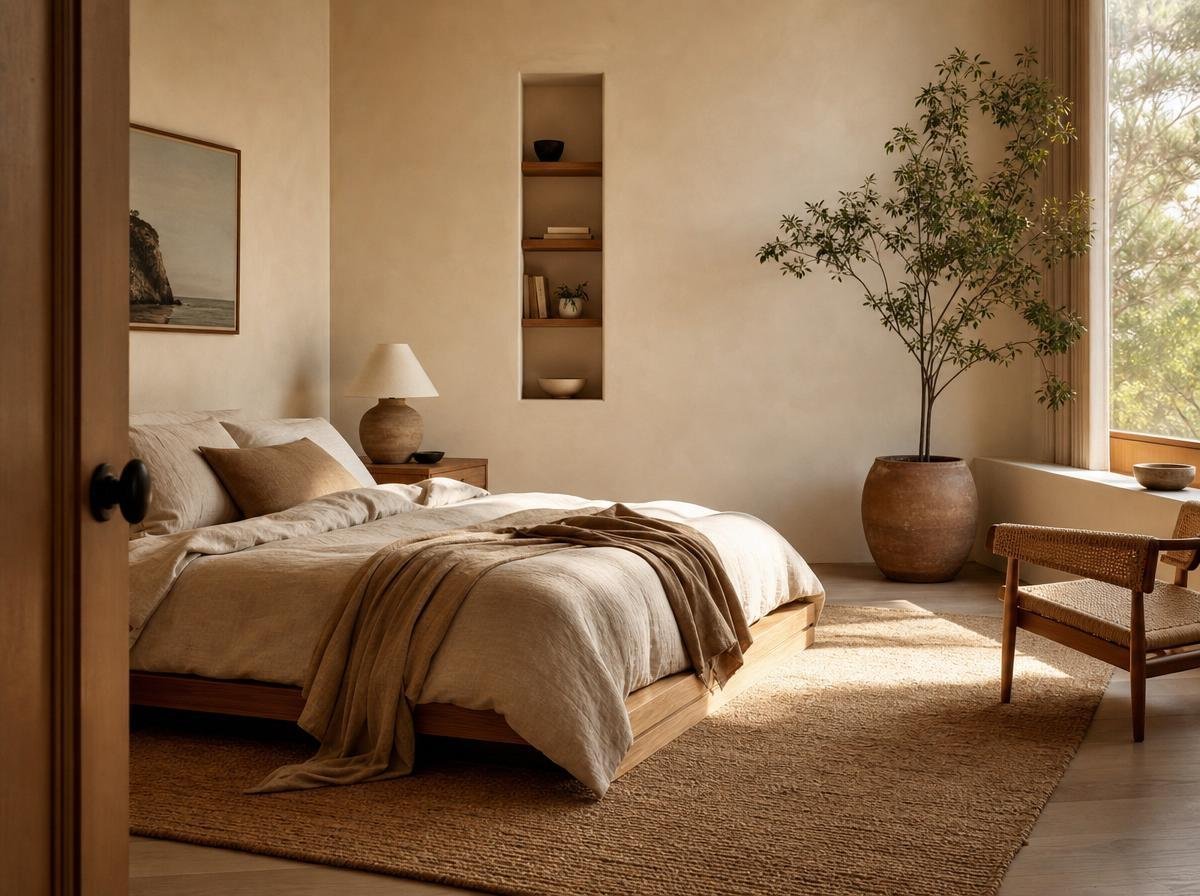
Wood tone selection is one of the most impactful decisions you’ll make in this room. Light to medium woods — white oak, ash, walnut with warm undertones — all work beautifully in a warm minimalist context. Avoid very dark stains, which can feel heavy, or very orange-toned woods from the 1990s, which read as dated rather than warm.
Your bed frame is usually the largest wooden element. If you’re choosing between a few options, lean toward something with clean lines but visible grain — a platform bed in white oak or a solid wood frame with simple joinery. The natural variation in the wood does the decorative work without adding visual complexity.
Linen, Cotton Waffle, and Natural Textiles
Beyond wood, the textiles you choose carry enormous weight in this aesthetic. Linen is the queen of warm minimalism — slightly rough, naturally matte, and impossibly elegant in its imperfection. Stone-washed linen for your duvet cover and pillowcases is a near-universally good starting point.
From there, layer in a cotton waffle or chunky knit throw across the foot of the bed. A jute or wool area rug under the bed adds grounding texture underfoot. These layered textiles create the sensory richness that makes this style feel warm and human rather than empty.
Stone, Ceramic, and Other Natural Accents
On your nightstand or dresser, a single travertine tray, a hand-thrown ceramic lamp base, or a small piece of raw quartz does more work than a dozen decorative objects. These natural materials carry their own quiet visual interest without demanding attention. Let them breathe.
Mastering Negative Space in a Bedroom
Here’s the truth about negative space: it isn’t emptiness. It’s actually the most active design tool you have. In a warm minimalist bedroom, the spaces between things are as intentional as the things themselves.
What Negative Space Actually Does
Negative space gives the eye a place to rest. Without it, even the most beautiful objects start to compete for attention and the room feels anxious. With it, every piece you’ve chosen has room to be seen and appreciated. It’s the design equivalent of silence in music — what makes the notes meaningful.
In practical terms, this means resisting the urge to fill every surface, and actively choosing not to add a seventh pillow or a third item to the nightstand. The restraint is the design. It takes confidence to leave a wall bare, but when it’s right, you feel it immediately.
Furniture Placement and Visual Flow
In a warm minimalist bedroom, furniture should feel considered rather than crammed. Give your bed room to breathe on at least three sides if your layout allows. Pull nightstands in slightly so they feel intentionally placed rather than pushed to the wall. Leave floor space visible, especially around the foot of the bed and near windows.
If you’re working in a smaller room, fewer, larger pieces almost always read better than many small pieces. A single oversized reading chair in a corner creates more calm than two small stools and a floor lamp crowded together.
“The most beautiful rooms aren’t the ones with the most in them — they’re the ones where everything left behind was chosen with love.”
Layering Textures Without Overdoing It
Texture layering is the art form at the center of this whole aesthetic. Done well, it creates rooms that feel warm, complex, and incredibly inviting. Done poorly, it becomes clutter with good intentions. Here’s how to stay on the right side of that line.
The Rule of Three Textures
A practical starting framework: aim for three distinct textures within any single zone of the room. On the bed, that might be smooth linen, a chunky waffle throw, and a velvet accent pillow. On the nightstand, it might be raw wood, ceramic, and a cotton bookmark tucked into a book. Three textures create richness without chaos.
The key is that your textures should vary in scale and hand feel — something smooth, something nubby, something with weight. When all three textures are at the same scale or softness level, the layering disappears and everything reads as one flat surface.
How to Edit Your Accessories
In a warm minimalist bedroom, accessories are edited ruthlessly — but lovingly. Every item on a surface should be there for a reason: it’s beautiful, functional, or emotionally meaningful. If something is there just because it was there before, it probably needs to find a new home.
On a nightstand, the sweet spot is usually three to five objects: a lamp, something with height variation (a small plant, a stack of books), one tactile or meaningful object, and nothing else. If you find yourself with more than that and can’t remove anything, move the whole vignette to a different surface and start fresh. Sometimes distance helps you see clearly.
When to Stop Adding
The honest answer? Stop adding one item before you think you need to. Warm minimalism lives in the just-before-full feeling — a room that could hold more but chooses not to. When you photograph a styled vignette and notice your eye is moving easily around the frame without snagging, you’ve found the edge. Stay there.
Warm Minimalist Lighting: The Overlooked Mood-Maker
Nothing undermines a beautifully styled warm minimalist bedroom faster than harsh overhead lighting. Lighting is the atmosphere — it’s the filter over everything else in the room, and it deserves as much attention as your bedding or your furniture.
Layering Light Sources
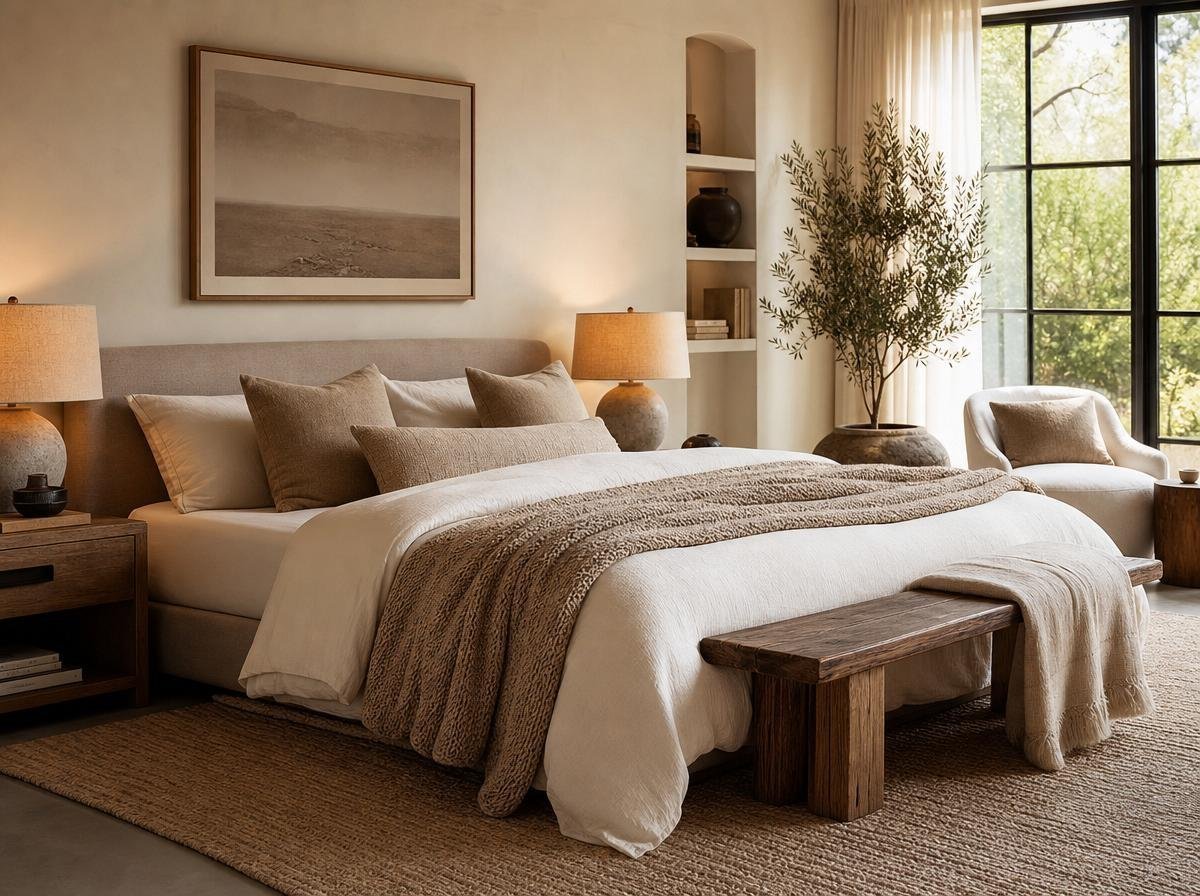
The goal in a warm minimalist bedroom is to eliminate dependence on a single overhead source. Layered lighting — a combination of ambient, task, and accent sources — creates the warm, dimensional glow that makes a room feel like a retreat at any hour.
Start with table lamps on your nightstands. Opt for warm bulbs (2700K or lower) and shades in natural materials — linen, rice paper, or raw cotton diffuse light beautifully and add texture of their own. Add a floor lamp in a reading corner if space allows, and consider a small plug-in sconce if your nightstand space is tight.
Natural Light and Window Treatments
During the day, maximize natural light and let it do the heavy lifting. Linen or cotton voile curtains in a warm white or oatmeal tone filter light beautifully without blocking it. Hang them high and wide — ceiling height if possible — to make the windows feel architectural and the room feel taller.
In the evening, layer sheers with a heavier linen or cotton panel for privacy and cocooning. The ability to modulate between open and enclosed is part of what makes a bedroom feel like a true sanctuary.
Shopping Guide: Warm Minimalist Bedroom by Budget Tier
One of the most important things I believe about good design is this: intentional curation always wins over expensive accumulation. You don’t need a designer budget to build this bedroom. You need a clear vision and a willingness to be patient. Here’s how to approach it at every budget level.
| Item | Budget ($) | Mid-Range ($$) | Investment ($$$) |
|---|---|---|---|
| Bed Frame | IKEA Malm/Neiden, thrifted wood frame | Article Culla, Rugs USA platform frame | Floyd, Pottery Barn open-frame oak |
| Bedding | Target Threshold linen-look, Quince linen | Cultiver, West Elm Belgian linen | Brooklinen Luxe, Boll & Branch linen |
| Area Rug | Amazon basics jute, Wayfair natural fiber | Rugs USA wool, Loloi Magnolia Home | Anthropologie handwoven, vintage kilim |
| Nightstand Lamp | IKEA Sinnerlig, Target ceramic base | McGee & Co, Threshold with Studio | Visual Comfort, Serena & Lily |
| Curtains | IKEA DYTÅG, H&M Home linen look | West Elm linen, Threshold textured | Pottery Barn Belgian linen, Restoration Hardware |
| Throw Blanket | TJ Maxx finds, H&M Home waffle knit | Parachute waffle, Coyuchi organic cotton | Jenni Kayne cashmere blend, Sferra |
Budget Shopping Strategy
At the budget tier, your best friends are IKEA (genuinely beautiful at this price point), Quince for surprisingly quality linen bedding, and your local thrift or Facebook Marketplace for wood furniture. The secret is to buy one quality anchor piece — even just one good lamp — and let everything else support it.
At the mid-range tier, prioritize bedding and lighting above all else. Those two elements have the biggest daily impact on how the room feels. A beautiful rug from Rugs USA and a West Elm linen duvet can carry an otherwise budget room further than you’d expect. For more ideas on making meaningful upgrades without overspending, the strategies behind inexpensive family room updates apply just as well to a bedroom refresh.
Investment Pieces Worth Saving For
If you’re going to splurge anywhere, make it the bed frame and the rug. These are the two pieces you’ll keep for decades, and quality here shows. A solid white oak platform bed and a hand-knotted or vintage area rug will elevate every other element in the room, even if everything else is mid-range.
Small Details That Make the Biggest Difference
Warm minimalism lives in the details. Not in accumulating them, but in choosing the right ones with intention. These are the finishing touches that separate a room that looks designed from one that simply looks tidy.
The Nightstand Vignette
Your nightstand is a daily ritual object — it’s the first and last thing you see each day. Treat it with that kind of care. A single ceramic lamp, a small stack of books, one meaningful object (a crystal, a piece of driftwood, a small plant), and nothing else. The discipline of keeping it this simple is deeply satisfying once you commit to it.
Artwork and Wall Treatments
In a warm minimalist bedroom, less wall art is almost always more. One large-format piece — a simple abstract in warm tones, a landscape, a quiet photograph — does more than a gallery wall ever could in this context. (Though if maximalist walls are your thing, the approach to styling a maximalist salon wall is a whole other beautiful world worth exploring.)
Alternatively, a textured wall treatment — limewash paint, a single panel of grasscloth wallpaper behind the bed, or even a large woven wall hanging — adds depth without busy-ness. These architectural-feeling elements bring warmth and visual interest while keeping the overall feeling calm.
Plants and Natural Objects
One or two plants, thoughtfully placed, add the kind of life a room needs without tipping into jungle territory. A tall fiddle leaf fig or olive tree in a corner, or a trailing pothos on a high shelf, brings organic movement into an otherwise still space. Pair with a simple terracotta or stone pot — never anything shiny or over-designed — and let the plant be the focal point.
Maintaining the Feel: Living in a Warm Minimalist Bedroom
Here’s something design content doesn’t talk about enough: a beautiful room has to be liveable. The warm minimalist bedroom aesthetic isn’t a museum installation — it’s a space you sleep in, read in, and wake up in every single day. Maintaining the feel means building habits, not just a look.
Daily Reset Habits
The most powerful thing you can do for a minimalist bedroom is make the bed every morning. It sounds almost absurdly simple, but a made bed with well-arranged linen immediately signals calm and intention. It takes less than three minutes and resets the entire room.
Beyond that, designate homes for everything — a tray on the dresser for jewelry and keys, a basket in the closet for clean laundry you haven’t put away yet. The visual tidiness that makes warm minimalism work isn’t about perfection; it’s about having a system that keeps clutter contained without requiring constant effort.
Seasonal Refreshes
One of the joys of a neutral, minimal foundation is how easily it adapts to seasonal shifts. Swap a summer linen throw for a heavier wool or chunky knit in autumn. Add an extra layer of bedding in winter and strip it back to the lightest possible sheets in summer. These small seasonal shifts keep the room feeling current and alive without requiring any actual redesigning.
Frequently Asked Questions
What is warm minimalism in bedroom design?
Warm minimalism is an approach to interior design that combines the intentional simplicity of minimalism with the sensory richness of natural materials, warm tones, and tactile textures. Rather than cold and stark, a warm minimalist bedroom feels calm, human, and deeply restful — think linen bedding, natural wood furniture, soft neutral walls, and carefully curated accessories that all earn their place in the room.
What colors work best for a warm minimalist bedroom?
The most effective palettes for a cozy minimalist bedroom are built from warm neutrals: linen white, greige, parchment, warm taupe, and soft cream. Earthy accents like dusty sage, muted terracotta, and faded caramel can be woven in through textiles and accessories without disrupting the overall calm. The key is staying within the same warm family and keeping the total palette to no more than four tones.
How do I layer textures without making my bedroom feel cluttered?
The rule of three is your best guide: aim for three distinct textures within any single zone or surface grouping. Vary the scale and hand feel — something smooth, something nubby, something with visible weight. The other key is restraint on quantity. Three well-chosen, varied textures will always feel richer than seven textures crowded together. When in doubt, remove one item and see how the space opens up.
Is linen bedding worth it for a minimalist bedroom?
Absolutely — linen is arguably the perfect fabric for a warm minimalist bedroom. It’s naturally matte, gets more beautiful with every wash, breathes well in all seasons, and has a slightly relaxed, lived-in quality that no other fabric quite replicates. You don’t have to spend a fortune on it either; brands like Quince offer genuine linen at very accessible price points. Once you sleep in linen, it’s genuinely hard to go back.
How can I make a small bedroom feel calm and minimalist?
In a small bedroom, fewer larger pieces always read better than many small ones. Choose a bed frame with a low profile and clean lines, hang curtains at ceiling height to elongate the walls, and keep the floor as clear as possible. A light warm neutral on the walls (especially all four walls and the ceiling in the same tone) creates a seamlessly enveloping feeling that makes the space feel intentional rather than cramped. Mirrors used thoughtfully can also add depth without adding visual noise.
Do I need to spend a lot of money to achieve this aesthetic?
Not at all. Warm minimalism is actually one of the most budget-friendly aesthetics to build because it’s fundamentally about restraint and curation, not quantity. IKEA, Quince, Target’s Threshold line, and the secondhand market (especially for wood furniture) can all deliver genuinely beautiful results. Focus your budget on the two highest-impact elements — bedding and lighting — and build patiently from there.
What’s the difference between a warm minimalist bedroom and a Scandinavian bedroom?
They share a lot of DNA — clean lines, natural materials, neutral palettes — but Scandinavian design tends to incorporate slightly more pattern, bolder graphic moments, and a stronger emphasis on functionality. Warm minimalism leans a little more organic and sensory, with an emphasis on natural imperfection (like handmade ceramics and undyed linen) and a slightly warmer, more amber-toned palette. Think of Scandinavian as the cousin with slightly cooler taste and warm minimalism as the one who’s obsessed with texture and candlelight.
A warm minimalist bedroom isn’t a destination you arrive at once and leave unchanged. It’s an ongoing conversation between you and your space — one that evolves with your seasons, your needs, and your taste. Start with one good anchor piece, one honest edit of what’s already there, and build from a place of intention rather than accumulation. The room that awaits you on the other side — calm, human, quietly beautiful — is absolutely worth the patience it takes to get there. If you have questions or want to share your own warm minimalist bedroom transformation, drop it in the comments below. I’d genuinely love to see where this takes you. 🤍