Ever felt crowded in your laundry room, wondering how everything is supposed to fit? You are not alone. A busy household runs somewhere close to 300 loads a year, and most of them happen in the smallest room in the house.
The good news is that a laundry room rarely needs more square footage to work better. It needs the square footage it already has, used in a smarter order. Below are ten ideas we come back to again and again, from stackable machines and ceiling-height cabinets to a rolling cart that costs less than a takeaway dinner. Every one of them has a weekend version you can do for very little, and a version you can save up for.
Utilize Vertical Space
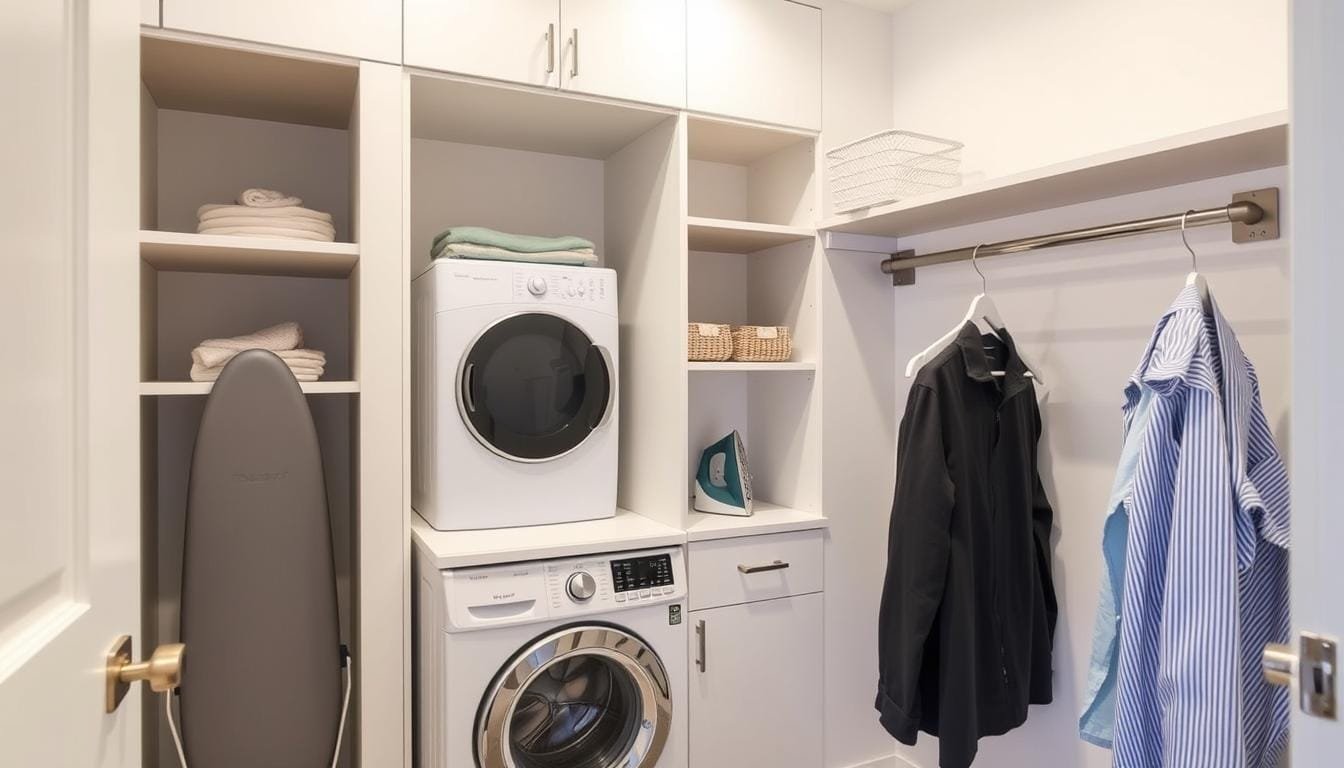
When floor space is tight, the room usually still has room above your head. Stacking the machines and running storage to the ceiling is the single change that frees up the most floor in the smallest laundry rooms.
Stackable Washer and Dryer
Stacking the dryer on top of the washer gives you back the footprint of a whole appliance — roughly 27 inches of floor you can then use for a hamper, a drying rack, or a narrow cabinet. Many existing front-loading pairs can be stacked with a bracket kit from the manufacturer, so check your model numbers before you shop for anything new. If yours can stack, this costs about the price of the kit rather than the price of two machines.
Ceiling-Height Cabinets
Cabinets that stop at standard upper-cabinet height leave a band of dead air above them. Running storage all the way up gives you a home for the things you reach for twice a year — spare bulbs, the carpet cleaner, holiday linens — which in turn clears the shelves you use every week.
No-budget version: one shelf board on two sturdy brackets above the machines, painted the same colour as the wall so it visually disappears. A single well-placed shelf holds more than most people expect.
Incorporate Multi-functional Furniture
Furniture that does two jobs is worth more than furniture that does one, and in a laundry room those two jobs are almost always work surface and storage. A counter you can fold on, with something useful tucked underneath, will do more for the room than any single new appliance.
Butcher Block Countertops
A butcher block counter laid across the top of front-loading machines gives you a folding surface, a sorting surface, and a warm bit of wood in a room that is otherwise all white and metal. It sands and re-oils rather than scratching permanently, which matters in a room where detergent bottles get set down hard.
If a full slab is out of reach, a pre-cut counter offcut from a home centre, or a hollow-core door cut to length and sealed, does the same job for a fraction of the price. The same thinking works in other tight rooms — it is why a work surface over storage shows up in our space-saving teen room ideas as well.
Rolling Storage Units
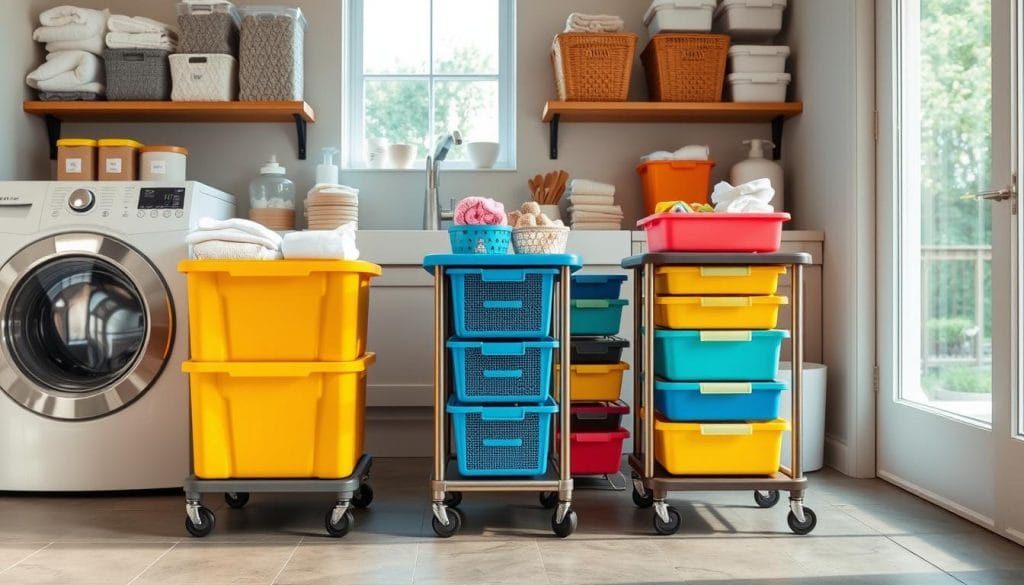
A rolling cart is the most flexible storage in the room for the least money. It slides into the gap between the machines and the wall, rolls out when you need it, and goes back when you do not. Use it for cleaning supplies, or as a mobile sorting station on laundry day.
A slim three-tier cart is inexpensive at most discount stores. If you would rather spend nothing at all, a plastic crate on a set of furniture casters does the same job.
Paint, a few baskets and something on the wall you actually like cost very little and change how the room feels more than the numbers suggest. In a room you stand in several times a week, that is not a small thing.
Convert Closet Spaces into Laundry Areas
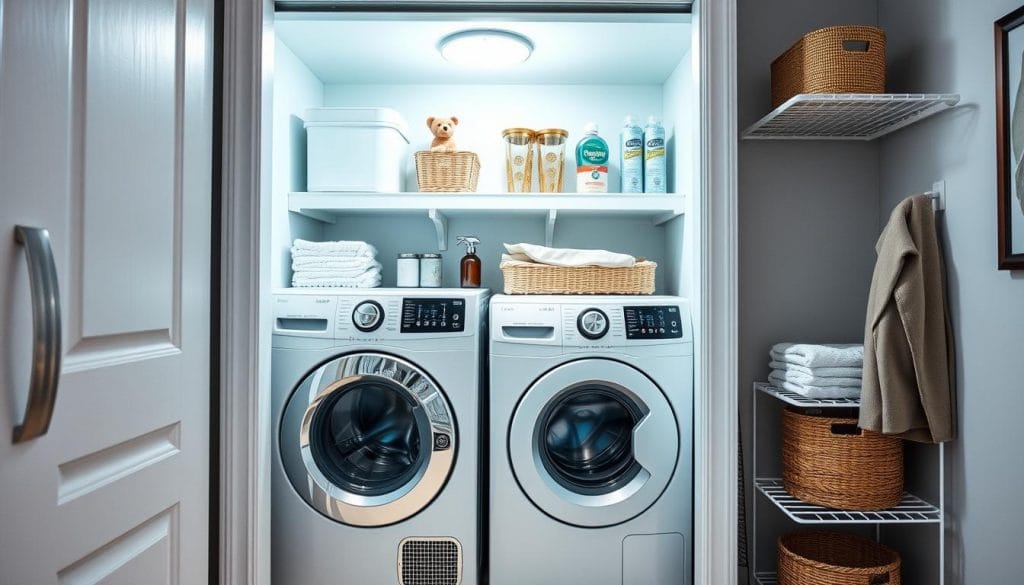
Turning a little-used closet into a laundry nook is one of the better trades available in a small home. You give up storage you were not really using and get back a whole utility area.
Slimline Appliances
Standard machines run about 27 inches wide; slimline and compact models run closer to 24 inches. Ventless washer-dryer combos remove the need for a dryer vent altogether, which is often the one detail that decides whether a closet conversion is possible at all. Measure the closet depth including the door swing before you fall for a particular model.
Built-in Storage Solutions
Once the machines are in, the space that is left is narrow and vertical. Pull-out drawers, floating shelves and labelled bins all work well. So do over-the-door organisers and a pegboard on the back wall, which cost very little and come out again cleanly if you rent. Under-shelf baskets clip onto a shelf you already have and add a second layer of storage for the price of the basket.
Between the right appliance size and a sensible storage plan, a closet nobody was using becomes the most useful four feet in the house.
Combine Laundry Room and Mudroom
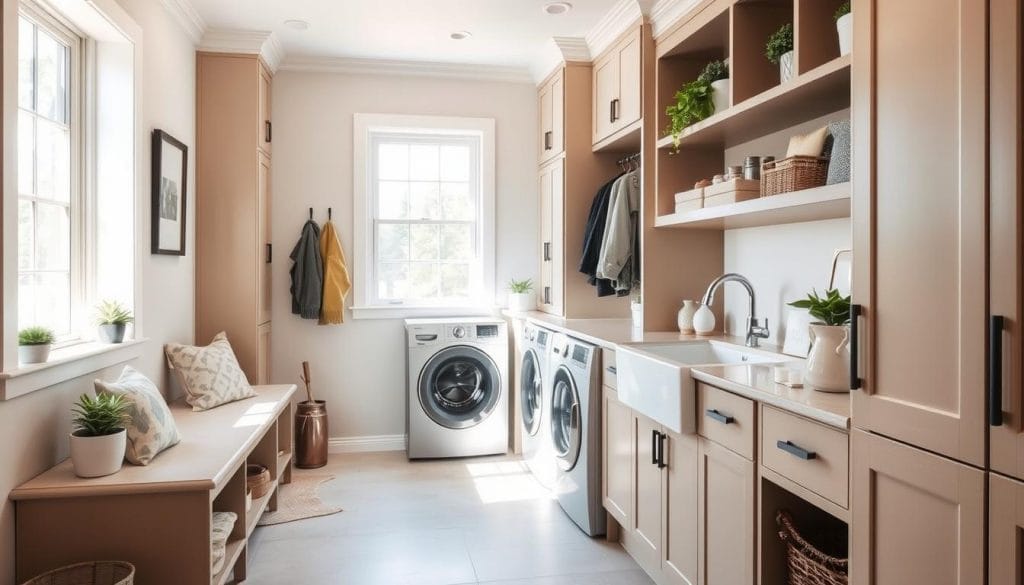
Putting the laundry and the back-door drop zone in the same room is a natural fit. Both are about things coming in dirty and leaving clean, and both want a floor you can mop without thinking about it.
The combined rooms that work best tend to share the same handful of features: a bench to sit on while boots come off, hooks at both adult and child height, one closed basket or cubby per person, and a hard-wearing floor. Keep the two zones visually separate even though they share a room — hooks and a bench on one wall, machines and cabinets on the other. That reads as two tidy areas instead of one cluttered one.
Budget version: a second-hand bench, a length of hook rail, and one labelled basket per person on a shelf above it. If the room is narrow, run everything along a single wall and leave the opposite wall clear. A narrow room with a clear walking lane feels considerably bigger than one with storage on both sides.
Add Tiered Rolling Carts for Easy Access
If you want one change that pays off immediately, it is a tiered rolling cart. Detergent, softener and dryer sheets live together, stay off the counter, and come with you to wherever you happen to be folding.
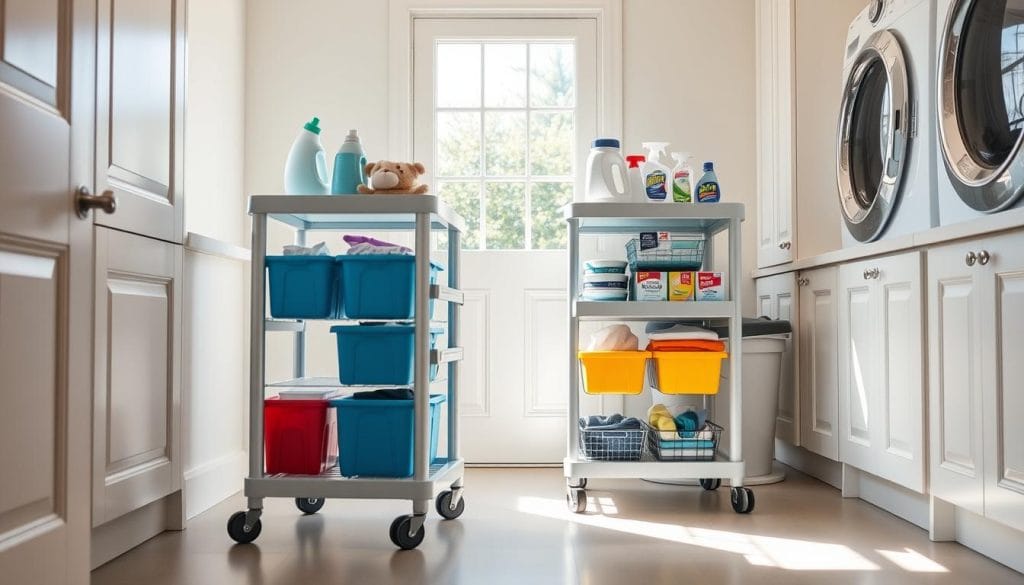
Tiered carts suit small rooms because they are narrow, tall and mobile — three qualities that are hard to find together in fixed storage. A few ways to put one to work:
- Sorting laundry: give each tier a category — darks, lights, delicates — so sorting happens as clothes arrive rather than all at once.
- Storing cleaning supplies: keep the whole kit on one cart and wheel it to whichever room needs it.
- Mobile folding station: use the top tier as a folding surface you can push out of the way afterwards.
- A bit of personality: a plant or a small stack of folded towels on the top tier makes the room feel looked after rather than purely utilitarian.
Here is how the common types compare:
| Type of Cart | Benefits | Ideal Use |
|---|---|---|
| Three-Tier Cart | Separates laundry categories without extra floor space | Sorting clothes by type or colour |
| Rolling Laundry Cart with Bag | Holds clothes and moves them in one trip | Households running several loads a week |
| Compact Utility Cart | Small footprint, fits gaps under 12 inches wide | Apartments and closet laundry nooks |
Position Appliances for Maximum Efficiency
Where the machines sit shapes how the whole room works. Two layouts do most of the heavy lifting.
Side-by-Side Layout
Side by side is the sensible default when you have the width for it. Wet clothes move across rather than down, which is easier on your back, and a counter run across the top of both machines gives you a folding surface for no extra floor space. Stainless steel and sealed laminate both hold up well to damp and detergent; a laminate offcut is the inexpensive option and looks perfectly good once the edges are finished.
Under-Window Setup
Putting the machines under a window uses a wall that is otherwise hard to fit cabinets on, and gives you daylight for checking stains — which is the one laundry task where good light genuinely changes the outcome. No window? A strip of LED tape under the upper cabinets costs very little, plugs in, and does much the same job for stain-spotting.
Implement Hidden Storage Solutions
A laundry room looks calmer when the supplies are put away rather than lined up on the counter. Retractable shelves, cabinet doors on open shelving, and a curtain hung on a tension rod across a storage alcove all achieve the same thing at very different price points. There are more layout ideas in this guide to a functional and efficient laundry space.
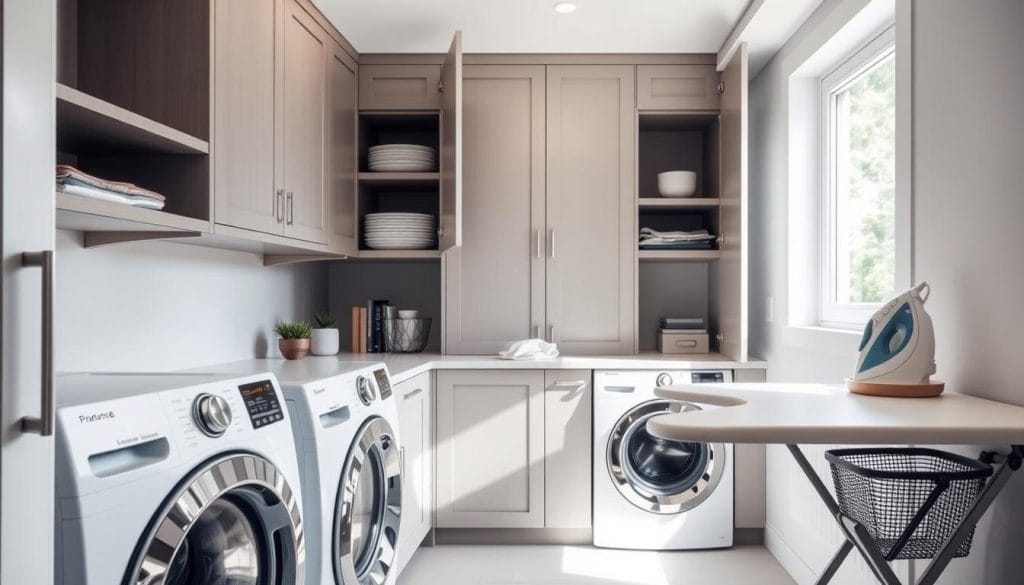
Sliding drawers make a deep cabinet usable all the way to the back, which is where things normally go to be forgotten. Keep heavy items — detergent jugs, the iron, anything you would not want to catch on the way down — at waist height or lower, and save the high shelves for light, bulky, rarely-used things. Small items do better in a shallow drawer than on a deep shelf.
Mesh bags for socks and a clear jar for powder cost almost nothing and remove two of the small daily annoyances of doing laundry. Start there before buying a storage system.
Create a Laundry Nook in Other Rooms
If there is no laundry room to work with, there is usually a corner somewhere that will take one — a bathroom wall, a hallway closet, a wide landing.
Bathroom Laundry Integration
Bathrooms already have the plumbing and the drainage, which makes them the cheapest room to add laundry to. Compact stackable machines fit the leftover wall; our DIY storage ideas cover what to do with the narrow space beside them.
Light colours or a small-scale wallpaper keep the corner from feeling heavy, and quartz or good vinyl handle the damp without much maintenance. A framed photo and a couple of hooks are enough to keep the nook from reading as pure utility.
Hallway Closets
A hallway laundry nook uses a closet that is usually holding coats nobody wears. Slimline machines and a bifold or pocket door keep the laundry out of sight when it is not in use, which matters more in a hallway than in a dedicated room.
Plan for how your needs will change: adjustable shelves cost the same as fixed ones and save you rebuilding later. A bright colour or a patterned paper on the inside back wall costs one sample pot and makes opening the door a small pleasure rather than a chore.
Install Foldable Ironing Stations
If space is tight, a foldable ironing board earns its place. Wall-mounted and cabinet-mounted boards fold flat when you are done, so you are not giving up floor area permanently to something you use once a week.
What to look for:
- Foldability: the board mounts to a stud or inside a cabinet door and folds out when needed.
- Space efficiency: no bulky stand to store, lean or trip over.
- Accessibility: keep the iron on a heat-safe rest within arm’s reach of the board, or the whole setup stops getting used.
Free version: a padded ironing blanket laid over the counter or the top of the machines. It rolls up into a drawer, costs a fraction of a mounted board, and works perfectly well for the occasional shirt. Labelling your shelves and giving each zone a job helps too — mostly because it means everyone else in the house can find things without asking.
10 Functional Laundry Room Ideas to Maximize Efficiency
Laundry rooms have quietly taken on more than laundry — storage, pet care, drying flowers, craft overflow. Pulling the ideas above together, three principles do most of the work.
Using Height
Cabinets to the ceiling, machines stacked, open shelves at eye level for what you use weekly. Vertical storage buys floor space, and floor space is what makes a small laundry room feel workable.
Combining Spaces
Laundry with a mudroom, laundry inside a bathroom, laundry in a hallway closet. Pair it with multi-use furniture — a butcher block top, a rolling cart — and one room quietly handles two routines.
Adding Style
Colour you like, a picture, a plant, and light you can actually see by. None of this is required and all of it is cheap, and it is the difference between a room you avoid and a room you do not mind standing in.
Incorporate Wall-Mounted Drying Racks
Wall-mounted drying racks are the answer to air-drying in a room with no floor to spare. They fold flat against the wall between uses, so the space costs you nothing when the rack is not in service.
They also save wear on clothes that should not go in the dryer, and save a little on the energy bill in the process. There are more small-space layouts worth borrowing in this roundup of small laundry rooms.
To get the most out of one:
- Choose the right location: within easy reach of the washer, and clear of the door swing.
- Consider materials: powder-coated or stainless steel, since a damp room will rust plain metal.
- Blend with the room: pick a finish that matches your hardware so it reads as part of the room rather than an add-on.
Here is how the two options compare:
| Feature | Floor Drying Racks | Wall-Mounted Drying Racks |
|---|---|---|
| Space Utilization | Occupies floor space whenever it is open | Folds flat to the wall; no floor footprint at rest |
| Convenience | Often awkward to move and store | Retractable and quick to open |
| Installation | None — unfold and use | Needs mounting into studs or solid wall fixings |
| Cost | Lowest up front; no tools needed | Higher up front, but frees the floor permanently |
If you are renting or not ready to drill, a tension rod across a recess or over the bath does most of the same work for a few pounds and leaves no holes behind.
Add Built-in Utility Sinks
A utility sink is the difference between treating a stain where it happened and carrying it to the kitchen. It is also where you fill buckets, rinse paintbrushes, and wash the things you would rather not put in the kitchen sink.
Deep single-bowl sinks suit laundry better than shallow double bowls, because the depth is what lets you soak a whole garment. Stainless steel and composite stone both shrug off detergent and bleach; a plain moulded plastic utility sink on legs costs a fraction as much, installs in an afternoon, and does the identical job if looks are not the priority.
Building the sink into a run of cabinetry gives you storage underneath and a continuous counter for folding. If that is beyond the budget, a freestanding sink with a fabric skirt on a tension wire hides the plumbing and the mop bucket for the price of a metre of fabric.
Whichever you choose, plan the surround before the sink: a small shelf or a couple of hooks beside it for the stain stick and the scrub brush is what makes it get used.
Conclusion
A laundry room does not have to be big to be good. Nearly all of the ideas above come down to the same two moves: use the height you already have, and give every item one clear home.
Colour helps more than it should in a windowless room — whites, soft blues, greys and warm wood all keep a small space feeling open. Durable flooring like tile or sheet vinyl handles the occasional overflow without drama. If you are replacing cabinets, ready-to-assemble boxes cost a fraction of custom and take paint well; if you are not, painting the doors you have and swapping the handles gets you most of the way for the price of a tin and a pack of knobs.
Pick one change from this list rather than all ten. A rolling cart, a shelf above the machines, or a wall-mounted rack will tell you quickly what the room actually needed.
FAQ
How can I create an efficient laundry room layout in a small space?
What are some space-saving laundry setups?
How can I convert a closet into a laundry area?
Can I combine a mudroom and a laundry room efficiently?
Are tiered rolling carts useful in a laundry room?
What are the benefits of positioning laundry appliances strategically?
How do hidden storage solutions work in a laundry room?
How can I integrate laundry functionalities into other rooms?
Are foldable ironing stations practical for small laundry rooms?
How can I make the most of wall-mounted drying racks?
What is the advantage of adding a built-in utility sink to the laundry room?
Working with a really tight footprint? Start with our complete guide to small laundry room ideas — it covers stacking machines, fold-away folding surfaces, and a weekend plan for every budget. If your machines live downstairs, our basement laundry room ideas tackle the low light and bare concrete that come with the territory.