
Most people reorganize their desk three or four times before anything sticks. Every system looks great for about a week and a half, and then the mail starts stacking up again, the charging cables go back to living in a tangled ball, and you’re hunting for a pen that works. It’s easy to read that as a personal failing — that some people just have the “organized person” gene and you didn’t get one.
After redoing my own desk more times than I’d like to admit, here’s what I can tell you: the problem is almost never the person. It’s that we copy organization systems built for someone else’s desk, someone else’s job, someone else’s house. A desk a teenager actually uses is a different problem again — our budget decor hacks for teen hangout spots cover that version, study zone included. A gorgeous minimalist setup from a photo doesn’t hold up if you’re the one who answers work email, pays the bills, helps with homework, and wraps birthday presents all at that same twenty-square-foot table. The system has to fit your actual Tuesday, not someone’s highlight reel.
So this is the version that holds up — the setup I keep coming back to, whether you’ve got a whole spare room or a laptop on the kitchen counter. There’s a free way to do almost everything here, and a splurge if you’d rather buy your way to Sunday-night calm.
Why most organizing advice doesn’t hold up
Most home office organization ideas assume you have one job to do at that desk. In real life, most of us are running two or three: paid work, household admin, kids’ school stuff, hobbies, the occasional gift-wrapping station. When your system only has room for “work,” everything else piles on top of it — literally.
The fix isn’t more bins. It’s sorting by what actually happens at your desk, then building storage around those categories instead of around what looks nice in a photo. Once a desk stops trying to look like a magazine spread and starts matching how it’s actually used, the clutter stops coming back.
Start with a five-minute audit, not a shopping trip
Before you buy a single organizer, empty one drawer or one basket and sort what’s in it into three piles: things you touched this week, things you touched this month, and things you haven’t touched since you put them there. That third pile is usually bigger than people expect, and it’s the fastest way to see what your space doesn’t need to hold at all.
Run this on the “important papers” drawer and the haul is depressingly predictable: a charger for a phone that got sold two years ago, a gift card with $4 left on it, a stack of instruction manuals for appliances that are no longer in the house. None of that needs a home. It needs the recycling bin.
Do this audit before you touch Pinterest. It’ll tell you exactly which of the ideas below are actually worth your money, and which ones solve a problem you don’t have.
Desk organization ideas that hold up day to day
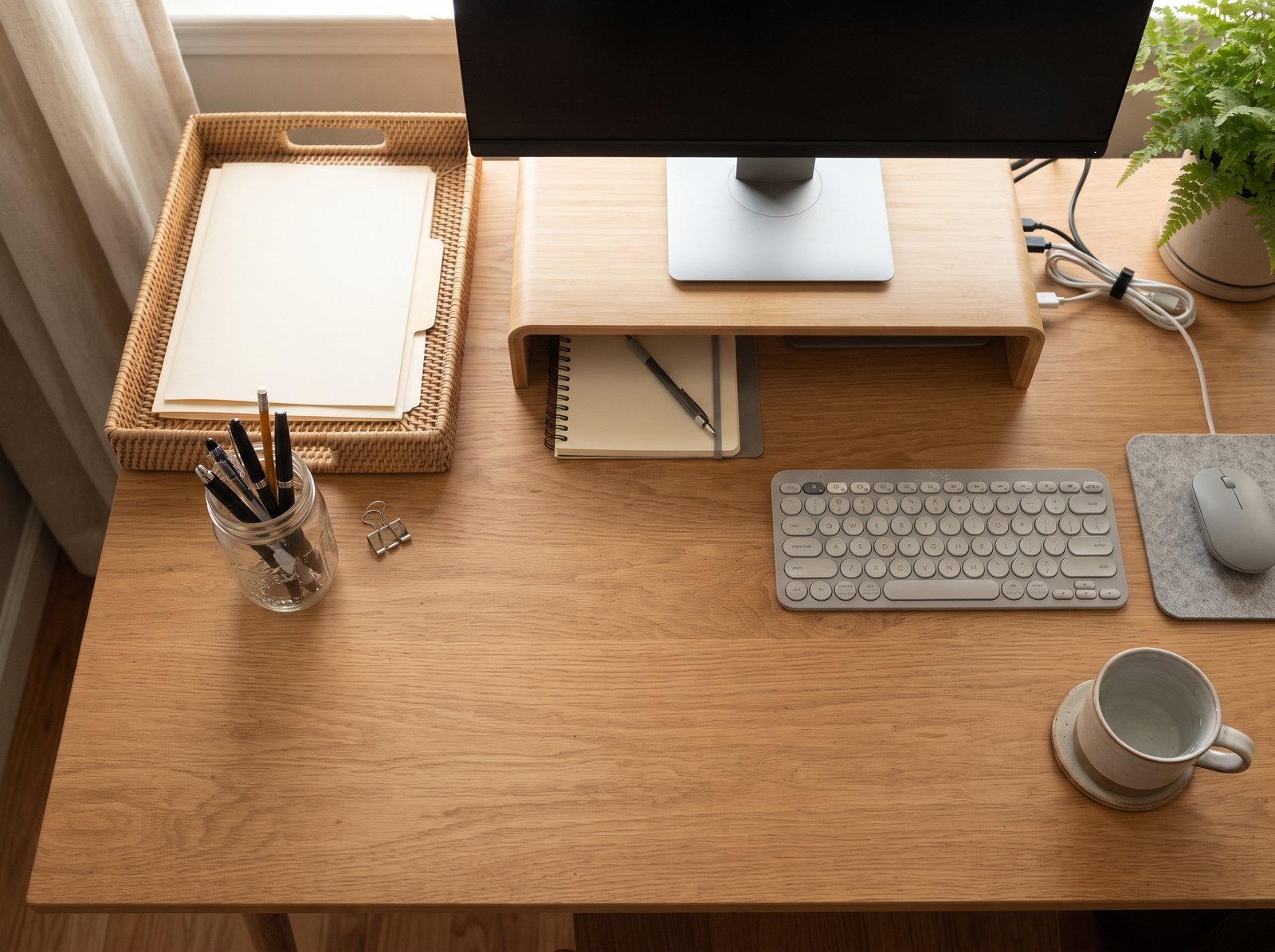
The desktop itself should only hold what you use every single day — everything else belongs one step away, not on top of the surface. A few things that hold up over months, not days:
- A shallow tray for in-progress paper, not a stack. If it doesn’t fit in the tray, it gets filed or tossed that day, not “later.”
- A pen cup with fewer pens than you think you need. Pull every pen out and test it — in most cups, roughly half are dead. Buying five nice pens and using all of them beats owning twenty you’re not sure work.
- One landing spot for your phone and keys if you work from home and use the same desk for household stuff. Nothing derails a tidy desk faster than random daily-carry items with no assigned spot.
- A monitor riser or small shelf that turns dead vertical space into storage for things you use weekly but not daily — notebooks, a planner, reference binders.
None of this requires a shopping trip. A shoebox lid makes a fine tray. A mason jar is a pen cup. Start with what you own before you buy the pretty version.
Vertical storage when you don’t have a spare room
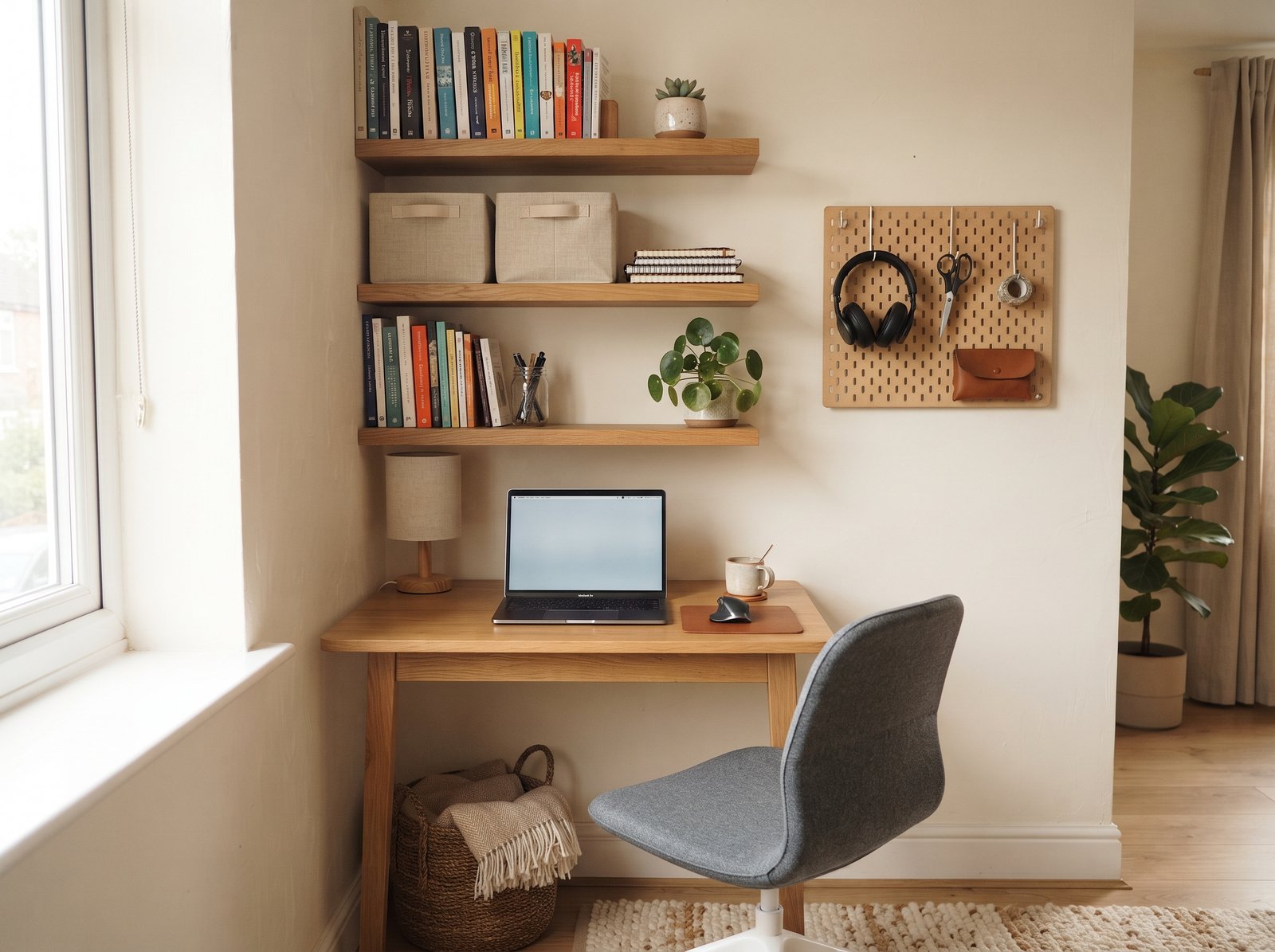
If your “home office” is a corner, a closet, or a section of the dining room, the floor space you don’t have is exactly why walls matter so much. A few ways to use the vertical space without it feeling like a warehouse:
- Floating shelves above the desk for reference books, a small plant, and closed storage boxes — save the open shelf space for things you actually want to look at, and let boxes hide the rest.
- A pegboard for anything you reach for constantly: scissors, tape, headphones, chargers. Seeing it is often more useful than a drawer, because you’re not digging.
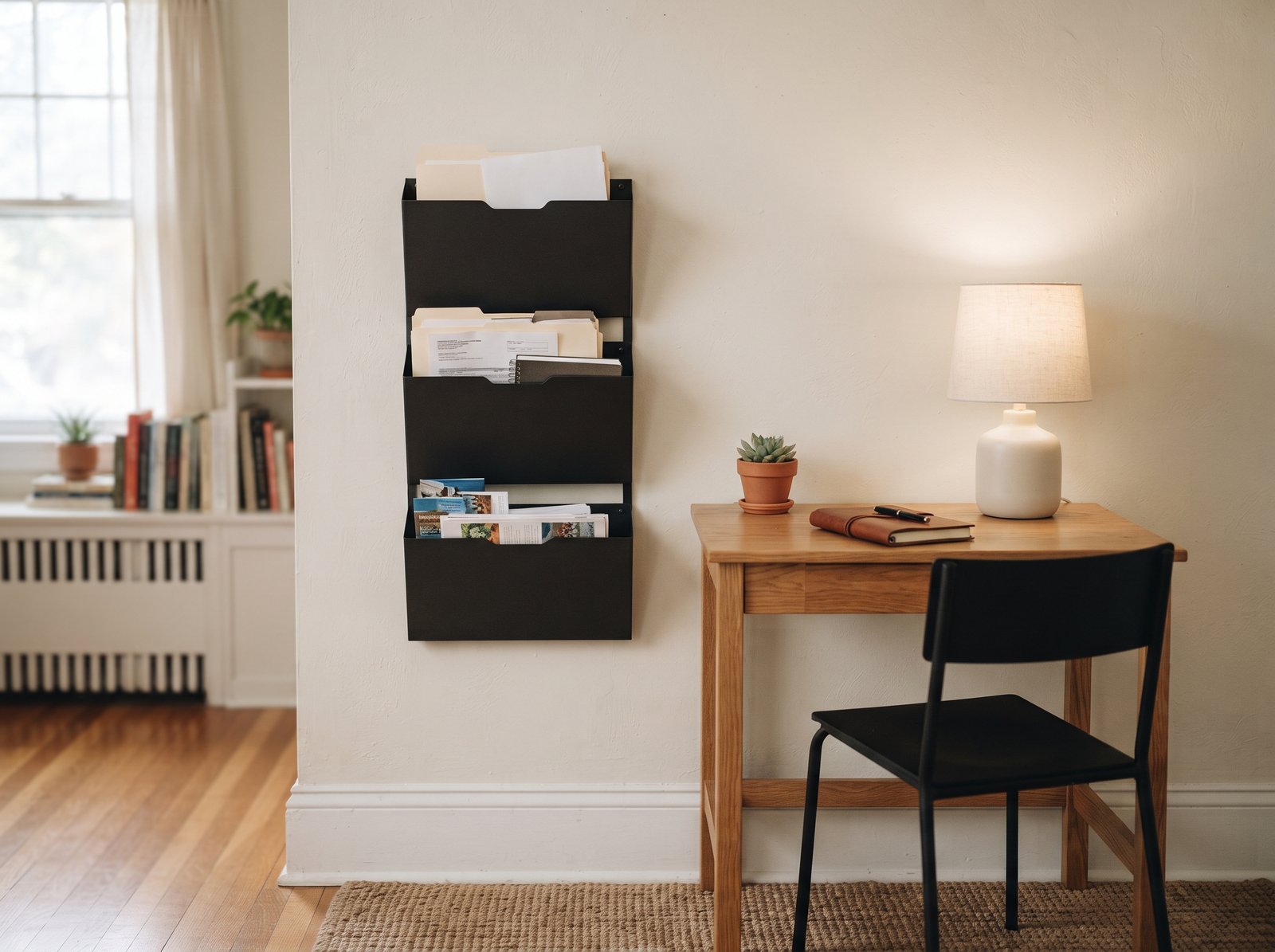
- Wall-mounted file organizers instead of a filing cabinet, if floor space is tight. Three slots — to do, to file, to shred — solves 90% of the “where does this paper go” problem.
- Hooks under the desk for a bag or a charging cord caddy, so cords aren’t dangling where your knees go.
If your setup leans more “converted attic corner” or “repurposed nook” than dedicated room, our attic home office conversion guide walks through making an awkward space actually work for a full workday, and it pairs well with everything in this section.
Small home office organization ideas for shared and multi-use spaces
A desk that also has to be a guest room, a craft table, or the good end of the kitchen table needs one thing most single-purpose offices don’t: an easy way to disappear when it’s not being used.
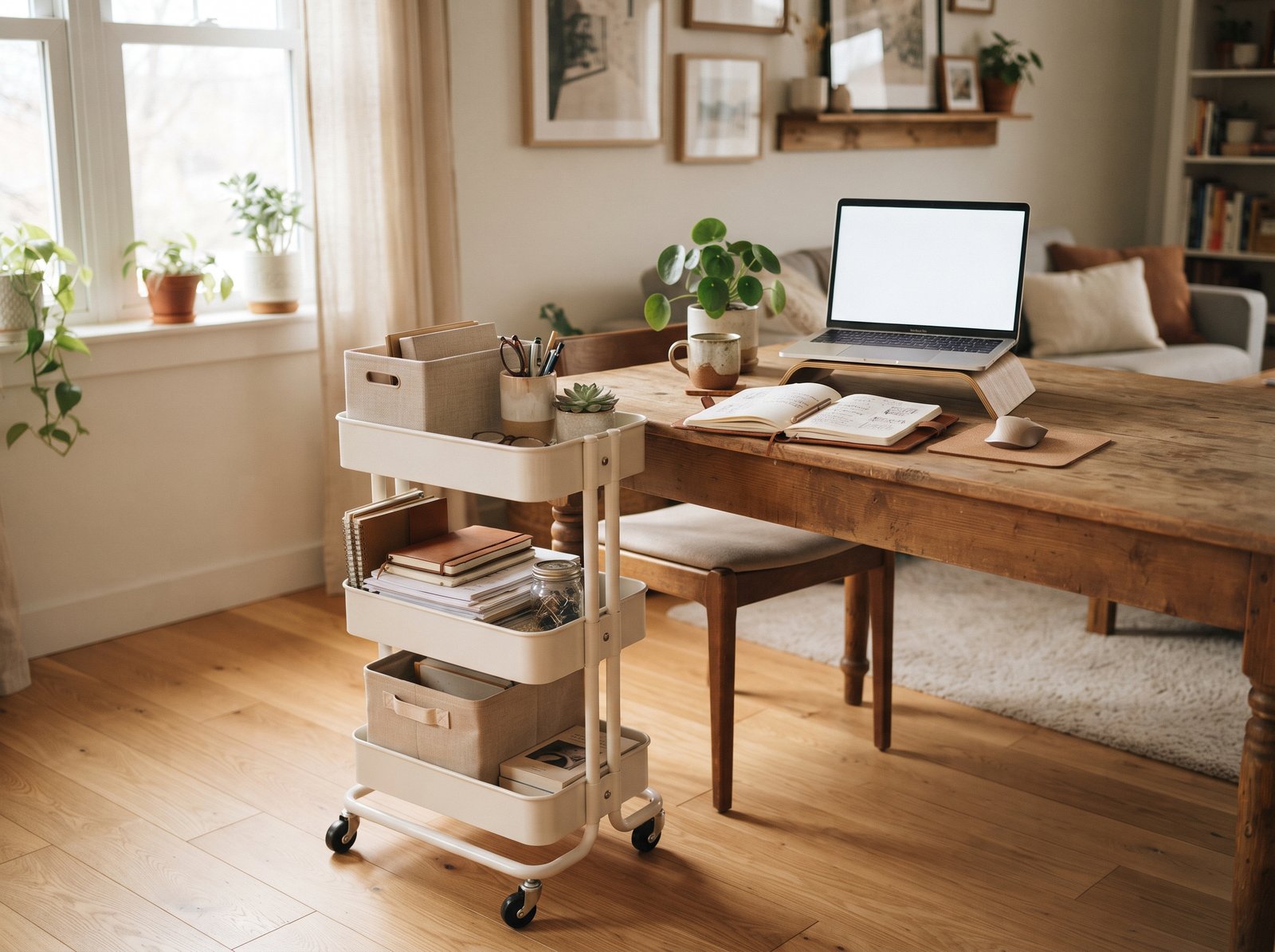
- A rolling cart that holds your whole active setup — laptop stand, notebook, charger, a small file box — and tucks into a closet at the end of the day. This is the single highest-impact change in a shared space, and it’s the reason a dining table stops doubling as a permanent inbox.
- A lidded bin under the bed or in a closet for anything that doesn’t need daily access but has to live somewhere between uses.
- A vertical file caddy that sits on a shelf rather than a full cabinet, if a whole piece of furniture isn’t in the cards.
- Fabric or lidded bins over open baskets in shared rooms — open storage looks tidy for about three days in a busy household, then it becomes a catch-all everyone can see.
If your whole home runs small, our piece on styling small spaces without overcrowding them has more of this “hide it, don’t just store it” thinking applied to other rooms too. And if you’re working with literally no dedicated room at all, it’s worth reading how one of our other posts handled it: our garage mudroom conversion turned an unused corner into a functioning zone without a full renovation, which is the same idea, different room.
Cord and cable management, the unglamorous MVP
Nobody puts “loose cords everywhere” in their vision board, but it’s the thing that makes an otherwise organized desk look like a mess. A few fixes that take fifteen minutes and cost almost nothing:
- Binder clips on the edge of the desk to keep cords from sliding down behind the furniture every time you unplug something.
- A cardboard toilet paper roll (yes, really) to bundle cords you rarely unplug, labeled with a piece of tape.
- A power strip mounted under the desk with removable Velcro, so it’s not rolling around on the floor collecting dust.
- Color-coded tape on cords if you’ve got multiples of the same cable — it saves the “which one is the monitor again” moment every single time.
Paper and mail systems that don’t pile up
Paper is the thing that defeats almost every organizing system, usually more than once. What finally works is giving paper exactly three possible destinations, decided the moment it enters the house:
- Action needed — goes in the shallow desktop tray, dealt with within the week.
- File for later — goes straight into a labeled folder, no detour onto the desk first.
- Recycle — most mail, if you’re honest with yourself.
The trick isn’t the folders. It’s deciding in the moment you touch the paper, instead of setting it down “to deal with later.” Later is where clutter lives.
Home office organization ideas on a budget
You don’t need a full office overhaul to feel the difference. Here’s the free-to-cheap version alongside the splurge, because a real budget matters more than a Pinterest board:
- Free: Repurpose boxes you already have (shoeboxes, cereal boxes cut down, mason jars) as drawer dividers and pen cups. Do the five-minute audit above before buying anything — most people already own half of what they need.
- Under $30: A pack of stackable bins, a roll of adhesive hooks, and a $10 pegboard panel will solve cords, small supplies, and vertical storage in one trip.
- Splurge, if it’s in the budget: A proper rolling storage cart or a small filing cabinet that matches your other furniture. Worth it if you’re short on floor space and want something that looks intentional, not necessary for everyone.
If the whole room needs a refresh and not just the storage, our budget-friendly home office upgrade ideas go further into paint, lighting, and furniture swaps that don’t require a renovation budget.
Maintaining it: the five-minute reset
The organizing part is maybe 30% of the actual work. The other 70% is the tiny daily habit that keeps it from sliding back into chaos, which is the part nobody’s Pinterest board shows you.
The one I recommend to every client is a five-minute reset at the end of the workday: paper goes to its folder or the recycling, the desktop tray gets cleared, and anything that doesn’t belong on the desk gets carried back to its actual home. It’s not deep cleaning. It’s closing the loop on the day so tomorrow starts at zero instead of picking up where the mess left off.
If you only take one thing from this whole post, take that one. The bins and the pegboard matter less than the five minutes that keeps them working.
A few more places to look
If you’re building out a full home office and not just organizing an existing one, our inspiring home office ideas for productivity and 15 features for a better home office setup are good next stops. If your style leans clean and uncluttered by design, sleek minimalist office design and streamlining your workspace take the same organizing principles further. And if you’re considering carving out an entirely separate workspace, our comparison of a she shed versus a garage studio conversion walks through which makes more sense for your yard and your budget. If you’ve already landed on the shed, our she shed ideas guide covers layout, power and insulation, and what it really costs to finish one.
You don’t need a perfect system. You need one that survives a Tuesday. Start with the audit, keep the parts that actually solve your problems, and skip the rest — your desk doesn’t have to look like anyone else’s to work.
Go clear one drawer today. That’s the whole first step. — Quinn
How do I organize a home office on a small budget?
Start by auditing what you already own before buying anything — most people can solve half their clutter with boxes and jars they already have. Then add cheap fixes like stackable bins, adhesive hooks for cords, and a small pegboard, which together usually cost under $30 and solve most day-to-day clutter.
What’s the best way to organize a home office with no extra room?
Lean on vertical space and portable storage instead of floor space: floating shelves, a pegboard, and a rolling cart that holds your whole setup and tucks away when you’re done for the day. This works especially well if your desk doubles as a dining table or guest room.
How do I stop paper from piling up on my desk?
Give every piece of paper exactly one of three destinations the moment you touch it: a shallow action tray, a labeled file folder, or the recycling bin. The habit of deciding immediately matters more than the folders themselves.
How often should I reorganize my home office?
You shouldn’t need to reorganize from scratch if you build in a five-minute daily reset — clearing the desktop tray, filing or recycling loose paper, and returning stray items to their spot. A full audit once or twice a year is usually enough beyond that.
What’s the difference between home office storage and home office organization?
Storage is the physical bins, shelves, and furniture that hold things. Organization is the system that decides what goes where and why. You can buy all the storage in the world and still end up cluttered without a system — the audit and daily reset in this post are what make the storage actually work.