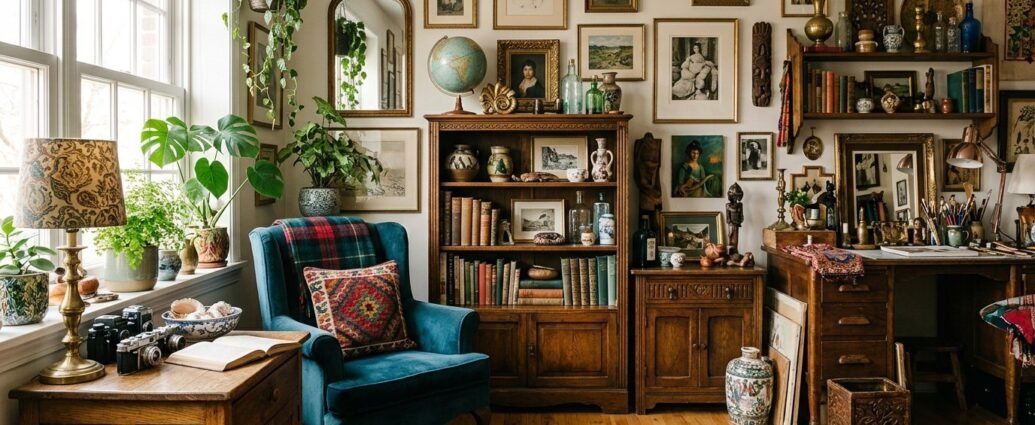
Do you ever walk into a room and feel like it’s whispering stories — where every corner holds something worth lingering over, something that makes you ask, where did that come from? That feeling isn’t an accident. It’s the quiet magic of a home that collects with intention, where the things you love aren’t just stored but actually displayed like they mean something.
If you’ve been quietly accumulating vintage ceramics, old cameras, antique maps, or a shelf full of crystals and wondering how to make it all feel less like a storage unit and more like a curated editorial spread, you’re in exactly the right place. We’re going to walk through how to display collections at home in a way that feels maximalist and layered — but never chaotic — and how to keep hunting for beautiful things without breaking the bank.
Key Takeaways
- Grouping by color or material creates visual cohesion across mismatched objects.
- Negative space is a tool, not an absence — even maximalist rooms need breathing room.
- Shelves styled like editorial vignettes elevate collections into art.
- Estate sales and thrift stores are goldmines when you shop with a focused eye.
- Mixing scales, heights, and textures keeps curio displays dynamic and interesting.
What Makes Maximalist Decor with Antiques Feel Intentional
There’s a fine line between maximalism and visual noise, and it all comes down to one word: intention. Maximalist decor with antiques works when every piece feels chosen rather than accumulated by default. Think of it less like filling a room and more like editing a magazine spread — everything in frame has a reason for being there.
The difference between a space that feels rich and layered versus one that feels overwhelming usually comes down to a few quiet principles that work beneath the surface. Understanding those principles is what gives you the freedom to collect boldly without losing the thread.
The Editorial Eye — Curation Over Collection
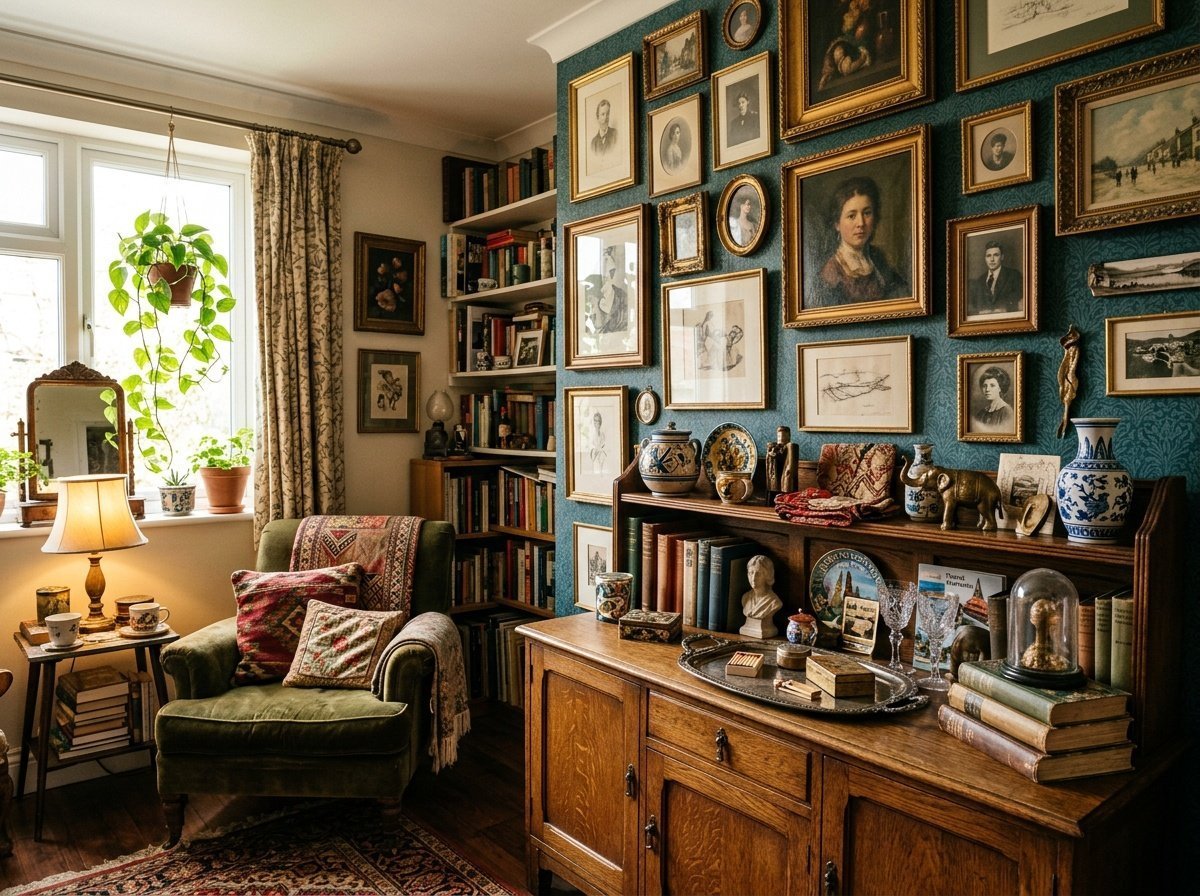
An editorial eye means looking at your objects and asking: does this earn its place? It’s not about minimizing — it’s about being honest. A shelf of twenty vintage ceramics where each piece is intentionally chosen feels completely different from twenty pieces that just ended up there. The former has a point of view. The latter is just stuff.
Start by pulling everything off your display surfaces and editing before you put anything back. You’ll likely find a smaller core group of pieces that genuinely excite you. Those are your anchors. The rest can wait in storage, rotate seasonally, or move to a less prominent spot.
Cohesion Through a Shared Thread
Even the most eclectic home decor needs a thread running through it. That thread might be a recurring color — cream, tobacco brown, dusty sage. It might be a material — aged brass, matte stoneware, raw wood. Or it might be a feeling — weathered, organic, slightly worn. When your objects share even one of these threads, they start to feel like they belong together even if they came from completely different eras and places.
This is how you can have a taxidermy moth next to a Victorian apothecary bottle and a mid-century ceramic vase and have it all feel completely intentional. The thread is the story. And collecting vintage decor with that thread in mind from the start makes everything so much easier down the line.
Grouping by Color and Material — The Designer’s Shortcut
Color and material grouping is genuinely one of the most powerful tools in the collector-decorator’s toolkit. It’s the shortcut that turns a random assortment into a considered arrangement without requiring you to buy a matching set of anything. This approach works especially well for things like shells, crystals, and vintage glassware.
The beauty of this method is that it creates visual harmony while still allowing for total variety in subject matter and origin. A cluster of objects in warm amber tones — a honey-colored glass bottle, a rust-glazed ceramic bowl, a piece of banded jasper — reads as a composed still life even though each piece is completely different.
Monochromatic Groupings for Maximum Impact
Try pulling together every cream and white object you own — shells, white stoneware, bleached driftwood, plaster casts, ivory candleholders — and group them on a single surface. The result is almost always stunning. The monochromatic palette lets the texture and form of each individual piece do the talking without competing colors pulling the eye in different directions.
This works particularly well in spaces where the walls or furniture are already doing a lot of visual work. A monochromatic grouping feels like a breath of focused air amidst a layered room.
Material-Based Clustering
Material grouping works similarly. Try gathering all your brass and metal objects together — old cameras with brass fittings, antique compasses, bronze bookends, a vintage alarm clock. Suddenly they form a cohesive collection even though none of them are technically related. The shared material creates a conversation between them.
For ceramics specifically, grouping by finish — matte stoneware together, glossy glazed pieces in another arrangement — creates a more polished look than mixing finishes randomly. These small distinctions are the difference between a display that looks styled and one that looks assembled.
| Grouping Method | Best For | Examples |
|---|---|---|
| Monochromatic Color | Mixed object types in a single palette | All-white shells, ceramics, and candles |
| Shared Material | Objects from different eras or categories | Brass cameras, compasses, clocks together |
| Height Variation | Shelf and mantle displays | Tall bottle, medium vase, small dish |
| Thematic Narrative | Telling a specific story or era | Antique maps, compass, explorer’s journal |
| Texture Contrast | Adding depth to flat displays | Rough geode, smooth glass, woven basket |
Curio Display Ideas — Using Shelves as Storytelling Surfaces
Shelves are the gallery walls of three-dimensional objects, and styling them well is genuinely one of the most satisfying parts of decorating a collected home. The best curio display ideas treat each shelf like a composed scene rather than a storage solution. Think foreground, midground, background. Think height, weight, and breathing room.
Whether you’re working with a built-in bookcase, floating shelves in a reading nook, or a vintage apothecary cabinet, the principles stay the same. It’s all about creating a visual rhythm the eye can follow without getting lost.
The Rule of Odd Numbers and Triangular Arrangement
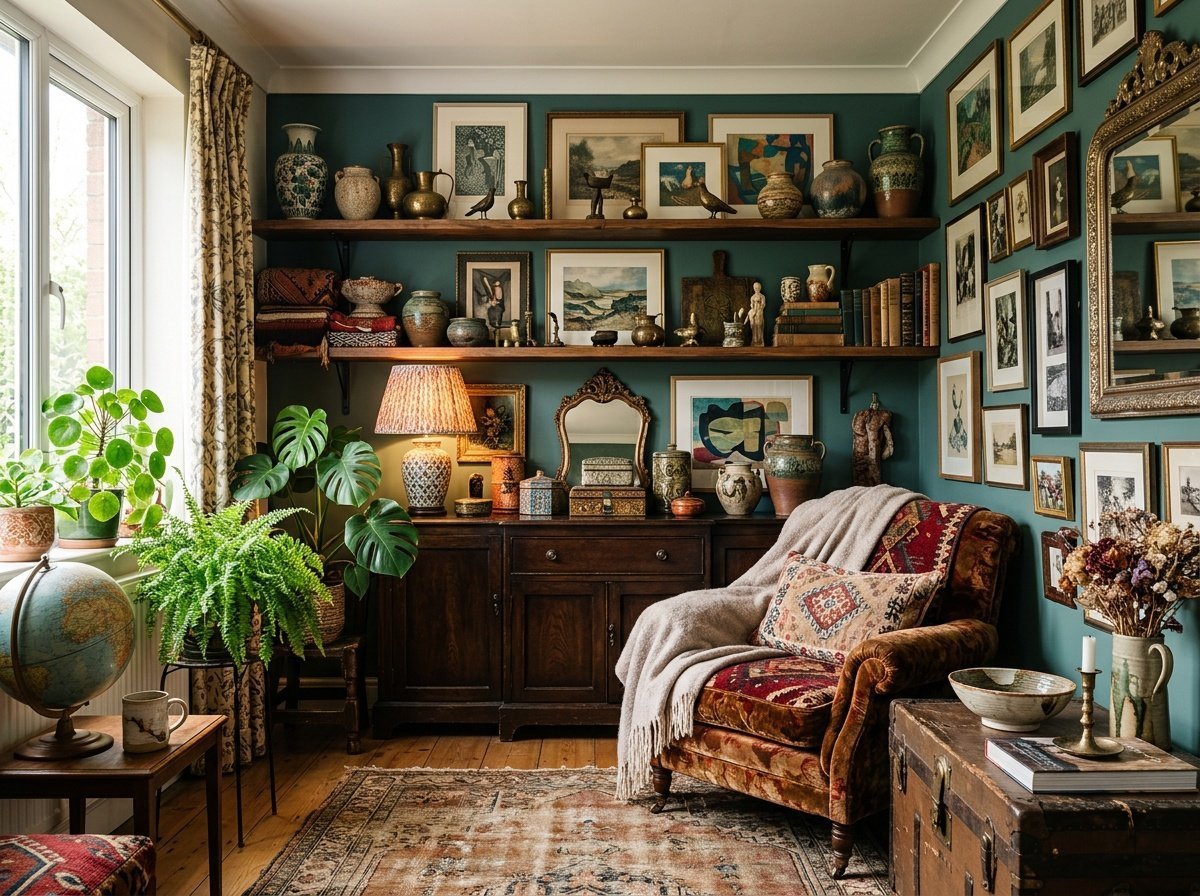
Odd numbers naturally feel more dynamic than even groupings, and designers lean on this constantly. Three objects almost always look better than four. Five beats six. Within those groupings, arrange pieces in a loose triangle — tallest at the back or one side, medium in the middle, small at the front — and the arrangement will have a natural flow to it.
This doesn’t mean every shelf needs exactly three items. It means thinking in triangular compositions when you’re placing things. It creates movement rather than a flat row of similar-sized objects standing in a line.
Layering Books, Objects, and Art
Books are one of the most underused tools in curio display. Use stacked books horizontally as risers to lift smaller objects to different heights. Lean a small framed antique map or botanical print behind a ceramic bowl to add a vertical layer. Let a trailing plant or dried botanical spill over one edge to soften the geometry.
This layering is what makes a shelf feel collected over time rather than styled all at once. And if you’re also updating other parts of your home on a budget, you might find that inexpensive family room updates like better shelf styling make a bigger visual impact than almost anything else.
Rotating Seasonal Pieces
Not everything needs to be on display all the time. Part of the joy of collecting is that you can rotate pieces in and out seasonally, keeping displays feeling fresh. Shells and sea glass come out in summer. Amber-toned ceramics and dried botanicals feel right in autumn. Crystals and white objects work year-round but feel especially beautiful against winter light.
This rotation also helps prevent visual fatigue — both yours and your guests’. When pieces change, the room keeps offering something new to notice.
The Importance of Negative Space in a Maximalist Room
Here’s the counterintuitive truth about maximalist decorating: negative space is one of your most powerful tools. Negative space — the empty, uncluttered areas within a display or room — is what makes the objects around it feel intentional rather than overwhelming. It is, in a way, the pause between the notes that makes the music.
“Negative space isn’t emptiness — it’s the permission a room gives your eye to actually see what’s there.”
Strategic Breathing Room Within Displays
Even on the most densely styled shelf, leaving small pockets of empty space between groupings makes the overall display feel more deliberate. Think of it like paragraph breaks in writing. Without them, everything runs together. With them, each idea gets the space to land.
A practical rule: no matter how full a shelf is, keep at least one section of it with nothing but open surface. This creates a visual rest stop that actually makes the busier sections feel richer by contrast.
Choosing One Statement Wall
In a room with strong collections, choose one wall to be your main visual event — your gallery wall of antique maps, your full floor-to-ceiling shelving unit, your curio cabinet — and let the other walls breathe. This gives the eye a clear focal point and prevents the room from feeling like it’s shouting from every direction at once.
This principle works beautifully in spaces where you might be working with awkward architecture too. If you’ve ever dealt with a low or unusual ceiling situation, you know how strategic placement of display elements can transform the whole feeling of a room — something I’ve explored in depth in my post on low ceiling basement ideas that actually work.
How to Shop Estate Sales and Thrift Stores Strategically
This is where the real adventure begins. Estate sales, thrift stores, flea markets, and antique fairs are the heartbeat of a collected home, and shopping them well is genuinely a learnable skill. It’s not about luck — it’s about having a clear vision before you walk through the door and the discipline to walk past things that don’t fit that vision, no matter how interesting they are.
Know Your Thread Before You Shop
Going into an estate sale without a focus is how you end up with six interesting things that don’t work together. Before you go, remind yourself of your thread — your color palette, your materials, your era or mood. Take a photo of your main display space on your phone so you can reference it while you shop.
Ask yourself: does this piece add to what I already have, or does it start a whole new tangent? Both can be valid, but tangents have a cost — in space, in money, and in visual coherence.
What to Look For — and What to Leave Behind
At estate sales, focus on:
- Ceramics and pottery with unusual glazes or handmade irregularities
- Old books with beautiful spines for layering in shelving
- Small brass or bronze objects — trivets, inkwells, candlesticks
- Framed maps, botanical illustrations, and antique prints
- Wicker, rattan, and natural fiber baskets in good condition
Leave behind anything that’s only interesting because of the price. A bargain is only a bargain if the thing serves your space. Also be cautious with large taxidermy pieces or dramatically themed items until you know exactly where they’ll live — they’re hard to integrate once you get them home if you haven’t planned the placement.
The One-In-One-Out Discipline
For dedicated collectors, the one-in-one-out rule is genuinely life-changing. Every time a new piece enters your home, something else leaves — to storage, to a friend, or to donation. This keeps your displays from calcifying into an uneditable mass of things and forces you to keep re-evaluating what’s earning its place.
Displaying Specific Collections — Antique Maps, Taxidermy, Cameras, and More
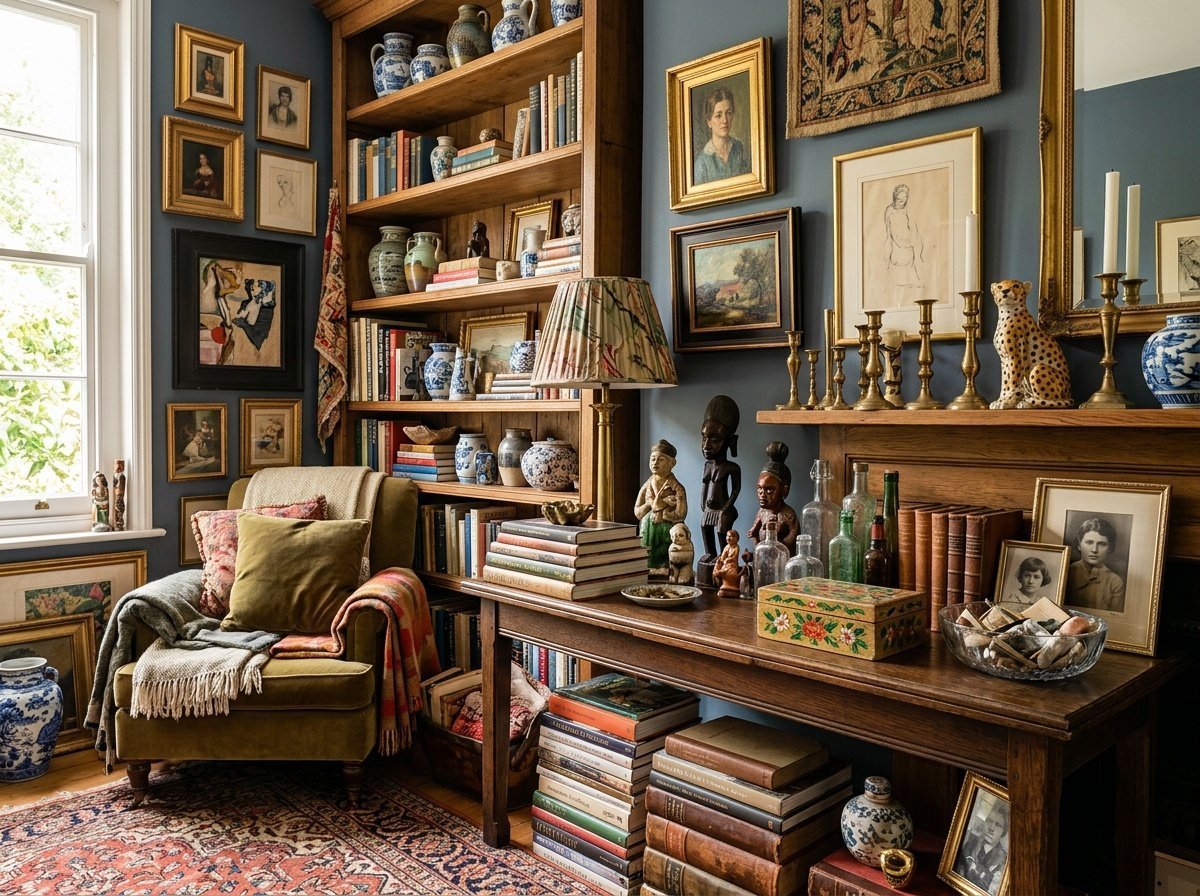
Different types of objects have different display personalities, and knowing how to work with each type’s specific qualities helps you get the most out of them. A vintage camera collection has completely different display needs than a crystal collection, and treating them thoughtfully makes a big difference.
Antique Maps and Paper Ephemera
Antique maps and paper ephemera work beautifully as the backdrop layer in a styled vignette. Frame them simply — thin black metal or warm gilded frames both work — and lean them rather than hanging them for a more casual, collected feel. Group multiple maps at different sizes together, overlapping slightly, and place dimensional objects in front of them to create depth.
Paper items are also vulnerable to light damage, so keep them away from direct sunlight and consider UV-protective glass for anything particularly precious.
Crystals and Minerals
Crystals and mineral specimens work best when grouped by color family or when arranged by scale — largest anchoring one end, smallest at the other. A single large geode or amethyst cluster can anchor an entire shelf arrangement, acting as a natural focal point that everything else orbits around.
Avoid placing crystals at floor level where they get lost. They earn their place at eye level or on raised surfaces where their color and light-catching quality can actually be appreciated.
Vintage Cameras
Old cameras are one of my favorite things to collect because they have such inherent visual interest — interesting shapes, aged leather, beautiful mechanics. Display them in a loose cluster on an open shelf, mixing with related objects like old rolls of film, a worn leather camera bag, or a black and white photograph.
Avoid the single-object-in-the-center approach. One camera on a shelf looks stranded. Three to five cameras at slightly different heights and angles, with a few supporting objects, looks like an intentional still life.
Shells and Natural Specimens
Natural objects like shells, driftwood, sea glass, and dried botanicals carry an organic softness that balances beautifully against harder, more architectural objects. Use them to fill the gaps in a display — tucked beside a ceramic bowl, scattered across the front of a shelf, or arranged in a shallow tray or ceramic dish.
If you’re building out a nature-forward display corner, consider the same earthy, organic palette principles I love for interiors generally — the kind of calm, grounded color story that also works beautifully in spaces like earthy and calming nursery color palettes, where natural textures create a sense of quiet warmth.
Building Your Collection Over Time Without Overwhelm
One of the most freeing things about collecting for your home is that it’s never actually finished — and that’s the point. A collected home is always in conversation with itself, always evolving as you discover new things and let go of what no longer fits. The pressure to have it all figured out immediately is the thing that makes the whole process feel stressful rather than joyful.
Start With One Anchor Collection
Rather than collecting broadly across every category at once, choose one anchor collection to develop deeply — vintage ceramics, say, or botanical prints — and let that collection set the visual tone for the space. Once that anchor is well established and cohesive, you can introduce secondary collections that complement rather than compete with it.
This focused approach also helps you develop a real eye for quality within your category. The more you look at vintage ceramics, for example, the better you get at recognizing which pieces are exceptional and which are merely fine.
Budget Rhythm — Mixing Investment Pieces with Found Objects
A collected home doesn’t need to be expensive — it needs to feel rich. The most visually interesting spaces I’ve ever styled mix one or two genuinely special investment pieces (a significant antique, a piece from a ceramicist you love) with dozens of affordable finds from estate sales, thrift stores, and flea markets.
The investment pieces anchor the collection and give it credibility. The found objects give it soul. Neither works quite as well without the other, and the budget balance between them is entirely yours to decide based on what excites you.
Frequently Asked Questions
How do I display collections at home without it looking cluttered?
The key is intentional grouping and strategic negative space. Rather than spreading objects across every surface, cluster related pieces together and leave breathing room between groupings. Grouping by color or material creates visual cohesion even among very different objects, and keeping at least one surface relatively clear in each room gives the eye a place to rest.
What’s the best way to start a maximalist decorated room?
Start with one anchor collection and one dominant color palette rather than trying to do everything at once. Establish the bones — your main display surface, your primary color story, your materials — and then layer from there. Maximalism built slowly feels rich; maximalism built all at once often just feels busy.
How do I shop estate sales strategically for home decor?
Go in with a clear vision of your space — take a photo on your phone for reference — and know your thread (color, material, era) before you arrive. Focus on categories you genuinely collect rather than buying interesting one-offs that don’t connect to anything else. And practice the discipline of walking away from something that doesn’t fit, no matter how good the price is.
Can taxidermy work in a modern or organic home?
Absolutely, when it’s placed thoughtfully. The key is using taxidermy as an accent rather than a theme — one carefully chosen piece in a room full of soft textures and natural materials feels unexpected and editorial. Avoid clustering multiple taxidermy pieces unless you’re committing to a full Victorian curiosity cabinet aesthetic, in which case, commit fully.
How do I display vintage ceramics without it looking like a shop?
Mix ceramics with non-ceramic objects — books, dried botanicals, small framed prints, natural specimens. A shelf of only ceramics, however beautiful, starts to look like inventory. Weaving in different object types creates the layered, lived-in feeling that makes a collection feel personal rather than for sale.
How many objects are too many for a shelf display?
There’s no universal number, but a useful test is this: if you can’t identify a clear visual focal point within the arrangement in three seconds, it probably needs editing. Every grouping should have one anchor piece the eye finds first, and the surrounding objects should support rather than compete with that anchor.
Where are the best places to find vintage and antique decor on a budget?
Estate sales are consistently the best source for quality vintage finds at accessible prices — apps like EstateSales.net and EstateSales.org let you preview items before you go. Thrift stores reward repeat visits since inventory changes constantly. Flea markets and antique fairs are great for browsing and building relationships with dealers who can keep an eye out for specific things you’re looking for.
The most beautiful collected homes I’ve ever walked into share one quality: they feel like someone actually lives there — someone with a genuine point of view, real curiosity, and the confidence to let their interests show up on the walls and shelves without apology. That’s what you’re building. Take it slowly, trust your eye, and remember that every piece you choose well is telling a little piece of your story. I’d love to see what you’re building — come share your collections with me over on Instagram and let’s talk about it. ✨