Farmhouse decor has been the most searched-for interior style in America for the better part of a decade, and that popularity has not been kind to it. Somewhere between the original idea — a working house furnished with honest materials and objects that earned their place — and the shiplap-and-signage era, the style picked up a great deal of costume jewelry. A lot of people say they want farmhouse and mean something much quieter than what the internet shows them.
This is the version I’d give a friend at their kitchen table: what the style actually is, how its branches differ, the specific materials and colors that carry it, and how to execute it room by room so the house reads as collected rather than themed. Farmhouse is one of the most requested looks there is, and the one most often in need of rescuing from itself.
Key Takeaways
- Farmhouse is a materials-and-function idea, not a shopping list: honest materials, simple forms, visible wear.
- Modern farmhouse is the high-contrast, edited branch; traditional is warmer and more layered; French country is the refined cousin.
- The palette is warm-neutral, never cool gray — Alabaster, White Dove, Accessible Beige, with Iron Ore or Railings for contrast.
- Texture does the work color does elsewhere: linen, jute, wool, unlacquered brass, honed stone, white oak.
- It ages badly when it becomes literal. Retire the word art, keep the materials, let one real antique per room do the storytelling.
What Farmhouse Style Actually Is
Strip away ten years of merchandising and farmhouse comes down to three ideas, all of which exist because real farmhouses were working buildings before they were aesthetic ones.
Honest materials. Wood that looks like wood, stone like stone, metal like metal. Nothing pretends to be more expensive than it is. A pine table is a pine table; it doesn’t have a faux-mahogany glaze. This is why laminate that mimics barn wood reads as wrong even to people who can’t say why — the whole style rests on material honesty, so a fake material is a grammatical error.
Function-first forms. Shaker cabinet doors are a flat panel in a square frame because that’s the simplest durable door. A trestle table has a trestle so people can sit along the sides. An apron-front sink projects past the cabinet because someone standing at it all day shouldn’t have to lean over a counter edge. Where there is ornament, it’s usually structural: a turned leg, a spindle back, a bracket under a shelf.
Patina is welcome. This is what separates farmhouse from every other neutral style. A wax ring on a table, a worn arm on a leather chair, a chipped enamel pitcher — these are features. The goal is a room that looks like it accumulated over thirty years, not one that arrived on a delivery truck. Everything else follows from those three rules; satisfy all three and a decision will read as farmhouse whether or not it appears in a catalog.
Modern Farmhouse vs. Traditional vs. French Country
People use “farmhouse” for at least three distinct looks that want different furniture, different paint, and different amounts of stuff. Deciding which you’re actually after is the highest-leverage thing you can do before spending money.
Traditional (Rustic) Farmhouse
The warmest and most forgiving branch. Wood runs mid-to-dark — hickory, heart pine, walnut, oak with an amber cast. Walls are cream rather than crisp white. There’s more of everything: pattern, quilts, ironstone, a hutch with actual dishes in it. Contrast is low, and interest comes from layering rather than graphic punctuation. This suits older houses, low ceilings, and anyone who owns inherited furniture and wants to use it.
Modern Farmhouse
The branch that dominated the 2010s. It keeps the materials and drops the layering: warm white walls, black window frames and hardware, wood held to one or two tones, clean-lined upholstery, an edited surface count. Modern farmhouse is what most people mean by “warm but not busy,” and it works far better in newer construction — open plans, tall ceilings — than the traditional version does. For the same instinct with more color, see our guide to modern country home decor.
French Country and Cottage
Related, but genuinely a different style, and the two get blended badly all the time. French country descends from Provençal rural houses and is fundamentally more decorative: carved and painted furniture, cabriole legs, toile and ticking, gilt mirrors, crystal against rough plaster. Its neutrals are creamier and its accents softer — lavender, sage, faded blue, ochre. Where American farmhouse is plain by conviction, French country is plain in the bones and pretty on the surface. If the elegance is what pulls you, read our French country cottage decor guide rather than forcing the American version to be something it isn’t.
| Traditional | Modern Farmhouse | French Country | |
|---|---|---|---|
| Wall color | Cream, warm beige | Warm white, greige | Chalky off-white, soft pastel |
| Wood tone | Mid to dark, amber | Light to mid, neutral | Painted, limed, gray-weathered |
| Contrast | Low | High (black accents) | Low to moderate |
| Metals | Iron, galvanized, oil-rubbed bronze | Matte black, brushed brass | Antique brass, gilt, pewter |
| Pattern | Checks, plaids, small florals | Minimal; texture instead | Toile, ticking, large florals |
| Surface count | Full — collections displayed | Edited — few objects | Curated decorative objects |
The Material Vocabulary
If you learn nothing else here, learn this. Farmhouse rooms are neutral by definition, which means texture and material carry the load color carries in other styles.
Woods
White oak is the current default: hard (1,360 Janka), it takes a matte finish without going orange the way red oak does, and rift-sawn boards give the quiet straight grain modern farmhouse wants. Eastern white pine is the historically correct choice — soft, dents readily, and that’s the point. Hard maple is the butcher block standard because its tight closed grain resists knife marks. Hickory gives dramatic light-to-dark variation within a single board, which suits traditional farmhouse and fights with modern. Poplar is the paint-grade workhorse for cabinets and trim — no reason to pay for oak you’re covering in Alabaster. Reclaimed heart pine and Douglas fir belong on beams, mantels, and open shelving, where the nail holes are the value proposition.
Metals
Matte black is the modern farmhouse signature, and finish quality matters — cheap black hardware wears to gray at the thumb contact point within two years. Unlacquered brass is the best long-game choice: it arrives bright and darkens unevenly with handling, which is exactly the patina logic the style is built on. Oil-rubbed bronze belongs to traditional farmhouse. Galvanized steel reads utilitarian and should live in genuinely utilitarian places — a mudroom bin, a wall-mount drying rack — not as a decorative planter. Two metals in a room is normal; four is a mess.
Textiles
Washed linen is the anchor fiber: it wrinkles, and the wrinkle is the look. For upholstery, 10 oz. or 12 oz. cotton duck is the traditional slipcover cloth and nearly indestructible; look for a Martindale rub count above 20,000 on a sofa that gets used. For rugs, jute is soft and warm but sheds for a few months, sisal is harder and does poorly with spills, and wool costs three to four times more and outlives both. Ticking stripe and small-scale gingham are the two patterns that never date.
Stone and Surfaces
Honed marble — Carrara, or the cheaper Danby — etches and stains, and in a farmhouse kitchen that’s acceptable in a way it isn’t in a contemporary one. Soapstone is the most historically appropriate counter: soft, non-porous, darkens to near-black with mineral oil. Butcher block in maple or walnut runs about 1.5 in. thick and wants mineral oil monthly for six months, then quarterly. For tile, 3×6 subway with slightly off-white grout, handmade zellige with its intentional color variation, and unglazed hex floor tile are all defensible; large-format glossy porcelain is not.
The Farmhouse Palette
The most common paint mistake is choosing a cool gray or a stark white. Farmhouse neutrals are warm neutrals. These are the colors I specify most:
- Sherwin-Williams Alabaster SW 7008 — the warm white that made the style. LRV 82, soft enough it never goes clinical, and the safest whole-house trim and cabinet color there is.
- Benjamin Moore White Dove OC-17 — slightly creamier, and the better trim choice in a house with a lot of natural wood.
- Benjamin Moore Swiss Coffee OC-45 — for traditional farmhouse walls where you want cream, not white.
- Sherwin-Williams Accessible Beige SW 7036 — the reliable greige when white is too much. Warmer than Agreeable Gray, which drifts cool in north light.
- Benjamin Moore Revere Pewter HC-172 — the mid-tone greige for rooms with strong southern light that would blow out something lighter.
- Sherwin-Williams Iron Ore SW 7069 — the near-black for exterior windows, interior doors, and island cabinetry. Softer than Tricorn Black SW 6258.
- Farrow & Ball Railings No. 31 — a blue-black with real depth for one dramatic element, like a range hood or back door.
- Sherwin-Williams Evergreen Fog SW 9130 and Benjamin Moore October Mist 1495 — the muted sages that have quietly replaced white as the default cabinet color.
- Benjamin Moore Hale Navy HC-154 — when you want a dark that isn’t black or green. Excellent on a mudroom bench.
The working formula is roughly 70 percent warm neutral, 20 percent natural wood, 10 percent dark accent. For the fuller range, including earthier and bolder directions, our guide to timeless farmhouse color palettes works through fifteen of them.
Farmhouse Room by Room
The Kitchen
This is where the style is most legible and most expensive to get wrong. The signatures are an apron-front sink, Shaker cabinet fronts, some open shelving, and a warm counter material. A standard 30–33 in. apron sink needs a 36 in. sink base with a modified front — the single most common surprise in a farmhouse kitchen budget, because you usually cannot drop one into existing cabinetry.
The numbers that matter: hang pendants so the bottom of the shade sits 30–36 in. above the counter. Allow 12–15 in. of island overhang for seating and 24 in. of width per stool. A 36 in. counter wants a 24–26 in. seat height; a 42 in. bar wants 29–30 in. Open shelves should be 10–12 in. deep with 14–16 in. of vertical clearance — enough for dinner plates and bowls without becoming a display case.
If a renovation isn’t happening: replace hardware ($150–$400 for a kitchen at $4–$12 per piece), open up one wall of uppers only, and leave a wood board and a stoneware crock out and nothing else. For twelve worked examples with cabinetry and backsplash decisions laid out, see our roundup of farmhouse kitchen designs.
The Living Room
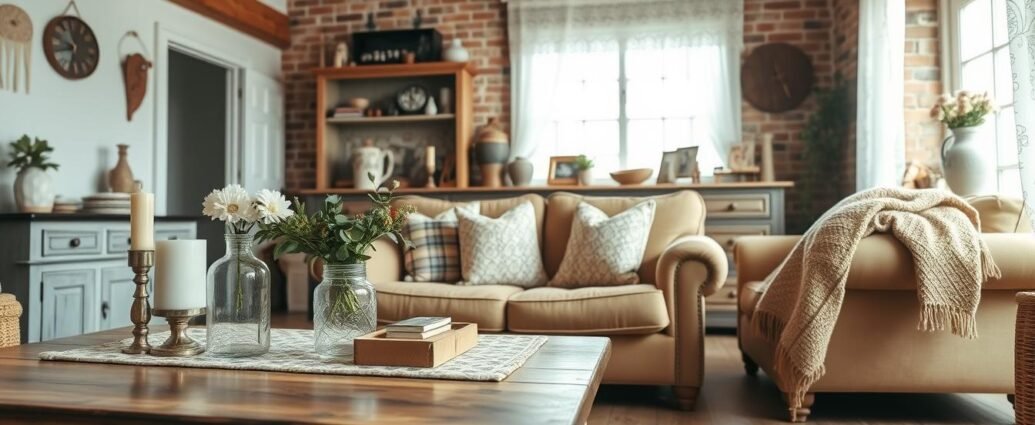
Anchor with a slipcovered or linen sofa in a warm neutral. Slipcovers aren’t a compromise here — they’re the historically correct answer and they wash. Then layer three textures minimum: a jute or wool rug, linen pillows, and one nubbier thing.
An 8×10 rug is the minimum for a standard three-seat sofa, and the front legs of all seating should sit on it — a rug floating in the middle with everything off it is the fastest way to make a room look unfurnished. Leave 14–18 in. between sofa and coffee table and 30–36 in. of walking path behind seating. Hang curtains 4–6 in. above the window casing, or halfway to the ceiling, whichever is higher, using panels totaling twice the window width so they still look full drawn back. Our dedicated guide to farmhouse living room decor ideas goes deeper on fireplaces and furniture arrangement.
The Bedroom
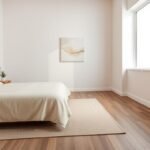
The easiest farmhouse room to get right, because restraint is already the goal. A simple wood frame in white oak or pine, or a classic iron bed, anchors it. Layer washed linen or cotton percale in white, oatmeal, or soft greige, add a quilt folded at the foot and one wool throw, and stop.
Nightstands should land within 2–4 in. of the mattress top, and the bottom of a bedside lampshade should sit at roughly eye level when you’re sitting up reading — usually a 26–28 in. lamp on a 24 in. nightstand. Use 2700K bulbs on a dimmer; nothing kills a warm room faster than 4000K light. For character, one aged piece — a painted dresser, a spindle bench, a foxed mirror — does more than five new accessories. Keep pattern quiet: a ticking stripe or small check, not a bold floral.
The Bathroom
Farmhouse bathrooms live or die on three decisions. The vanity: a freestanding piece with legs rather than a wall-to-wall box, because visible floor is the whole trick in a small room. The floor: unglazed hex mosaic, small square tile, or wide-plank engineered wood if you’ll accept the moisture risk. The fixtures: a bridge or widespread faucet in unlacquered brass or matte black.
Beadboard wainscoting at 32–42 in. with a simple cap rail is the highest-value move here, and in a powder room it costs a weekend and under $200. Above it, paint — sage, Hale Navy, or warm white. Avoid the shiplap-plus-barn-door-plus-sign combination; a bathroom is small enough that two farmhouse gestures read as five.
The Entryway and Mudroom
This is where farmhouse is genuinely at its best, because its function-first logic actually solves the problem. The core kit: a bench 17–19 in. high with shoe storage beneath, iron or brass hooks at 60–66 in. for adults (plus a lower row at 42–48 in. for kids), a durable runner, and a basket per person.
Built-in lockers are the upgrade and needn’t be expensive: 30–36 in. per bay in painted poplar, with a shelf above at about 72 in. Paint the whole assembly one saturated color against warm white walls. A jute or flatweave wool runner survives better than sisal here. If your entry opens straight into a living room, a 12–14 in. deep console with a mirror above does the same job in less space.
The Dining Room
The one room where a single piece carries everything: a real wood table with visible grain and, ideally, some history. Allow 24 in. of table width per person, a minimum 36 in. (better 42–48 in.) between table edge and wall, and a rug extending 24–30 in. past every side so back chair legs stay on it when pushed out.
Hang the light fixture 30–34 in. above the tabletop and size it to roughly half to two-thirds the table’s width. Mismatched chairs are the classic farmhouse move and they work — but keep either the material or the color consistent, or the room reads as an accident rather than a choice. Two cross-backs, two ladder-backs, and a bench along one side, all in the same wood tone, always looks deliberate.
How to Keep It From Looking Like a 2016 Pinterest Board
The era that made farmhouse popular gave it a very specific and now very dated dialect. The materials aged fine; the messaging did not.
Retire the words. Painted script on a plank is the single strongest date stamp on the style. Wall art can be a botanical print, a landscape, an old map, a framed textile, or genuinely nothing.
Use fewer, larger, better objects. The 2016 version filled every surface with small vignettes. The current one puts a single substantial thing on a surface: a large ceramic vessel, three books, a lamp.
Warm the neutrals up. The cool grays of that period are what read as dated fastest. Moving from a gray-based greige to a beige-based one changes a room more than new furniture does.
Let wood be wood. Heavy distressing, chalk paint over everything, and orange-toned stain have given way to matte natural finishes and actual old pieces with actual wear.
Ration the shiplap. One wall, one ceiling, or one room — not a whole house. And a nickel gap of roughly 1/8 in. with tight level courses looks intentional; a sloppy one looks like a project.
Add one thing that isn’t farmhouse. A modern light fixture, a piece of abstract art, a chrome accent. Every convincing farmhouse room I’ve been in has one element that breaks the theme, and that’s what makes it read as a home rather than a set.
Six Mistakes I See Most Often
- Buying the whole look at once, from one store. A matched set defeats the collected-over-time premise. Leave a wall blank for six months until the right thing turns up.
- Using cool gray as the base. The most common reason a farmhouse room feels cold and slightly medical.
- Faux materials. Printed barn-wood laminate, plastic “galvanized” bins, resin beams. Material honesty is load-bearing; break it and nothing else will fix the feeling.
- Rugs that are too small. Second only to paint temperature as a cause of rooms that feel unfinished. Size up, then size up again.
- Over-decorating open shelves. Open shelving is supposed to hold the dishes you use. Once it becomes a still life, it stops being farmhouse and starts being staging.
- Lighting too cold and too bright. 2700K, dimmers everywhere, three light sources per room minimum. The whole mood depends on it.
What Farmhouse Actually Costs
This is the most budget-flexible major style, because its core material — secondhand solid wood furniture — is the cheapest thing on the resale market. A pine dresser or oak dining table at $80–$250 from an estate sale is exactly what the style wants, where the equivalent mid-century piece would be five times that.
| Element | Budget | Mid-range | High |
|---|---|---|---|
| Slipcovered sofa | $500–$900 | $1,200–$2,500 | $3,500+ |
| Apron-front sink | $300–$450 (fireclay) | $700–$1,100 | $1,300+ (cast iron) |
| Counters, per sq ft installed | $40–$70 (butcher block) | $60–$100 (quartz) | $100–$200 (soapstone, marble) |
| 8×10 rug | $150–$350 (jute) | $400–$800 | $1,200+ (wool) |
| Cabinet hardware, full kitchen | $150–$250 | $300–$500 | $800+ (unlacquered brass) |
| Dining table | $100–$300 (secondhand) | $800–$1,800 | $3,000+ (reclaimed, custom) |
With $500 to make a room read farmhouse, I’d spend it on paint, hardware, one large jute rug, and linen curtains hung high — in that order, and none of it on accessories. Our list of budget-friendly farmhouse decor ideas covers the sourcing side, and if you’d rather build than buy, the DIY farmhouse projects guide includes a dining table that comes in well under the cost of a bought one.
Frequently Asked Questions
What defines farmhouse decor?
Three things: honest natural materials, forms shaped by function rather than ornament, and a tolerance for visible wear. Everything else — the apron sink, the open shelving, the baskets — follows from those principles rather than defining the style.
What’s the difference between modern and traditional farmhouse?
Modern farmhouse uses warm white walls, high black-and-white contrast, lighter wood, clean-lined furniture, and few objects on surfaces. Traditional uses cream walls, darker amber wood, low contrast, more pattern, and displayed collections. Modern suits new construction; traditional suits older houses and inherited furniture.
Is farmhouse decor going out of style?
The 2010s dialect of it is — painted word signs, cool grays, heavy distressing, shiplap on every wall. The underlying vocabulary of natural wood, warm neutrals, linen, and iron has been in continuous American use for two hundred years and isn’t going anywhere.
What paint colors work best for farmhouse?
Sherwin-Williams Alabaster SW 7008 and Benjamin Moore White Dove OC-17 for warm whites, Accessible Beige SW 7036 or Revere Pewter HC-172 for walls needing more depth, and Iron Ore SW 7069 or Farrow & Ball Railings No. 31 for dark accents. Muted sages like Evergreen Fog SW 9130 have largely taken over from white on cabinetry.
Is farmhouse decor expensive?
It’s the least expensive major style to build, because secondhand solid-wood furniture is both cheap and exactly correct for the look. The expensive decisions are architectural — cabinetry, counters, sinks — not decorative.
Farmhouse works because it asks very little of a house and gives a great deal back: warm materials, forgiving finishes, and rooms that improve as they get used. Build it from the materials up rather than the accessories down and it will still look right in ten years. To take it somewhere more refined, our French country cottage decor guide is the natural next step; for a version with more color and personality, start with modern country home decor.