
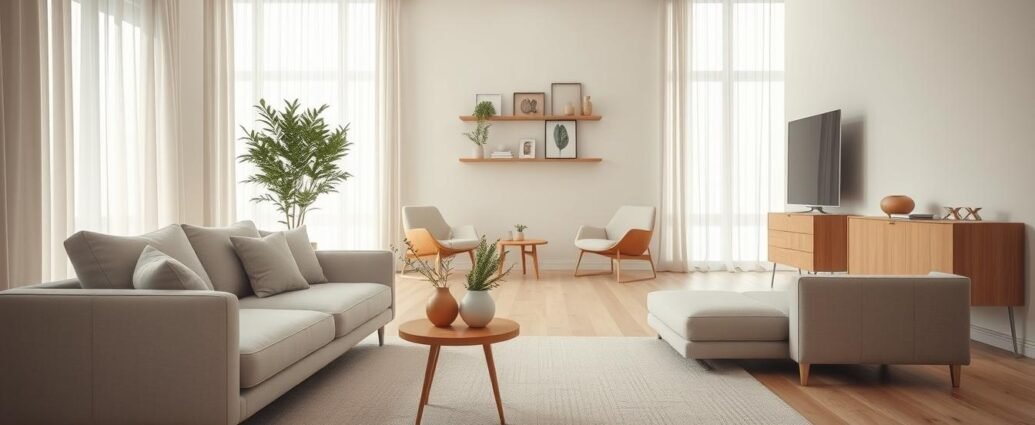
Of all the rooms in a house, the living room is where minimalist interior design pays off fastest. It’s the most-used, most-seen room in most homes, so every bit of visual calm you build here you feel every single day. The goal was never an empty room — it’s a warm, uncluttered space where the few things you own all earn their place.
The minimalist living rooms that fail almost always fail for one of two reasons: the furniture is the wrong size for the room, or there’s nothing soft in it. Both are fixable, and both come down to decisions you make before you spend a dollar. What follows is the practical version — layout, clearances, rug sizing, sofa scale, palette, storage, lighting, and the mistakes worth avoiding.
Key Takeaways
- Plan clearances first: 30–36 inches for main walkways, 14–18 inches between sofa and coffee table.
- Buy the rug big enough that at least the front legs of every seat sit on it — 8×10 and 9×12 are the sizes most rooms actually need.
- Anchor with one quality sofa rather than several small pieces; fewer, larger items read calmer than many small ones.
- Stay in one warm-neutral family and create depth with texture — wood, linen, wool, stone — instead of color.
- Three light sources at 2700K beat one overhead fixture every time.
- Warmth is what separates a serene minimalist room from a showroom.
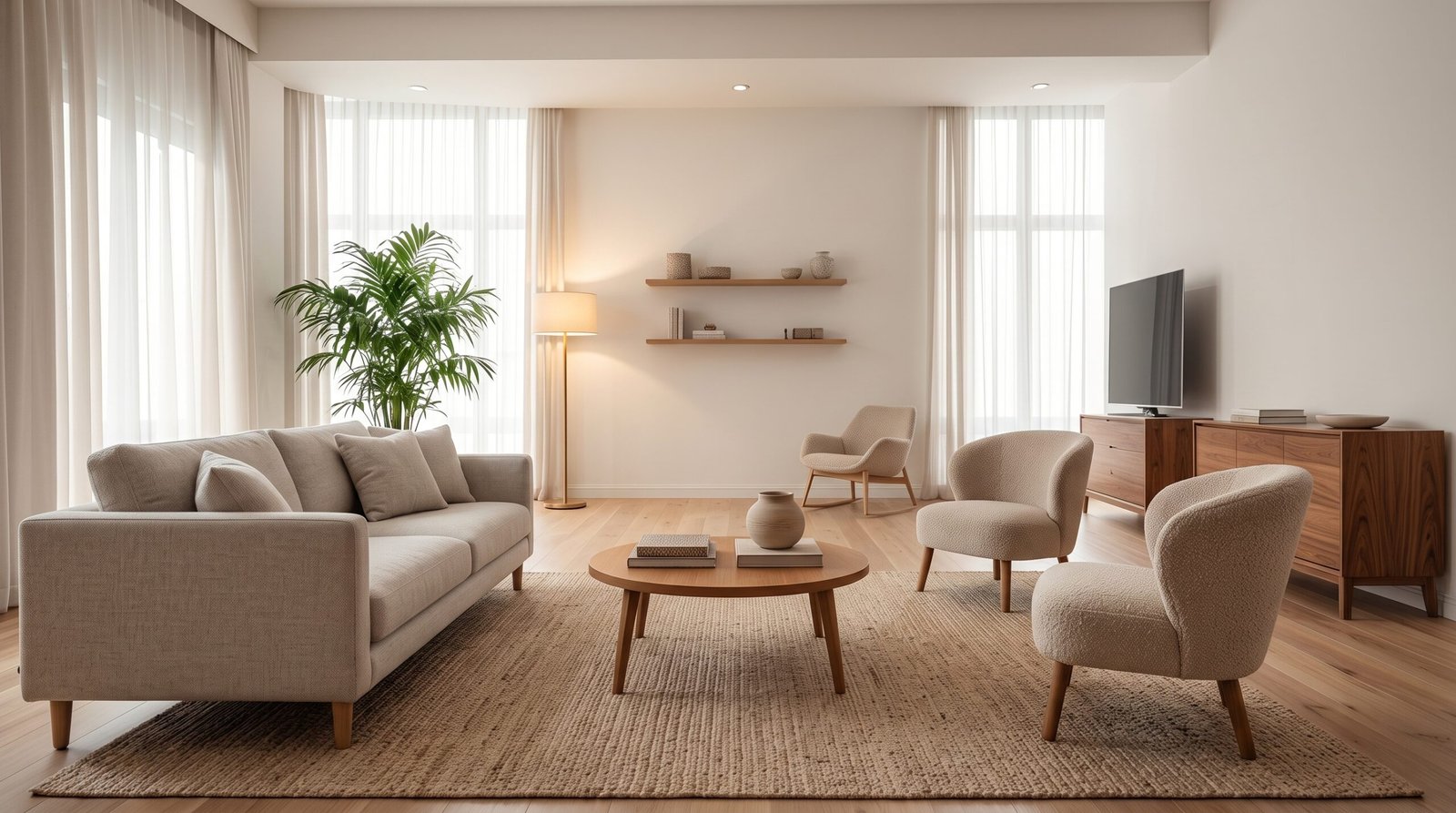
Start With the Layout, Not the Furniture
Before you shop, work out how people move through the room. Minimalism is mostly about negative space, and negative space is something you plan, not something left over after the furniture arrives.
Pull the seating slightly off the walls if the room allows it — even four to six inches of breathing room behind a sofa makes an arrangement look deliberate rather than pushed aside. Keep one clear, uninterrupted path from the main doorway through to wherever people are headed next. And resist the instinct to fill corners. An empty corner with good light in it is doing real work.
A single generous seating group almost always reads calmer than two small ones crammed together. If you’re short on square footage, that instinct feels backwards, but it holds: one sofa and one chair will make a small room feel larger than a loveseat, two chairs, and an ottoman.
Clearances Worth Measuring
These are the numbers I check on every plan. Tape them out on the floor before you buy anything — it takes ten minutes and saves a return.
| Measurement | Target |
|---|---|
| Main walkway through the room | 30–36 inches |
| Secondary path (behind a sofa, past a chair) | 24–30 inches |
| Sofa front to coffee table edge | 14–18 inches |
| Between facing seats across the room | 7–10 feet maximum for conversation |
| Side table height vs. sofa arm | Within 2 inches, level or slightly below |
| Clearance in front of a media console | 36 inches minimum |
Getting Sofa Scale Right
The sofa is the single decision that determines whether the room works. Fewer pieces means you can put real money into this one, and it’s worth doing.
For proportion, a good rule is that the sofa occupies roughly two-thirds to three-quarters of the wall it sits against. A 96-inch sofa on a 12-foot wall looks right; the same sofa on a 9-foot wall looks jammed. Standard seat depth runs 36–40 inches overall, with a seat height of 17–19 inches — go shallower than 21 inches of actual seat depth and taller people won’t be comfortable; go much deeper and it becomes a lounging sofa rather than a sitting one, which is a choice, not a mistake, as long as it’s deliberate.
Low-profile designs with exposed legs are the minimalist workhorse because they keep sightlines open and let you see floor underneath, which reads as more space. A skirted sofa that meets the floor visually blocks that. Tight backs and clean arms photograph well and, more importantly, don’t require you to fluff eight cushions every evening.
If you’re building slowly, buy the sofa first and live with it for a season before adding an accent chair. Most rooms need less than people think.
Rug Sizing: The Most Common Mistake
More minimalist living rooms are undone by an undersized rug than by any other single choice. A small rug floating in the middle of a floor makes the whole arrangement look unmoored and the room look smaller.
The standard to aim for: all four legs of the main seating on the rug if the room allows, and at the very least the front legs of every seat. Leave roughly 8–24 inches of bare floor between the rug edge and the walls so the flooring frames it.
| Room size | Rug size | Notes |
|---|---|---|
| Up to 10×12 ft | 5×8 | Front legs only; works for a single loveseat and chair |
| 11×13 to 12×15 ft | 8×10 | The most commonly correct size for a standard living room |
| 13×16 ft and up | 9×12 | All legs on; ideal for a full sofa plus two chairs |
| Open-plan great room | 10×14 or larger | Use the rug to define the seating zone |
For material, flat wool and jute both suit this look. Jute gives you texture and an earthy foundation for very little money; wool is softer underfoot and holds up better in high traffic. Layering a wool rug over a larger jute or sisal one is a reliable way to add depth without adding pattern.
The Coffee Table Rules
Aim for a coffee table roughly two-thirds the length of your sofa, with a top within an inch or two of the sofa’s seat height. Any lower and reaching for a cup becomes awkward; any higher and it visually blocks the sofa.
Keep 14–18 inches between the sofa and the table edge — enough to walk past comfortably, close enough to reach. A round table is worth considering in any room with a tight traffic path or small children; it softens all the straight lines a minimalist room accumulates and removes the corners you keep bumping into.
Material is where you get warmth. Solid oak, walnut, or ash with visible grain does more for a pared-back room than a glass or lacquered top, which can read cold. A lift-top or drawer version earns its keep if this is where remotes and chargers live.
Building a Warm, Restrained Palette
Choose one dominant neutral and stay inside its family. Soft white, greige, warm taupe, oat, and clay all work; the failure mode is mixing a cool gray wall with warm wood and cream textiles, which reads muddy rather than serene.
A workable ratio is roughly 70 percent dominant neutral (walls, large upholstery), 20 percent secondary tone (wood, rug, a second textile), and 10 percent accent — and in a genuinely minimalist room that accent is often just black: a lamp base, a picture frame, a metal leg. It gives the eye somewhere to land.
Matte and eggshell finishes suit this style better than satin or gloss. They absorb light instead of bouncing it, which softens the whole room and hides wall imperfections. If you want color at all, keep it in something swappable — a pillow cover, a throw — so a change of mind costs twenty dollars rather than a repaint.
Texture Is Where the Interest Comes From
Take color out of a room and texture has to carry it. This is the part people skip, and it’s precisely why some minimalist rooms feel like waiting areas. Scandinavian interiors solve this the same way: a quiet palette held up almost entirely by wool, linen and raw wood grain.
Layer materials that feel different from one another: a nubby linen or bouclé on upholstery, a wool throw, a jute rug underfoot, an oak or walnut table with open grain, a plaster or limewash wall finish, one piece of stone or ceramic. Wood slat panelling on a single wall adds real dimension and warmth without adding a single object to the room — it’s one of the few “feature wall” moves that suits minimalism rather than fighting it.
Two or three plants do more than any decorative object. Snake plants and peace lilies tolerate low light and neglect, which matters when the whole point is a room that doesn’t demand attention. The same logic that governs a Japanese minimalist interior applies here: natural materials, visible craft, and restraint about everything else.
Storage That Disappears
A minimalist living room is only sustainable if everything that lives in it has a home. Clear surfaces aren’t a discipline problem, they’re a storage problem.
- A closed credenza or sideboard is the single most useful piece you can add. Doors, not open shelves — open shelving becomes a display problem within a month.
- Built-in shelving reads as architecture rather than furniture, so it adds storage without adding visual bulk. Leave a third of it genuinely empty.
- A storage ottoman handles throws and blankets and doubles as seating or a footrest.
- Lift-top coffee tables swallow remotes, chargers, and games.
- Baskets under a console or beside the sofa handle the things that resist categorising.
Cable management deserves its own mention. Nothing undermines a calm room faster than a nest of cords under the TV. Run them through a console with a cutout, use adhesive channels along the baseboard, and move whatever you can to wireless charging. The same discipline that keeps a minimalist kitchen free of countertop appliances applies to a living room’s surfaces.
Lighting in Layers
A single overhead fixture is the fastest way to make a beautiful room feel like an office. Aim for at least three sources at different heights, all on the warm end.
Use 2700K bulbs throughout — the warm-white range. Anything at 3000K and above starts to feel commercial, and mixing color temperatures in one room is more noticeable than most people expect. Put everything you can on dimmers.
Practical heights: a floor lamp’s shade bottom should land near eye level when you’re seated, roughly 58–64 inches from the floor. A table lamp beside a sofa works best when the shade bottom sits at about 40–42 inches, again near seated eye level, so you see light rather than the bulb. Add one low source — a small lamp on a credenza, or a plug-in sconce — for evenings when you want the room lit at ankle-and-table height only. That third source is what makes a room feel like a retreat after dark.
During the day, sheer linen panels filter light without blocking it. Hang the rod 4–6 inches above the window frame (or halfway to the ceiling if you want the wall to feel taller) and extend it 8–12 inches past each side so the panels stack off the glass. Panels should end about half an inch above the floor.
Where the TV Goes
Most people mount televisions too high. The center of the screen should sit at roughly eye level when you’re seated, which for a standard sofa puts it about 42 inches from the floor. Over a fireplace usually violates this by a foot or more, which is why it’s comfortable to look at and uncomfortable to watch.
Allow a viewing distance of about 1.5 to 2.5 times the screen’s diagonal — a 65-inch set wants roughly 8 to 11 feet. In a minimalist room, a low console below a wall-mounted screen keeps the floor visible and gives you closed storage exactly where the cables are. If the TV genuinely bothers you visually, a matte-finish screen and a dark wall behind it will do more than any cabinet door.
Styling Surfaces With Restraint
Surfaces are where minimalist rooms slip back into clutter. The formula that holds up: two or three objects per surface, in varied heights, in odd numbers.
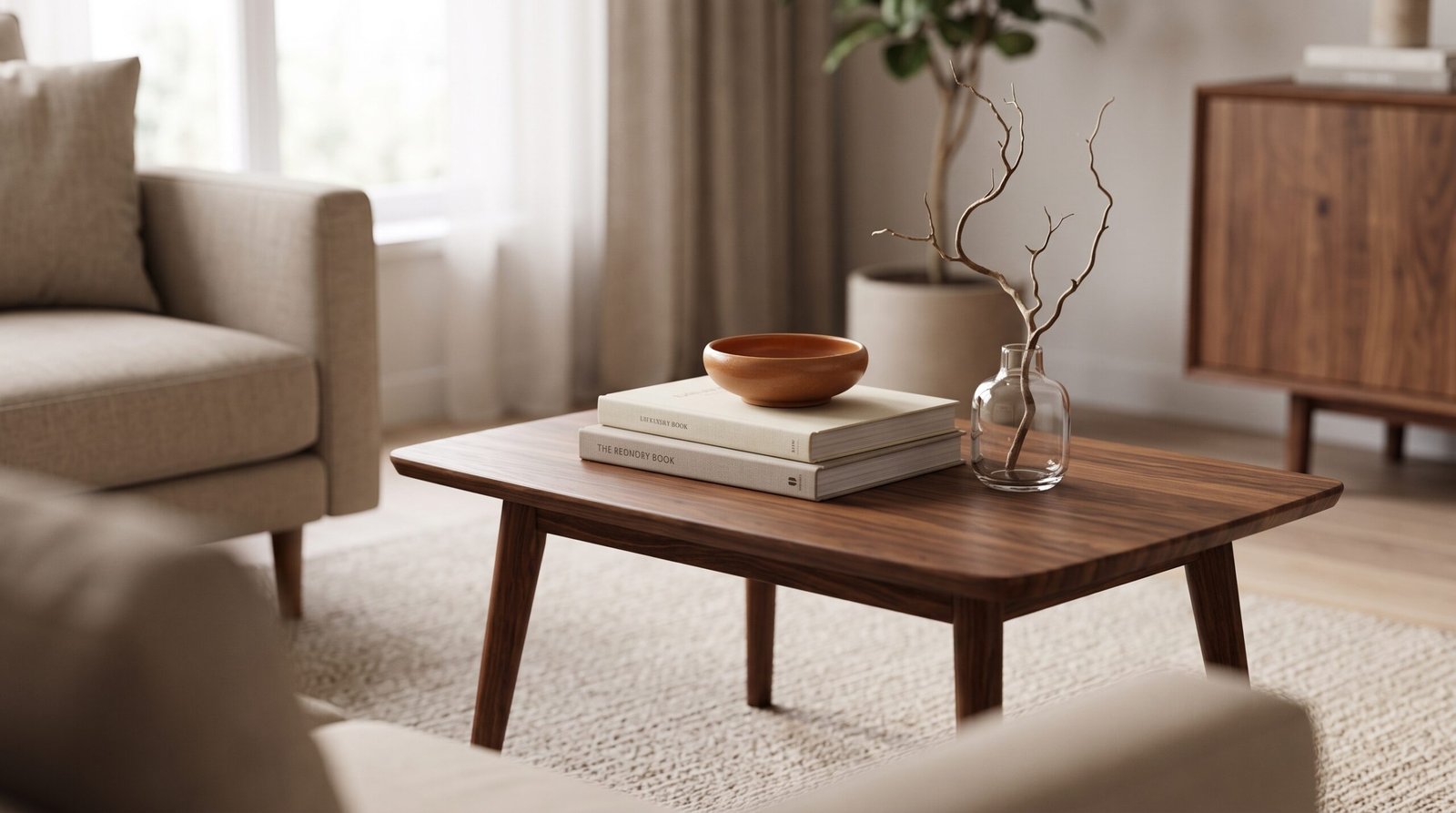
On the coffee table, that’s usually a low stack of books, one vessel or bowl, and one sculptural or natural piece — a ceramic, a branch in a vase. On a credenza, a lamp, one piece of art leaning against the wall, and a single object. On open shelving, group in threes and leave a genuine gap between groupings; the empty space is the design.
For wall art, one large piece beats a gallery wall of small ones almost every time in a minimalist room. Hang it so the center sits 57–60 inches from the floor — gallery height — and if it’s going above the sofa, keep the bottom edge 8–10 inches above the sofa back and size the piece at roughly two-thirds the sofa’s width.
The working rule: stop adding one item before you think you should.
What It Costs
Minimalism suits a phased budget better than almost any other style, because you’re buying fewer things and each one can be better.
Entry-level pieces that still look right — a good lamp, a small stool, a simple side table — generally sit under $500. Mid-range upholstery and case goods that will last a decade fall roughly in the $550–$2,200 band, which is where most people should spend on a sofa. Above about $2,200 you’re buying solid hardwood frames, eight-way hand-tied springs, and materials that improve with age.
Prioritise in this order: seating, then rug, then lighting, then storage, then decorative objects. A room with one excellent sofa and nothing else on the walls looks far better than a fully furnished room of compromises. Buy fewer things, slowly.
Free option: Minimalism is the one style where the no-spend version is also the most honest one, and it is worth doing before any of the budget above. Clear every surface in the room into a box, then put back only what you reach for or genuinely like looking at. Pull the sofa four to six inches off the wall. Move the one lamp you already own to the darkest corner instead of beside the sofa, where it is probably duplicating the overhead light. Swap any cool-white bulbs for the warmest ones in the house, borrowed from a room you use less. That is four changes, none of them costs anything, and together they do more for a living room than most of the purchases on this list.
Mistakes I See Most Often
- The rug is too small. Almost always. Size up one increment from whatever feels right.
- Everything is pushed against the walls. This makes rooms feel like corridors, not larger.
- One overhead light. Instantly clinical, no matter how good the furniture is.
- Cool grays with warm wood. Pick a temperature and commit to it.
- Too many small objects. Five little things on a table is clutter; three is styling.
- No soft materials. If every surface is hard, the room will sound and feel harsh. Add a rug, curtains, and one textile.
- Matching furniture sets. A suite bought together reads as a showroom, not a home. Mix wood tones deliberately.
Frequently Asked Questions
How do I make a small living room feel minimalist, not empty?
Choose fewer, larger pieces rather than several small ones, keep the floor as visible as possible with legged furniture, and use one warm neutral across walls and large upholstery. Layered texture and three light sources supply the warmth that keeps a pared-back small room feeling intentional rather than bare.
What size rug do I need for a minimalist living room?
An 8×10 suits most standard living rooms and a 9×12 suits larger ones. The test isn’t the room size but the furniture: at minimum, the front legs of every seat should sit on the rug, with 8–24 inches of bare floor between the rug and the walls.
How far should the coffee table be from the sofa?
14–18 inches. Close enough to reach a cup without leaning, wide enough to walk past. Keep the table top within an inch or two of the sofa’s seat height and roughly two-thirds its length.
What’s the ideal minimalist living room color scheme?
One dominant warm neutral — soft white, greige, oat, or taupe — with one or two close tonal companions and a small amount of black for definition. Build interest through wood, linen, wool, and stone rather than through additional colors.
How high should I mount a TV in the living room?
Center the screen at about 42 inches from the floor, which is roughly eye level from a standard sofa. Sit 1.5 to 2.5 times the screen’s diagonal away — about 8 to 11 feet for a 65-inch set.
How many decor items should I put on a minimalist coffee table?
Two or three, with varied height. A small stack of books, one low vessel, and a single sculptural or natural piece is a reliable formula that never looks fussy.
Minimalist living room design is really a series of small, confident edits — get the clearances right, buy the rug one size up, light the room in layers, and stop early. If you’re carrying the same approach into the rest of the house, our minimalist bedroom ideas cover layout and bedding in the same detail, the warm minimalist bedroom guide is worth a look if you want a cozier take on the same palette, and our simple minimalist bathroom ideas apply the same restraint to a much smaller footprint. For the principles behind all of it, start with our complete guide to minimalist home interior design.

11 Comments