
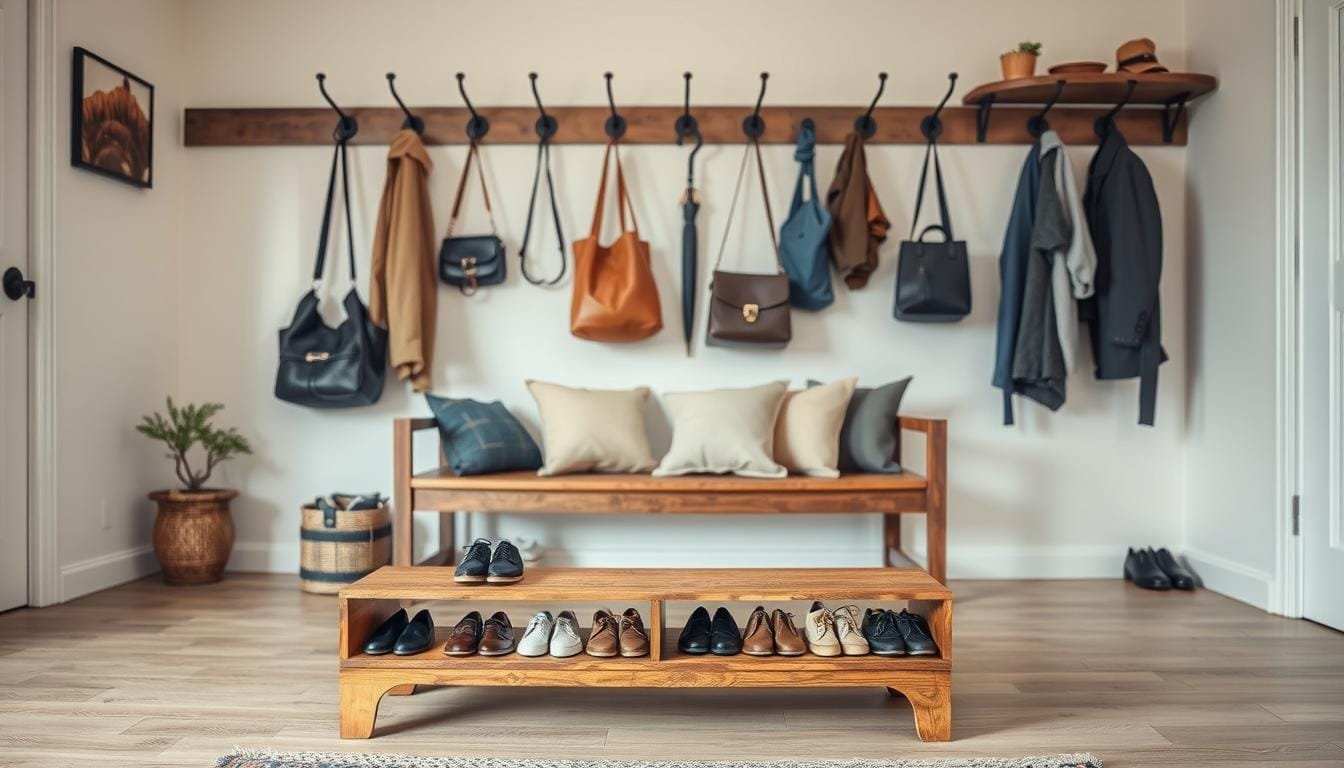
Your entryway does more work than almost any other few square feet in your home. It catches shoes, coats, bags, mail, and whatever else came through the door with you. When it has a system, mornings run smoother. When it doesn’t, everything lands on the floor.
A working entry usually comes down to three jobs: somewhere to sit, somewhere to hang, and somewhere for shoes to land. A bench with storage underneath, a row of sturdy hooks, and a low rack or tray by the door will cover most households. None of it has to be expensive, and in a rental, none of it has to be permanent.
Below we walk through how to measure the space you actually have, what’s worth buying versus what you probably already own, and which options work when you can’t put a hole in the wall.
Introduction to Entryway and Mudroom Organization
Your entry is the first room you use each morning and the last one you pass through on the way out. Setting it up well is less about how it photographs and more about taking friction out of the busiest two minutes of your day.
Why an Organized Entryway Matters
When everything has a landing spot, you stop hunting for keys, and the grit from outside stops travelling through the rest of the house. In a family home, a mudroom works as a buffer: boots, backpacks, and damp coats stop there instead of migrating to the sofa.
If your “entryway” is a narrow hall or a three-foot patch of floor by the front door, that still counts. The same three jobs apply, and you scale the pieces down to suit. Our guide to entryway storage solutions for small spaces goes deeper on tight footprints.
The Role of Storage Solutions in Daily Life
Built-in storage works because it puts things where your hands already go. A bench with a hollow seat means shoes get put away in the same motion you use to take them off. Hooks at shoulder height mean a coat goes up instead of over a chair back. The less a system asks of you, the more likely you are to keep using it.
| Feature | Benefit |
|---|---|
| Custom Cabinetry | Storage sized to what you actually own |
| Vertical Hooks | Uses wall space for coats and bags |
| Hidden Compartments | Keeps everyday clutter out of sight |
Once you know which of these you need, the next step is measuring. That’s the part people skip, and it’s the reason so many good-looking benches end up blocking a door.
Benefits of an Organized Mudroom
A mudroom that works is quietly one of the most useful rooms in a busy house. It’s a transition zone, and when it does its job, the rest of the house stays calmer.
Enhanced Functionality for Busy Families
Give each person a named spot and mornings get shorter. That can be a set of lockers, or it can be one hook and one cubby per person, labelled with masking tape. Kids especially do better with a hook they can reach without help, which usually means mounting a second, lower row around 40 to 44 inches from the floor.
Vertical space is your friend here. Wall-mounted hooks and shelves keep the floor clear, which makes the room easier to sweep and easier to move through. If you have plumbing nearby, a utility sink stops muddy cleanup from happening in your kitchen.
Creating a Welcoming Atmosphere
A mudroom doesn’t have to be purely utilitarian. A bench cushion, a warm light bulb instead of a cold one, and a rug you don’t mind wiping down all soften the space. It’s the first thing you see coming home, so it’s worth a little attention.
Durable flooring and per-person storage aren’t glamorous upgrades, but they’re the ones you notice every single day. If you want the room to feel warmer as well as work harder, our cozy entryway decor ideas pair well with everything here.
Shoe Racks, Hooks, and Benches: The Entryway Essentials Worth Having
The right pieces make the difference between an entry that works and one that just holds a pile. Here are the core elements, and the numbers to check before you buy any of them.
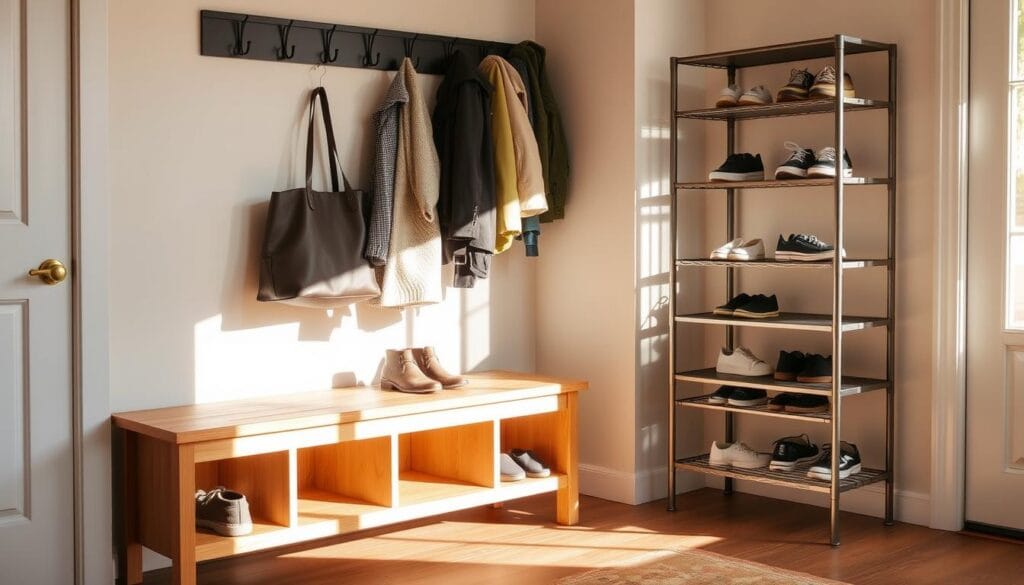
Measure First: The Numbers That Matter
Take five minutes with a tape measure before you shop. These are the figures that decide whether a piece fits or fights you:
- Usable wall width. Measure between the door casing and the next obstacle (a corner, a radiator, a light switch). Subtract two inches so the piece isn’t wedged in.
- Walkway depth. Leave 36 inches of clear floor for people to pass. In a tight hall, 30 inches is the practical minimum.
- Door swing. Open the door fully and mark the arc on the floor with painter’s tape. Nothing goes inside that line.
- Bench height and depth. A seat 17 to 19 inches off the floor is comfortable for most adults. Depth of 15 to 18 inches is enough to sit on without eating your walkway.
- Hook height. Around 60 to 66 inches from the floor for adult coats, plus a lower row at 40 to 44 inches for kids.
- Shoe capacity. Allow about 12 inches of depth and 8 inches of width per pair, then count the pairs that actually live by the door.
Write the numbers on your phone and take them shopping. It’s far cheaper than a return.
Integrating Style with Practical Storage
Storage doesn’t have to look like storage. A slim bamboo rack, a painted wooden shelf, or a run of black metal hooks can read as part of the decor rather than an appliance. Pick a material that already appears somewhere else in the room so it looks intentional. Customizable systems let you match finishes to what you already have, and a coat of paint does the same job on a secondhand piece for a few dollars.
Here’s a quick comparison of popular storage options:
| Feature | Benefit |
|---|---|
| Wall-Mounted Racks | Saves floor space, easy to install |
| Adjustable Shelves | Adapts to boots one season, sandals the next |
| Enclosed Storage | Keeps clutter out of sight |
With your measurements in hand, the bench is usually the piece to settle first, since everything else works around it.
Choosing the Right Storage Bench for Your Space
A storage bench earns its keep twice over: it gives you somewhere to sit while you deal with laces, and it swallows the things that would otherwise sit on the floor.
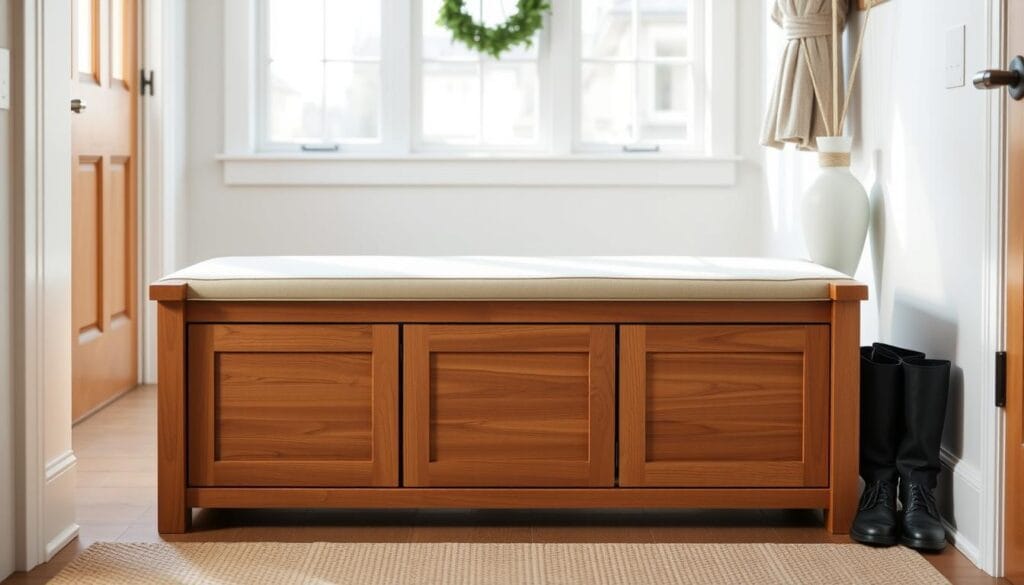
Built-In Storage Options Under the Seat
You have three basic formats. Drawers slide out, so they need clearance in front of the bench (add the drawer depth to your walkway measurement). Lift-top seats need clearance above instead, which rules them out under a low window. Open cubbies need no clearance at all and are the easiest to actually use, but everything in them is visible, so they suit baskets.
Wood finishes hold up well to daily knocks and can be sanded and refinished later. If wet boots are part of your life, look for a sealed finish or set a boot tray inside the cubby so moisture isn’t sitting against bare timber.
Comfort and Design Considerations
Sit on it before you commit. A bench that’s too deep tips you back; one that’s too shallow puts you on the edge. If it’s hard-topped, a cushion or folded blanket makes a real difference for the thirty seconds a day you use it.
| Feature | Benefit |
|---|---|
| Built-In Drawers | Keeps items organized and out of sight |
| Wood Finishes | Durable and easy to refinish |
| Padded Seats | More comfortable for daily use |
What to Buy and What to Repurpose
Not everything needs to be bought new. Here’s roughly how we’d split it:
- Worth buying: the hooks (cheap ones bend under a wet winter coat), a boot tray with a raised lip, and the bench itself if it’s carrying weight daily.
- Worth repurposing: a dining chair or piano bench you already own makes a fine seat. A bookshelf turned on its side becomes shoe cubbies. A wooden crate or an old drawer with felt pads glued underneath works as a low shoe box.
- The free version: a doormat plus a plastic underbed box for shoes plus three adhesive hooks costs very little and solves eighty percent of the problem. Start there and upgrade one piece at a time.
For guidance on getting the seat height right for your household, this guide to choosing the perfect mudroom bench height is a useful cross-check.
Incorporating Hooks and Racks to Maximize Vertical Space
Walls and the backs of doors are the most under-used storage in most homes. Hooks and racks reclaim that space without taking a single inch of floor.
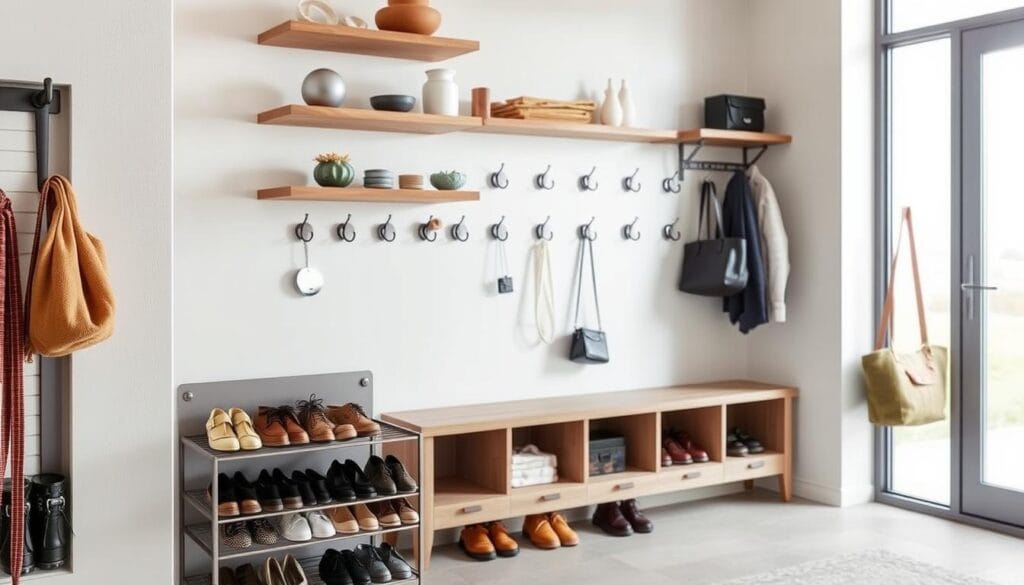
Space-Saving Benefits
A coat on a hook takes up no floor and dries faster than one folded over a chair. It also makes the room easier to clean, since there’s nothing to move before you sweep.
Two practical notes on installation. Hooks holding heavy winter coats should hit a stud or use a proper drywall anchor rated for the weight, not the little plastic sleeve that came in the packet. And mount a rail rather than individual hooks if you want the spacing to look even without measuring each one.
Renter-Friendly Options That Don’t Need a Drill
If you can’t make holes, you still have good choices:
- Over-the-door racks hang on the door edge and hold coats, bags, and hats. Check the door thickness first, since standard hooks fit doors up to about 1 3/4 inches.
- Adhesive hooks handle light loads well. Look at the stated weight rating, clean the wall with rubbing alcohol first, and let them cure for an hour before hanging anything. Skip them on textured or freshly painted walls.
- Tension rods across a narrow alcove make an instant coat rail with hangers.
- A freestanding coat rack or hall tree needs no wall at all. Weight the base or set it against a wall so it doesn’t tip.
- A leaning ladder propped against the wall holds scarves, tote bags, and a folded throw, and leaves no marks.
Multi-Purpose Functionality for Coats, Bags, and Accessories
One sturdy rack can carry coats, bags, and umbrellas. Add a few smaller hooks or a shallow shelf above for the things that get lost, like gloves, sunglasses, and dog leads. Group like with like so nobody has to think about where something goes.
The aim is a spot for everything you carry in and out most days. Anything seasonal can live elsewhere and come back in October.
Innovative Shoe Storage Ideas for a Clutter-Free Entryway
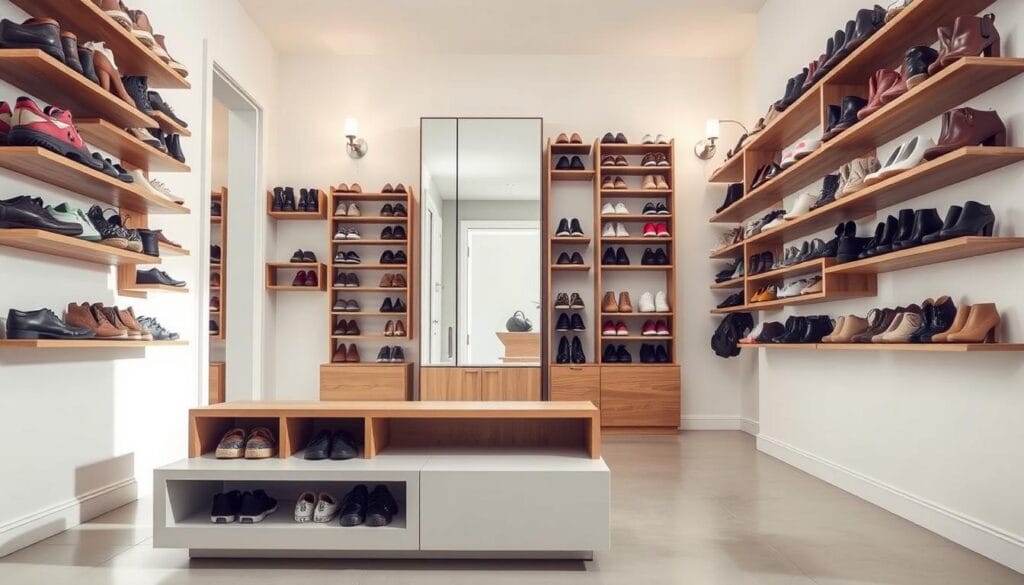
Shoes are usually the thing that overwhelms an entry, mostly because the number of pairs by the door creeps up quietly. Decide how many pairs live here, and store for that number.
Custom Cubbies and Drawer Systems
Cubbies work because there’s no lid to open. One cubby per person, sized to their shoes, and the system runs itself. Adjustable shelves matter more than they sound: boot season and sandal season need very different heights.
Pull-out drawer systems hide everything, which suits a formal entry, but they add a step. If your household tends to kick shoes off and keep walking, open storage will get used and closed storage won’t.
Wall-Mounted and Over-the-Door Solutions
When floor space is limited, go up. A wall-mounted rack holds several pairs at a height that’s easy to reach, and it leaves the floor clear underneath. Over-the-door pocket organizers are the cheapest option going and work well for flats, sandals, and kids’ shoes, though they won’t hold boots.
For wet weather, a towel rail with S-hooks lets boots hang upside down to dry, which stops that puddle by the door. A baking tray with a lip, or a boot tray from a hardware store, does the same job for a few dollars.
Enhancing Entryway Decor with Multifunctional Furniture
Once storage is sorted, a couple of pieces that do two jobs at once will finish the room without crowding it.
Combining Aesthetics with Practicality
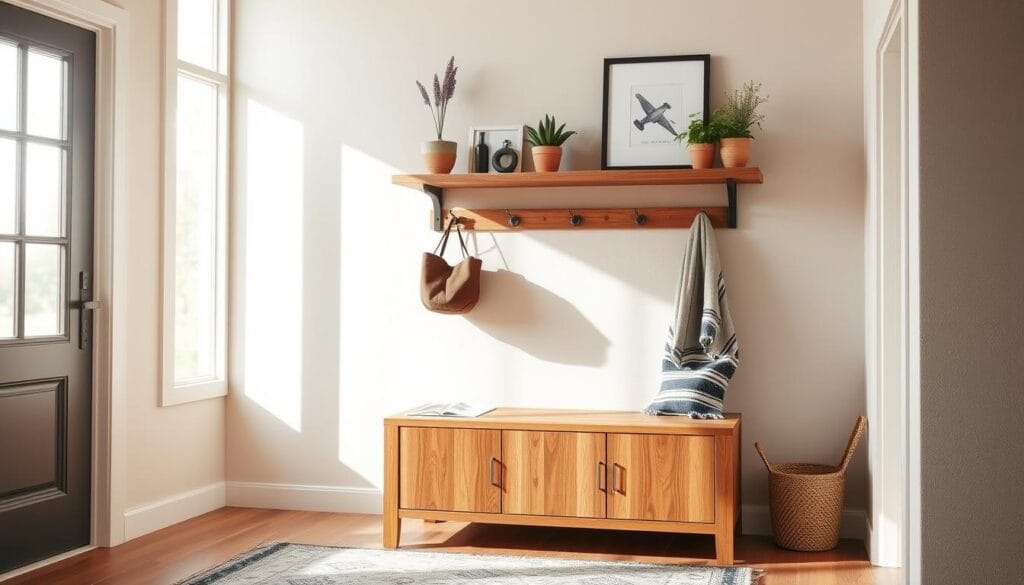
A mirror with a shelf or hooks built in bounces light into a dim hall and holds your keys at the same time. In a narrow entry, a mirror on the long wall makes the space read wider, which is a free trick if you already own one.
Woven baskets are the workhorse here. They swallow hats, scarves, and dog gear, and they hide the contents without needing doors. One basket per category beats one big basket for everything.
A few pieces that pull double duty:
- Mirrors with shelves: light and storage in one footprint.
- Lidded baskets: contents out of sight, and they stack.
- Key trays: small, cheap, and the single fastest fix for lost keys.
Choose pieces that solve a problem you actually have. An entry with three decorative objects and nowhere to hang a coat is a room working against you.
Utilizing Custom Shelving Solutions for Extra Organization
Custom shelving is worth considering when your entry has an awkward shape that off-the-shelf furniture won’t fit: a shallow alcove, a sloping ceiling under the stairs, a wall interrupted by a radiator.
The advantage is fit. Shelving built to your dimensions uses the full height and depth available, where a bought unit leaves dead air above it. Adjustable shelves keep that flexibility as your needs change.
Key benefits of custom shelving:
- Uses the full wall: shelves run right to the ceiling instead of stopping at a standard height.
- Adaptable design: adjustable shelves handle boots, then baskets, then books.
- Personalized storage: compartments sized to what your household actually owns.
If the budget isn’t there, the low-cost version is a run of simple bracket shelves cut to length at the hardware store, painted the same color as the wall so they recede. It costs a fraction of built-ins and solves the same problem.
Here’s a quick comparison of popular shelving features:
| Feature | Benefit |
|---|---|
| Adjustable Shelves | Reconfigures as your storage needs change |
| Wall-Mounted Units | Saves floor space, easy to install |
| Built-In Compartments | Keeps clutter out of sight |
Quick Declutter and Reorganize Tips for Busy Mornings
Storage only works if there’s a small routine holding it up. These are the habits that keep an entry functioning without much effort from you.
Step-by-Step Mudroom Reset Guide
Give everyday items a fixed spot first. A boot tray contains muddy footwear, hooks take coats and scarves, and one basket catches incoming mail so it never reaches the kitchen counter.
Then reset in three passes. Clear the floor, putting anything that belongs elsewhere in a single pile to redistribute later. Clear the surfaces, returning keys, bags, and post to their spots. Wipe down the bench and the door handle. The whole thing takes about ten minutes and it’s worth doing on a Sunday evening.
Time-Saving Decluttering Strategies
Keep frequently used things at the front. Boots and scarves belong near the door in winter and in a cupboard in July. A small wall-mounted organizer for keys and mail keeps the two most-lost items within reach as you head out.
Build in a five-minute evening tidy. Reset the entry before bed and you never wake up to yesterday’s pile. In a family, giving each person one named spot does most of the work for you, because nobody has to decide where anything goes.
| Strategy | Benefit |
|---|---|
| Designated Spots | Keeps items organized and easy to find |
| Daily Reset Routine | Prevents clutter from accumulating |
| Wall-Mounted Organizers | Uses wall space and keeps items in reach |
Combining Practicality with Style in Your Home Entry
Once the practical side is handled, the finishing touches are quick. A good-looking coat rack holds outerwear and gives the wall something to look at. A runner rug in a dark pattern hides grit between vacuums and softens a hard floor underfoot.
Clear floor space does more for how an entry feels than any decorative object. Baskets and trays corral shoes and accessories so every item has a spot, and the room reads calm even when it’s busy.
Three ideas that pull the room together:
- Designated spots: assign areas for keys, bags, and shoes so nothing is homeless.
- Multifunctional furniture: a bench with storage does two jobs in one footprint.
- Vertical solutions: wall-mounted hooks and shelves keep the floor clear.
If you want to take the look further, our entryway styling secrets cover the decorative layer, and this guide on optimizing your space has more storage ideas for the rooms that work hardest.
Conclusion
An entry that works comes down to three things: a seat, some hooks, and a home for shoes. Get those right at the correct heights and depths for your household, and the rest is decoration.
Start with the tape measure. Then buy the pieces that carry weight daily, repurpose what you already own for the rest, and use adhesive hooks, over-the-door racks, or a freestanding hall tree if drilling isn’t an option where you live.
Pick one job to fix this week rather than the whole room at once. A single row of hooks by the door changes the morning more than you’d expect, and it costs almost nothing to try.


1 Comment