
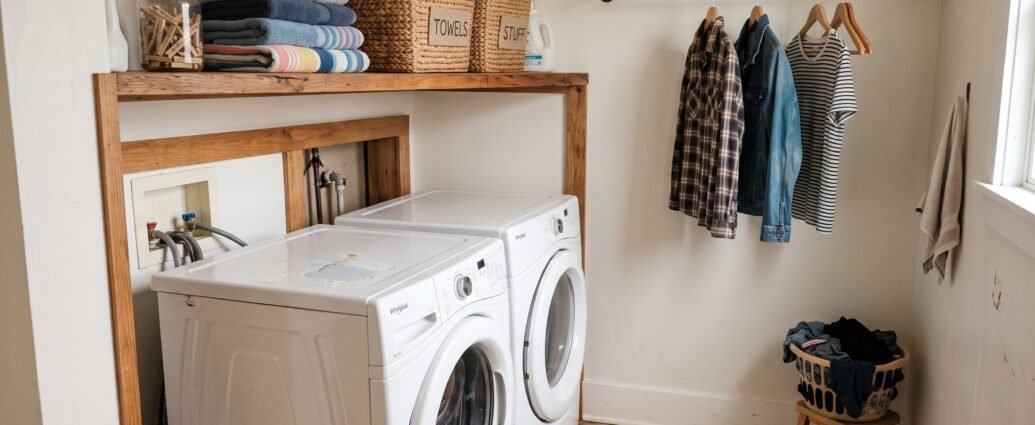
I’ll be real with you: the laundry space is the room nobody plans. I’ve watched the same scene play out in every place I’ve lived — a closet with a bifold door that won’t fully open because the hamper is in the way, and a little dance every load to shuffle the hamper, wedge the door, and balance the detergent on top of the dryer. Eventually the detergent loses the balancing act, pours itself down the back of the machine, and somebody spends an hour on the floor with a flashlight and a lot of feelings.
The homeowners who end up happy with their laundry space are the ones who stop treating it like a lost cause and start treating it like a real room — a tiny one, but a real one. It usually takes about a month of small weekend projects and less money than one fancy throw pillow. The result isn’t beautiful, exactly (though it’s almost always much better), but it works.
If your laundry space is a closet, a basement corner, or a hallway pass-through, this is everything I’ve learned making small, awkward laundry spaces work — organized so you can start with whatever’s bugging you most.
It’s the same approach that worked on our home office organization: start with what actually annoys you, not with what looks good in a photo.
Start With the Annoyance Audit (It’s Free)
Before you buy a single basket, do the step almost everyone skips: run three loads of laundry and write down every moment that annoys you. The lists people hand me look remarkably alike — nowhere to set the detergent, nowhere to hang shirts straight from the dryer, hamper blocks the door, socks disappear behind the machines, the light is so dim you can’t tell navy from black.
That list is your whole project plan. Here’s why this matters: most small laundry rooms don’t fail because they’re small. They fail because the stuff in them has no assigned home, so every load turns into improvising. When you fix the specific annoyances instead of copying a Pinterest room, you get a space that fits how you actually do laundry — and you skip buying organizers you don’t need.
Cost: zero dollars and three loads you were doing anyway.
Look Up: The Wall Above Your Machines Is Prime Real Estate
The biggest lightbulb moment in most small laundry rooms is realizing everyone’s been ignoring about 30 square feet of wall while complaining about 20 square feet of floor.
One shelf above the machines changes everything. Detergent, stain spray, a jar for the mystery buttons and lost-sock singles — all off the machine tops, all reachable mid-load. If you can hang two shelves, even better: everyday stuff on the lower one, backstock and bulk paper goods up top.
A few things worth knowing before you drill:
- Mount into studs or use proper anchors. A shelf holding liquid detergent is heavier than it looks — a 100-ounce jug runs about seven pounds, and they add up fast.
- Leave 18–20 inches of clearance above a top-loader lid or you’ll smack the shelf every time you open it. (Measure with the lid open — measuring it closed is the single most common mistake I see.)
- Skip the doors. In a tight space, cabinet doors need swing room you don’t have. Open shelving with a few matching bins looks tidy and works faster.
The budget version works beautifully here: a single pine board and two brackets from the hardware store run about $15–$25, and after a coat of leftover paint it looks intentional. If you rent and can’t drill, a freestanding over-the-machine shelving unit — the kind with legs that straddle the washer — does the same job for $40–$70 and moves out when you do. The same vertical thinking rescues other tight spots — it’s how I finally fixed our tiny entryway, with hooks at two heights instead of the console table there was never room for.
Stack the Machines (or Put a Counter on Top)
If you have front-loaders and you haven’t stacked them, this is the single biggest space move available to you. A stackable washer dryer setup hands you back roughly nine square feet — in a tiny room, that’s the difference between “storage closet with machines” and “room with a folding counter and a drying rod.”
Two honest caveats, because this one isn’t free or instant: you need a stacking kit made for your exact models (usually $30–$60 — don’t improvise this, the dryer vibrates), and the dryer controls end up high, so if anyone in your house is on the shorter side, keep a sturdy step stool in the room. Budget about twenty minutes and a second pair of hands for the install.
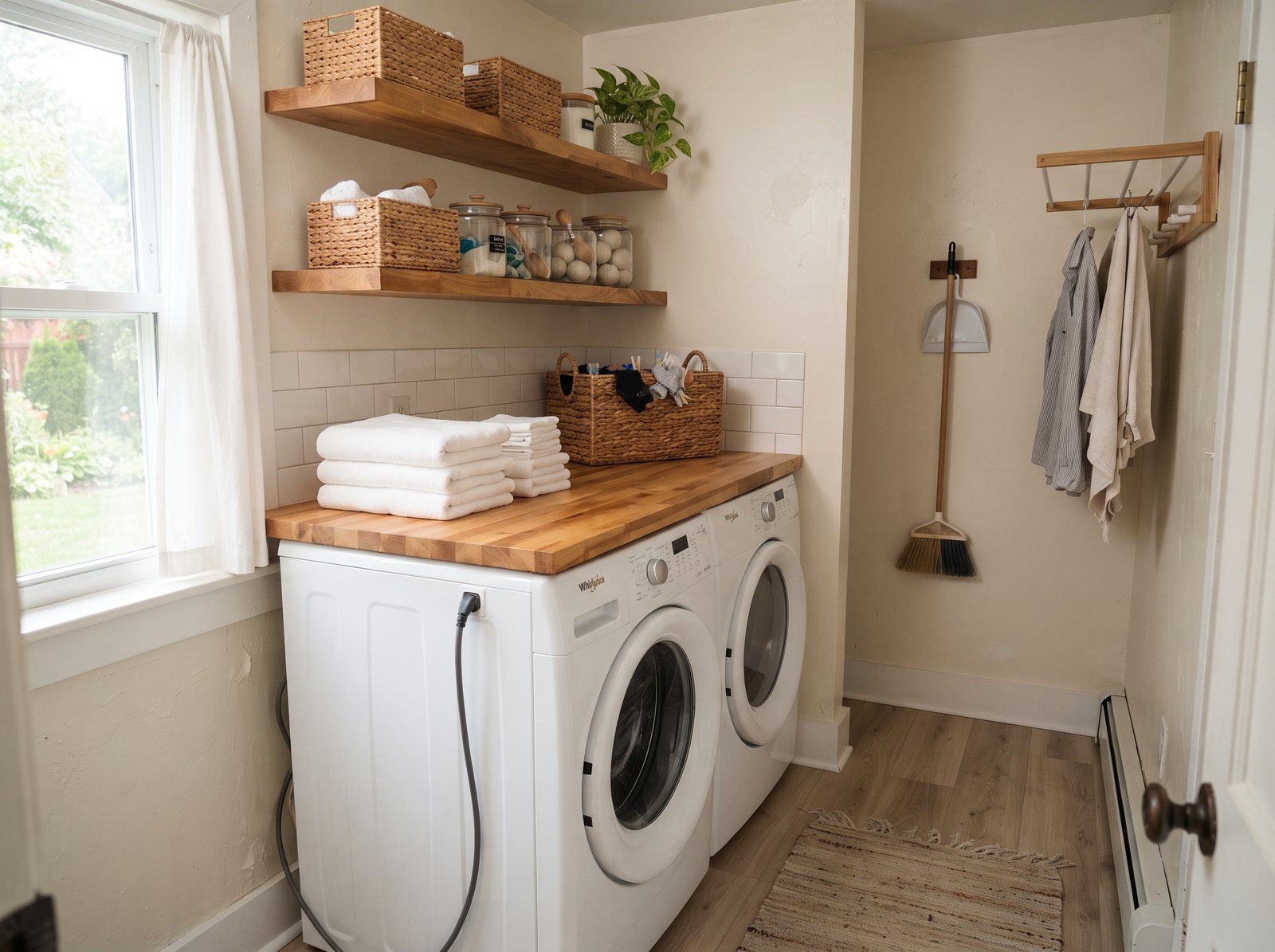
Already have side-by-side front-loaders and no plans to change? Put a counter across both machines instead. A laminate countertop remnant or a sanded plywood panel cut to size gives you a folding station exactly where the clean clothes come out, and it hides the gap where socks go to disappear. The plywood version runs about $35 including a can of matte sealer. It’s the same “one surface changes the whole room” logic behind this basement laundry room makeover, and it’s the upgrade I’d do first in any laundry space with side-by-sides.
Top-loaders can’t take a fixed counter, but a rolling cart between or beside the machines gets you most of the way there — more on that in a minute.
Solve the Folding Problem Where the Clothes Actually Land
Here’s the why behind so many laundry-chair pileups in bedrooms: clothes get folded wherever there’s a surface, and if the nearest surface is your bed, that’s where laundry lives now. The fix is giving yourself even a small surface in the laundry space, so folding happens while the next load runs.
Options by space and budget:
- Wall-mounted drop-leaf table. Folds flat against the wall when you’re not using it, opens to a real work surface when you are. About $50–$120, and the one project in this post I’d call genuinely worth the drilling.
- The counter-over-machines move from the last section, if you have front-loaders.
- A rolling cart with a flat top. The skinny 10-inch ones slide into the gap beside almost any machine and give you a surface plus three shelves of storage. $25–$40, no tools.
- Free version: a cutting board or a leftover shelf board laid across the machine tops while you fold. Not glamorous. Completely functional. Plenty of households run on exactly this for a year before they upgrade, and nothing bad happens.
If your small-space problem extends past the laundry room, the same principles — every surface earns its keep, nothing lives on the floor that can live on a wall — run through my guide to styling small spaces without overcrowding them and these space-saving multifunctional furniture picks.
Build In Drying Space That Disappears
Air-dry items are where small laundry rooms really fall apart. Sweaters draped on doorknobs, leggings over the shower rod, a bra hanging off the towel bar — it’s the most reliable sign a laundry space has run out of room. The trick is drying space that exists only while you need it:
- A wall-mounted accordion drying rack folds to about four inches deep and opens to hold a full load of delicates. $30–$60.
- A tension rod or wall-mounted closet rod above the machines (or across a laundry closet) gives shirts a place to hang straight from the dryer — fewer wrinkles, less ironing, and it uses air space no one was using. A tension rod is about $10 and needs zero tools, which makes it the best dollar-per-usefulness buy in this whole post.
- A retractable clothesline mounts small and pulls across the room only on wash day. Around $15–$25.
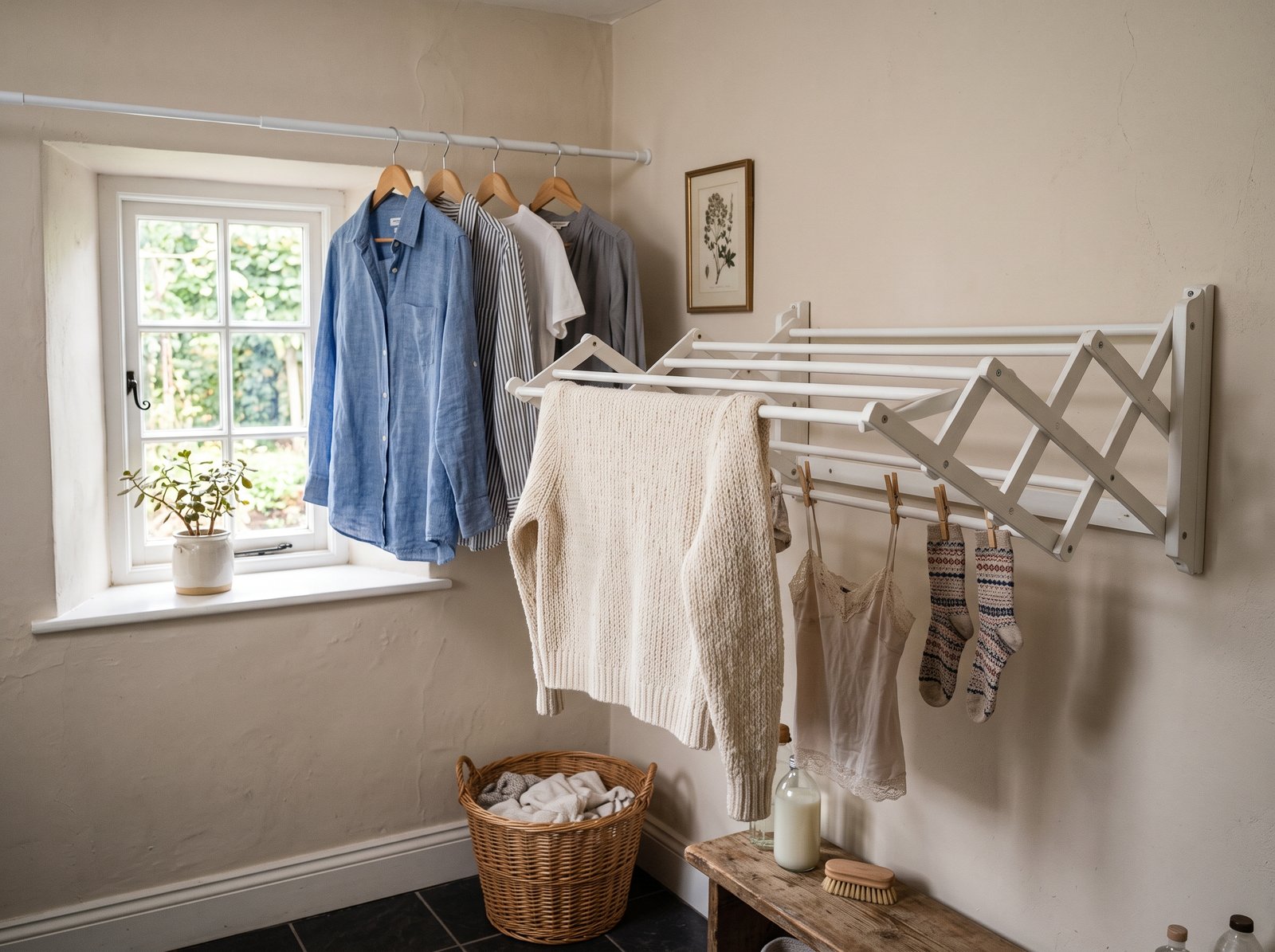
The why: dedicated drying space isn’t about the drying. It’s that every air-dry item with a real home is one less thing migrating through the rest of your house.
Laundry Room Organization That Survives Real Life
The beautiful-jars-of-decanted-detergent look photographs well and almost never survives past the first refill. What actually holds up is a system with fewer steps, not prettier containers:
- One bin per category, labeled. Stain stuff, dryer stuff, backstock. When the category is the label, everything has a home even when you’re shoving it back one-handed.
- A “pockets” jar. Coins, hair ties, the occasional LEGO. Empty it monthly. This jar prevents approximately one thousand household arguments a year.
- A small trash bin or hanging bag for lint and dryer sheets. If there’s no bin, the machine top becomes the bin — that’s the rule in every laundry room I’ve ever seen.
- Sorting hampers that fit your actual space. A triple-sorter is lovely if you have the floor for it; a slim two-bag rolling sorter or wall-mounted fold-down hamper works when you don’t. And if the hamper blocks the door, that’s not a you-problem — it’s a wrong-hamper problem.
If you want to go deeper on the sorting-and-containing side, I’ve collected more creative laundry storage ideas and my favorite DIY storage solutions for an organized home in earlier posts.
Make It a Room You Don’t Mind Standing In
This is the part almost everyone skips because it feels frivolous, and it’s the wrong call. You spend real hours in this space. Ten dollars of effort toward it being pleasant pays back every single week.
Fix the light first. Most laundry spaces have one sad builder-grade bulb. Swap it for a bright LED — I’d go 100-watt-equivalent in daylight (5000K) here, even though I preach warm bulbs everywhere else in the house, because you need to see stains and tell navy from black. If there’s no fixture where you need it, battery-powered stick-on LED lights under a shelf run about $20 and need zero wiring. Light does more for a windowless laundry space than any decor purchase, and I get into the why of all of it in the power of lighting.
Then paint — or peel-and-stick. A laundry room is maybe the cheapest full-room paint job in your house; most take one quart and one afternoon. Go lighter and brighter than you think, especially with no window. Renters: peel-and-stick wallpaper on the one wall you actually face turns “utility closet” into “little room with personality” for about $30–$40.
One nice thing. A small framed print, a low-light plant (pothos does not care that your laundry room is a cave), a decent rug that catches drips. One or two things, not more — this room is small, and clutter is clutter even when it’s cute. For the pretty-and-practical balance, my stylish laundry area decor ideas post has the full list.
If Your “Laundry Room” Is a Closet
Laundry closet ideas deserve their own section because closets have their own physics. Three things make the biggest difference:
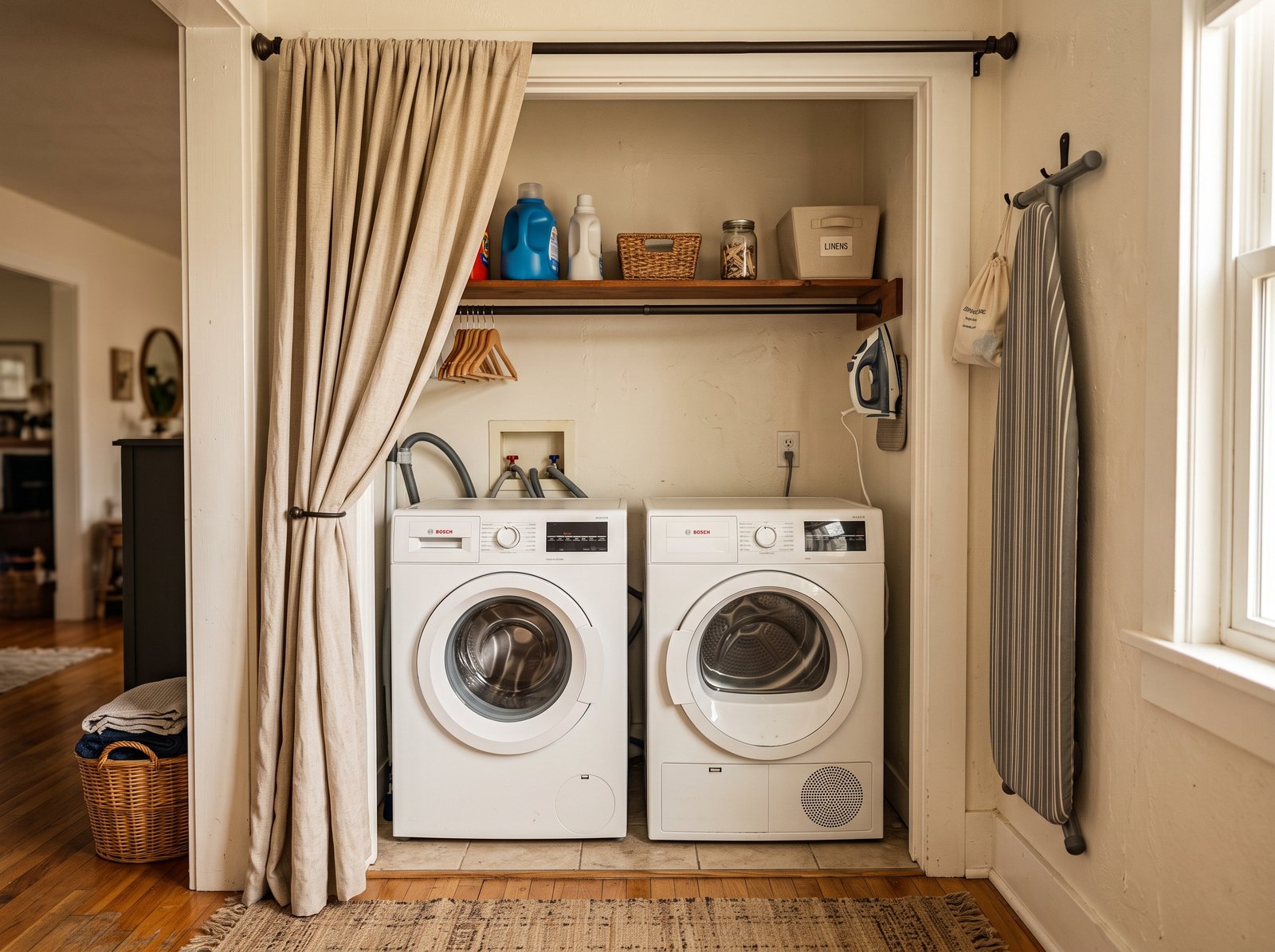
- Swap the bifold or swing door for a curtain. Full door clearance back instantly, plus a hamper can live in front of the machines again. Tension rod + curtain panels: about $35, fully reversible for renters.
- Use the side returns. Those skinny walls beside the machines will hold an ironing board on a hook, a drying rack, or a narrow shelf for detergent. In a closet, inches are the whole game.
- Go all the way up. One deep shelf near the ceiling holds everything you touch twice a year. In a closet, “I’ll need a step stool for that shelf” is a feature — it keeps everyday stuff at arm’s height and overflow out of the way.
If Your Laundry Lives in the Basement
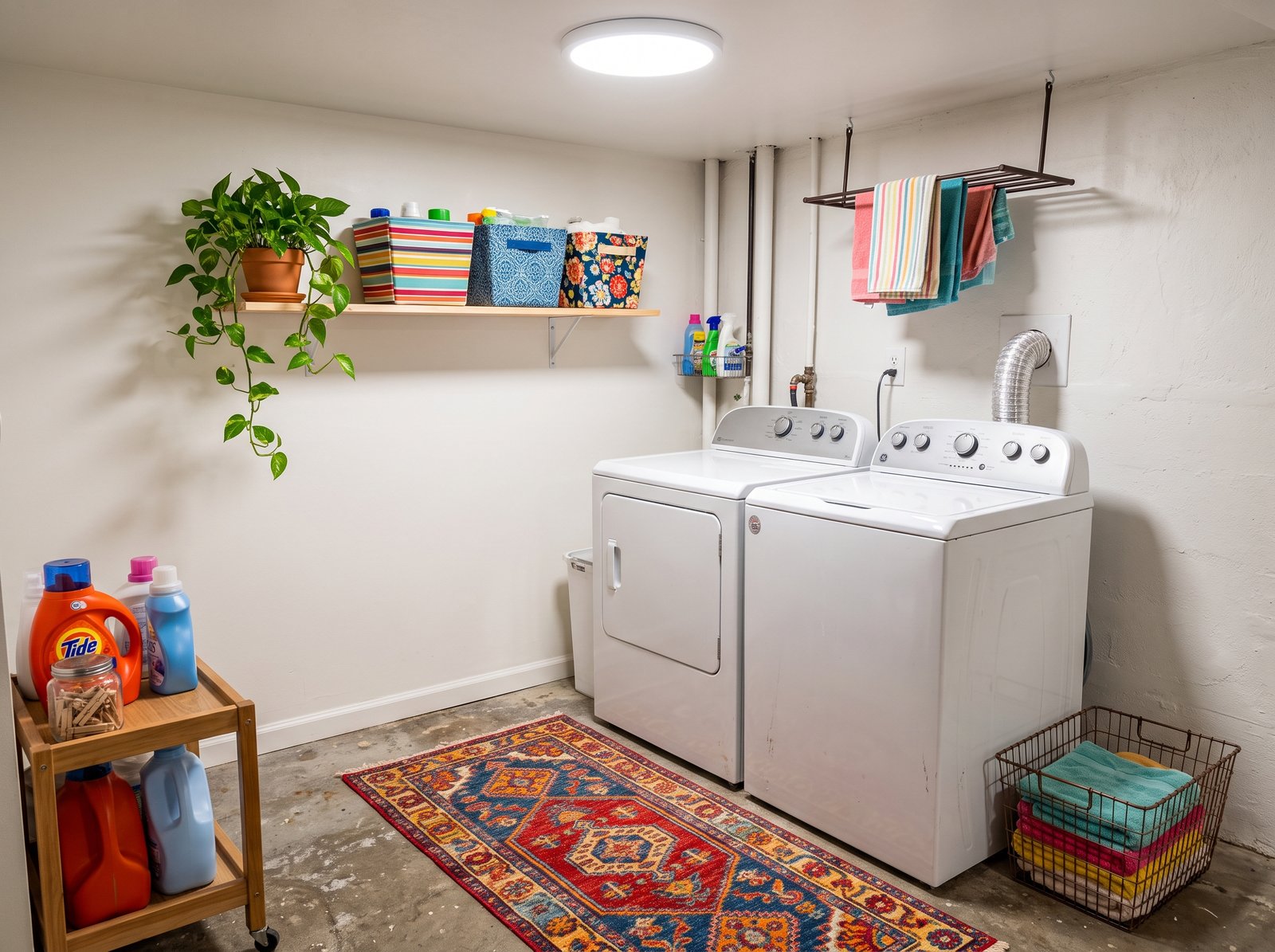
Basement laundry has one extra enemy: gloom. The good news is the fixes stack — bright light, light paint on the wall behind the machines, a rug so you’re not standing on cold concrete, and suddenly it’s a place you don’t dread. I wrote a whole basement laundry room guide with the full bright-and-organized treatment, and the functional laundry room ideas post covers layouts that work when your machines share space with a water heater and twenty years of storage bins.
The Weekend Plan, By Budget
Because “someday” projects don’t happen and weekend projects do:
$0 — The reset. Annoyance audit. Clear the machine tops. Pull everything out, wipe it down, put back only what belongs. Assign the pockets jar (any jar). Board-across-the-machines folding surface.
Around $50 — The workhorse upgrade. Tension rod for hanging ($10), skinny rolling cart ($30), bright LED bulb ($10). This combination fixes the three most common complaints — nowhere to hang, nowhere to set things, can’t see — for the price of a takeout dinner.
Around $200 — The mini makeover. Shelf or two above the machines, wall-mounted drying rack, paint or peel-and-stick on the focal wall, a rug, labeled bins. This is roughly what a full laundry room makeover on a budget comes to, spread over a month of weekends. It’s the version most people can actually finish without taking time off work.
If you’re in a season where even $50 isn’t happening, start with the $0 list and the lightbulb you probably already have in a closet somewhere. The reset alone fixes more than you’d think, and my budget-friendly laundry refresh tips post has more no-spend swaps. Dreaming bigger for a future house? Keep a wish list — my ideal laundry room features roundup is a good place to window-shop.
Small Laundry Room FAQ
How do I maximize space in a small laundry room?
Work the vertical space first: shelves above the machines, a hanging rod, and a wall-mounted drying rack use air space instead of floor. If you have front-loaders, stacking them frees up about nine square feet, and a skinny rolling cart fills the gap beside almost any machine. Give every category of supplies one labeled home so surfaces stay clear.
What is the best layout for a small laundry room?
The best layout keeps machines, a folding surface, and hanging space within arm’s reach of each other. Stacked machines with a drop-leaf table beside them is the most space-efficient; side-by-side front-loaders with a counter on top is the most fold-friendly. In a laundry closet, a curtain instead of a door plus shelves on the side returns wins back the most usable room.
How can I make my laundry room look nicer on a budget?
Start with light: a bright daylight LED bulb makes any laundry space look instantly cleaner. Then paint (a quart usually covers it) or use peel-and-stick wallpaper on one wall, add a rug, and corral supplies into matching bins. One small piece of art or a low-light plant finishes it — the whole refresh can land under $100.
Where should detergent go in a small laundry room?
On a shelf mounted above or beside the machines, not on top of them — machine tops vibrate, and bottles migrate and spill. If you can’t drill, a freestanding shelf that straddles the machines or a slim rolling cart in the side gap keeps detergent reachable mid-load. Decanting into smaller containers only helps if you’ll actually refill them.
Are stackable washers and dryers worth it in a small space?
If you have compatible front-loaders, usually yes — stacking reclaims the footprint of an entire second machine, which becomes folding, hanging, or hamper space. You’ll need the stacking kit made for your exact models, and a step stool helps with the upper controls. Top-loaders can’t stack, so a counter alternative or rolling cart works better there.
Go stand in your laundry space tonight and write down the first three things that annoy you. That list is worth more than anything in a container-store haul. Tell me what’s on it. — Quinn


2 Comments